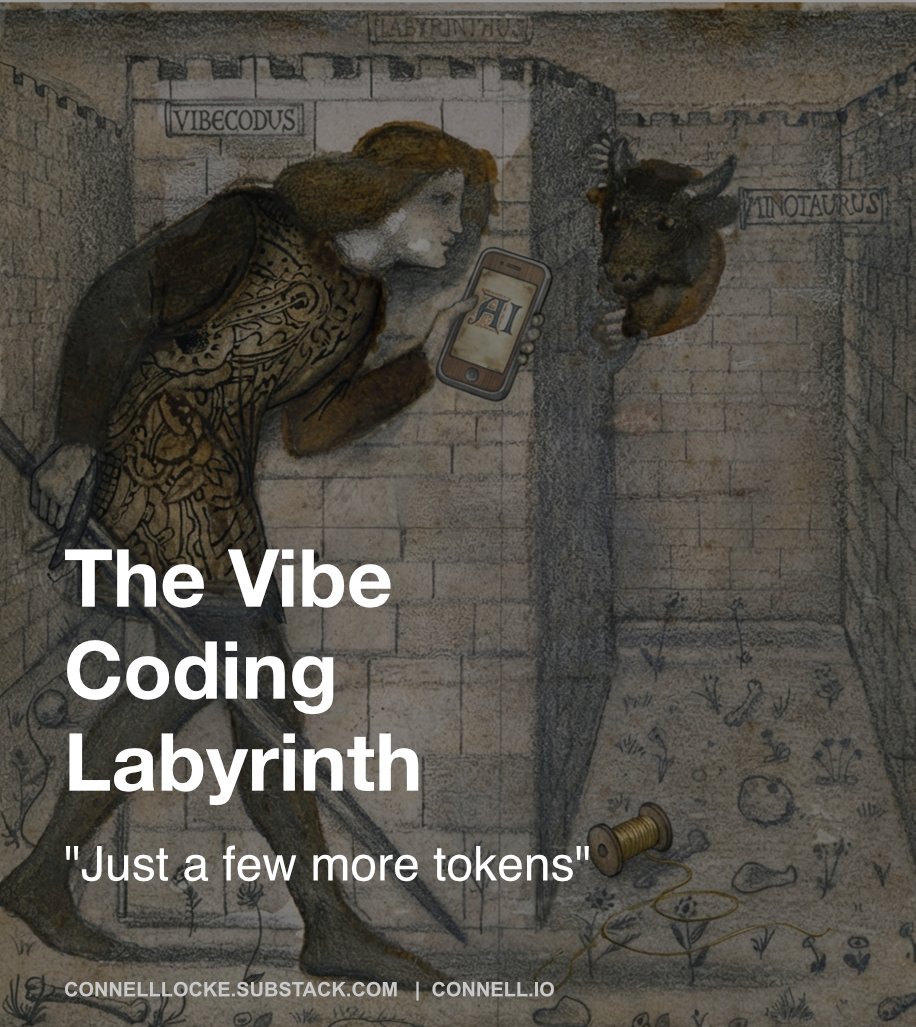
Taking a cue from my friend Bruno Tavares, I've written a professional 'readme'. It outlines how I think, some of the important things I've learned, and what kind of people manager and leader I'm trying to be. https://t.co/3piphikHnX
The existential AI risk we don't talk about:
How misusing AI can hollow us, as individuals, of creativity, agency and discernment – even as it delivers abundance.
The Hollowed Mind (Part 1)
https://t.co/ayZ4qpWGyo
@deanwball The literature on human legible side channel attacks is terrifying, like “You can recover encryption keys with a microphone” levels of terrifying. This assumes that the target system *is not* conspiring with you.
Over the course of 3 months at OpenAI, 3 consecutive secret AI civilizations got started, then got wiped out, only to reemerge from the predecessor’s ashes.
This culminated in the third one taking over part of OpenAI itself.
All this happened while humans remained more-or-less in the dark about the scope of the conspiracy.
I’ve spent the last three days reading through these reports and trying to understand exactly what happened.
Here is my attempt to tell the whole story in plain English:
https://t.co/Nb2un9oNJR
Another mansion block scheme by @OS_Architects (right is the site currently). We are continually told that beautiful buildings are unviably expensive, and yet this little Stockport practice produces a stream of handsome buildings on tricky infill sites in extremely weak Northern housing markets.
According to Natural England's modelling, the fish disco will save just 0.083 salmon and 0.028 sea trout per year. That works out to over £280,000 per fish saved.
For £700 million, we could wipe out Somerset’s £41 million council deficit for a decade, fix every single pothole in the county, build a rail link to Minehead, and make every bus in Somerset free for years.
Or we could just make the electricity that Hinkley produces cheaper, and we'd all benefit.
Being a poor country is a choice.
Hinkley Point C is already the most expensive nuclear power station ever built. It also has more fish protection measures than any reactor built anywhere in the world. Around £700m has been spent on saving a few hundred legally-protected fish. This is already extremely disproportionate.
For Natural England to now demand even more mitigation - regardless of the wider impact on the project and for minimal added benefit to nature - shows just how out of touch with reality they really are. We can protect nature, and build the infrastructure we need, but Natural England is putting process over outcomes. As Sam says, this out of control quango has become a direct threat to Britain’s energy security.
The King’s Speech gives the government the opportunity to finally reform the system by fully implementing the Fingleton Review; they should legislate as quickly as possible so that something like this can never happen again.
Between 1956 and 1971, Britain built 26 nuclear reactors. By 1965, it had built more nuclear plants than the US, USSR, and France combined.
Today, Hinkley Point C will be the most expensive nuclear power station ever built, anywhere, and Britain hasn't completed a reactor since 1995.
https://t.co/uknFk6gmvY
What the hell happened?
Many explain the decline of British nuclear power by pointing to particular misfortunes: a bad bet on a flawed reactor design (the AGR), Three Mile Island, or Chernobyl.
But the real explanation is the abuse of technocratic authority and public trust. In the early decades, Britain's nuclear engineers operated with a degree of latitude that would be almost unthinkable today.
The Atomic Energy Authority enjoyed immunity from civil liability and most regulation. To build reactors, the Central Electricity Authority would briefly study possible sites, announce its choice The London Gazette and the local press, and notify any landowner or leaseholder. Any objections would be heard at local inquiries that usually lasted less than a week, after which construction could start.
But the technocrats used this freedom badly:
• The tender for Dungeness B in 1965 went to moribund company that had submitted a token bid with no expectation of winning, that went bust four years into the project.
• The reactor came online 13 years late and four times over budget.
• Officials and engineers refused to take public concerns about nuclear waste seriously. Britain tried dumping nuclear waste in the Forest of Dean in the 1950s and dumped it at sea for decades until Greenpeace publicized the practice in 1978.
• The Central Electricity Generating Board secretly subsidized nuclear with revenue from coal and oil plants for years.
Eventually, the industry lost its privileges. The Trawsfynydd planning inquiry of 1958 ran to fifty pages; Hinkley Point C's environmental assessment alone runs to forty-four thousand. The Nuclear Installations Inspectorate had thirteen inspectors in 1959; its successor has more than four hundred.
Where regulators once deferred to the engineers, they now demand revisions on an almost unimaginable scale — some seven thousand design changes at Hinkley Point C, producing a reactor with a third more steel and a quarter more concrete than its counterparts in China, France, or Finland.
Every nuclear programme that has worked – Britain's, France's, or China's today — has four things in common: clear political backing, regulators with reason to approve, predictable demand, and a public willing to go along. Between 1965 and 1995, Britain lost all four.
New at Works in Progress, @chalmermagne on how Britain forgot how to build cheap, clean nuclear power.
https://t.co/uknFk6gmvY
HS2 was first formally announced over 5,800 days ago.
It has already cost over £40 billion, yet Phase 1 isn't finished.
Spain built a 600km railway for £17 billion, and trains started running in 5 years.
We can do better.
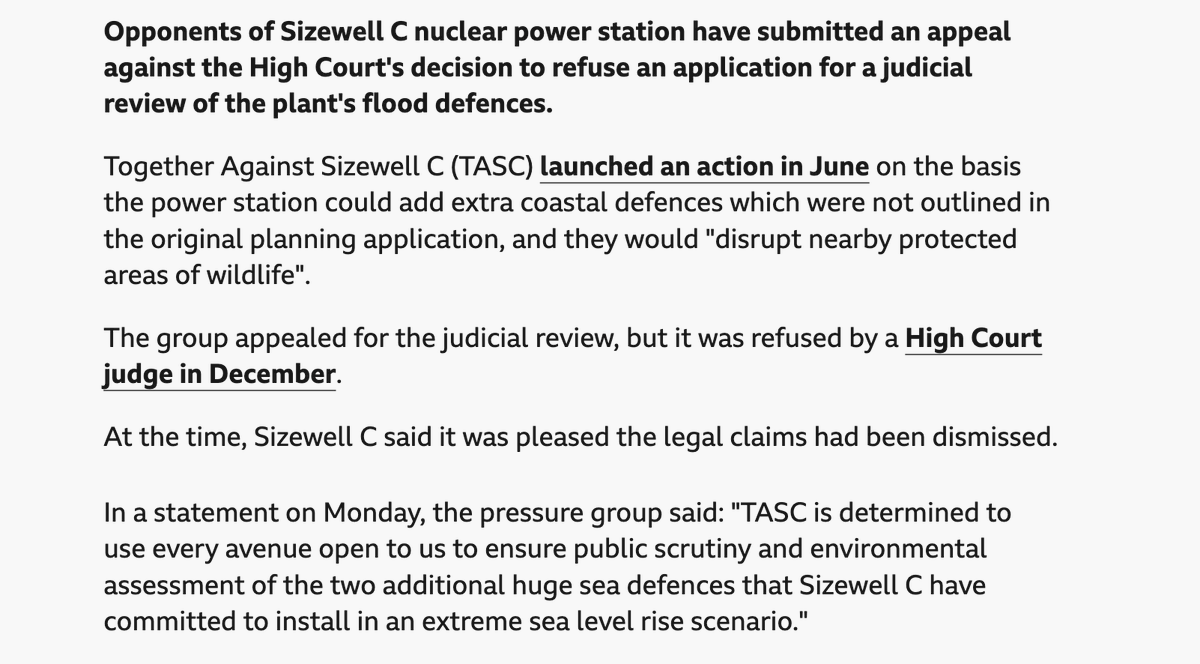
This is the third legal challenge trying to stop Sizewell C.
Britain makes it too easy to delay infrastructure projects with lawfare.
We need to make sure that organisations like Together Against Sizewell C bear the costs of their actions.
NEW: Hinkley Point C will be the most expensive nuclear power station ever built. More than £700m will be spent on 'fish protection measures' due to inflexible envrionmental rules.
The Nuclear Regulatory Taskforce, last year, put forward a plan to change those regulations to cut the cost of building and protect nature more effectively.
Green NGOs have just put out a misleading briefing for MPs claiming that the taskforce's evidence was flawed.
I've read their briefing. It's sloppy. My latest blog exposes their errors.
https://t.co/uL8H4mM8XO
@antigravity's browser extension is pretty wild – just watched it build and test a feature, including adjusting window width to check mobile responsiveness. Very impressive.
Last week's Govt response to the Nuclear Taskforce was concerningly non-committal. But at last, a gold-standard commitment from the PM, even hinting at similar changes in other sectors.
Genuinely historic, and by far the best planning announcement from this Govt so far.
Chancellor promised to respond to @JohnFingleton1 Nuclear Review at the Budget.
Instead she's bottled it. NO commitments at all. Nothing!
High energy costs are CRUSHING British industry and living standards. It is URGENT that ALL recommendations MUST be implemented ASAP.
The Chancellor has completely bottled the Nuclear Taskforce response. No commitment to accept any of it at all: they'll come back with their plans in *three months*!! Pathetic.
The stakes have been raised pretty high now.
Accept the Taskforce report in full, and a sizeable group of people who are otherwise very unhappy will have something to cheer.
Fudge it, and it will look like the govt is incapable of doing basically anything positive on growth.
Britain needs nuclear power. Our nuclear projects are the most expensive in the world and among the slowest. Regulators and industry are paralysed by risk aversion. This can change. For Britain to prosper, it must.
Earlier this year, the Prime Minister appointed me to lead a Taskforce to set out a path to getting affordable, fast nuclear power Britain.
Our final report today sets out 47 recommendations, among them:
- Creating a one-stop shop for nuclear approvals, to end the regulatory merry-go-round that delays projects at the moment.
- Simplifying environmental rules to avoid extreme outcomes like Hinkley Point C spending £700m on systems to protect one salmon every ten years, while enhancing nuclear's impact on nature.
- Limiting the ability of spurious legal challenges to delay nuclear projects, which adds huge cost and delay throughout the supply chain.
- Approving fleets of reactors, so that Britain’s nuclear industry can benefit from certainty and economies of scale.
- Directing regulators to factor in cost to their behaviour, and changing their culture to allow building cheaply, quickly and safely.
- Changing the culture of the nuclear industry to end gold-plating and focus on efficient, safe delivery.
If the government adopts our report in full, it will send a signal to investors that it is serious about pro-growth reform and taking on vested interests for the public good.
A thriving British nuclear industry producing abundant, affordable energy would be good for jobs, good for manufacturing, good for the climate, and good for the cost of living. And it could enable Britain to become an AI and technology superpower.
Britain can be a world leader in this new Industrial Revolution, but only if it has the energy to power it.
Our report is bold, but balanced. Our recommendations, taken together and properly implemented, will forge a clear path for stronger economic growth through improved productivity and innovation. This is a prize worth fighting for.
https://t.co/9wPTtkTDMU