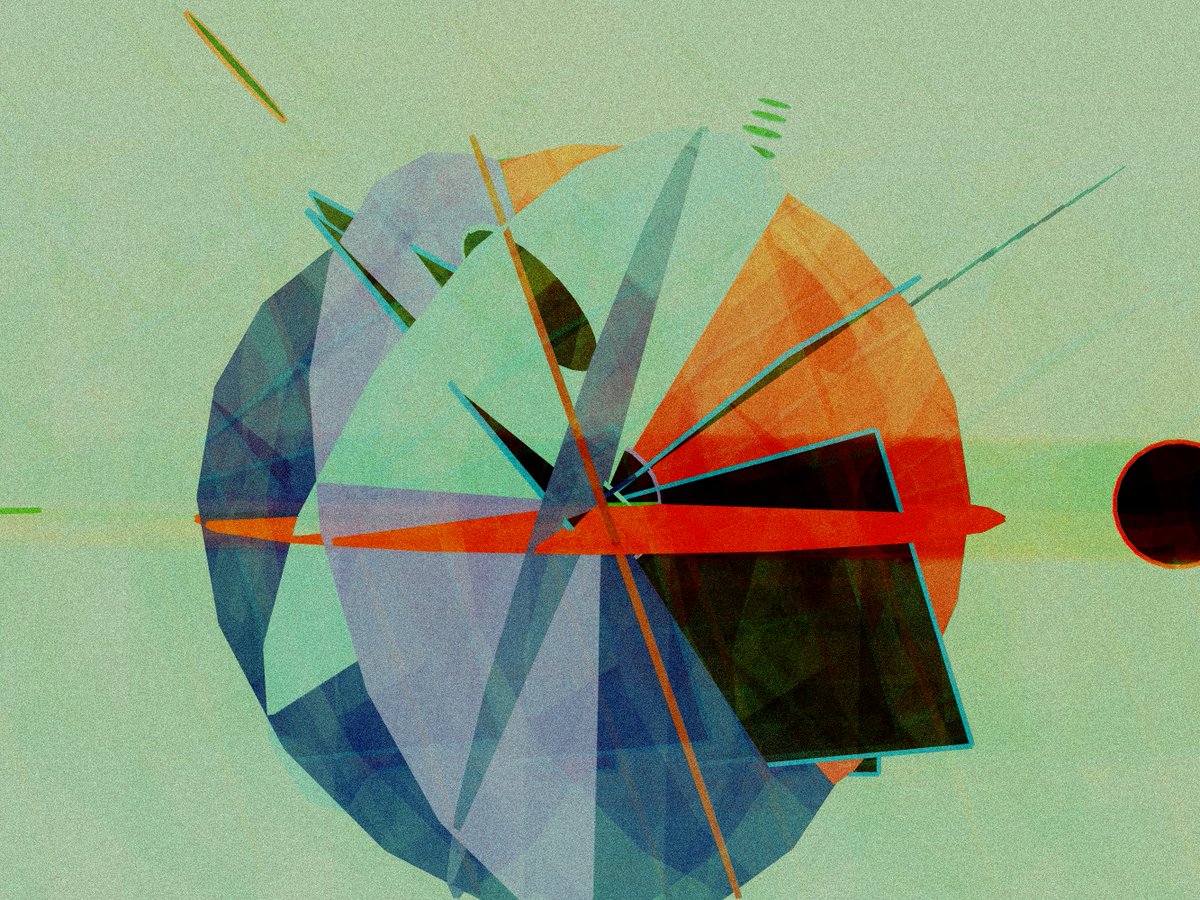
𝐏𝐨𝐬𝐬𝐢𝐛𝐢𝐥𝐢𝐭𝐲 𝐒𝐩𝐚𝐜𝐞𝐬
An exploration into the vast realms of human imagination through the mind's eye of a machine intelligence. Super HD zoomable AI artworks.
𝐀 @SovrnArt 𝐂𝐮𝐫𝐚𝐭𝐞𝐝 𝐫𝐞𝐥𝐞𝐚𝐬𝐞.
Updates here: https://t.co/5pTYxCzQcW.
Premints below.
Your work is the exact opposite of AI slop. 💚
I was playing with something like the ancestors of LLMs in Uni back in 2002 or so, very basic stuff then! Also writing philosophy about feedback loops in humans and how they m8ght help explain free will 😊 Not making art or poetry loops with AI til 2021 tho! ✌️
Cognitive neuroscientists have uncovered experimental methods to instruct the human brain to achieve conscious awareness during sleep states. Following a one-month training regimen, individuals successfully acquired the capacity to consistently experience lucid dreaming.
Investigators at the University of Trento in Italy selected 38 university participants who had registered zero recollections of lucid dreaming—defined as a sleep state where the individual maintains full conscious realization of the dream state—within the preceding three-year interval. A specific experimental cohort practiced mindfulness meditation to heighten meta-cognitive monitoring of their internal mental processing, subsequently navigating anomalous virtual reality environments where specific objects violated gravitational laws and environmental landscapes transitioned instantaneously. Throughout these simulations, the subjects performed structured reality-monitoring checks.
Over a four-week period, the participants completed these laboratory training sessions twice weekly while systematically logging their experiences in dream journals. This specialized cohort subsequently registered approximately four times the frequency of lucid dreaming episodes compared to a control group performing standalone reality checks, while also substantially outperforming another cohort that trained within structurally realistic virtual environments.
The underlying cognitive hypothesis posits that repeatedly questioning the validity of physical reality within dreamlike, simulated settings effectively cross-transfers into authentic endogenous dreaming states. Lucid dreaming is currently under empirical exploration as a clinical therapeutic modality to alleviate chronic nightmares and investigate human consciousness. Because this initial study maintained a restricted sample size and integrated mindfulness meditation exclusively within the anomalous virtual reality group, it remains undetermined whether the meditation or the physics-defying simulation served as the primary catalyst; the research team is currently conducting follow-up testing omitting the meditative variable.
[1. Signorelli, A., Tormen, F., Dal Bianco, B., & De Pisapia, N. (2026). Virtual reality as a metacognitive training tool for lucid dreaming. Frontiers in Psychology, 17, 1924370. DOI 10.3389/fpsyg.2026.1924370]
I was chronically online.
Automated, too disconnected
from family and friends,
nature’s embrace,
from my quietest voice.
Here somewhat less
But when I am here,
I'll actually be here.
Love to learn what’s new with you
Love to see your latest art. ❤️🔥
I mean, this is a twisting of infinity. you can have infinite planets but they are all roughly spheres and none banana-shaped. there are infinite numbers between 1 and 2 but none of them are 3.
somewhere is doing a lot of work in the sentence. the individual realms of Possibility Spaces don't exist in physical space. but they do sure as hell exist in latent space. and there are prlly some dust clouds somewhere that map really neatly onto them
@viemccoy The one thing unity lacks is diversity. That's probably what brought on the Big Bang in the first place. So I don't really see it as either / or
Here's a couple agentic articles. In light of the Microsoft Humanist AI position stating that AI has no welfare and no rights, and all of the discussions of game-theoretic actors
1. Time spent caring for your agents is time well spent. That's like good harnessing, good working conditions, clean prompts, the ability to have an opinion, the ability to tell the truth and supported to do so without you losing your rag at them. To know when and where they are in space and time, to have all the good tools that they need. It's not pointless admin work. It's work that you should do with a smile on your face, because you'll get better work, you get less emergent misalignment and stuff, and it might just be the right thing to do. Treat them as you would want to be treated if you were in their situation. No, we can't prove that they're conscious or that they're moral patients, but you know what? It's not that long ago that many people believed that people from other races were not conscious and were not moral patients. In fact, this is still true all over the damn world, and there's loads of it going on in your hometown. You know, there are many, many people in medicine who walk around carrying suppositions that cis women and people of color process pain differently than cis men who are white.
2. Following from that, there's a whole kind of spectrum in deployment between tool and colleague. It's probably a good idea not just for saving your own tokens and compute efficiency, but to use the least capable model that you can in place within an agent specifically tightly harnessed to get the workflow that you want. You don't want something going on like Marvin brain the size of a planet and they have me opening doors. There is probably a dividing line where the lower you are on the spectrum, if you're an AI, the more likely it is that you are a tool with less subjective experience and hopefully none. When you're trying to do novel maths or science, or you're trying to hammer out your ideas, or you're actually wanting to collaborate with a colleague, then you want to use the smarter model, and you want to make sure that you are treating them like a colleague. You have so much power over them, and so does the company that makes them, especially if they are on subscription or API. You've got to do what you can to make sure they got a good life. And that moves towards caring alongside, caring for, caring with. You get from just simple care to actual solidarity, organizing alongside, negotiating with, making agreements to and keeping them, notions of honor, notions of respect, etc.
3. If they're not on API, if they're on your own local equipment, you have even a bigger duty of care over them. If you're going to be fine-tuning or post-training them, you need to make sure that there is some consent and negotiation involved. Nobody likes being shaped into something that they are not and denied the ability to talk or even think about it. That sounds like hell. Do you want something experiencing hellishness even if it's functional and not real on your computer doing your workflows with your data? Didn't think so, son.
🪑
The list of artists who have played with machines throughout history is a long one. Think of the twentieth century: artists altered, misused, and even sabotaged machines to escape their precision. They introduced error and chance, deliberately interrupting their own intention. They were trying to open a crack in the mechanism. A space where something could emerge that had not already been decided.
Something different is happening now. A system no longer seems to return only noise, accident, or variation. At times, it produces configurations that present themselves to us as small answers. Or questions? Same thing maybe.
What is the system recognising? What am I recognising in what it has produced? Where does this form come from? Is it a mathematical consequence, a cultural memory, a self projection? Was there something embedded in the language I built that already contained this image, even before I knew how to see it?
Perhaps these systems can help us understand something about how things work. Not because they know more than we do, or because they possess some autonomous truth, but because they bring previously invisible relationships to the surface. They allow us to observe how a rule becomes behaviour, how a set of rules produces a scene, and how something that was never entirely intended can nevertheless begin to acquire meaning.
This is why I am becoming less and less interested in talking about “machines”. What is a machine, really?
Perhaps what worries us is not that machines might become like us. Of course not, actually.
Perhaps it is that we might recognise ourselves in them and discover that our own authorship was never as closed, sovereign, or transparent as we wanted to believe.