Is it still somebody out there? Proud to share the latest manuscript from the Elsässer lab: Pooled overexpression screening identifies PIPPI as a novel microprotein involved in the ER stress response https://t.co/YRACdAhqcL
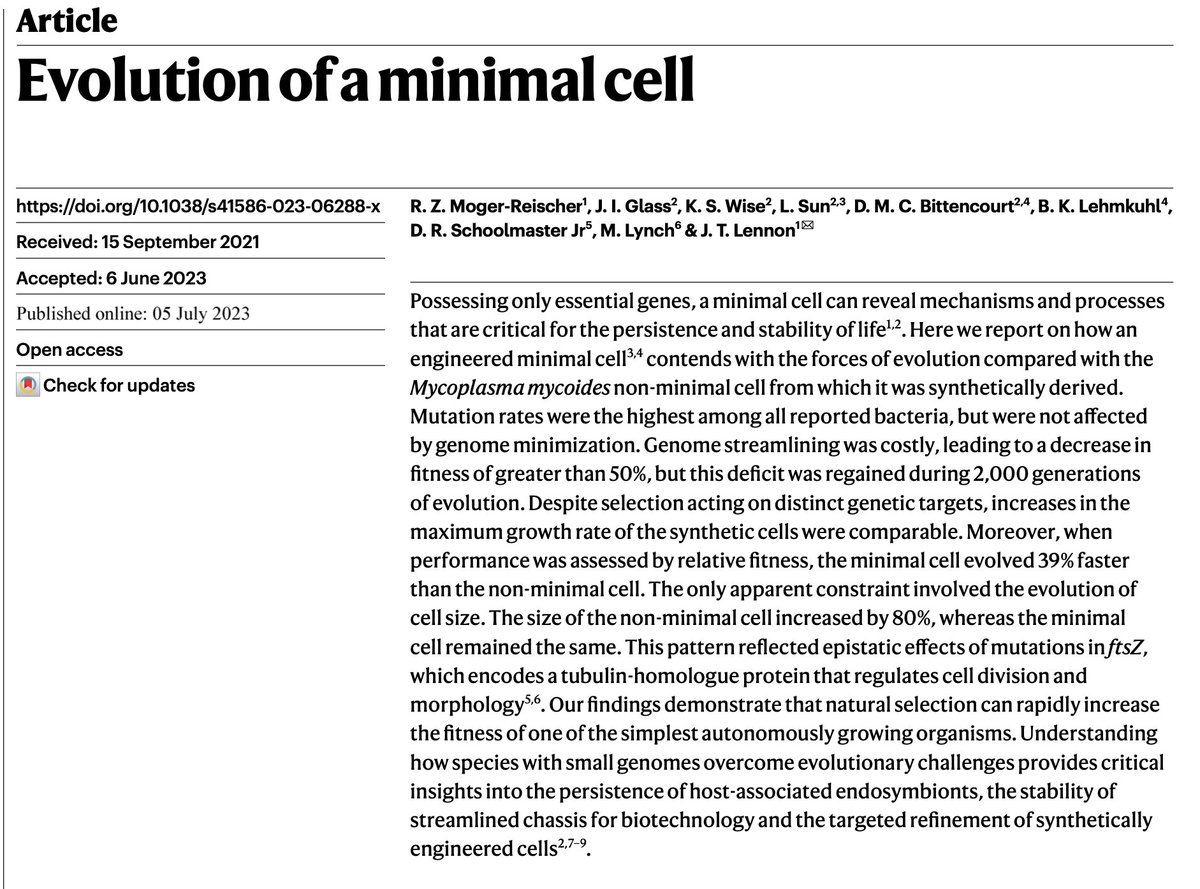
A mind-blowing paper has come out today in @Nature
In 2016, JC Venter Institute scientists trimmed a bacterial genome to its barest minimum required for life to synthesize what they called a "minimal genome" (https://t.co/Rk8oZJ0bUj).
Today, a group of scientists from Indiana University reports how that minimal genome evolved over 2000 generations in comparison to the non-minimal genome.
The authors found that even when you reduce a bacterial genome to its absolute minimum where every nucleotide matters, the genome undergoes mutational events generation after generation as much as the non-minimal genome. One simply cannot stop the evolution.
Just over 300 days of evolution (equivalent to 40,000 years in humans) the minimal cell has gained everything it lacked in fitness on day one in comparison to the non-minimal cell.
When comparing the evolved traits between the minimal and non-minimal cells, the scientists found something striking. The evolutionary process increased the cell size of non-minimal cells but not that of the minimal cell. But that is not the striking part.
The scientists were able to identify the key mutation that resulted in cell size evolution. And it turned out that the mutation that helped the non-minimal cells to grow bigger is the same that helped the minimal cells to stay smaller. Growing bigger had a survival advantage for non-minimal cells and not growing bigger had a survival advantage for minimal cells. So, the mutation had a context-dependent effect. This just demonstrates that the evolutionary effects on traits have no absolute direction. All that matter is what is beneficial for the organism's survival.
The conclusion of the paper is metaphorically a quote from the Jurassic Park movie:
“Listen, if there’s one thing the history of evolution has taught us is that life will not be contained. Life breaks free. It expands to new territories, and it crashes through barriers painfully, maybe even dangerously, but . . . life finds a way". (https://t.co/UlxRlb86CT)
https://t.co/zA9OAqSoAu
RIBOmap for spatially resolved single-cell translatomics is published today! Congrats to the whole team and thanks so much for the constructive feedback and great suggestion from the editor, reviewers, colleagues, and friends!
https://t.co/Dmxbe7atn5
Very interesting paper! The interplay between transcription, translation, and mRNA degradation governs quality control and mRNA concentrations, forming a coordinated mechanism that shapes gene expression in bacteria https://t.co/8SxwYTLlQv
Happy to share our work & the main part of my PhD now as a pre-print, searching for functional sORFs with @LoreLafra @simonelsasser Chris, Carmen & Jürgen. It's been quite the journey! Happy for any feedback, so feel free to reach out. https://t.co/KsQ9wVq6Ut
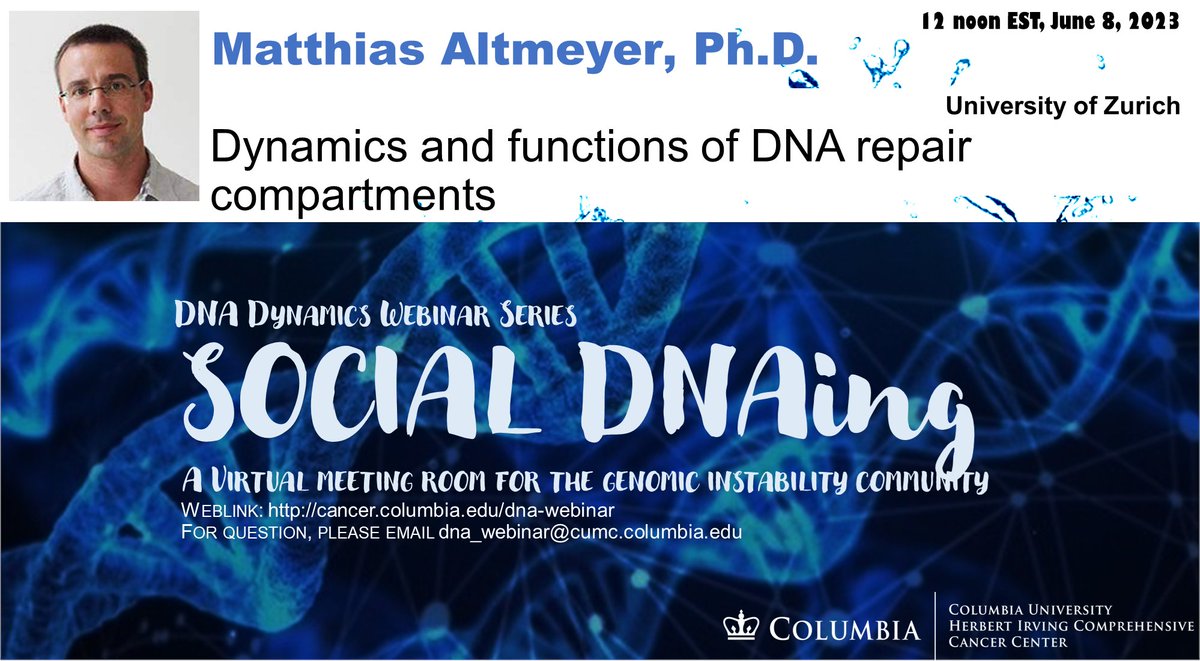
Thank Andy @DrAndyBlackford for a wonderful talk. Dr. Matthias Altmeyer @altmeyerlab
(https://t.co/WYgqcek4wk) from
@UZH_Science will dial up the "Dynamic" wheel. Sign up at https://t.co/XaGM9LsycS
Please RT: Are you interested in #microproteins and spontaneous? Due to a late cancellation for the #microproteins2023 meeting in Helsingør from May 31 to June 2, we have one spot available! Free registration, hotel, food, drinks and fantastic science. Contact us organizers!
What happens when a random pool of DNA sequences replicate? What sequence patterns emerge? Do initial biases propagate? Or does the final pool hold no memory of where it came from?
We are happy to share our newest preprint that addresses these questions:
https://t.co/5uRTF65GEF
Unveiling a proteomic response for (almost) all genes in a species! Discover how we combine functional genomics & proteomics and uncover principles driving protein expression and redefine gene annotation strategies. 🌐📚 #Proteomics#Genomics#ScienceNews https://t.co/eWnx8vTVlj
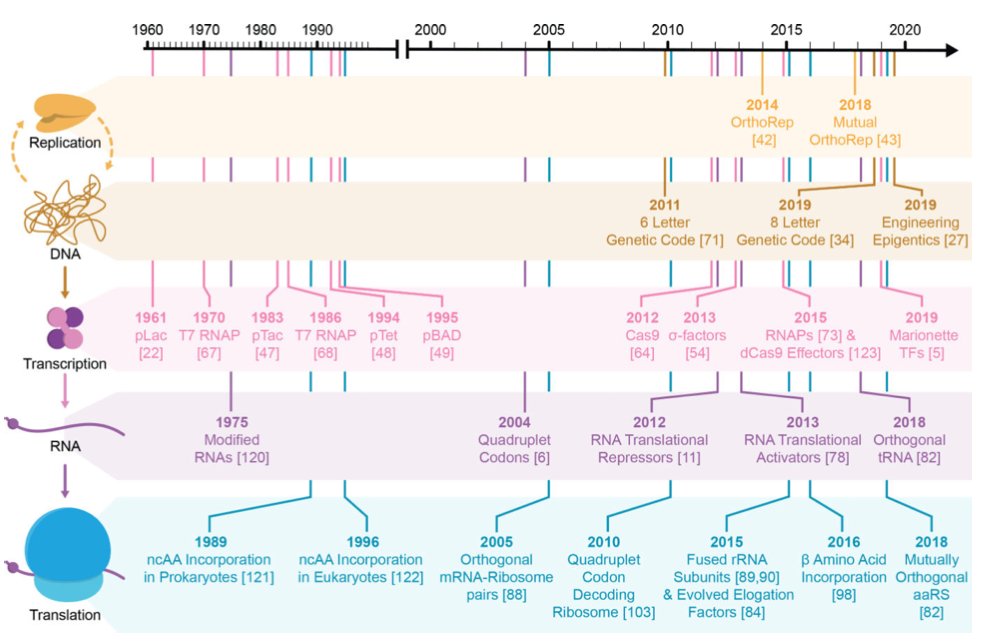
A timeline of orthogonal Central Dogma tools. ⌥
It's amazing to think that we can build our own replication, transcription, and translation systems.
But how close are we to a full, orthogonal Central Dogma in living cells?
From: https://t.co/hu8GPJRbTv
Like whole plasmid sequencing, but wish you didn’t need to ship to the USA? There’s now a UK company offering this solution and I can vouch that they’re great. ⬇️
Come join my group!!! It's the perfect time to study mechanisms of gene regulation with advanced CompBio methods integrating multiple transcriptomics technologies.
Please spread the word, we're a young and motivated bunch in a great new research institute:
https://t.co/rf5nJmqEZ8