It’s a privilege to announce Solve-RD’s latest manuscript based on years of work: “Genomic reanalysis of a pan-European rare-disease resource yields new diagnoses”
https://t.co/fSU1h9TDoR
A thread (1/n)
Image a set of 100 rare disease cases with the most difficult-to-detect mutations a human genetics lab can be faced with. …many of which very difficult or even impossible to detect with (short-read) sequencing methods, and/or requiring additional orthogonal tests…
Great (and scary) visualization of 2024 daily temperatures compared to prior years by the BBC today. Evocative of the iconic Joy Division album cover from 1979: https://t.co/o2zLigFV7h
My lab has been working for the past 15 years to develop a method to isolate specific genomic loci to identify its chromatin composition & protein interactome. Finally,… our superb physician/scientist Dr. Bercin Cenik @bkcenik did it and here it is https://t.co/f0vKe8pCFS Not only was she able to develop this method, which she calls TurboCAS, she was able to identify known & novel regulators of heat shock & Myc expression. Cannot wait to see what Bercin and TurboCAS will discover about the molecular basis of transcriptional regulation with great impact on clinic in the next few years! @NU_BMG_SQE@NUFeinbergMed@MolecularCell
Very happy to be one of the ZonMw Clinical Fellows grant awardees this year!
Thanks to all colleagues for the help and support, especially @LisenkaVissers@ahoischen and @WendyStams
Looking forward to finally have more time for research again! 🧬👩🔬
https://t.co/utjDVsgTni
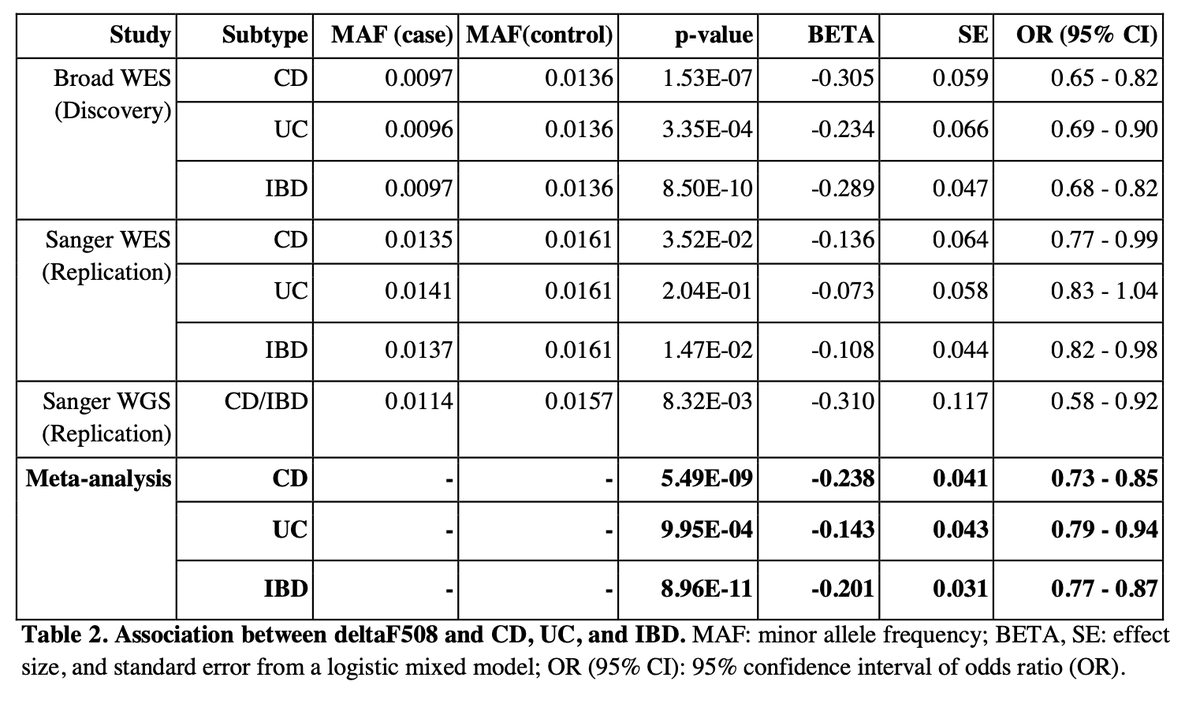
Analysis of sequencing data of 320k individuals (75k cases and 245k controls) shows heterozygous carriers of cystic fibrosis mutations are protected from inflammatory bowel disease. The protection mechanism could be due to an altered gut mucosal barrier that resists penetration by bacterial or other toxins. Prior animal studies have indeed shown that heterozygous state of cystic fibrosis mutation protects against cholera and typhoid bacterial toxins. It's amazing to see validation using human genetics with IBD as outcome. This was one of the ASHG abstracts this year that stood out for me. Nice to see it in preprint.
Yu et al. medRxiv (from International IBD consortium)
https://t.co/gMBNZhlhYe
I knew there were a lot of fake accounts on this platform, but they are usually obvious. I had no idea how intricate and complex the ruse could be.
Get a load of this story.
1/
Updated VISTA Enhancer Browser, 7 years in the making, out in @NAR_Open! >4,500 transgenic in vivo enhancer experiments for all your developmental biology, human variation and #evodevo needs. https://t.co/fE861VE3r7 #enhancers#embryos https://t.co/QxQDzGzBlf
Free scientific illustrations for biologists! 😍
@NIH has released a library of 500+ free scientific illustrations to create figures, presentations, and illustrations!
all freely available in the public domain.
Retweet and spread the message!
https://t.co/p1bD1kxO7H
Excited to share that denovo-db is now available on @ZENODO_ORG (https://t.co/wyGWP81iiS)! The new version of denovo-db contains >1 million de novo variants from published data on >70,000 individuals. After much thought, this feels like the right step for sharing with the #genomics community. Celebrating this milestone on my birthday and looking forward to launching an updated interactive site in the future! #denovo #genetics
📢📢📢Opportunity for young geneticists! @eshgsociety opens application for the
ESHG Mentorship Programm! Apply until 30th November, find your mentor, bild a a collaborative learning relationship, and discover new possibilities than can continue over time! 👩🎓👨🎓
@eshg_young
A Sunday read for you. A new blog post on a discovery of a noncoding mutation that causes a Mendelian cardiac arrhythmia through a fascinating mechanism: de novo creation of cardiomyocyte-specific enhancer. This adds to the list of my favorite noncoding discoveries that I've highlighted over the past couple of years. Two take homes for me are
- when searching noncoding disease variants, we tend to look at regions previously known to play a regulatory role (promoters, enhancers etc.). This work reminds us of the possibility that disease variants might be creating a new regulatory element themselves.
- when searching for causal genes, we tend to look at only those that are expressed in the disease-relevant tissues. This work reminds us that causal genes can be the ones that are not expressed in disease-relevant tissues.
Sometimes the answers come from places where we least expect to find.
Congratulations to the authors on this beautiful work!
https://t.co/dyuem9fgAc
Lannoo et al. examined whether rare autosomal trisomies revealed by noninvasive prenatal screening reflect fetal trisomy or confined placental mosaicism and whether they are associated with ⬆️ likelihood of adverse perinatal outcomes. Full correspondence: https://t.co/tVZE9lDcNP