2002: The U.S. added ~58 GW of new power capacity. Nearly all of it was natural gas.
2025: The U.S. is adding ~63 GW. Nearly all of it is solar and BESS.
Same scale of buildout. Completely different fuel. The grid is reinventing itself
People keep saying things like the NYT does today: "the cost of generating electricity from the sun and wind is falling fast." A quick look at the graphs below suggests the story is more complicated, with 3 distinct phases.
Phase 1: Introduction, 2000-early 2010s. Sharp cost declines that happened as the industry went from near zero to commercial scale. Significant tech and manufacturing advancements, economies of scale, cost of capital declines, new vendor and developer competition
Phase 2: Growth, early 2010s-2019. Smaller cost declines as industry matures. Technology improvements slow, gains from economies of scale and vendor competition plateaue, credit spreads tighten, but labor costs increase.
Phase 3: Maturity, 2020-now. Costs increase as the deflationary aspects either plateau or have become a small % of total costs. Technology advancements start hitting against physical constraints, materials and labor costs increase, top tier acreage near demand centers is already developed, interconnection delays, interest rate increase severely raises cost of capital, disruption from tariffs on Chinese solar panels, intense vendor competition eases, more accurate pricing of congestion risk, wind turbine manufacturers reprice after losing billions and, also, COVID supply chain interruptions.
The NYT writes that, "in 2023, costs rose because of supply-chain problems, inflation and other issues," as if it's a one-time event this year that will quickly reverse. I worry this cost increase is more structural.
Suppliers such as Sony are lobbying for more renewable power in Japan. They need to satisfy clients like Apple, who have committed to carbon-neutral supply chains. But policymakers lag behind. @KatrinaHamlin https://t.co/pjpEZs4FGj
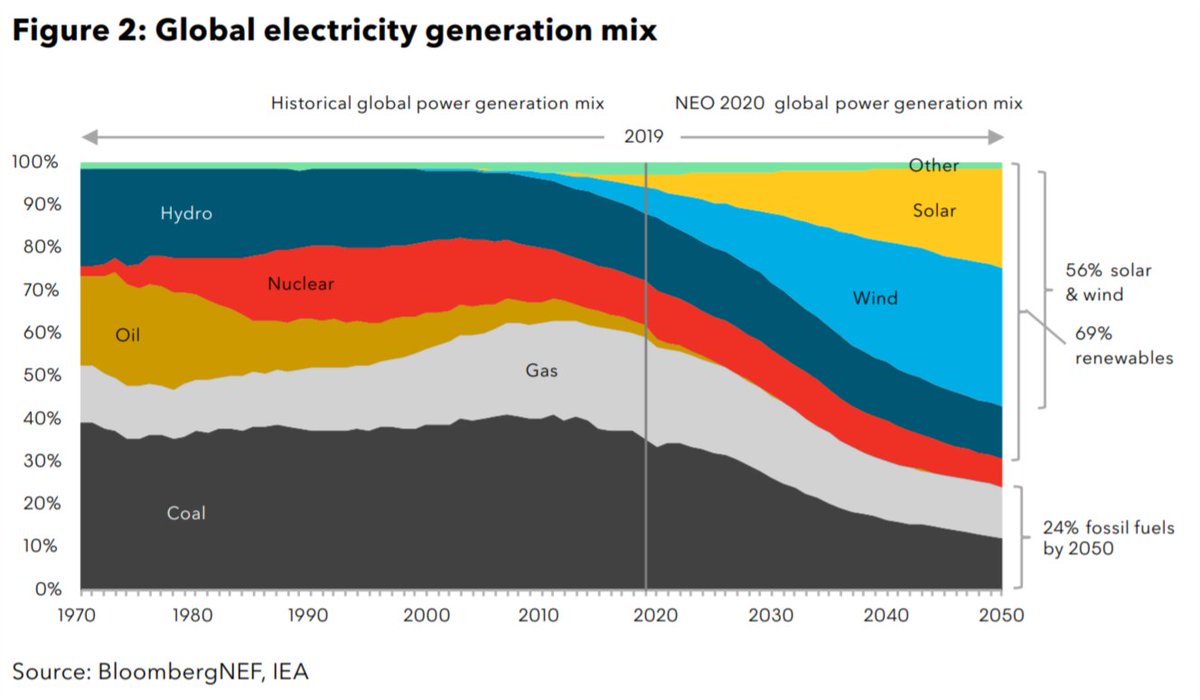
It's here - @BloombergNEF's 2020 New Energy Outlook. Peak energy emissions, peak oil demand, peak coal demand, 56% wind and solar power in 2050, hydrogen pathways, and $78-130 trillion (with a T) in investment 2020-50. Highlights: https://t.co/sw9FjP8rVz #BNEFNEO THREAD:
Investor demand for companies deemed to have high ESG standards has never been higher. ESG-focused funds manage $1.1 trillion, more than double 2016 levels, according to industry tracker Morningstar https://t.co/q3ZdQuXi9h
We do not know what the magnitude of the economic shock the US and global economies will suffer. It does appear though, that large and extensive are the operative words.
https://t.co/jRmJvB6M63
The market can remain irrational longer than you can remain solvent. But what goes up must come down. We ask when the longest bull market in US history will end.
https://t.co/47Np5bbtHr
#ESG in action: https://t.co/UUvB0B2n5z JPM following leads of other banks on this issue. "Wells Fargo said in January it was reducing its relationship with the prison industry as part of its 'environmental and social risk management' process."
Looks like Nike saw a boost in online sales after launching #Kaepernick campaign, despite warnings of a backlash. Will be interesting to see if this trend holds:
https://t.co/gltcMkohfM