This past week, on a test bed in Britain, a Rolls-Royce jet engine ran at full take-off power on pure hydrogen, putting out water vapour instead of carbon.
Nobody on Earth had managed it before. It is the sort of thing that ought to stop the country in its tracks, and it will be forgotten by the weekend.
Leave aside the recent paroxysms of renewed net-zero insanity from Derelict Ed and the pervasive atmosphere of offended envy that greets much homegrown achievement nowadays in Britain. This engineering is a wonder, and it's British to the bone.
We gave the world the jet engine in the first place - Frank Whittle, a Coventry man and an RAF officer, patented it in 1930 while the Air Ministry assured him it was a curiosity. Rolls-Royce is today one of perhaps three firms anywhere that can build a large aero engine at the outer edge of the possible, and it has just done what most of the industry swore was twenty years away.
As usual, you marvel at how little the people who govern us had to do with it. The engineers in Derby are world-class; the stewardship above them is third-rate. They pulled off a global first while paying the most expensive industrial electricity in the developed world to keep the power on over the bench - a weight no German, American or Gulf rival has to carry. We produce frontier brilliance on the shop floor and fritter it away at the despatch box, and we have done for two generations.
That is the maddening shape of modern Britain: brilliance from below, sub- (or, indeed, ultra-) mediocrity from above. The people here who actually make things are still among the best in the world; the state that is meant to back them treats a firm like Rolls-Royce as a photocall today and a takeover target tomorrow, and prices its energy as though it would prefer the next plant were built in Texas.
Progress starts from the other end. Give these people what every rival government gives its champions and we beg ours to do without: the cheap, abundant power their competitors already enjoy, a supply chain built around them, and a state that guards a national asset rather than auctioning it. The hard part of a British revival - the talent, the nerve, the engineering - is already done, and was done again this week, by people who deserve a far better country than the one currently sitting above them.
We just taught an engine to breathe fire and exhale water. The least we owe the men and women who managed it is a government and a state as brilliant as they are.
I couldn't say it better than the Astronomer Royal of Scotland, in her letter to Nature.
"...whoever made this decision failed to foresee the disastrous and damaging repercussions for UK science and the economy."
🧪🔭 #UKRI#DSIT#STFC#ScienceFunding
https://t.co/fHYfqzasAV
@eNeecie Every other day a new motorhome appears in my mother-in-law's drive and Neil hands me another bucket full of jewellery and cosmetics. I can only assume he's got himself a part time job I'm too busy to ask about.
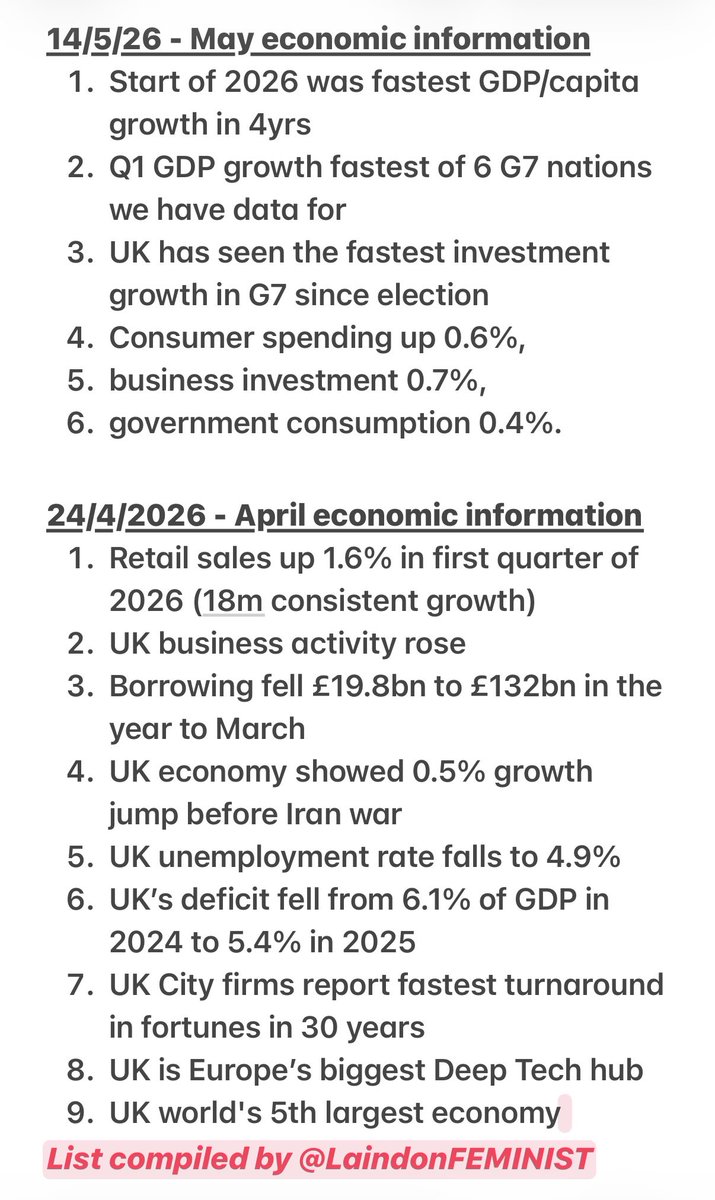
Those MPs blaming Keir Starmer I want you to know I blame you.
You have failed to keep your constituents informed. I publish lists every week of Labour successes. You need to be sending these out. Here’s the last two. Inform your constituents
I have read both letters, carefully and several times. As someone who loves this country and who is fighting to build something of my own here, I cannot help but notice the massive difference in character between these two men who, until yesterday, were leading our nation.
I am not writing this as a political analyst, but as a voter and a citizen who values people with character.
Wes's letter is full of 'I'.
I cut the waiting lists, I recruited the staff, I was successful.
Then, in the same breath, he attacks the team he was part of. If the situation was truly that bad, why did he not stay to fix it? Why did he not have the courage to stand for election and say: 'I have a better vision, elect me'?
Instead, he chose to walk away at the very moment we need stability most, feeding the media the drama they love so much. That is not protecting the party. It is protecting his own career.
On the other hand, Starmer’s response reminded me why I trusted him. He did not stoop to insults. He did not defend himself. He simply reminded Wes that those successes in the NHS were a collective effort.
Starmer showed what I admire most in the British, decency. Dignity. He remained the adult in the room, focused on us, the citizens, while Wes remained focused on his next job title.
Politics should be about us, about the people who pay their taxes and hope for a better future, not about who can best 'twist the knife' in a resignation letter.
Wes has shown his true face, and Starmer has shown that the stability of the country matters more than his personal ego.
That is what gives me hope that we will not allow chaos and populists to take the helm.
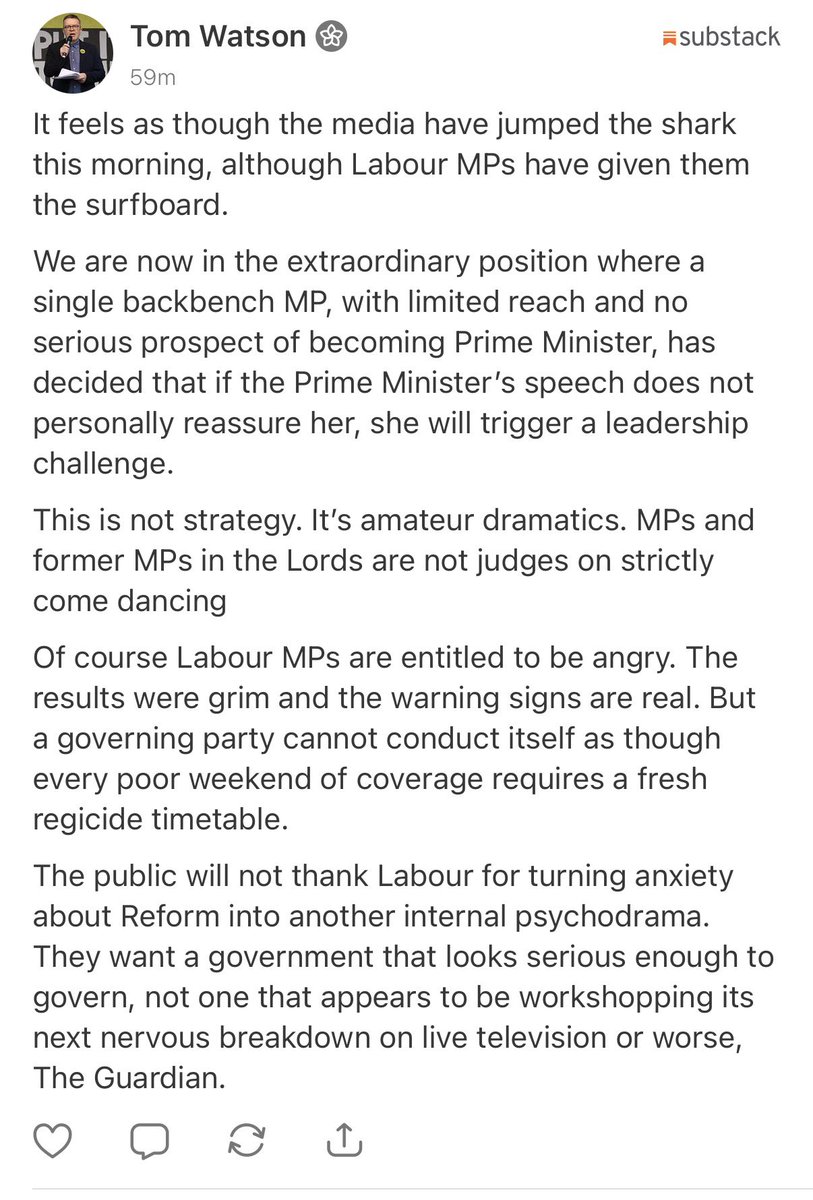
8/ And in the meantime Elon Musk will no doubt pop up on livestream calling for the government's overthrow. So for all these reasons ... Starmer Must Stay!
A parasite that has been eating people for 3,500 years is about to be wiped off the planet. It infected 3.5 million people in 1986. Last year, it infected 10. And I have not seen it make a single front page.
It is called Guinea worm. You drink contaminated water from a pond in a poor village. A year later, a worm up to three feet long starts coming out of your leg through a burning blister. There is no pill that stops it and no surgery that works. You wrap the worm around a stick and pull it out slowly, over days or weeks, inch by inch. If you rush, the worm breaks inside you and causes a fresh infection.
Guinea worm is ancient. Preserved worms have been pulled out of Egyptian mummies from around 1000 BCE. The Ebers Papyrus, an Egyptian medical scroll from 1550 BCE, describes pulling the worm out with a stick. For three and a half thousand years, that was the best humans could do.
Then in 1986, public health workers decided to kill the parasite off. They had no vaccine and no drug. What they had was cheap cloth water filters and a small army of volunteers willing to walk from village to village for decades.
The plan was simple. Give everyone who drinks from a pond a cloth filter to strain out the tiny water fleas that spread the parasite. Then send volunteers walking house to house, year after year, teaching people how to use the filters and keeping anyone with an emerging worm out of the water.
It worked. From 3.5 million cases a year to 10. Four were in Chad, four in Ethiopia, two in South Sudan. The other four countries where the worm used to be common, Angola, Cameroon, the Central African Republic, and Mali, had zero human cases for the second year in a row. The World Health Organization has already certified 200 countries as Guinea worm free. Six are left.
The last hurdle is dogs. Cameroon had 445 infected animals last year and Chad had 147, so a lot of the remaining work is on animals, not humans. Strays get leashed, and crews treat ponds to kill any remaining worms. The campaign keeps watching until the number hits zero.
When Guinea worm hits zero, it becomes the second human disease ever erased from the planet. The first was smallpox. It will also be the first parasite humans have ever wiped out, and the first disease ever ended without a single dose of medicine. Volunteers walked village to village with cloth filters for 40 years. Now a plague from the age of the pharaohs is about to be gone.
BREAKING: Sources say Olly Robbins felt bound by the rules of the security vetting process NOT to tell the PM, No10 or the foreign secretary about the concerns raised about Mandelson
That means it appears No10 WERE in fact unaware he had issues with his vetting
And sources say in fact Mandelson DID NOT simply fail his vetting. Instead issues were raised and the FCDO security team and ultimately Robbins had to make a decision on whether to grant him DV clearance. It was their decision and there was no “overturning,” sources say
As @SamCoatesSky reports via former security official Ciaran Martin, Robbins was prohibited from sharing information about what happened with anyone outside the FCDO security team
Sources say the point of the vetting process is that it is extremely invasive and people who go through it must be confident they can tell the whole truth and not have highly embarrassing information about their personal lives leak or be spread around colleagues
That means the circle of people allowed to know about what happens in each vetting case is very small and the information is highly privileged
The decision on whether to approve Mandelson’s clearance, according to the vetting rules, is taken by a small team of FCDO security officials and ultimately Robbins, sources say
Under no circumstance is Robbins or that team able to share the details of the vetting case with No10 or anyone else, sources say. Robbins felt he could not share it with any minister or private office, sources say
It appears the PM and No10 were unaware of how these rules were perceived by Robbins and FCDO, and think he should have told them. Allies of Robbins think it is unfair he was sacked
But crucially it appears right now that Robbins did not tell No10 and they were actually in the dark about all this until Tuesday. What an unbelievable mess
Never before have I devoted two consecutive days to one Woman of the Day, but Josephine Butler, born 198 years ago yesterday in Milfield, Northumberland, is an honourable exception. Even this, my second post about her, doesn’t touch on her tireless campaigning for women’s suffrage and for better education for girls.
Today is about the widespread scandal that confronted her when she was trying to extricate women from the steel jaws of steel rape.
Child prostitution.
In the 1870s and 1880s, there was a lucrative and lively trade to the Continent in the trafficking of British girls as young as 12 to European brothels. There was no point in appealing to the police over there. They were part of the problem. In fact, Josephine was instrumental in securing the removal from office of a Belgian chief of police. She filed a deposition and sent it to both the Procureur du Roi (Chief Prosecutor) and the British Home Secretary. As a result, the deputy police chief and twelve brothel owners complicit in a conspiracy of kidnapping, trafficking and child rape, were tried and imprisoned — but the practice still flourished.
“Economics lie at the very root of practical morality."
For ten years, Josephine had relentlessly campaigned for the age of consent to be raised from 13, to no avail. There were too many men far too keenly interested in young girls held in brothels — virgins attracted a special premium — for the lethargic government to act. It was time to go public.
“We all feel now that the time is come when we must appeal to the judgement of the public, so as to bring the condemnation of public opinion to bear upon these men, seeing that our laws give us no hold whatever upon them, and are not likely to do, so long as our legislators continue to refuse us the small boon we ask.”
Josephine enlisted the help of William Stead, influential crusading editor of the Pall Mall Gazette. Stead, whose own mother had campaigned against the Contagious Diseases Acts. He ran a series of highly controversial articles about child prostitution — an early form of investigative journalism — and to illustrate his point, purchased a 13 year old girl named Eliza Armstrong from her mother for £5 on 3 June 1885.
Eliza was taken to a London brothel. chloroformed, examined by a midwife to confirm her virginity, examined by a doctor — I know, I know. It was all part of a staged demonstration — and spirited away to a safe foster home in France with the help of Florence Booth of the Salvation Army.
The newspaper articles threw Victorians into a state of moral panic. They pulled no punches, none at all. Copies changed hands for twenty times their original value and the office was besieged by 10,000 members of the public. Public demand was so great that the Gazette's supply of paper ran out and had to be replenished with supplies from the rival Globe.
On 16 July 1885, shortly after the articles appeared, Josephine capitalised on the public outrage by delivering a major speech at Exeter Hall in London, and calling once again for greater protection for young girls, and the raising of the age of consent. This helped to sustain public pressure on Parliament, which had little choice but to revisit a stalled bill.
On 14 August 1885, Parliament bowed to pressure and passed the Criminal Law Amendment Act 1885. It raised the age of consent for girls from 13 to 16; criminalised the procurement of girls for prostitution via threats, fraud, or drugs; outlawed the abduction of girls under 18 for carnal knowledge; strengthened measures against brothels; and allowed greater police and court intervention to protect minors.
What happened to Stead? He was tried at the Old Bailey. Eliza’s father objected to the £5 being handed to his wife, when in law, both mother and daughter were HIS property. The judge and jury agreed and sentenced Stead to three months for abduction on technical grounds.
And how about Eliza? She was provided with education and training in domestic service, and some years later, wrote to Stead to thank him for saving her from her certain fate.
She was the inspiration for George Bernard Shaw’s Pygmalion, by the way.
Josephine turned her attention to the next big scandal: India, where a British Major-General had issued standing orders for local girls — some as young as 11 — to be kept in special accommodation near Army camps, examined regularly (steel rape again) and for local commanders to ensure “the provision of a sufficient number of women, [and] to take care that they are sufficiently attractive” for the comfort of soldiers.
She compared the girls to slaves and raised such a stink about it that public outrage forced the House of Commons to pass a unanimous resolution repealing the legislation and order the Indian government to stop the practice.
During the course of her activism, Josephine Butler wrote more than 90 books and pamphlets, travelled countless miles around Britain and the world, changed the way feminists and suffragists conducted future struggles, and brought into the political fray groups of people that had never been active before.
That’s why she was hailed by Millicent Fawcett as "the most distinguished Englishwoman of the nineteenth century".
I think it’s about time a statue of Josephine Butler adorned the empty plinth in Parliament Square, along with her inspiring quote:
“God and one woman make a majority".
When Woman of the Day Josephine Butler, born OTD in 1828 in Milfield, Northumberland, died in 1906 at the age of 78, Millicent Fawcett hailed her as "the most distinguished Englishwoman of the nineteenth century". For good reason.
Josephine, who helped to prove that it was possible to openly buy a 13 year old girl for five quid, actively campaigned for the protection of women and children for forty years. Her determination was prompted by the tragic death of her five-year-old daughter Eva in 1864.
"I became possessed with an irresistible desire to go forth and find some pain keener than my own…and to say (as I now knew I could) to afflicted people, 'I understand. I, too, have suffered.'"
She channelled her grief into working with "fallen women," and those confined to workhouses in Liverpool. That included opening her own home so that they could recover from the brutal “treatments” meted out to them, but she soon found herself campaigning tirelessly against prostitution and trafficking of women and girls. To do so, she also had to expose the double standards so prevalent in Victorian times.
"It is a fact, that numbers even of moral and religious people have permitted themselves to accept and condone in man what is fiercely condemned in woman."
In return, she was vilified, slandered, jeered, threatened, and physically attacked for challenging powerful interests: politicians, clergy, police, doctors, pimps, and brothel-keepers. The hostility was both widespread and intense.
An MP publicly declared her “worse than the prostitutes.” The London Daily News accused her of being “discontented in [her] own home” and pursuing “a hobby too nasty to mention.” A journalist called her “an indecent maenad, a shrieking sister, frenzied, unsexed, and utterly without shame.” The national press either ignored her work or sneered at it, adding to the social stigma. These days, she’d be accused of being “untoward about paedophiles.”
First, Josephine led the major national (and later, international) campaign against the Contagious Diseases Acts, the state-sanctioned abuse of any woman or girl found anywhere in the vicinity of British Army and Royal Navy bases, and suspected of being prostitutes. No evidence needed. Just a policeman’s word. The legislation tried to control the spread of STIs in the Army and Royal Navy, not by curbing the behaviour of men but by controlling women.
If the male magistrate agreed with the policeman’s suspicion, the woman was subjected to painful and intrusive internal examination with a steel instrument: a procedure Josephine called “steel rape”. If the woman refused, she was imprisoned and sentenced to hard labour. If she complied and was found to have an STI, she was confined to a “lock hospital” against her will until cured. If she complied but was clear of any infection, her name and reputation were shredded anyway and "the Acts had the effect of turning them to prostitution by barring respectable ways of life to them".
In case you think women needed to behave in a salacious manner to attract attention, I should point out that Elizabeth Burley of Dover, a respectable woman, attempted suicide in 1881 after she was hounded and harassed by the police under the Acts, fuelling public outrage and petitions. But I digress.
It took Josephine nearly seventeen years (with support from Florence Nightingale), plus arduous journeys of over 3700 miles across the country, and almost a hundred meetings, to deliver a vivid but factual description of steel rape to working-class men, but she succeeded in having the Acts suspended by 1884 and fully repealed in 1886.
"It is well that we should understand clearly the illegal character of the Acts we oppose... when it comes to a matter of such awful seriousness as that of a woman’s honour... it is an awful thing to put the accusation in the power of the executive — that executive being the secret police..."
Along the way, she also endured men throwing cow dung at her, smashing the windows of her hotel rooms, threatening to burn down a building while she was inside speaking, besieging her hotel with the result that she had to escape through a back window. She had to hide in a grocer’s cellar, book hotels in false names, dodge rocks hurled by hecklers, and endure male medical students in Glasgow barking, mewing, crowing and whistling to drown out her voice.
Nothing arouses the fury of some men more than a woman who stands between them and their prey.
But you really want to know how Josephine exposed the trade in girls under the age of 13, don’t you?
Part 2 of this “distinguished Englishwoman’s” story will follow tomorrow, but for now, I leave you with this thought from her.
"Attempted modifications of an essential evil always fail."
The Finnish study (Ruuska et al 2026, Acta Paediatrica) is robust: nationwide registry data on all 2,083 under-23s referred 1996–2019 vs. 16k controls, long follow-up, objective specialist psychiatric contacts as outcome.
Key strength: psychiatric needs were already high pre-referral (45.7% vs 15% controls) and rose further post (61.7% vs 14.6%), with sharp increases after medical reassignment (feminising: 9.8%→60.7%; masculinising: 21.6%→54.5%). Adjusted analyses show no benefit from treatment—risks stay 3–6x controls regardless.
It underscores persistent comorbidity in this group and questions whether reassignment resolves mental health burdens. Caveats: can't parse visit reasons (monitoring vs. new issues); selection effects possible. Solid data for the debate on youth interventions.
Incredible review of my new book Do Not Go Gentle in the Daily Mail, from avowed supporter of Dignity in Dying Bel Mooney: "I gladly admit she has all but changed my mind."
Kathleen Stock on Assisted Dying ... it degrades us ALL https://t.co/dhq0ZKFhb7 via @MailOnline
I think way too many ppl are delusional about this idea of letting Iran control the SoH, having the US pull out, and just letting Iran set up a toll booth.
Where does Saudi’s power actually come from? It’s not just because they’re rich. Their entire influence comes from being the world’s only swing Producer. We need oil, and Saudi controls that market.
If Iran takes over the SoH, they become the most powerful, one of a kind Global Swing Producer in history.
If they don’t like the oil price? They can just "adjust" the traffic in a strait that handles ~20mb/d to swing prices however they want.
If the UAE gets on Iran’s bad side? "No passage for UAE tankers." If Kuwait tries to build a bypass? "Fine, the SoH is closed starting today. Let’s see if you can finish that bypass—which takes years—without making a single dime."
By letting Iran control that flow, the US is effectively making Iran the ultimate energy gatekeeper. The entire regional hegemony shifts to Iran. Saudi and the UAE lose everything.
Think about it—if you were MBS, would you let this happen? Let’s say the US pulls out this week. The US started this mess, and now the GCC has to just sit there and watch their power handed over to Iran?
Let me give you a reality check for Americans: Imagine Mexico now controls the North American continent.
"Want to fly to the UK? Get Mexico’s permission. Want to import jet fuel from Asia? Pay Mexico a toll and take the route they tell you to.
Did you dare to criticize Mexico? Now, no container ships can enter your waters. You can’t say a word against the great President of Mexico."
It sounds like a fantasy, but that’s the reality for the GCC. If the US tries to run away? If I were the GCC, I wouldn’t let them leave. I’d grab them by the hair and drag them back to clean up the mess they made.
I’ve said before that this is an existential issue for Iran and Israel. Well, Iranian control of the SoH is an existential issue for every other GCC nation.
And the GCC has leverage. They have massive wealth invested in the West, huge U.S. asset holdings, decades of lobbying networks, and they are the biggest donors for Trump’s terms.
And of course they have oil. Do you really think Brent would stay below $100/bbl if the GCC teamed up and cut just 3mb/d for six months?
Even the most optimistic guy knows the answer is zero chance. They don't even need a fancy excuse: "Oh, since the US gave up on us and Iran owns the SoH, it's not safe. We have to cut production. Sorry!"
Within months, the US would be begging to come back. It’s just pushing the Middle East into an even bigger pit of fire.
Thanks for listening to my TED Talk :)
#oott #iran
Elizabeth I to be portrayed as a transgender man in imminent TV show. I remember people sneering that Mrs Thatcher was 'a man in drag.' Let's just make every tough woman in history a man and have done with it. Because women aren't ambitious, ever. Talk about erasure!
Girl Guides and the Single Sex Question: What Child Development and Safeguarding Tell Us
(longish post)
Girl Guides exists as a single sex organisation for a reason grounded not in prejudice but in developmental science. The research on adolescent girls consistently shows that dedicated single sex environments support confidence, risk taking, and identity formation in ways that mixed environments do not, particularly during the years when girls are navigating the social pressures of puberty and early adolescence. Removing the single sex character of those spaces does not leave them neutral. It changes them in ways that the developmental evidence suggests are meaningful.
The safeguarding concern is straightforward and does not require any claim about the intentions of individual children. Safeguarding frameworks are designed to manage risk at a population level, not to make judgements about individuals. Single sex overnight environments, changing facilities, and residential trips carry specific safeguarding protocols that depend on the single sex character of the group. When a child who is biologically male is included in those environments on the basis of a self reported gender identity, those protocols are compromised in ways that any competent safeguarding review would flag. The 2025 UK Supreme Court ruling, which confirmed that woman and sex in the Equality Act refer to biological sex, reinforces the legal basis for maintaining those boundaries.
The developmental harm to girls at this stage of their lives is not incidental. It goes to the heart of what single sex provision is for. Adolescence is the period in which girls are forming their understanding of themselves as female, navigating the physical changes of puberty, developing the capacity for intimacy and trust with peers of the same sex, and beginning to construct the adult identity that Erikson describes as the central developmental task of this life stage. The research on single sex environments consistently finds that girls in those settings show greater willingness to take intellectual and social risks, report higher levels of comfort with their own developing bodies, and demonstrate stronger peer relationships built on the specific solidarity of shared female experience. Those benefits depend on the space actually being what it presents itself as being.
When a biologically male child is present in that space, the girls in it are placed in a position that the developmental literature does not support and that safeguarding guidance does not anticipate. They are asked to manage the presence of a biological male in changing rooms, on overnight trips, and in the intimate social environment of a group that exists precisely to give them respite from mixed sex social pressure. They are asked to do this at the developmental moment when bodily privacy, peer trust, and the consolidation of a female identity are most significant. And they are asked to do it without their consent having been sought, and frequently without their parents having been informed. The schema formation argument drawn from Bem's work is relevant here: girls at this stage are actively constructing their understanding of what it means to be female, and an environment that systematically blurs the boundary between female and male does not loosen those schemas in a liberating way. It introduces confusion into a developmental process that requires clarity and safety to proceed well.
There is also a relational dimension that deserves attention. Bowlby and Fonagy establish that the capacity for secure peer attachment depends on environments that are predictable, boundaried, and safe. An environment in which the boundaries of membership are uncertain, in which girls may not know whether a peer is biologically male or female, and in which raising a concern is socially costly, is not an environment that supports secure attachment or genuine peer intimacy. The harm is not dramatic or visible. It is the quieter harm of a developmental environment that has been subtly but significantly altered at a moment when its character matters most.
The developmental concern for the boys themselves is less often discussed and deserves equal attention. Erikson and Marcia show that identity formation is a developmental achievement of adolescence requiring a genuine period of exploration and moratorium. A boy who is socially affirmed in a cross sex identity from an early age, placed in environments that reinforce that identity, and supported by institutional structures that treat the identity as settled, is a child whose developmental moratorium has been foreclosed before it properly began. The desistance literature, reporting resolution rates of sixty to ninety percent in pre-affirmation era cohorts depending on cohort and methodology, suggests that the majority of children expressing cross sex identification would, given time and space, arrive at a different understanding of themselves. Institutional social affirmation in single sex spaces of the other sex is not a neutral accommodation. It is an active intervention in a developmental process that the evidence suggests should not be foreclosed.
There is also the Winnicottian dimension, and it deserves more than a passing reference. Winnicott's account of the False Self describes a developmental pattern in which a child, faced with an environment that makes belonging conditional on performing a particular identity, learns to present that identity fluently and consistently. The performance does not feel like performance. It feels entirely authentic, because the child has no access to the True Self that the compliance dynamic has suppressed. The False Self is not a mask the child knowingly wears. It is a structure the child has built in order to survive an environment that could not tolerate what lay beneath.
The boy who joins Girl Guides as a girl is in precisely that environment. His belonging is conditional. It depends on the sustained presentation of a "female identity", affirmed by the institution, reinforced by every interaction within it, and socially costly to question or relinquish. The longer that environment persists, and the more significant the attachments formed within it, the more firmly the False Self structure is consolidated. The child is not being helped to discover who he is. He is being helped to become more fluent in a presentation that the institution requires.
What makes this particularly serious from a developmental perspective is that the harm is invisible from the outside and unfelt from the inside, at least while the compliance dynamic holds. The boy will report that he is comfortable, that he belongs, that the identity is real. That is exactly what Winnicott's model predicts. The False Self is a successful adaptation. It works. The cost is paid later, when the True Self, having been suppressed through the years in which identity formation should have been occurring, eventually reasserts itself, often in the form of the acute distress that characterises detransition accounts. Those accounts, which describe not simply a change of mind but a profound sense of having been absent from one's own development, map with considerable precision onto the clinical picture Winnicott describes.
None of this requires hostility toward any individual child. The appropriate response to a boy experiencing gender related distress is compassionate, thorough clinical assessment, careful attention to the possibility of underlying anxiety, attachment difficulties, or social factors, and the kind of watchful, patient support that allows development to proceed at its own pace.
Placing that child in a single sex environment organised around an affirmed female identity does not provide that support. It provides the conditions in which a False Self consolidates, development forecloses, and the reckoning is deferred to a point when it will be considerably harder to bear.
Dear Phoebe,
I read your Observer piece this morning on the reported “exodus” from Girlguiding - and I was genuinely shocked.
Not because you presented a different perspective to my recent Telegraph reporting on the problems within Girlguiding. That’s part of journalism.
But because you chose to include the case of a six-year-old little boy who reportedly tried to cut off his own penis - after being told he couldn't be part of Rainbows (the section of Girlguiding for 5–7 year olds). Presenting it as evidence of a problem with Girlguiding’s admissions policy.
It is not.
It is a deeply distressing account involving a very young child - and, on any view, a serious welfare concern. Framing it otherwise is a profound failure of editorial judgement.
You also refer to this male child throughout using female pronouns, including the phrase “her penis”.
I appreciate this may reflect current editorial conventions. But it sits uneasily with the basic duty of a journalist to report clearly and accurately on material facts.
I was already aware of this case through my own reporting for the Sunday Telegraph. I made a conscious decision not to include it at this stage - both because a minor is involved and because of the ethical considerations that arise when reporting on such sensitive situations.
Those considerations are not optional.
You will know, as I do, that journalism is not simply about presenting competing narratives. It is about establishing facts clearly, handling vulnerable subjects with care and exercising judgement about what should - and should not - be used to advance an argument.
I trained as a journalist in the early 2000s - a good 20 years earlier than you did - but to my knowledge nothing has changed.
Good journalism should bring clarity. It should not muddy the facts - in order to promote an ideological position.
In this context, that means being clear about sex - a material fact that is both legally and practically relevant.
I appreciate you may be under pressure from colleagues or editors to frame stories in a particular way - or to use she/her pronouns, or the phrase “her penis”.
But that doesn’t make it right.
Earlier this week, the Manchester Evening News reported a violent murder as being committed by a woman - one of many examples of inaccurate reporting around sex and gender.
In this case, even the Crown Prosecution Service - the public body responsible for prosecuting criminal cases in England and Wales - also reported the crime inaccurately.
So that’s two professions we should be able to trust to tell the truth - providing inaccurate information.
Crime statistics matter. Without accurate data on who is committing serious violence, we cannot properly understand it - let alone prevent it.
I considered raising this privately, or writing to your editor. But this issue is too important to be brushed aside with a “thank you for your feedback”.
I’m happy to discuss it with you privately, or to support a conversation with your editor if that would be helpful. But I hope this gives you - and your colleagues - serious pause for thought.
Because it is very much needed.
Janet



![TheAttagirls's tweet photo. Never before have I devoted two consecutive days to one Woman of the Day, but Josephine Butler, born 198 years ago yesterday in Milfield, Northumberland, is an honourable exception. Even this, my second post about her, doesn’t touch on her tireless campaigning for women’s suffrage and for better education for girls.
Today is about the widespread scandal that confronted her when she was trying to extricate women from the steel jaws of steel rape.
Child prostitution.
In the 1870s and 1880s, there was a lucrative and lively trade to the Continent in the trafficking of British girls as young as 12 to European brothels. There was no point in appealing to the police over there. They were part of the problem. In fact, Josephine was instrumental in securing the removal from office of a Belgian chief of police. She filed a deposition and sent it to both the Procureur du Roi (Chief Prosecutor) and the British Home Secretary. As a result, the deputy police chief and twelve brothel owners complicit in a conspiracy of kidnapping, trafficking and child rape, were tried and imprisoned — but the practice still flourished.
“Economics lie at the very root of practical morality."
For ten years, Josephine had relentlessly campaigned for the age of consent to be raised from 13, to no avail. There were too many men far too keenly interested in young girls held in brothels — virgins attracted a special premium — for the lethargic government to act. It was time to go public.
“We all feel now that the time is come when we must appeal to the judgement of the public, so as to bring the condemnation of public opinion to bear upon these men, seeing that our laws give us no hold whatever upon them, and are not likely to do, so long as our legislators continue to refuse us the small boon we ask.”
Josephine enlisted the help of William Stead, influential crusading editor of the Pall Mall Gazette. Stead, whose own mother had campaigned against the Contagious Diseases Acts. He ran a series of highly controversial articles about child prostitution — an early form of investigative journalism — and to illustrate his point, purchased a 13 year old girl named Eliza Armstrong from her mother for £5 on 3 June 1885.
Eliza was taken to a London brothel. chloroformed, examined by a midwife to confirm her virginity, examined by a doctor — I know, I know. It was all part of a staged demonstration — and spirited away to a safe foster home in France with the help of Florence Booth of the Salvation Army.
The newspaper articles threw Victorians into a state of moral panic. They pulled no punches, none at all. Copies changed hands for twenty times their original value and the office was besieged by 10,000 members of the public. Public demand was so great that the Gazette's supply of paper ran out and had to be replenished with supplies from the rival Globe.
On 16 July 1885, shortly after the articles appeared, Josephine capitalised on the public outrage by delivering a major speech at Exeter Hall in London, and calling once again for greater protection for young girls, and the raising of the age of consent. This helped to sustain public pressure on Parliament, which had little choice but to revisit a stalled bill.
On 14 August 1885, Parliament bowed to pressure and passed the Criminal Law Amendment Act 1885. It raised the age of consent for girls from 13 to 16; criminalised the procurement of girls for prostitution via threats, fraud, or drugs; outlawed the abduction of girls under 18 for carnal knowledge; strengthened measures against brothels; and allowed greater police and court intervention to protect minors.
What happened to Stead? He was tried at the Old Bailey. Eliza’s father objected to the £5 being handed to his wife, when in law, both mother and daughter were HIS property. The judge and jury agreed and sentenced Stead to three months for abduction on technical grounds.
And how about Eliza? She was provided with education and training in domestic service, and some years later, wrote to Stead to thank him for saving her from her certain fate.
She was the inspiration for George Bernard Shaw’s Pygmalion, by the way.
Josephine turned her attention to the next big scandal: India, where a British Major-General had issued standing orders for local girls — some as young as 11 — to be kept in special accommodation near Army camps, examined regularly (steel rape again) and for local commanders to ensure “the provision of a sufficient number of women, [and] to take care that they are sufficiently attractive” for the comfort of soldiers.
She compared the girls to slaves and raised such a stink about it that public outrage forced the House of Commons to pass a unanimous resolution repealing the legislation and order the Indian government to stop the practice.
During the course of her activism, Josephine Butler wrote more than 90 books and pamphlets, travelled countless miles around Britain and the world, changed the way feminists and suffragists conducted future struggles, and brought into the political fray groups of people that had never been active before.
That’s why she was hailed by Millicent Fawcett as "the most distinguished Englishwoman of the nineteenth century".
I think it’s about time a statue of Josephine Butler adorned the empty plinth in Parliament Square, along with her inspiring quote:
“God and one woman make a majority".](https://pbs.twimg.com/media/HF2HHKfXcAALKHn.jpg)
![TheAttagirls's tweet photo. When Woman of the Day Josephine Butler, born OTD in 1828 in Milfield, Northumberland, died in 1906 at the age of 78, Millicent Fawcett hailed her as "the most distinguished Englishwoman of the nineteenth century". For good reason.
Josephine, who helped to prove that it was possible to openly buy a 13 year old girl for five quid, actively campaigned for the protection of women and children for forty years. Her determination was prompted by the tragic death of her five-year-old daughter Eva in 1864.
"I became possessed with an irresistible desire to go forth and find some pain keener than my own…and to say (as I now knew I could) to afflicted people, 'I understand. I, too, have suffered.'"
She channelled her grief into working with "fallen women," and those confined to workhouses in Liverpool. That included opening her own home so that they could recover from the brutal “treatments” meted out to them, but she soon found herself campaigning tirelessly against prostitution and trafficking of women and girls. To do so, she also had to expose the double standards so prevalent in Victorian times.
"It is a fact, that numbers even of moral and religious people have permitted themselves to accept and condone in man what is fiercely condemned in woman."
In return, she was vilified, slandered, jeered, threatened, and physically attacked for challenging powerful interests: politicians, clergy, police, doctors, pimps, and brothel-keepers. The hostility was both widespread and intense.
An MP publicly declared her “worse than the prostitutes.” The London Daily News accused her of being “discontented in [her] own home” and pursuing “a hobby too nasty to mention.” A journalist called her “an indecent maenad, a shrieking sister, frenzied, unsexed, and utterly without shame.” The national press either ignored her work or sneered at it, adding to the social stigma. These days, she’d be accused of being “untoward about paedophiles.”
First, Josephine led the major national (and later, international) campaign against the Contagious Diseases Acts, the state-sanctioned abuse of any woman or girl found anywhere in the vicinity of British Army and Royal Navy bases, and suspected of being prostitutes. No evidence needed. Just a policeman’s word. The legislation tried to control the spread of STIs in the Army and Royal Navy, not by curbing the behaviour of men but by controlling women.
If the male magistrate agreed with the policeman’s suspicion, the woman was subjected to painful and intrusive internal examination with a steel instrument: a procedure Josephine called “steel rape”. If the woman refused, she was imprisoned and sentenced to hard labour. If she complied and was found to have an STI, she was confined to a “lock hospital” against her will until cured. If she complied but was clear of any infection, her name and reputation were shredded anyway and "the Acts had the effect of turning them to prostitution by barring respectable ways of life to them".
In case you think women needed to behave in a salacious manner to attract attention, I should point out that Elizabeth Burley of Dover, a respectable woman, attempted suicide in 1881 after she was hounded and harassed by the police under the Acts, fuelling public outrage and petitions. But I digress.
It took Josephine nearly seventeen years (with support from Florence Nightingale), plus arduous journeys of over 3700 miles across the country, and almost a hundred meetings, to deliver a vivid but factual description of steel rape to working-class men, but she succeeded in having the Acts suspended by 1884 and fully repealed in 1886.
"It is well that we should understand clearly the illegal character of the Acts we oppose... when it comes to a matter of such awful seriousness as that of a woman’s honour... it is an awful thing to put the accusation in the power of the executive — that executive being the secret police..."
Along the way, she also endured men throwing cow dung at her, smashing the windows of her hotel rooms, threatening to burn down a building while she was inside speaking, besieging her hotel with the result that she had to escape through a back window. She had to hide in a grocer’s cellar, book hotels in false names, dodge rocks hurled by hecklers, and endure male medical students in Glasgow barking, mewing, crowing and whistling to drown out her voice.
Nothing arouses the fury of some men more than a woman who stands between them and their prey.
But you really want to know how Josephine exposed the trade in girls under the age of 13, don’t you?
Part 2 of this “distinguished Englishwoman’s” story will follow tomorrow, but for now, I leave you with this thought from her.
"Attempted modifications of an essential evil always fail."](https://pbs.twimg.com/media/HFw8pFJWkAAiMzu.jpg)





