Google just released a free 2-hour course on full Graph Engineering.
How to go from one prompt to 100 agents running inside one graph:
17:44 - Build your first AI agent
39:30 - Run agents with loop engineering
1:12:38 - Turn agent loops into graphs
1:34:26 - Build agents that throttle themselves
1:55:05 - Orchestrate the full multi-agent system
Most people build one agent and stop there.
Google is teaching the full stack:
Prompt → Agents → Loops → Graphs → Multi-Agent Systems
Single agents are the old workflow.
Self-regulating agent graphs are the new one.
This 2-hour watch is worth more than most paid agent engineering courses.
Bookmark and watch it today
Then read the full architecture below ↓
This is Algebrica. A mathematical knowledge base I’ve been building for 2.5 years.
215+ entries, carefully written and structured.
400k+ views over this time. Not much in absolute terms, but meaningful to me.
No ads.
No courses to sell.
No gamification.
No distractions.
Just essential pages, aiming to explain mathematics as clearly as possible, for a university-level audience.
Built simply for the pleasure of sharing knowledge.
Content licensed under Creative Commons (BY-NC).
Best experienced on desktop.
If it helps even a few people understand something better, it’s worth it.
Introducing "codebase to course", a skill that turns any codebase into an interactive coding course
So that you can learn coding through your own projects, complete with visualization, plain-English code translations, metaphors, even quizzes...
I vibe code a lot but have no idea how the code works under the hood. This is how I think "learning to code" should be in the AI age: Build first, learn later
Link below
someone built a web-based System Design Simulator.
you drag and drop components (api gateways, dbs, caches) and it actually simulates real-time traffic.
you can watch latency, bottlenecks, and failures happen live...
Backend devs:
If you’re still spinning up Postgres, Redis, and other services manually, opening multiple terminals, running different commands, fixing port issues… you’re doing extra work.
One simple file can start your entire backend stack in seconds.
Bookmark this for later and retweet so more devs see it.
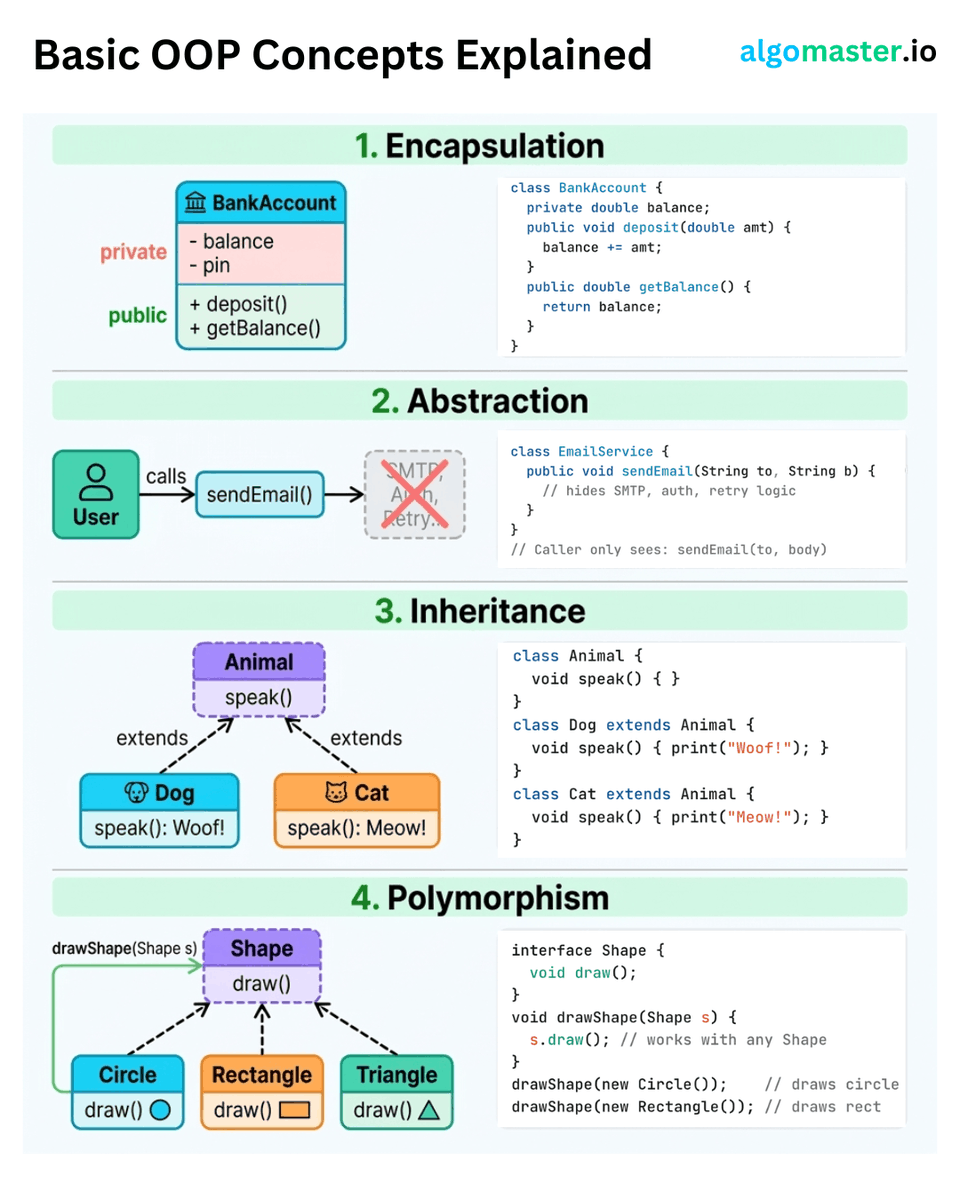
Basic OOP Concepts Explained with Clear Examples:
1. 𝐄𝐧𝐜𝐚𝐩𝐬𝐮𝐥𝐚𝐭𝐢𝐨𝐧
Hide internal data behind public methods.
- Example: A BankAccount class keeps balance and pin private. The only way to interact with it is through deposit() and getBalance().
2. 𝐀𝐛𝐬𝐭𝐫𝐚𝐜𝐭𝐢𝐨𝐧
Expose a simple interface, hide the complexity behind it.
- Example: An EmailService class gives you sendEmail(to, body). Internally, it handles SMTP connections, authentication, and retry logic. The caller doesn't need to know any of that. They just call one method and it works.
3. 𝐈𝐧𝐡𝐞𝐫𝐢𝐭𝐚𝐧𝐜𝐞
Let child classes reuse and override behavior from a parent class.
- Example: An Animal class defines speak(). Dog extends it and returns "Woof!", Cat extends it and returns "Meow!". Shared logic lives in one place, and each subclass customizes what it needs.
4. 𝐏𝐨𝐥𝐲𝐦𝐨𝐫𝐩𝐡𝐢𝐬𝐦
Write code that works with multiple types through a common interface.
- Example: Define a Shape interface with a draw() method. Now Circle, Rectangle, and Triangle each implement draw() their own way. A single drawShape(Shape s) method works with all of them.
♻️ Repost to help others in your network
GIVEAWAY ✨
Halo semuanya, aku mau giveaway Honkai: Star Rail x MOONDROP TWS Robin
Syaratnya
-RT+Like tweet ini
-Reply tweet bebass
-ID Only
End : 18 March 2026 12:00
Pemenang akan diumumkan setelah giveaway ditutup
Local Desktop is a new Android app that allows you to run Arch Linux on your phone, no root access required on Android.
#AndroidDev
https://t.co/mQqfh4Rav0
𝗘𝗫𝗣𝗟𝗢𝗜𝗧 𝗗𝗘𝗩𝗘𝗟𝗢𝗣𝗠𝗘𝗡𝗧 🐌
🔗 Part 1 : Intro :-
https://t.co/AHjVYNvAcu
🔗 Part 2 : Understanding Stack Memory :-
https://t.co/RnXPbpAZyG
🔗 Part 3 : Understanding Heap Memory :-
https://t.co/DwIitKVWfL
🔗 Part 4 : Understanding Binary Files :-
https://t.co/a504lhs7lE
🔗 Part 5 : Dealing with Windows PE files programmatically :-
https://t.co/j5MgycQtZc
🔗 Part 6 : Dealing with ELF files programmatically :-
https://t.co/jMty8otCIj
🔗 Part 7 : How to do magic with string format bugs :-
https://t.co/WxI5VAIsrl
🔗 Part 8 : Buffer Over-Read Attacks and Developing a Real Exploit :-
https://t.co/BFQgofxFkO
@BlueTeamKit #exploit_development #binary_exploitation #vulnerability_research #buffer_overread









![sysxplore's tweet photo. Bash Scripting basics: Understanding (), {}, [], $(), $(()), ${}, and [[]] https://t.co/61EHacjyxf](https://pbs.twimg.com/media/G3ymzVYWQAAFfse.jpg)





