🚀 ANNOUNCING: AI Engineering Journey
Over the next 10–12 weeks, I'm documenting my journey of becoming an AI Engineer—one episode at a time.
Not by memorizing buzzwords.
Not by copy-pasting tutorials.
But by understanding how modern AI systems actually work.
This series is for you if you're:
• 🎓 A college student trying to break into AI
• 💻 A Software/Data Engineer planning to transition into AI
• 🤖 Curious about LLMs but don't know where to start
• 📚 Tired of tutorials that either dive straight into math or only show demos
Over 45 episodes, I'll break down and document my learning on:
→ LLMs & APIs
→ Prompt Engineering
→ RAG
→ Vector Databases
→ AI Agents
→ MCP
→ Evaluation
→ Deployment
→ Building production-ready AI applications
I'm not claiming to know everything.
I'm learning, building, making mistakes, and documenting everything in public.
If you're on the same path, follow along.
Episode 1 drops soon. 🚀
#AI #AIEngineering #LLM #BuildInPublic #GenerativeAI
Most people memorize SQL JOIN syntax.
Very few understand why JOINs exist.
In production, your data doesn't live in one giant table.
Customer data, orders, payments, products, employees, departments—everything is normalized into separate tables.
JOINs are what allow you to reconstruct the complete business story from scattered pieces of data.
If you don't understand JOINs, you're not querying data—you're querying fragments.
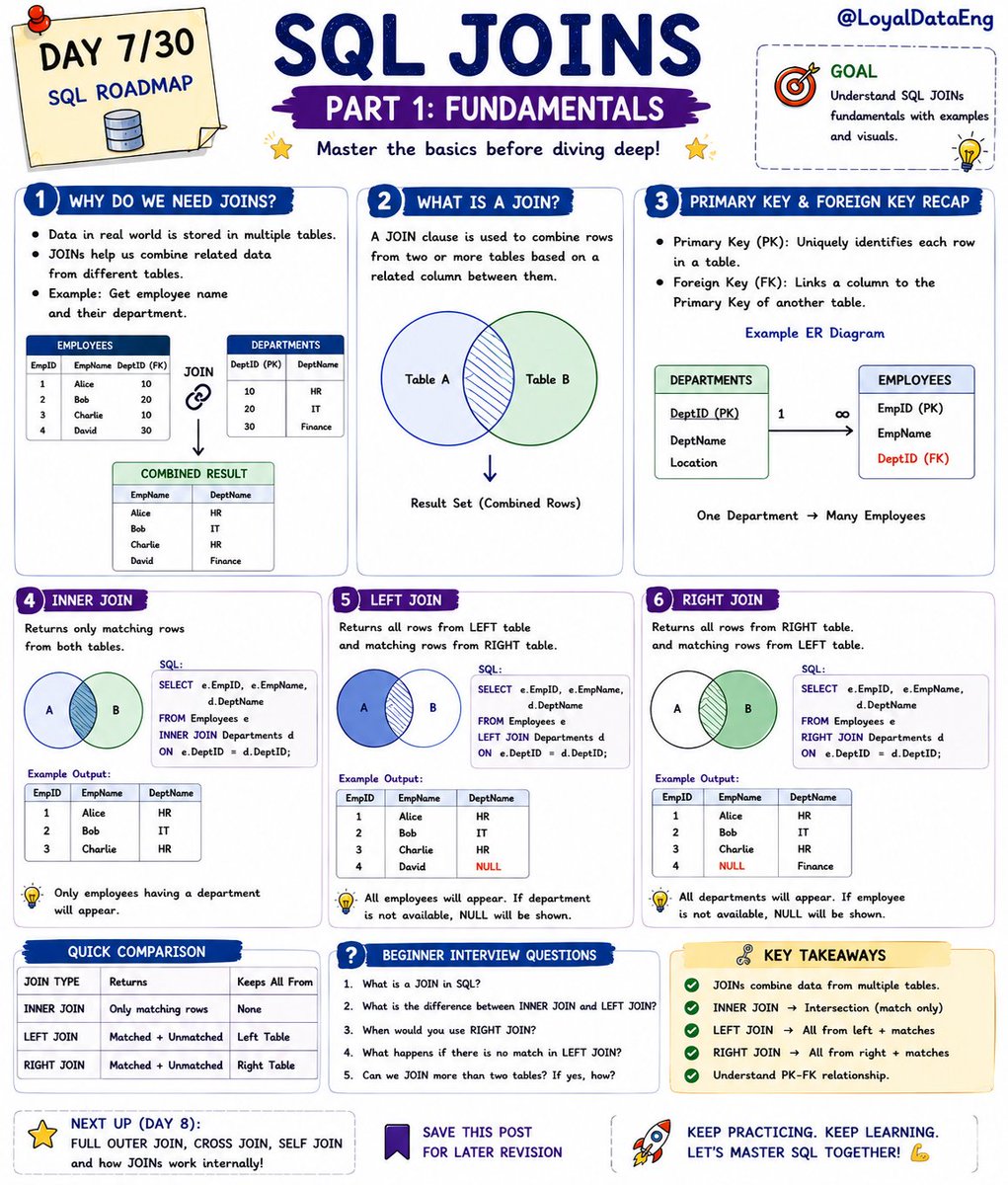
Day 7/30 – SQL JOINS (Part 1) covers:
📘 Why JOINs exist
📘 PK & FK relationship
📘 INNER JOIN
📘 LEFT JOIN
📘 RIGHT JOIN
📘 Visual diagrams
📘 Real examples
I intentionally slowed down this topic instead of rushing through it. JOINs deserve depth because they're used almost every day in analytics, backend systems, and Data Engineering.
📌 Save this for future revision.
Follow @LoyalDataEng for daily SQL, Python, AI & Data Engineering content.
🚀 Day 6/30 – SQL Constraints
Bad data doesn't happen because of SQL.
It happens because databases are missing the right constraints.
Today's topic is covered in 2 detailed parts:
📘 Part 1 – Fundamentals ✅ PRIMARY KEY ✅ FOREIGN KEY ✅ UNIQUE ✅ NOT NULL ✅ CHECK ✅ DEFAULT ✅ Real-world examples ✅ Interview questions
📕 Part 2 – Deep Dive 🔥 Constraint enforcement 🔥 CASCADE, SET NULL & RESTRICT 🔥 Composite constraints 🔥 ALTER TABLE constraints 🔥 Best practices 🔥 Common production errors 🔥 Advanced interview questions
Constraints are the first line of defense for data quality. Every Data Engineer should understand them beyond just syntax.
📌 Save this post for future revision.
💬 Which SQL topic should we cover next: JOINS or GROUP BY?
Follow @LoyalDataEng for daily SQL, Python, AI & Data Engineering content.
🐍 Day 8/30 – Python Conditional Statements
Every intelligent program starts with a decision.
Whether it's approving a payment, validating data, detecting fraud, or processing an ETL pipeline, it all comes down to one thing:
Making the right decision at the right time.
That's exactly what conditional statements do.
Today's lesson is divided into 2 focused parts:
📘 Part 1 – Fundamentals • if • if...else • if...elif...else • Nested if • Flow diagrams • Common mistakes
📗 Part 2 – Deep Dive • Truthy vs Falsy • Short-circuit evaluation • Ternary operator • is vs == • Membership operators • Guard clauses • Real Data Engineering use cases
I also redesigned the posters with a cleaner notebook-style layout so they're easier to read on mobile and better for quick revision.
💬 How are you liking the new design compared to the old one?
📌 Save this post—you'll use conditional statements in almost every Python program you write.
Follow @LoyalDataEng for daily Python, SQL, AI & Data Engineering content.
🐍 Day 7/30 – Python Strings Interview Mastery
Strings are one of the most frequently asked topics in Python interviews.
Instead of just covering theory, I redesigned today's content into a 3-part interview series with a new visual style for better readability.
📘 Part 1: Core Interview Concepts
📗 Part 2: Coding Problems & Solutions
📕 Part 3: Advanced Scenarios for Data Engineering & MNC Interviews
Topics covered include: ✅ Palindrome & Anagram ✅ Character Frequency ✅ Log Parsing ✅ CSV Cleaning ✅ Email & URL Validation ✅ Unicode ✅ Performance Optimization ✅ Output Prediction ✅ Real-world Data Engineering scenarios
I also changed the design style to make every concept easier to understand on mobile.
💬 How are you liking the new format? Better than the previous one?
📌 Save this thread for interview preparation and future revision.
Follow @LoyalDataEng for daily Python, SQL, AI & Data Engineering content.
I once bought an expensive GATE course from MADE EASY.
I was excited.
I thought this would change my career.
But because of my hectic schedule...
I never completed it.
What hurts me even today isn't that I wasted the course.
It's the fact that my father arranged that money by borrowing it from someone because he believed in me.
I couldn't live up to that trust.
If you're not serious about learning, don't spend your parents' hard-earned money on expensive courses.
Their sacrifices deserve your commitment.
The biggest career mistake isn't choosing the wrong tech stack.
It's waiting until you're ready to start building in public.
Your first project won't get you a job.
Your tenth might.
Start today.
I think "work harder" is becoming outdated advice.
The people growing fastest in tech aren't always working longer hours.
They're removing repetitive work.
They're documenting everything.
They're building systems.
They're using AI where it makes sense.
In 2026, productivity isn't about doing more.
It's about wasting less time on work that doesn't need a human.
It's not wrong, bro, from a student's point of view.
When I was a student, I felt the same way. I used to think, Why spend money on a course when so much information is available for free? Or I can share with someone.
Creators earning crores won't be at a loss if a few people don't buy their course and share this with each other.
A toxic workplace doesn't always shout.
Sometimes it quietly convinces you that:
• Working weekends is "normal."
• Taking leave makes you look lazy.
• Saying "no" hurts your career.
Healthy teams don't reward burnout.
They reward sustainable performance.
Don't mistake constant pressure for professional growth.
@nikitabier Heyy guys let's follow original content from nowonward.
Brand new Ai engineering series on x.
It will best utilisation of ur 10mim time u spent on X.
Let's bookmarks and check this series.
🚀 ANNOUNCING: AI Engineering Journey
Over the next 10–12 weeks, I'm documenting my journey of becoming an AI Engineer—one episode at a time.
Not by memorizing buzzwords.
Not by copy-pasting tutorials.
But by understanding how modern AI systems actually work.
This series is for you if you're:
• 🎓 A college student trying to break into AI
• 💻 A Software/Data Engineer planning to transition into AI
• 🤖 Curious about LLMs but don't know where to start
• 📚 Tired of tutorials that either dive straight into math or only show demos
Over 45 episodes, I'll break down and document my learning on:
→ LLMs & APIs
→ Prompt Engineering
→ RAG
→ Vector Databases
→ AI Agents
→ MCP
→ Evaluation
→ Deployment
→ Building production-ready AI applications
I'm not claiming to know everything.
I'm learning, building, making mistakes, and documenting everything in public.
If you're on the same path, follow along.
Episode 1 drops soon. 🚀
#AI #AIEngineering #LLM #BuildInPublic #GenerativeAI