Excited to release a huge evolution project on the works for many years:
An experimental evolution project across climates to understand rapid adaptation
Preprint: https://t.co/z3Zcffh5PU
All data available: https://t.co/hgD7rSqPP9
#MOILAB@UCBerkeley @HHMINEWS
🧵👇
New paper from our #MOILAB at @OUPBioinfo from @LucCzech w/ long term collab @spence_jeffrey_
Lucas created a ⚡️speed C++ code for popgen analysis using Pool sequencing!
https://t.co/H60FJpNtSe
@UCBerkeley @HHMINEWS @Stanford@carnegiescience
https://t.co/syguzw4SLr
New @ClimateChangeAI blog post by @LucCzech, @bjornlutjens & @dwddao presenting ForestBench and talking about their efforts in technological innovation and community engagement for carbon data collection in the Global South. Read more: https://t.co/hc66eQV79Z
@IanDworkin @MExpositoAlonso@github happy to hear, and happy to get feedback on it! there is much to be done still, with much room for improvement - let me know what urgent features are missing!
@ChrisWWheat@MExpositoAlonso@github Grenedalf is under active development, and we value constructive feedback and feature requests. It is indeed hard to guess which functionality is most needed in practice. If you have suggestions, feel free to open a GitHub issue.
@ChrisWWheat@MExpositoAlonso@github Yeah, you'd currently have to split the positions yourself first by S/NS. Can you open an issue on GitHub about this please, so that we can consider it for the future?
@IanDworkin @MExpositoAlonso @spence_jeffrey_ I think email gives you more space to elaborate, but as you prefer. We even accept GitHub issues :-) Thanks, looking forward to it!
@ChrisWWheat@MExpositoAlonso@github Grenedalf treats every line in the gff as a region window, and computes the statistic in each of those windows. So you can add or filter regions in the gff beforehand as needed. Or do you have a more convenient way in mind?
@ChrisWWheat@MExpositoAlonso@github Thanks for the suggestions!
To compute stats in regions (instead of fixed sized intervals), see `--window-type`, and `--window-region-gff` to provide a GFF file.
SS/NS is not implemented yet, I've put it on the list ;-)
Feel free to suggest more: https://t.co/Y4P6sh5qfH
@IanDworkin @MExpositoAlonso@github Thanks @IanDworkin, happy to hear that you like the cathedral plot idea (see picture)!
Also thanks for spotting the typo - if that's the only mistake we made in close to 50 pages, I'm happy! 😂
Our new preprint is out!
grenedalf: population genetic statistics for the next generation of pool sequencing
Preprint: https://t.co/iRjbgrBHY3
GitHub: https://t.co/AD5atNq1dw
with @spence_jeffrey_ and @MExpositoAlonso
also to be presented at #evolution2023
Another episode of "have you ever fought with software X?"
Current tools for pool-seq in Evolve+Reseq data are too slow or have other problems (🧵)
@LucCzech wrote from scratch an easy to use C++ tool for pool-seq + comp popgen stats w @Spence_Jeffrey_
https://t.co/qw5WstGpk7
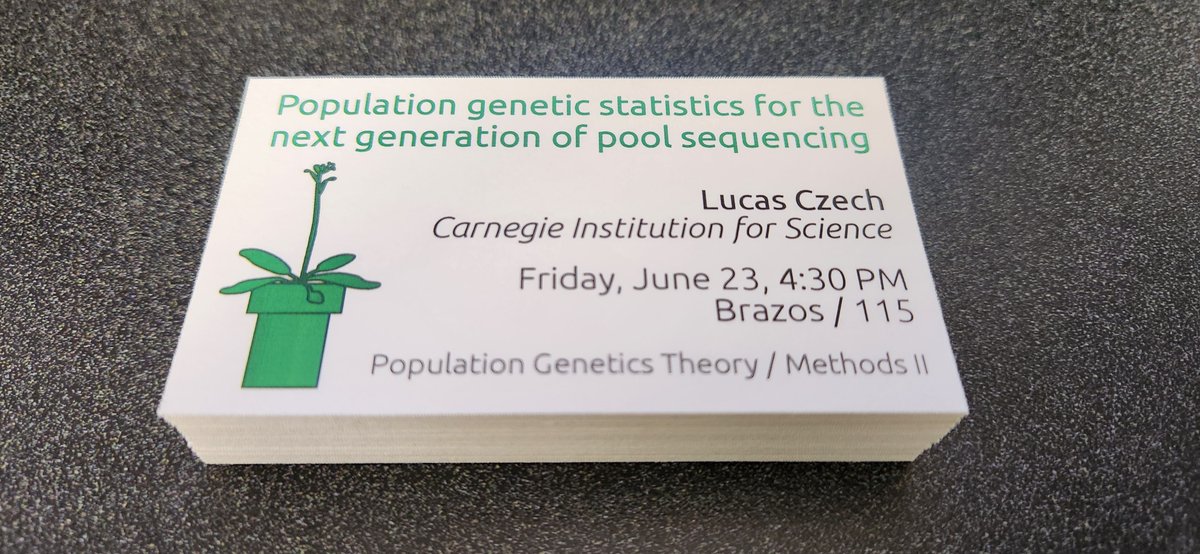
Getting ready for #evolution2023#evol2023 - come find my talk, Friday 23rd, 4:30pm, Brazos/115:
"Population genetic statistics for the next generation of pool sequencing"
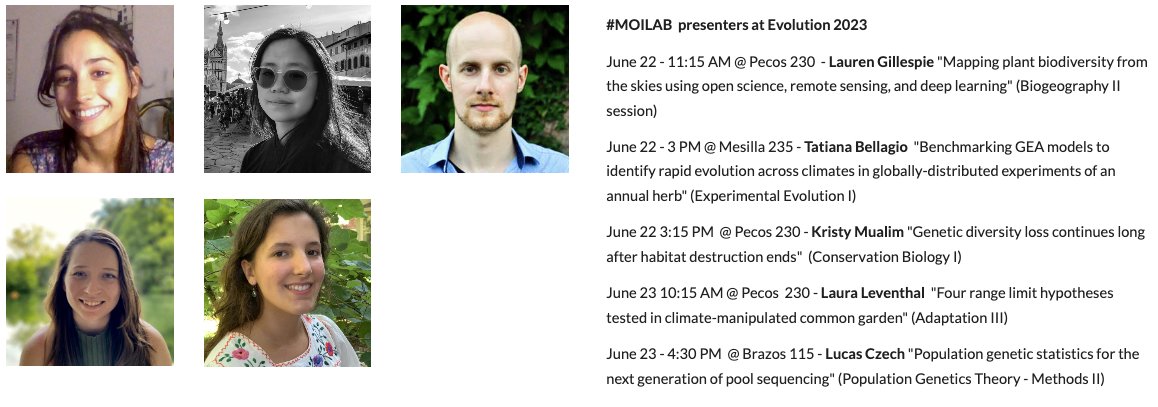
Also don't miss out on the other #moilab talks: @BellagioTatiana@ksmualim@leg2015 @LauraCLeventhal
The #MOILAB will be at #evolution2023 presenting in diverse topics: experimental evolution and popgen, ecology and local adaptation, to conservation biology, and biogeography!
https://t.co/VGmWI36yfR
@CarnegiePlants
@CarnegieEcolo
@Stanford
@HHMINEWS
https://t.co/AdS2FBsTGK
me: makes all figure in pdf form, so they are infinitely scaleable without loss of resolution
journal: please convert to tiff or eps, both of which look like garbage at the maximum allowed file size. Thanks!
me:
@DanielBolnick Do you know which those tools were, and what they compute? In existing implementations, Tajima's D has been bugged, and Fst had biases in pool-seq analysis. @MExpositoAlonso, @spence_jeffrey_ , and I are working on fixing this. Would like to compare ours to the tools you mention!