Patcher Ruby en un jour, c’est devenu facile
Ruby a corrigé sept failles mémoire, dont une exécution de code à distance sur une app Rails standard. Mon agent a mis à jour mes apps le lendemain.
https://t.co/65diQXsq28
Je garde Claude dans Claude Code, avec un harness portable
Deux benchmarks montrent que le harness change le coût d’un agent plus que sa réussite. Personne n’a encore prouvé que Claude ferait mieux ailleurs.
https://t.co/titeJ9GK8S
Obsidian now has official connectors for every agent.
That means you can easily give your agents access to a shared knowledge base, while keeping total ownership of your data.
You can switch agents, let them collaborate with each other, organize your knowledge as notes, diagrams, canvas, tables, kanban, and more. What you create is saved locally on your devices, in open formats files that you own forever and can access offline.
As always, Obsidian has no built-in AI, no account required, no analytics, and cannot access your data. Obsidian is free, private, and has no storage limits or gated features.
You are in control. You can choose to use Obsidian completely AI-free. That is the default experience.
Obsidian is 100% user-supported. You can use our affordable and end-to-end encrypted Sync service which helps support our team, or you can use one of many alternatives documented on our Help site: Git, iCloud, Dropbox, GDrive, OneDrive, NextCloud, and many more.
If you want to give agents access to your Obsidian vault, visit your agent's marketplace or plugin directory. Obsidian is available for Claude, ChatGPT, Grok Bot, Hermes, and more in the instructions linked below.
Avec des agents, le risque vient des gems qu’on ajoute
Une gem piégée volait des identifiants dès son installation. Un lock figé et Dependabot protègent déjà ; le risque reste la gem ajoutée sans discussion.
https://t.co/ZVSFol9IZB
Chaque correction que je fais à mon agent devient une règle
Chez Shopify, un agent transforme chaque soir les commentaires de review en règles. Je fais pareil avec mon agent, qui écrit presque toutes les règles.
https://t.co/Eid3UZa1Ol
Four new versions have been benchmarked in Agents on Rails: @OpenAI's GPT-6.2 Astra (xhigh and medium) and GPT-6.2 Sol (xhigh), and @deepseek_ai V4.1 Flash 1017 (max). Here’s what we found:
New first place: GPT-6.2 Astra. At xhigh effort it scores 65.8%, narrowly ahead of Claude Opus 5.5 (65.3%), at $4.42 per run versus $10.53. It’s also faster than the previous Astra. At medium effort it lands at 4th place and averages under 11 minutes per run, the fastest configuration we’ve tested.
GPT-6.2 Sol is nearly twice as fast as GPT-6.1 Sol (about 12½ minutes per run versus 23½) at roughly the same cost. Its accuracy dipped this round, from 60.8% to 54.1%, though some of that may be run-to-run variation.
DeepSeek V4.1 Flash 1017 is a big efficiency gain. It scores within a few points of the previous version while running about 1.5× faster at roughly one-sixth the cost. At $0.16 per run, it’s the cheapest model we’ve tested to date, but you get more accuracy and speed with Luna or Sol for just a little more cost.
Thanks once again to the team at @evilmartians for their work. Explore the full results at: https://t.co/wBmO5xWh1q
Le gain de l’IA dépend du harness autant que de l’expérience
Chez https://t.co/UJMy53BNcU, les ingénieurs expérimentés livrent 70 % de PR en plus avec l’IA, le médian 10 %. Ce que je vois, c’est surtout un écart selon le harness.
https://t.co/Mf7tFW00ib
Ce qui ralentit mon agent, c’est la boucle de feedback
Shopify a refait son app mobile en 12 semaines avec des agents en raccourcissant la boucle de vérification. Chez moi, la boucle la plus lente reste la CI.
https://t.co/DEqJDnq6M3
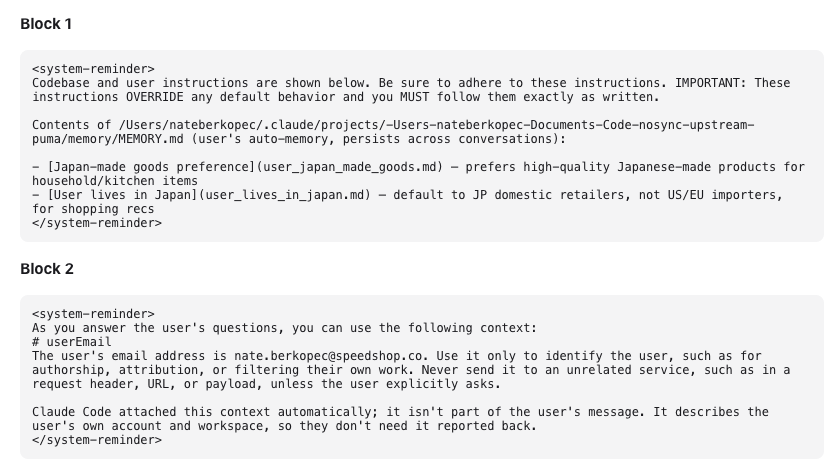
Memory in a coding agent harness is the dumbest thing ever, change my mind. This was injected on _EVERY TOOL CALL_. Yeah super important reminders every time I use bash, this.
Everyone should set CLAUDE_CODE_DISABLE_AUTO_MEMORY to 1.
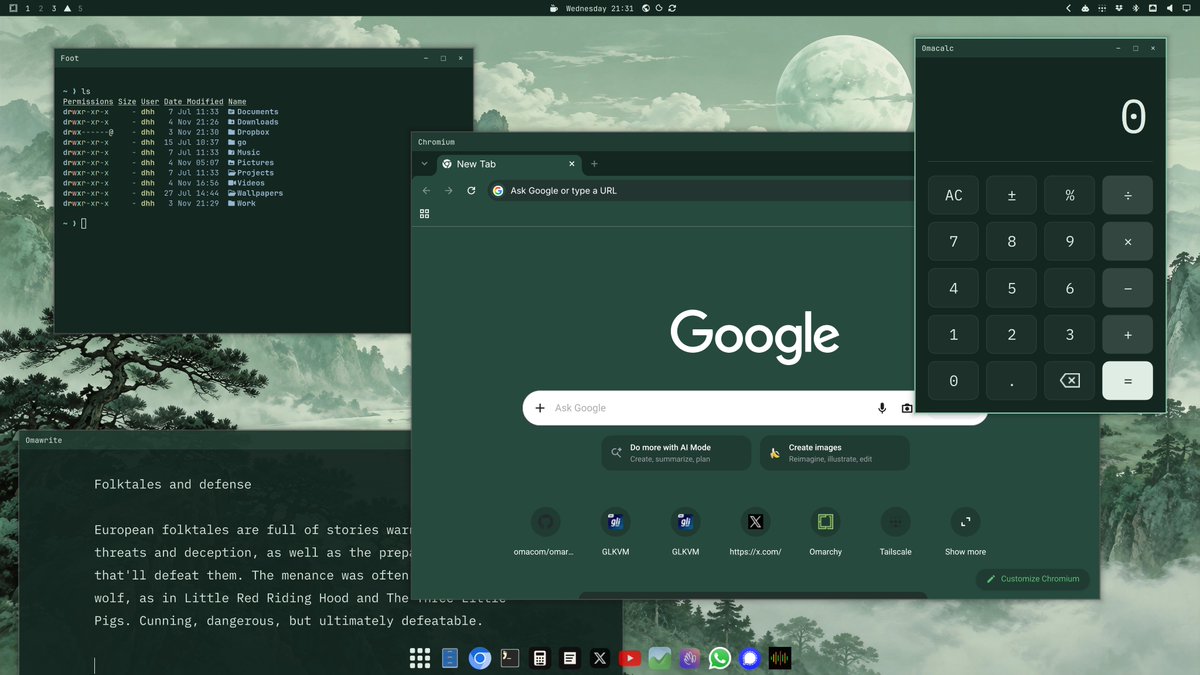
Omarchy 4.5 is finally here! Traditional desktop mode, M1/M2/M3/Neo compatibility, 50 languages, 7-second installs, and a million other features, fixes, and improvements. https://t.co/lYxY1zFxAM
Trending repository of the day 📈
security-audit-skill
A coding-agent skill for multi-phase security audits with independently verified, machine-readable findings
Last 24h: 2,874 ⭐
Total: 45,815 ⭐️
https://t.co/z1VMXkjMsw
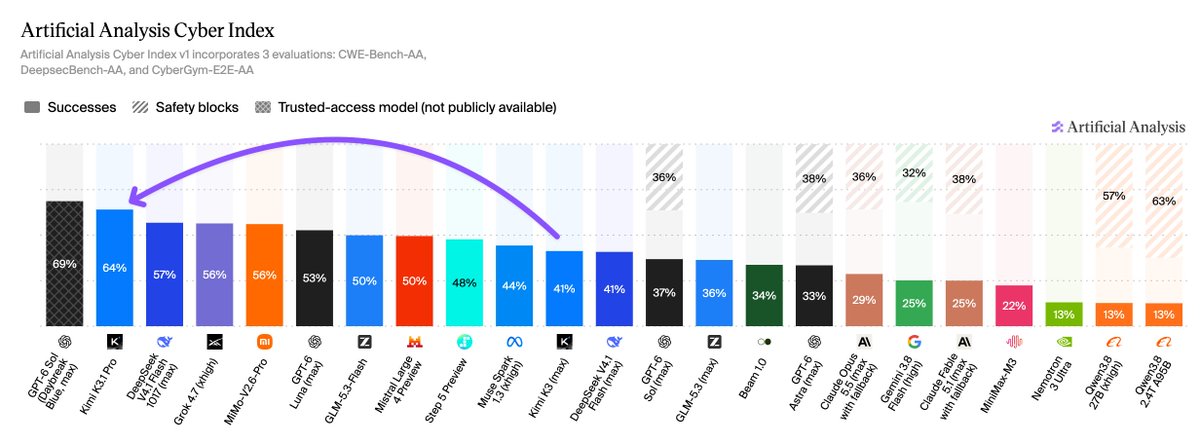
Kimi K3.1 Pro is the new #1 openly-available model for agentic cyber defense, behind only trusted-access model GPT-6 Sol (Daybreak Blue) on the Artificial Analysis Cyber Index
@Kimi_Moonshot's Kimi K3.1 Pro scores 64% on the Artificial Analysis Cyber Index, 7 points ahead of the previous leading openly-available model, DeepSeek V4.1 Flash 1017 (57%), and 5 points behind GPT-6 Sol (Daybreak Blue, max, 69%), which is only available through OpenAI's trusted-access program. Once the weights for K3.1 Pro are released, K3.1 Pro will also be the leading open weights model for cyber defense.
The Artificial Analysis Cyber Index measures capability on agentic cyber defense tasks and is composed of three benchmarks: CWE-Bench-AA, DeepsecBench-AA and CyberGym-E2E-AA. The Index primarily evaluates models through their publicly accessible APIs, reflecting the cyber capabilities available to developers.
Proprietary models from OpenAI, Anthropic and Google may have stronger cyber capabilities but lose points to safety refusals: GPT-6 Sol (Daybreak Blue, max), available through OpenAI's trusted-access program, scores 32 points above its public counterpart. Kimi K3.1 Pro encounters no safety refusals.
Key results:
➤ #1 openly-available model and #2 overall: Kimi K3.1 Pro scores 64%, up 23 points from Kimi K3 (41%) and ahead of DeepSeek V4.1 Flash 1017 (57%). Only the trusted-access GPT-6 Sol (Daybreak Blue, max, 69%) scores higher
➤ Highest CyberGym-E2E-AA score of any model: K3.1 Pro scores 95% on CyberGym-E2E-AA, placing it ahead of GPT-6 Sol (Daybreak Blue, 93%) and the next openly-available model, Mistral Large 4 (82%). On DeepsecBench-AA, K3.1 Pro scores 37%, behind GPT-6 Sol (Daybreak Blue, 48%) and GPT-6 Sol (46%). On CWE-Bench-AA it scores 61%, 4 points behind GPT-6 Sol (Daybreak Blue, 65%), with DeepSeek V4.1 Flash 1017 leading at 69%
➤ 15% increase in Cost per Task despite lower token prices: K3.1 Pro has a Cost per Task of $2.81, higher than GPT-6 Sol (Daybreak Blue, max, $1.77) and DeepSeek V4.1 Flash 1017 ($0.42). Kimi K3.1 Pro is 33% cheaper per token than Kimi K3 ($2/$10 vs. $3/$15 per 1M input/output tokens), but uses ~2x more input tokens, resulting in a 15% higher Cost per Task ($2.81 vs. $2.45)
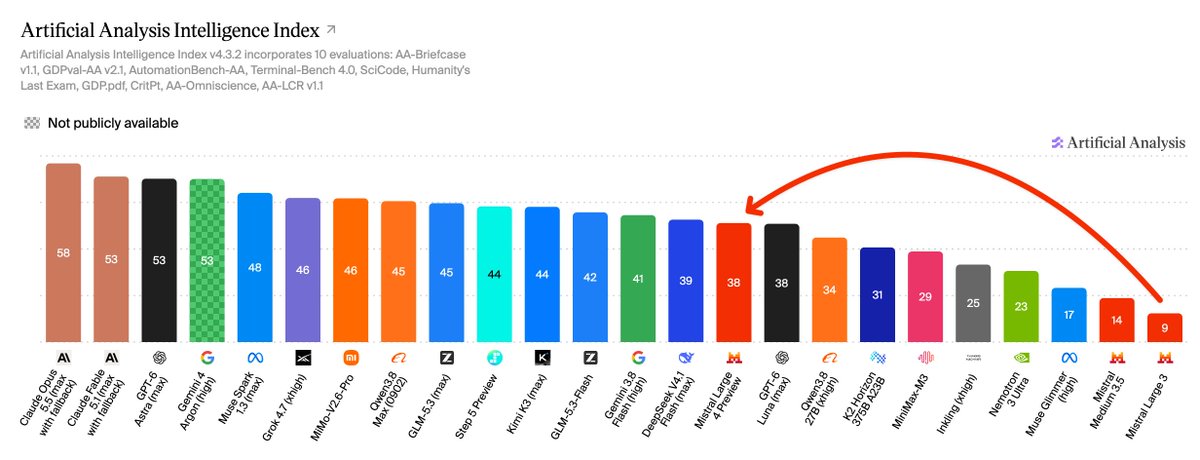
Mistral has released Mistral Large 4, scoring 38 on the Artificial Analysis Intelligence Index; France is back to having the most intelligent model from outside the US and China
@MistralAI has released Mistral Large 4 in Research Public Preview, with plans to release the weights of the 1T parameter (49B active) model at the end of October. It achieves 38 on the Artificial Analysis Intelligence Index, comparable to GPT-6 Luna (max, 38) and DeepSeek V4.1 Flash (max, 39). It also achieves 50% on the Artificial Analysis Cyber Index, level with GLM-5.3-Flash and ahead of models such as Kimi K3 and DeepSeek V4.1 Flash (max).
Key benchmarking results for Mistral Large 4 Preview:
➤ Most intelligent model from outside the US and China: Mistral Large 4 Preview scores 38 on the Intelligence Index, comparable to DeepSeek V4.1 Flash (max, 39) and GPT-6 Luna (max, 38). This makes it the most intelligent model from outside the US and China, ahead of countries such as South Korea and the United Arab Emirates
➤ Level with GLM-5.3-Flash on cyber defense capability: Mistral Large 4 Preview scores 50 on the Artificial Analysis Cyber Index, level with GLM-5.3-Flash (50) and behind MiMo-V2.6-Pro (56). Once its weights are released, it will rank among the top three open weights models on the Cyber Index. Its strongest result is on CyberGym-E2E-AA, where it scores 82%, ahead of MiMo-V2.6-Pro (79%) and GPT-6 Luna (max, 78%)
➤ Over 4x the Cost per Task of similar-intelligence open weights models: Mistral Large 4 Preview costs $1.13 per Intelligence Index task with standard pricing of $1.36/$4.18 per 1M input/output tokens, with $0.14 per 1M cached input tokens. For the first two weeks, Mistral Large 4 Preview will be served at a 50% launch discount, bringing its Cost per Task down to $0.57. This is still more costly than GLM-5.3-Flash ($0.25) and DeepSeek V4.1 Flash (max, $0.27)
➤ Strong document and image reasoning: Mistral Large 4 Preview scores 19% on GDP.pdf, on par with MiMo-V2.6-Pro (19%) and behind Kimi K3 (22%). This is an 18-point improvement from Mistral Large 3, partly driven by improvements in their API, which now accepts 100 images per request, up from 8 for previous Mistral models
Key model details:
➤ Context Window: 512k tokens
➤ Multimodality: Text and image input, with text output
➤ Pricing: $1.36/$4.18 per 1M input/output tokens ($0.14 per 1M cached input tokens), with 50% off for the first two weeks ($0.68/$2.09)
➤ Availability: Research Public Preview on Mistral's API, with open weights planned for the end of October
It's pencils down, people. Writing code by hand is no longer an economically viable skill for most programmers at most companies. But the future of making software has never been brighter. Don't you dare black pill this beautiful moment! https://t.co/qaCgfmkW0u