🌌 Voyager 1 is 15.95 billion miles from Earth as of February 2026.
49 years after its 1977 launch.
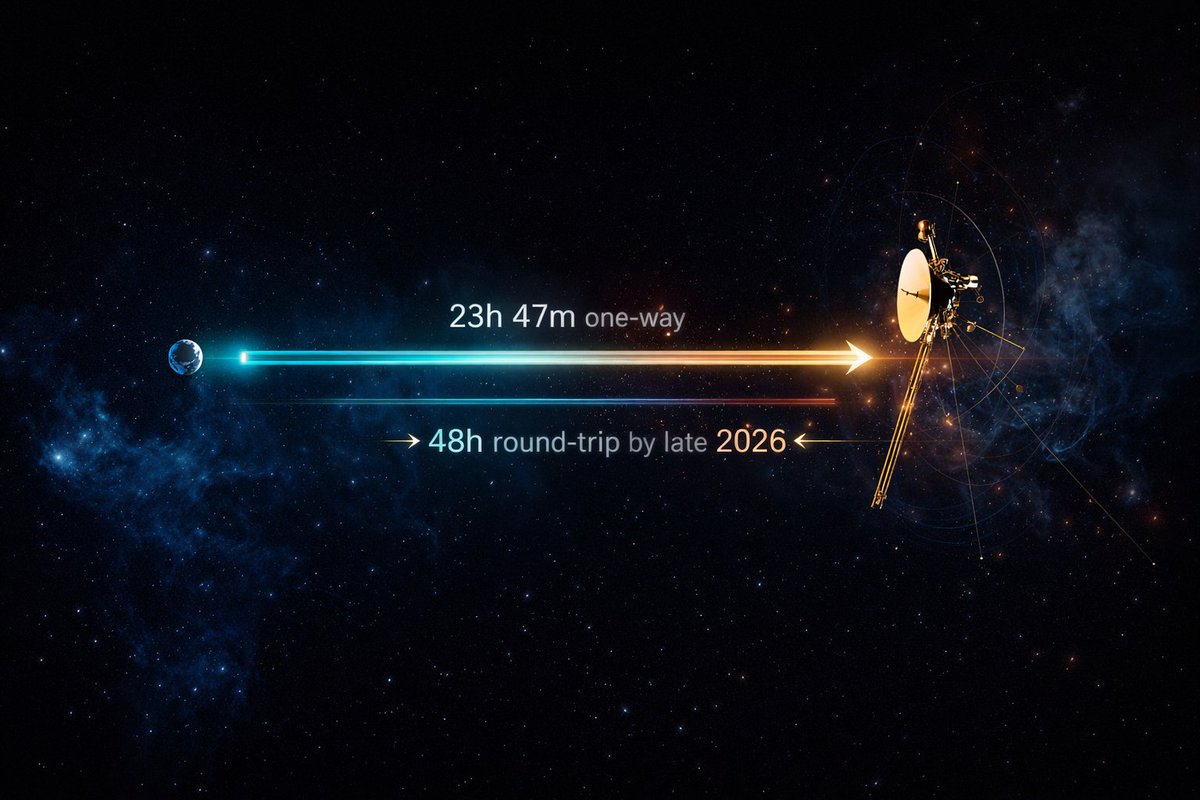
One way radio signals now take 23 hours and 47 minutes.
It will cross one light day 16.1 billion miles in November 2026.
Only the magnetometer and plasma wave subsystem remain active.
Plutonium RTGs lose 4 watts of power each year.
1977 era computers still process data from interstellar space.
Round trip commands will soon require two full days.
Humanity’s farthest creation is slipping into a silence where real time contact becomes impossible.
📌 NASA JPL Voyager mission status February 2026, Wikipedia Voyager 1 entry March 2026, JPL one light day projections November 2026
🚨: After 48 years of travel, NASA 's Voyager 1 is nearing one light-day from Earth, almost 16 billion miles away.
A proud milestone for humanity, and a humbling reminder of how small we are in an infinite universe.
🚨BREAKING: You can now run Claude Code for FREE.
No API costs. No rate limits. 100% local on your machine.
Here's how to run Claude Code locally (100% free & fully private):
@curiosityonx The Sun doesn’t stand still.
It's orbiting the Milky Way at ~220 km/s, taking 225-230 million years for one full "galactic year", and the planets follow suit.
The Chinese have made history. In a much-publicized event, a J-35 naval stealth fighter was catapulted off CNS Fujian using its electromagnetic launcher - the first stealth jet ever to do so! 1/2