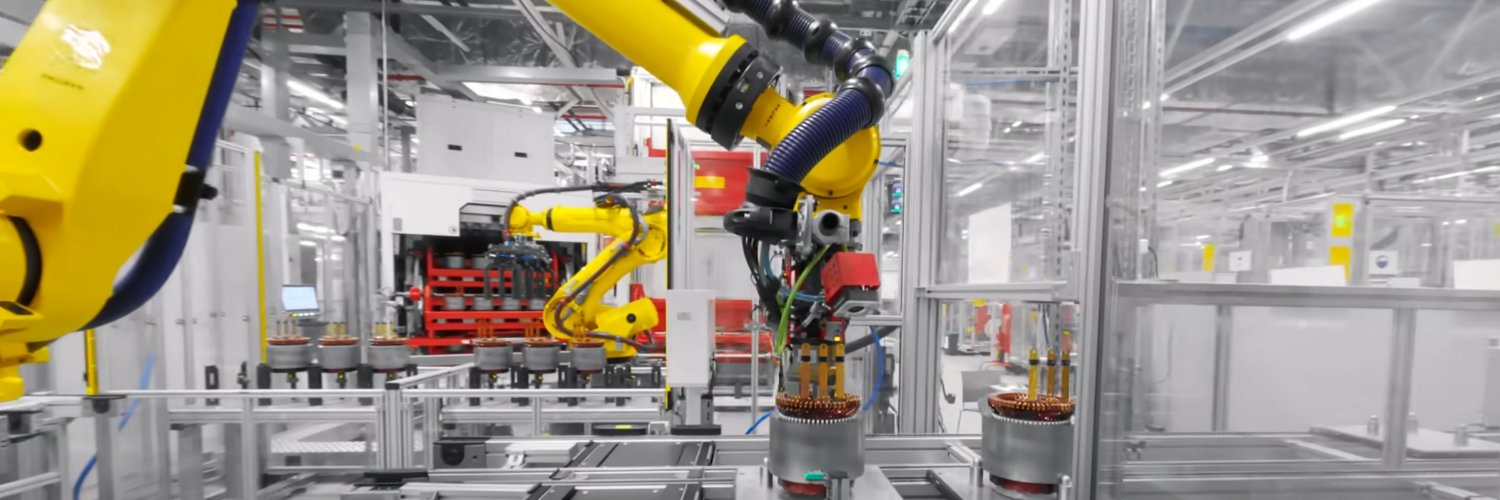
@tinytapeout I like this flow: sample validation in transit, then a full factory test on arrival. I'd be curious how you correlate the in-transit delay and resistance data with your final spec limits. Does a marginal in-transit result ever trigger a closer look?
be an engineer.
• lost at 24.
• learning the fundamentals at 25.
• broke, building prototypes at 26.
• failed 100 experiments at 27.
• built something that works at 28.
• turned it into a company at 29.
• building the future at 30.
don’t fucking stop building.
@namrun23 Agreed. From my side of the industry, that bridge is reliability engineering. Contact-rich tasks expose every tolerance stack-up and component weakness. The deploy cos that last will treat hardware quality as seriously as the models.
@oprydai The kingfisher example hits closest to home for me. Aerodynamics is full of this: Shinkansen engineers solved tunnel sonic booms with a bird's beak profile. Old geometry, new application. Cross-domain collection is where the real ideas come from.
@ORNL This matters for industry. If neutron imaging maps density gradients and porosity evolution mid-cycle, I'd tighten sintering windows for SiC components considerably. Strong characterization work.
@Hacksterio Depth-selective laser etching replacing photolithographic masking is what impresses me most here. 50.8 PPI from an airbrush setup is remarkable for electroluminescent stacks. And conformal substrates open real wearables applications.
@Michaelskywal That 80x is why I always spec toroids near analog front ends. Closed magnetic path, no external return flux. Drum cores only win on cost and DCR. Where do you land on gapped ferrite for higher current rails?
@Michaelskywal The dissipation factor is what kills you at 77 GHz. FR-4 Df around 0.02 vs 0.001 for Rogers makes the difference between a working radar front-end and a heater. Hybrid stackups are the pragmatic answer, watch the CTE mismatch at the interface.
@leto__jean Will stop by poster 166. In assembly automation we run into the same pattern: vision alone breaks down once tolerances get tight. Good tactile feedback is exactly what bridges that gap.
@iamtobi I'd step in too. Drive-by-wire with no mechanical backup is the real milestone here, not the interior. Redundant steering and braking is what makes it possible. Impressive engineering.
@the_real_btaba Congrats on the 1.0 release. In my own work the transfer gap is exactly where projects stall, so shipping sim-to-real examples out of the box is the right call.
@Aryannbrb Manual placement was the right call, placement is where these tools are still weakest in my experience. On size, I'd look at sharing via/pads between decoupling caps and trimming the power stage. What's your target footprint?
Fun clip, but I'd want to see the footage provenance first. Dynamic stability on snow is a far harder problem than a flat factory floor. If real, that control stack is genuinely impressive. #Robotics#PhysicalAI
@Michaelskywal Good question. In my experience the real constraint is the silicon loop: tapeout to bring-up takes 12 to 18 months regardless of AI tooling. That cycle time is what protects you from a rival with better AI.
💷 Accurate costing. Faster quotes. Greater consistency!
#PSLDatatrack has helped Technoset revamp its quoting process, supporting commercial sustainability while remaining competitive.
🎥 Hear Adam Land explain how in the full @mtdcnc testimonial: https://t.co/xVtSoetm8R 🎤
@NVIDIARobotics@UTAustin Impressive sim-to-real pipeline. I have seen how shared GPU access like this at TACC lets student teams iterate far faster than with dedicated hardware only. Well done to the team.
@BenBajarin Looking forward to this one. The 2028 glut thesis deserves scrutiny. Hyperscaler capex cycles have historically overshot demand, and advanced packaging lead times make the correction sharp when it comes.
Food manufacturer Gousto increased mechanical availability from 70% to 95% within six months of deploying an industrial DataOps architecture. That 25-point gain came from standardizing how shop floor data was collected, contextualized, and shared across the plant. Partner content with @HighByteInc. #highbyte_iiot
Note: Video generated by AI.
@GoingBallistic5 22 DoF with a 17-actuator forearm points to tendon routing through the wrist. I'd want to know how they manage thermals in that actuator pack at sustained duty cycles. That's the real challenge there.