Data Nerds! It's only taken me over 2 years, but I finally launched my FREE Data Analyst Bootcamp!
This 35-hour video is what I wish I'd had when I got started; it's for those with no degree or experience, helping one go from zero to job-ready.
For this bootcamp, we’re focusing on the top 4 demanded skills for a Data Analyst
1️⃣ SQL (45% of job postings)
2️⃣ Excel (32%)
3️⃣ Python (31%)
4️⃣ Power BI (28%)
But here's what makes this more than just a "How-To" video. It's not about the tools. The real work is learning how to be a data analyst and actually perform the analytics. The tools? They're just a necessity to facilitate it.
And the best way to learn all that? You build it:
🛠 6 hands-on portfolio projects (because employers want experience)
🤖 AI built into your workflow to learn and work efficiently
🐙 GitHub to share everything you build
So you finish each skill with something real to show, not just a "completed" badge.
Now the real talk. I pulled the numbers from my own course-takers on how long each skill will take to learn:
🐘 SQL ~3 months
❎ Excel ~3 months
📊 Power BI ~2 months
🐍 Python ~6 months
Realistically, that's 8 to 12 months to transition if you're doing this part-time.
Alright, let's get to building. 🤙
⚠️ Fundamental DE concepts are more important than focusing on tools first.
I break down how I rank these tools based on the core concepts here👉 https://t.co/y3156oVojC
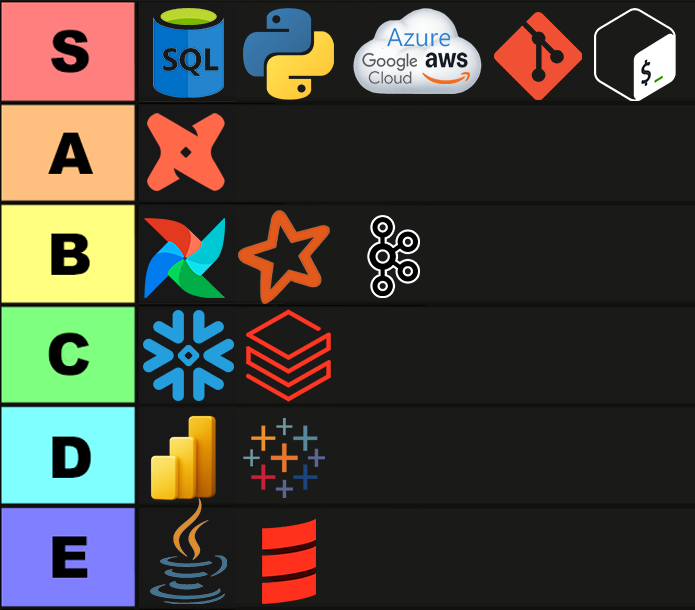
Data Nerds! I ranked every data engineering tool by how often it shows up in 4M+ job postings. 📊
But here's the catch 😳.
Some critical skills show up way less than they should because they're often assumed to be foundational skills for jobs. (e.g., Skills like Bash/Terminal for running pipelines)
Anyway, here's the breakdown of the tiers 👇 (Note: % = how often each tool appears in DE job postings)
🔴 S TIER — Non-Negotiable
The core skills needed for any DE job. Don't apply without these:
📊 SQL (~68%) — every warehouse runs on it. Query, transform, and model data.
🐍 Python (~67%) — the pipeline language. Ingestion, automation, APIs, glue between systems.
⌨️ Terminal/Bash (~11%) — every tool you'll use runs from here. This is highly undervalued in postings.
📁 Git (~11%) — version control. Every team uses it. Same posting-% caveat as Bash.
☁️ One cloud platform + warehouse (~26-46%) — AWS + Redshift, GCP + BigQuery, or Azure + Synapse. Combined cloud presence is in nearly every posting.
Start with SQL, then Python. Everything else you absorb alongside them.
🟠 A TIER — Job-Ready Foundation
The tool that closes the gap from "learning DE" to "hireable for modern stacks":
🪛 dbt (~10%) — only 10% of all DE postings, but 36% in Analytics Engineer (AE) roles.
That's not a niche, it's a leading indicator. AE is the new hybrid role modern data teams are hiring for: part analyst, part engineer.
✅ Land the job with S + A. Pass the interview with conceptual knowledge of B Tier 👇
🟡 B TIER — Interview-Aware
Know what they solve. Don't expect to code from scratch:
⚙️ Airflow (~17%) — orchestration. Built on DAGs (directed acyclic graphs).
⚡ Spark (~38%) — distributed computing for processing large datasets.
🌊 Kafka (~19%) — real-time event streaming between systems.
All these depend on a foundational knowledge of Python & SQL; don't jump the gun learning these.
🟢 C TIER — Data Platform Awareness
Pick the one your company uses. Understand both conceptually:
❄️ Snowflake (~26%) — pure SQL warehouse. Optimized for analytics. Modern-stack favorite.
🧱 Databricks (~24%) — lakehouse on Spark. Handles structured + unstructured. ML/AI heavy teams.
🔵 D TIER — Versatility Multipliers
Lower headline demand, but high value per hour:
📊 Power BI (~15%) / Tableau (~10%) — but the kicker: in AE roles these jump to 28% / 33%.
Modern data teams want pipeline builders who can also visualize. For analysts pivoting to DE, lead with this in interviews.
🟣 E TIER — Path-Dependent
High demand on paper, but concentrated in legacy enterprise stacks. Skip until your job requires it:
☕ Java (~25%) — legacy enterprise data infrastructure
⚖️ Scala (~22%) — Spark's native language. Spark-heavy shops.
🎥 How did I derive this ranking? In my latest video, I walk through the concepts first (the DE lifecycle, what each tool actually solves) and then derive the tiers. (Link in comments 👇)
Data Nerds! I just launched a FREE 10-Day Crash Course on Becoming a Data Engineer! 🛠️
This course is for the analyst whose boss heard 'I know SQL' and somehow translated that to 'build our entire data infrastructure.' 😵
Over the course of 10 days, I'll deliver it straight to your inbox, one email at a time:
🧑💻 Day 1: What Data Engineers actually do
🔄 Day 2: The Data Engineering Lifecycle — the framework everything clicks around
🛠️ Day 3: Essential DE tools — backed by real job posting data
🏗️ Day 4: Data warehouses, lakes, and lakehouses
📐 Day 5: Data modeling — the skill that separates analysts from engineers
📥 Day 6: Batch vs. streaming ingestion
🔧 Day 7: ETL, ELT, and transformations
📊 Day 8: Serving data to the business
⚙️ Day 9: Orchestration and production pipelines
🗺️ Day 10: Your DE learning roadmap
🎁 Bonus: How to land your data job
It's the crash course I wish I had back when I was nodding along to words like 'orchestration' and 'ingestion' and praying nobody asked me to define them. 😅
No fluff. No tool-of-the-week hype. Just the concepts that make the rest of it click.
📩 Link in the first comment 👇
Data Nerds! I just rebuilt https://t.co/MZqZ6Cb9Q0, my free job market intelligence app. 📲
But first, why the heck is this app even needed?
Ask any AI what the top skills for data analysts are, and you'll get a confident answer — pulled from the same biased sources that have always polluted this topic.
Colleges list outdated technologies to justify their aged programs. Course providers list their own courses as "top skills." Influencers (including me) are falling for it, too.
As someone who wasted months learning outdated tools because I thought it was “relevant” (...thanks, Microsoft Access 🤦🏼♂️)
I built an app that cuts through the noise.
🙅🏼♂️ No opinions. No agendas.
📊 Just an analysis of real-time job postings telling you exactly what employers are actually demanding.
Since launching 3 years ago, https://t.co/MZqZ6Cb9Q0 has aggregated over 4 million job postings so data nerds like you can focus on the skills that actually matter and stop wasting time on the ones that don't.
And here's what the rebuild actually brought:
🌍 A faster, cleaner pipeline pulling real-time job postings from around the world
🔍 A brand new job search feature where you enter YOUR current skills and find recently posted jobs that match you
No more "what should I learn next?" Just data telling you where you stand and what's in demand right now.
Tomorrow I'm dropping a full walkthrough video on everything the app can do. Stay tuned. 🙌