Postdoc at Cardiff University Brain Research Imaging Centre. M/EEG, computational neuroscience, microstates, connectivity, epilepsy, dementia, schizophrenia
New preprint with @mgfellow@DomDunstan1@f_tamagnini available online!
Longitudinal assessment of the conversion of mild cognitive impairment into Alzheimer's dementia: Observations and mechanisms from neuropsychological testing and electrophysiology
https://t.co/ulqMkHH5Aj
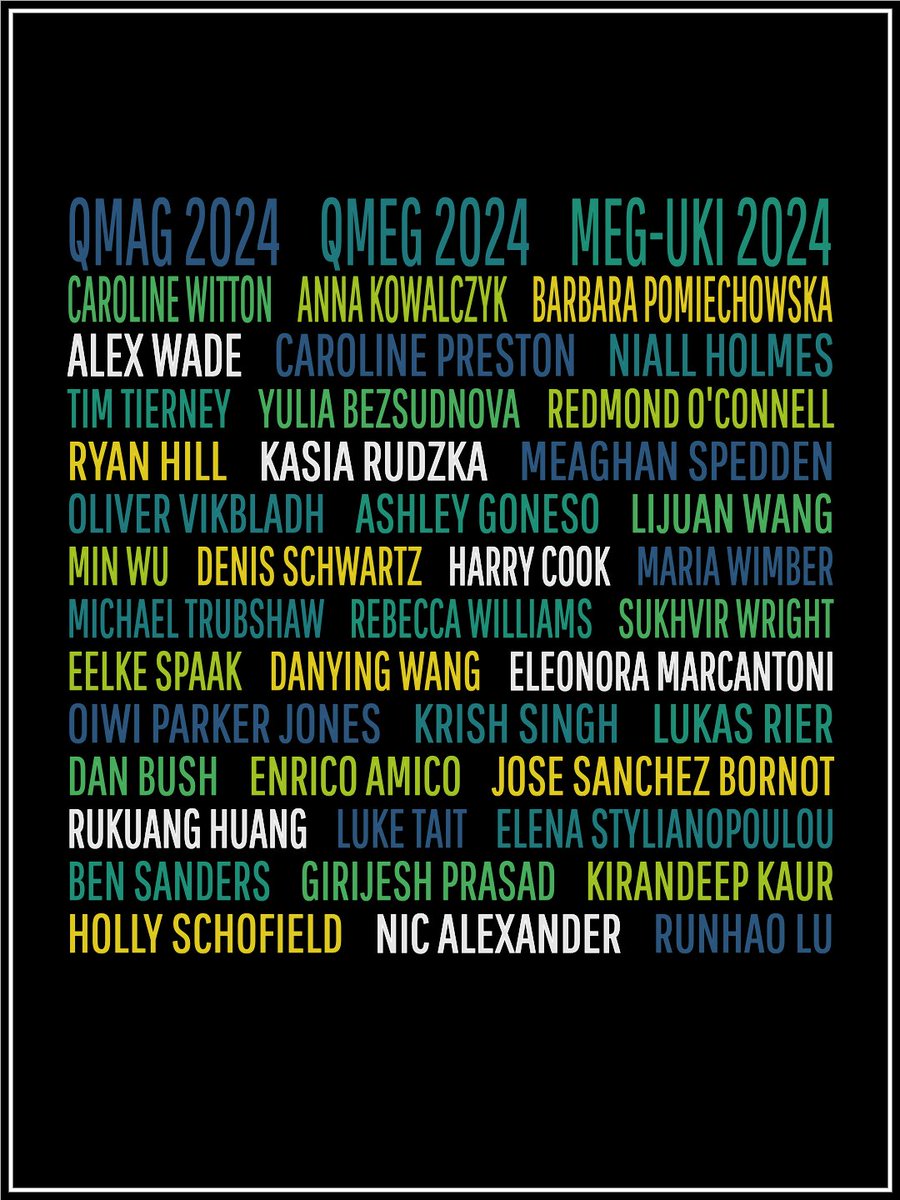
Who says festival season is over? 🎸📷🥁
Presenting the hottest lineup in town!
We're so excited to welcome these speakers to @unibirmingham on October 28th-31st for QMAG, QMEG and MEG-UKI 2024.
Stay tuned: We may be adding some Special Guests to this lineup soon😉
We have a new fully-funded PhD opportunity just advertised for UK candidates! Come work with us at @CUBRICcardiff@neurosciencecu on MEG measures in psychosis. Supervisory team is @drcarolynmcnabb, @LukeWTait and me!
Apply at:
https://t.co/iaYS0U4Rga
Our paper on changes in periodic & aperiodic neural activity in Alzheimer's dementia is now published!
We find in AD a specifically periodic change, different from aperiodic changes in healthy aging!
Work w @MKopcanova, @LukeWTait, @ChrisSYBenwell & co!
https://t.co/YZ6OPyBzPN
🎓📜New paper with @ChrisSYBenwell & co on spectral changes in Alzheimer's disease!
We found that spectral parameterization shows the key changes in AD are periodic, differentiating AD from the aperiodic changes of healthy aging.
First authors: @MKopcanova & @LukeWTait
In our new pre-print, we find evidence that EEG changes in Alzheimer's disease are primarily oscillatory in nature, and not aperiodic. A multi-centre collaboration with @MKopcanova @LukeWTait@Tomdonoghue@MouhsinShafi@alvaropleone et al: https://t.co/SMIFsMQTMx
Join the second BPML of the year on Wednesday 30th November at 7pm by Dr Paul Roberts titled 'Patterns: dangerous and beautiful’ Watch live in Watson Building or on Zoom using this link: https://t.co/ZHjtk4yuOc. Visit https://t.co/LUV96WrGry for more info
WEBINAR: Register now for 'Advanced brain stimulation approaches for treating depression and anxiety'. 6th Dec 0915-1145 hosted by Alexander Zhigalov @zhigalov_ax. Speakers: Luca Cocchi, Richard Morriss, Jonathan Roiser & Marcus Kaiser. https://t.co/oQGlMzs2QF via @unibirmingham
Great opportunity for ECR to use your skills in #Math#datascience#Physics to work in interdisciplinary projects and develop your own research programme with these #fellowships in Birmingham https://t.co/LlwkUAa0Ay
Our new work @CommsBio The individual difference of brain connectivity relates to grey and white matter microstructure. 3T/7T/MRI+MEG. Super Group effort @esinkarahans@LukeWTait @MaciekSzul @profkimgraham+others @CUBRICcardiff@SMQB_UoB@CompFoundry https://t.co/Qs7hOKMI5S 1/n
New paper with @ccbrainlab in @NeuroImage_EiC!
+microstate: A MATLAB toolbox for brain microstate analysis in sensor and cortical EEG/MEG, https://t.co/ZJQq9yEjT1
Highlights: Source-space microstates, microstate-connectivity, novel statistics, resting/evoked data, simulations
The toolbox comes with tutorial scripts which make use of freely-available open-access data, so you can exactly reproduce all figures/analyses from the paper. Tutorials include resting-state sensor EEG, group-level source MEG & microstate connectivity, simulations, ERFs.
Funded Computational Neuroscience PhD opportunity! 🧠
Interested in dynamical systems, whole-brain models, parameter estimation, clinical cohort and pharmacological data + lots more...
Supervised by @mgfellow and I.
Ask Qs!
https://t.co/dXDUe8un9B
Finally, if you want to perform cortical microstate analysis (or use a wide range of novel statistical tools for sensor-space microstate analysis!), the pipeline is available in the +microstate toolbox:
https://t.co/f8lJJbilT5
https://t.co/1KZkC0jo4R (under review)
7/7
New paper out now in Neuroimage with @ccbrainlab! MEG cortical microstates: Spatiotemporal characteristics, dynamic functional connectivity and stimulus-evoked responses. https://t.co/mLcNpnOHra @NeuroImage_EiC 1/7
Our results suggest that cortical microstates are a powerful tool for studying anatomically interpretable brain states and dynamic functional connectivity. More work is in progress to further develop and validate the pipeline, so watch this space! 6/7