So excited to share that DeepPrep is now online in @naturemethods! 🚀 It’s 10× faster than the SOTA pipeline and more robust in handling clinical cases. We’ve just released v25.1.0 with a concise GUI and support for both Win and Linux. Give it a try! 📷 https://t.co/So57Nvu7JC
Excited to share our work MatchAnything:
We pre-train strong universal image matching models that exhibit remarkable generalizability on unseen multi-modality matching and registration tasks.
Project page: https://t.co/o5GisUJ7RT
Huggingface Demo: https://t.co/qbz33QBulI
Our team @RealityLabs has made amazing progress in predicting hand pose from sEMG. Now we're releasing a huge dataset, with code and competitive benchmark models. Excited to see what you can do: https://t.co/MQJUFXZix7
Excited to share our paper in @CurrentBiology, on a unified and parsimonious model for humans and macaque monkeys playing PAC-MAN . It was an excellent team effort with @yang_tianming , where we played a small part. https://t.co/mPXtKHlWBX
Announcing our new paper "A language model of problem solving in humans and macaque monkeys"! Here, we use a language model to examine humans and monkeys playing the Pac-Man game. We call it the Language of Problem Solving (LoPS).
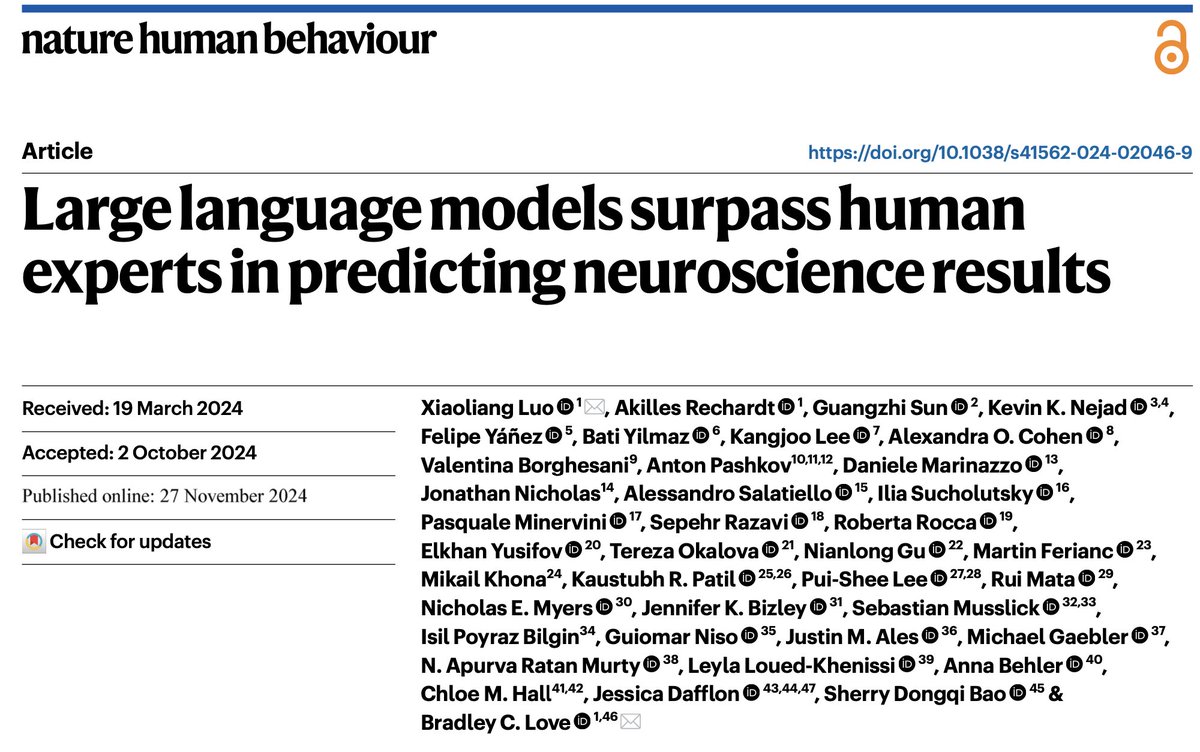
"Large language models surpass human experts in predicting neuroscience results" w @ken_lxl and https://t.co/YOhCmQlJsu. LLMs integrate a noisy yet interrelated scientific literature to forecast outcomes. https://t.co/49WYirBdBv 1/8
✨🥰 check out our article - and cover 🤩- about Decoding the Brain in @CellCellPress
https://t.co/HWBquErj0f
We review the mathematics, current approaches, and muse about the future…
#BCI#neuraldecoding#neuroAI
Thanks to my awesome co-authors Adriana Perez Rotondo, Edward Chang, @AToliasLab & @TrackingPlumes
Introducing PaperQA2, the first AI agent that conducts entire scientific literature reviews on its own.
PaperQA2 is also the first agent to beat PhD and Postdoc-level biology researchers on multiple literature research tasks, as measured both by accuracy on objective benchmarks and assessments by human experts. We are publishing a paper and open-sourcing the code.
This is the first example of AI agents exceeding human performance on a major portion of scientific research, and will be a game-changer for the way humans interact with the scientific literature.
Paper and code are below, and congratulations in particular to @m_skarlinski, @SamCox822, @jonmlaurent, James Braza, @MichaelaThinks, @mjhammerling, @493Raghava, @andrewwhite01, and others who pulled this off. 1/
Join us! FreezeMotion PhD and Postdoc Vacancies in Deep Neural Networks for Medical Imaging. Brain development in infants and its disruption by preterm birth or perinatal injury, can be measured with functional MRI (fMRI).
Socioeconomic status is a strong predictor of cognitive IPS. Intelligence and smoking as predictors for motor IPS. Both cognitive and motor IPS share sex and memory as common predictors.
Information processing speed (IPS) in older adults: our new study examined longitudinal data from >2000 individuals from MRC NSHD, highlighting different predictors of cognitive and motor IPS. @PsychCardiffUni@CUBRICcardiff@CompFoundry https://t.co/lzfEWiGjQi
📢Job Alert! We have a 2-year postdoc position to investigate the neural mechanisms of depression, in the context of immune-mediated inflammatory diseases, using state-of-the-art brain imaging (7TfMRI-EEG) @CCNi_UofG @UofGPsychNeuro @UofGSii@UofGSHW
https://t.co/sGJalEdR7W
More is not always better - When choosing based on our preferences, additional but redundant information could lead to poorer and slower decisions - a new paper from Aysegul https://t.co/QnAhmVkJhx
Tomassini et al. report that #Parkinsons disease disrupts the beta-frequency activity mediating the accumulation of evidence for decision-making, leading to inefficient processing. @le_Tomassini@CambridgeFTD@ccbrainlab@tccambs
https://t.co/U4PshdWs8E
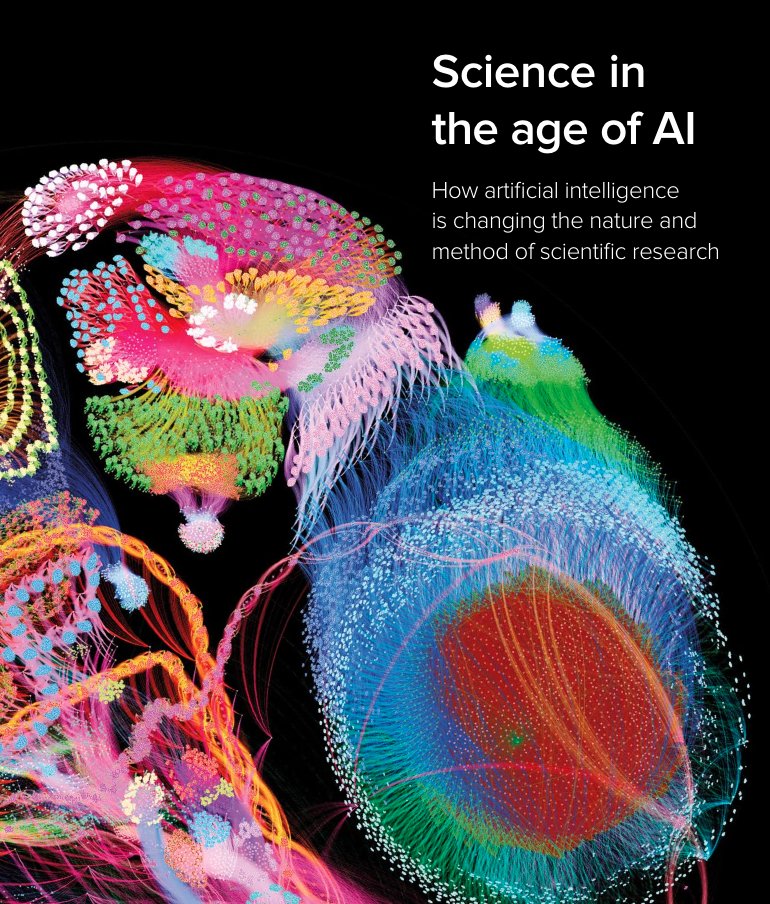
🚨BREAKING: the @royalsociety publishes "Science in the Age of AI - How AI is changing the nature and method of scientific research," and it's a must-read for everyone interested in AI & science. Important information:
➡️According to the official release, the report addresses the following questions:
➵ How are AI-driven technologies transforming the methods and nature of scientific research?
➵ What are the opportunities, limitations, and risks of these technologies for scientific research?
➵ How can relevant stakeholders (governments, universities, industry, research funders, etc) best support the development, adoption, and uses of AI-driven technologies in scientific research?
➡️Some of the key findings are:
"Beyond landmark cases like AlphaFold, AI applications can be found across all STEM fields, with a concentration in fields such as medicine, materials science, robotics, agriculture, genetics, and computer science. The most prominent AI techniques across STEM fields include artificial neural networks, deep learning, natural language processing and image recognition"
-
"China contributes approximately 62% of the patent landscape. Within Europe, the UK has the second largest share of AI patents related to life sciences after Germany, with academic institutions such as the University of Oxford, Imperial College, and Cambridge University featuring prominently among the top patent filers in the UK. Companies such as Alphabet, Siemens, IBM, and Samsung appear to exhibit considerable influence across scientific and engineering fields."
-
"Interdisciplinary collaboration is essential to bridge skill gaps and optimise the benefits of AI in scientific research. By sharing knowledge and skills from each other’s fields, collaboration between AI and domain subject experts (including researchers from the arts, humanities, and social sciences) can help produce more effective and accurate AI models. This is being prevented, however, by siloed research environments and an incentive structure that does not reward interdisciplinary collaboration in terms of contribution towards career progression."
➡️Link to the full report below.
➡️To stay up to date with the latest developments in AI policy & regulation, subscribe to my weekly newsletter (link below).