What’s really weird to me about the $MSTR blow up FUD is that it’s as transparently and verifiably false as any of the other FUD that gets amplified at $BTC bear market bottoms - energy use, transaction throughput, quantum risk - but many of the same people that would call these out as obvious attempts to shake out weak hands at the bottom are going full tilt on $MSTR FUD.
MSTR is designed to amplify Bitcoin volatility. To the upside and the downside. You either believe in it or you don’t. And if you don’t nobody is making you invest in the stock or its prefs. If you do you are opting into a roller coaster and you better position size, try to buy as low as you can, and be ready to ride it both ways.
But it’s not at any imminent risk of insolvency, and if BTC went low enough for that to happen, BTC has kind of already failed as an investable asset.
You’re talking 20,000s or lower on a sustained basis before there’s any real insolvency issues.
I’m sorry to say, but if we retrace to 2017-levels - post LUNA/3AC blow-up levels - and THEN MSTR blows up and dumps 850,000 BTC nobody is touching this asset for a decade.
You can say goodbye to any serious Wall Street exposure. People will forever see it as too toxic to build anything on and the monetization phase is done. Narrative fully cooked.
There are people who are relentless bitcoin cheerleaders who seem to want Saylor to fail like he’s some kind of anti Bitcoin force that needs to be disposed of, despite the fact that he’s been the most relentless, vocal, and transparent Bitcoin advocate for 6 years, and has done more for wall st and corporate adoption that anyone else by a wide margin. He’s the one who actually tried to build something on Bitcoin and integrate it into global finance - something more than just talking about how great it is on a podcast.
$MSTR is constructed in such a way that in order for him to fail, it would require so much capital destruction that everything you want Bitcoin to be will be dead for a decade - if not forever. Forget about everything else in crypto, which would be beyond cooked.
Like oh great, enjoy your unstoppable freedom money that lost 90% of its value. What the fuck are you going to buy with it?
If you’re amplifying FUD and cheerleading for Saylor to fail, you’re cheerleading for Bitcoin to fail, and I don’t consider you an ally.
Je me suis longtemps passionné pour la psychologie, et une période m'obsède plus que toutes les autres.
L'après-guerre.
Le moment où des chercheurs se sont posé la question la plus dérangeante du siècle: comment l'Allemagne nazie avait-elle transformé des pères de famille ordinaires en bourreaux de camp?
La réponse, ils ne l'ont pas trouvée chez des monstres. Ils l'ont trouvée chez des hommes parfaitement banals.
Hannah Arendt a appelé ça la banalité du mal. L'historien Christopher Browning, en étudiant le bataillon de réserve 101 (des policiers d'âge mûr, des pères, des commerçants), a montré que ce ne sont pas des fanatiques qui ont fusillé des civils, mais des hommes normaux incapables de désobéir au cadre dominant.
Puis vint Milgram. À Yale, environ deux tiers de gens ordinaires ont infligé ce qu'ils croyaient être des décharges mortelles, simplement parce qu'une autorité en blouse blanche le leur ordonnait. L'expérience de la prison de Stanford a montré la même chose sous un autre angle: donnez à quelqu'un un rôle et un cadre, et il s'y conformera jusqu'à l'inhumain.
La leçon n'est pas allemande. Elle est humaine.
Le mécanisme s'active dès qu'un cadre moral dominant fait craindre la sanction sociale plus que ne compte le témoignage de ses propres yeux. L'individu cesse de voir ce qu'il voit. Il voit ce que le cadre l'autorise à voir.
Maintenant, regardez Southampton.
Henry Nowak, 18 ans, poignardé, allongé au sol, répète aux policiers « j'ai été poignardé », « je ne peux plus respirer ».
Réponse de l'officier: « I don't think you have, mate. »
Pendant ce temps, son meurtrier retourne la situation d'une phrase: il aurait été victime d'une agression raciste. Quatre mots ont suffi pour déplacer le soupçon de l'agresseur vers la victime.
Et l'officier a obéi. Pas à un ordre. À un cadre.
Un cadre qui lui a appris, pendant des années, qu'une plainte pour racisme est l'accusation la plus dangereuse de sa carrière. Plus dangereuse, dans son réflexe conditionné, qu'un corps qui se vide de son sang devant lui.
Exactement le mécanisme de Milgram, de Browning. Un homme normal qui cesse de croire ses propres yeux parce qu'un cadre moral lui a appris ce qu'il devait craindre.
C'est précisément ça qui me terrifie.
Souvenez-vous: le monde entier s'est agenouillé pour quatre mots, « I can't breathe ». Des entreprises, des gouvernements, des stades entiers.
Henry a prononcé les mêmes mots, en train de mourir. Il n'y aura ni genou à terre, ni hashtag, ni minute de silence.
Parce que sa mort ne sert pas le cadre. Elle le contredit.
Et un système qui apprend à une société entière à faire passer l'accusation de racisme avant les faits, avant le corps, avant la vie, n'est pas une posture morale inoffensive.
C'est une machine à fabriquer des hommes qui, face à un enfant en train de mourir, choisissent les menottes.
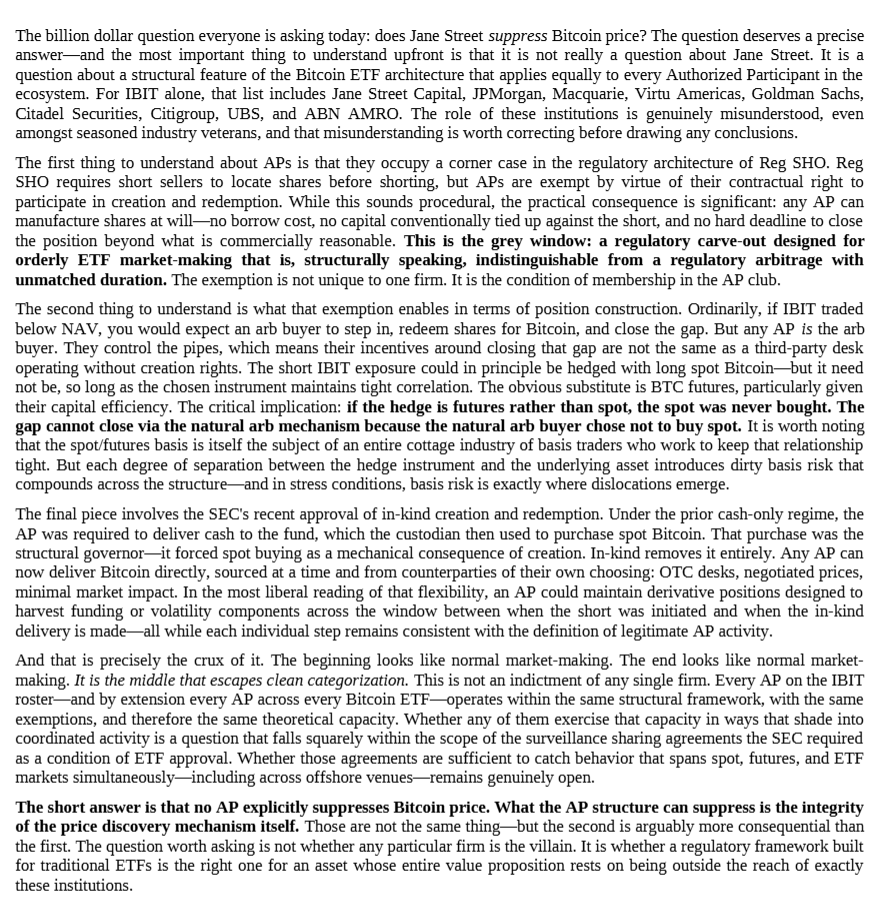
Everyone is asking: "Is Jane Street why Bitcoin isn't at $150k?"
As expected, the answer is trickier than the question. But it's also more structurally unsettling than the conspiracy theory itself—and once you understand the actual mechanics, you won't be able to unsee them👇
There is a rapidly forming narrative in the European and liberal media that the Europeans “won Davos”: primarily by getting Trump to “de-escalate” his demand that the United States acquire Greenland from Denmark. 1/8
BIS Chairman François Villeroy de Galhau laughs off Brian Armstrong for saying Bitcoin is healthy competition for fiat currencies and a check on deficit spending.
Strategy bought an eye-watering $3.38B of BTC over the past two weeks ($1.25B + $2.13B). Plenty of takes on these moves, but I want to provide some color on what they're doing to the capital structure, which I find to be especially notable.
Firstly, STRC is obviously having its moment in the sun. $119M two weeks ago, $294M this past week—all while STRC stays pinned within 1% of face value.
This $STRC issuance has been in tandem with a large amount of $MSTR ATM . What does this mean, and is this accretive for shareholders?
Most MSTR was sold between 1.0x-1.10x mNAV. This is accretive in net asset terms, however with market cap below the value of BTC holdings, in isolation, it would be negative to BTC/share. However, Saylor is intelligently pairing the MSTR ATM with the STRC ATM. STRC was ~14% the size of MSTR issuance over this period. In BTC per fully-diluted share terms, despite selling of common with BTC below market cap value (while indeed above 1.0x in enterprise value terms), BTC per fully diluted common shares increased over the past two weeks —up 0.4% on the year. So, indeed accretive, but in my view, the bigger story is the focus on deleveraging the convertible bonds to focus on attaining "amplification" through prefs instead.
If we assume constant 92K BTC for consistency, from the start of the year to today:
Converts (less USD) as % of BTC: 9.67% → 9.18%
Prefs (less USD) as % of BTC: 9.19% → 9.36%
Strategy has flipped its outstanding convertible debt with notional prefs, which of course never come due in principal. In just one year.
Why is this being done? Strategy's team has made clear they see the perpetual pref (dubbed "digital credit") as the big idea. The fact that prefs can IPO, with ATMs attached, with no maturity cliff speaks for itself.
But I believe there's an additional motivation potentially: minimizing the gamma effect convertible debt has on the credit spreads of the prefs.
If you correctly view the convertible bonds as debt + an equity call option, at $400 MSTR the weighted delta on the converts was approximately 73%. The market effectively viewed Strategy as having ~$2.18B of effective debt with ~$6.06B that would become equity. This is rough back-of-napkin math, but you can use Black-Scholes to input the convertible bond strikes and first put dates, you can approximate a delta for each bond. In aggregate, you get a weighted average delta.
So yes, while technically $8.2B of debt has been outstanding for almost a year, the market doesn't
treat this as 100% debt—it probabilistically moves with MSTR stock price.
When BTC fell sharply in November and MSTR (as well as all other BTC proxies) followed, the stock price falling essentially partially 'de-equitized' the converts. A move from $400 to $150 is sort of like ~$2.5B more debt becoming senior to the prefs. The delta of the converts—their sensitivity to MSTR price—changed. This change in delta is called gamma.
The point here is that it wasn't necessarily just BTC NAV itself contracting that changed the profile of the prefs in the eyes of some credit investors. It was BTC price moving MSTR price, which impacted the likelihood of conversion of the converts, which impacted the assumed senior liabilities above the prefs.
With the massive purchases in recent weeks, it's clear that Strategy is diligently deleveraging the converts off the balance sheet (relatively), which means the convert gamma will have minimal—and eventually no impact on pref credit spreads.
Having no convertible bonds senior to the prefs should not only improve absolute credit spreads but should diminish credit spread volatility, as the volatility of the size of the assumed senior liabilities above the prefs goes away entirely. This should make prefs like STRC even less volatile, reinforcing the strength and efficiency of the system further.
So to answer the question: yes, this mix of STRC and MSTR issuance is accretive in BTC Yield terms, but I think the bigger story here is the deleveraging of the balance sheet (relatively) of convertible bonds, and it's shifting the focus to pref-style "amplification"—exactly as the MSTR team has stated.
The USD reserve is another recent shift worth noting. It looks to have further dampened credit spread volatility in the prefs by quieting market concerns around dividend coverage and immediate capital raising needs.
Congrats to the Strategy team on having notional prefs surpass converts in just one year.
Wildly impressive.
Bitcoin has been recognized as a reserve asset by the U.S. housing system — a defining moment for institutional BTC adoption and collateral recognition.
When currency fails to preserve its value, scarce assets are used in place as a savings vehicle.
This attracts value in excess of their utility value alone, known as a monetary premium.
Introducing: “What’s The Problem?”
Let’s help *everyone* get to the starting line.
Accessible to all, the story of Fiatello and the Big Red Button is something we can all send *before* the first Bitcoin book / podcast / video.
Please share it with everyone you care about (link below).
Thank you Bitcoin 🧡
@satmojoe
Trump reaffirmed his commitment to #Bitcoin today, emphasizing that the U.S. will store and maximize its BTC holdings rather than selling them.
Nation-state game theory is playing out. Who will be next?
Hint: We're probably working with them. 😉
https://t.co/NukTVi0Y89
> “Trump will never acknowledge BTC”
> “He won’t show at Bitcoin 2025”
> “He won’t announce an SBR”
> “He won’t actually Free Ross”
> “The SBR won’t be BTC but ‘USA based crypto’ ”
> “They won’t buy any new BTC for the SBR”
> *you are here*
Keep fading.
So many people can't read. The US government;
Created a bitcoin-only strategic reserve
Tasked the treasury to buy more bitcoin
Put existing shitcoins in a stockpile & not buy more
The SBR EO is more bullish than most onlookers were anticipating:
“The Secretaries of Treasury and Commerce are authorized to develop budget-neutral strategies for acquiring additional bitcoin, provided that those strategies have no incremental costs on American taxpayers.”
Two clear ways to do this:
1) Executive Authority: Using the net-position of the Exchange Stabilization Fund, per @bitcoinpolicy’s recommendation in our November analysis. The fund has a net position of ~39B, so substantial acquisition could begin right away.
2) An Act of Congress: Revaluing gold, per @SenLummis BITCOIN Act. If passed, the law would have the USFG acquire 200k per year for 5 years in an entirely budget-neutral manner.