@EricLDaugh@mrddmia Mixing western women and middle eastern men is not advisable. Women are subservient to men in Islam and generally have lower standing than sheep and goats.
@heidi_snow95670@EricLDaugh@DixieBushWookie If you want mass surveillance or want to live in a country HOA please kindly fuck off, pack your bags, and go to any of the following countries:
North Korea
Russia
China
UK
Across New York’s public schools, 2,005 employees now earn more than $200,000 a year, a 19% jump in just twelve months.
Top of the list: retired Superintendent Henry Grishman, who collected $662,478. Next: Patrick Jensen, at $403,116.
In New York City, Schools Chancellor Melissa Aviles-Ramos earns $428,280. One DOE teacher, Todd Myles, actually out-earned her, pulling $492,002 across two assignments.
Meanwhile, only 31% of our students are reading proficient. 28% are chronically absent from class.
In the private sector, this kind of performance gets you fired. In New York’s schools, it gets you a raise.
If you’re a parent watching your child fall behind while the people running the system cash half-million-dollar checks, you should be furious.
Accountability starts with a Comptroller willing to say so.
I will be that Comptroller.
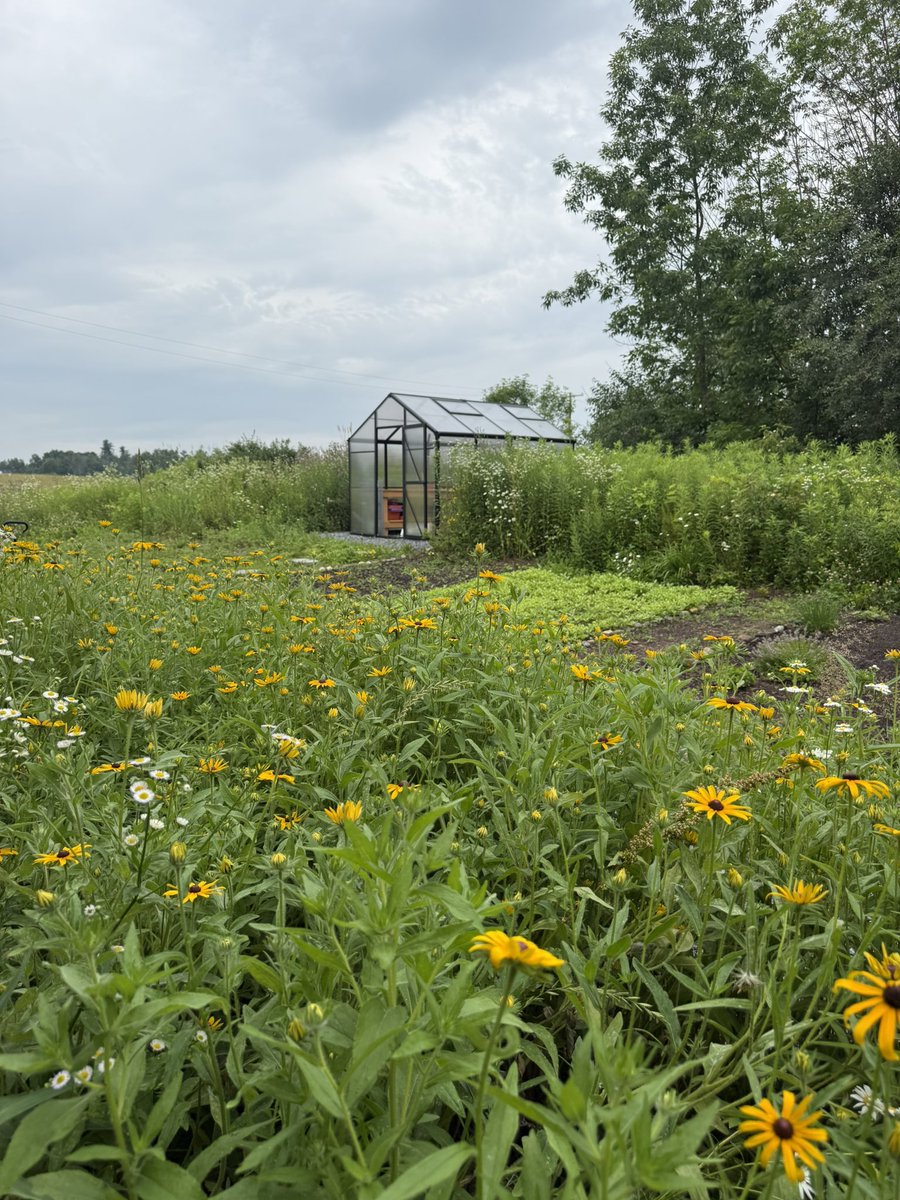
We take for granted how rich and versatile our soil is in the Northeast.
I didn’t realize this until I spent a day with ranchers from out West.
We’ve all heard of the Dust Bowl of the 1930s. But what about that land today?
Ranchers from Utah, Arizona, etc. talked about how the land is so dry, arid, and rocky that they can’t till. If they do, it’ll blow away in the wind. Heavy irrigation is required if they want to grow food in the ground.
So they ranch instead (and we thank them for it!).
In contrast, our soil is so fertile and richly watered in Upstate NY that the vast majority of it qualifies as @USDA prime farmland. You can walk outside, clear a patch of land in your yard, plant seeds, and watch them grow.
Do you understand how much of the world would kill for that kind of soil?
That’s the same soil @KathyHochul is throwing away to foreign corporations as part of the green energy grift.
A nation that discards its most fertile soil for subsidies and credits is a nation that will not exist to see its future.
@NassauExec Yes we heard the line “GONNa CuT YOur tAxEs” gonna have to let us know what your plan is.. Nyers are getting sick of it all and it’s driving ppl out the state.
The single richest man in America personally bankrolled the Revolution, kept Washington's army alive with his own money, and then died broke in a debtors' prison. The man who funded the country got thrown in jail for being poor. Meet Robert Morris.
If the United States has a financial founding father, it's this guy, and almost nobody knows his name.
He was born in Liverpool, England, in 1734 and came to America as a 13 year old boy. He got into the shipping business in Philadelphia and was so good at it that by 1775 he was likely the wealthiest man in all of the colonies. Ships, trade, credit, money moving everywhere. He was the money.
Here's the wild part. At first he didn't even want to declare independence. He thought it was premature and voted against rushing into it. But once the decision was made, he didn't hedge. He signed the Declaration of Independence and threw his entire fortune behind the cause.
And thank God he did, because the young country was flat broke. The army was starving, unpaid, falling apart. So Morris did something almost nobody would do. He used his own personal credit and his own personal cash to keep the war going. When Washington needed money to march on Yorktown for the campaign that basically won the war, Morris helped raise it, at times pledging his own name and fortune to cover it. He became known as the Financier of the Revolution, and it's not an exaggeration. He kept the lights on.
He's also one of only two men to sign all three of America's founding documents, the Declaration of Independence, the Articles of Confederation, and the Constitution. When Washington offered to make him the very first Treasury Secretary, Morris turned it down and pointed him to a young Alexander Hamilton instead.
Now the tragedy. After the war, Morris poured everything into massive land speculation, betting enormous sums on the future of the country. The bets went bad. Spectacularly bad. He ended up owing something like three million dollars, a genuinely staggering fortune for the time.
And so, in 1798, the man who had personally financed American independence was locked in a debtors' prison in Philadelphia. He sat in that cell for years. The Financier of the Revolution, penniless, behind bars, while the country he'd funded moved on without him.
He finally got out around 1801, aided by a new bankruptcy law, and lived quietly and broke until his death in 1806.
A man who was richer than anyone, gave it to a nation, and died with nothing.
Robert Morris. He bought America's freedom and went bankrupt doing it.
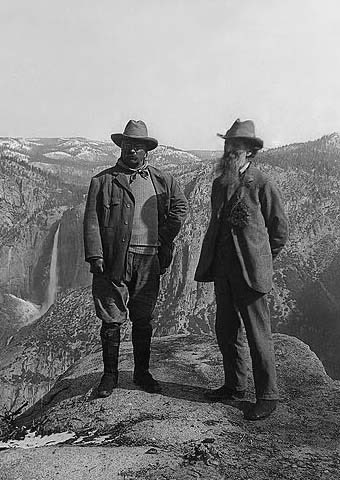
A heartbroken cowboy became America's greatest conservationist.
Before he was president, Theodore Roosevelt was a grieving 25-year-old who came to the North Dakota Badlands to disappear.
His wife and his mother died on the same day. He wrote a single line in his diary that day: "The light has gone out of my life." Then he left politics, bought two cattle ranches along the Little Missouri River, and spent the better part of two years as a rancher in wild country most Americans back east had never seen.
He later said it was where the romance of his life began. He said he never would have been president without it.
The landscape did something to him. He watched overgrazing strip the grass and market hunters empty the plains of game. He saw how fast a place could be used up.
By the time he reached the White House, he had taken those lessons to heart and made them policy.
Roosevelt put roughly 230 million acres under public protection.
150 national forests.
51 wildlife refuges.
5 national parks.
18 national monuments.
He signed the Antiquities Act in 1906 and used it to protect the Grand Canyon when Congress wouldn't.
This week, a presidential library opened in Medora, on the edge of the Badlands he ranched. It's built into a butte above the Little Missouri, facing the same country he looked out on while he was trying to put his life back together. It gathers his whole story in one place for the first time, and it carries his conservation legacy forward.
Roosevelt's story is a testament to the resilience of the American spirit and the healing power of our land. Our landscapes have shaped and inspired some of our greatest heroes, and will continue to do so, but only if we make it a priority to protect them.
📍 Use the DeFlock Map
We’re building a public map of ALPRs, AI surveillance cameras, drones, and connected surveillance infrastructure so communities can see what’s being installed around them.
The DeFlock App works great, too!
https://t.co/5fwipJBsqX
Aristotle didn't think young people should study politics.
Near the beginning of the Nicomachean Ethics, he says:
"This is why a youth is not a suitable student of political science; for he lacks experience of the actions in life, which are the subject and premises of our arguments."
Politics, Aristotle argues, isn't like mathematics, where the same formula always produces the same answer. It deals with human beings, and human beings are messy, emotional, inconsistent, and endlessly complicated. Understanding them requires living.
Someone who has never managed a family, worked through failure, experienced betrayal, or carried real responsibility simply hasn't seen enough of life to judge it well. They may know the theories, but they don't yet know people.
That's why Aristotle thought experience was one of the greatest teachers. Wisdom doesn't come from reading another book or winning another argument. It comes from years of observing how people actually behave and learning the difference between what sounds good and what is good.
It's an interesting idea because modern society assumes the opposite. We believe that more information automatically leads to better judgment. Aristotle wasn't convinced. He believed knowledge without experience was incomplete.
In other words, you could memorize every political theory ever written and still lack the wisdom needed to govern well.
New York residents are furious at Zohran Mamdani over power restrictions
Con Edison implemented 8% voltage reductions in parts of Queens, Brooklyn, the Bronx and northern Manhattan. This means residents have to deal with things like slightly lights and appliances not working at full power
“Zohran Mamdani you're a real piece of f*cking sh*t. I get a message from Con Ed and they tell me that they're going to lower the voltage in my area to reduce outages. What a coincidence, the same day Taylor Swift gets married— Imagine going to a gas station paying full price, but they quietly give you 10% less than what you're supposed to get. Welcome to socialism”
Remember that while this is happening and residents are being told to keep their air conditioning at 78 degrees, the New York Post did investigative journalism and found temperatures inside City Hall were as low as 54
Rules for thee but not for our socialist leaders
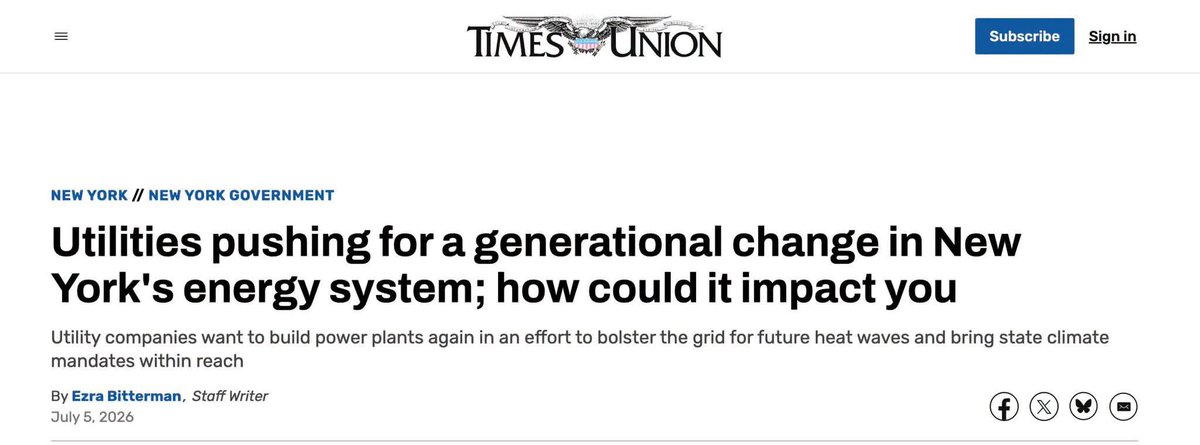
I was shocked when I read this @timesunion this morning.
The article begins:
"New York regulators are considering letting monopolistic utility companies own large-scale power generation again, something they’ve largely been banned from doing in the
state for nearly 30 years."
That is quite the stance for a newspaper that largely avoids criticizing the failure of the 2019 Climate Act in New York State.
To summarize... National Grid and ConEd want in on the green energy grift.
And to no one's surprise, who popped up in this article but Boralex, the Canadian corporation behind Fort Edward Solar.
“Simply shifting ownership does not address the underlying issues in the procurement process,” Boralex, a renewable energy developer active in New York, told the Public Service Commission."
Boralex has had quite the formidable seat at the table in New York's energy buildout... going back to its influence on the 2019 Climate Act. Why are we allowing foreign corporations to dictate our energy policies in New York State?
It wouldn't be due to... monetary deals between @KathyHochul and the Canadian government, right?
Allowing utility companies to own large-scale energy generation again benefits no one. Why? Those utility companies are already foreign-owned.
National Grid is owned by the UK and NYSEG is owned by Spain.
Instead of admitting the rollout of wind and solar has been a failure in New York State, the green energy grift continues as foreign governments lobby our figurehead of a governor to keep the money train chugging along.
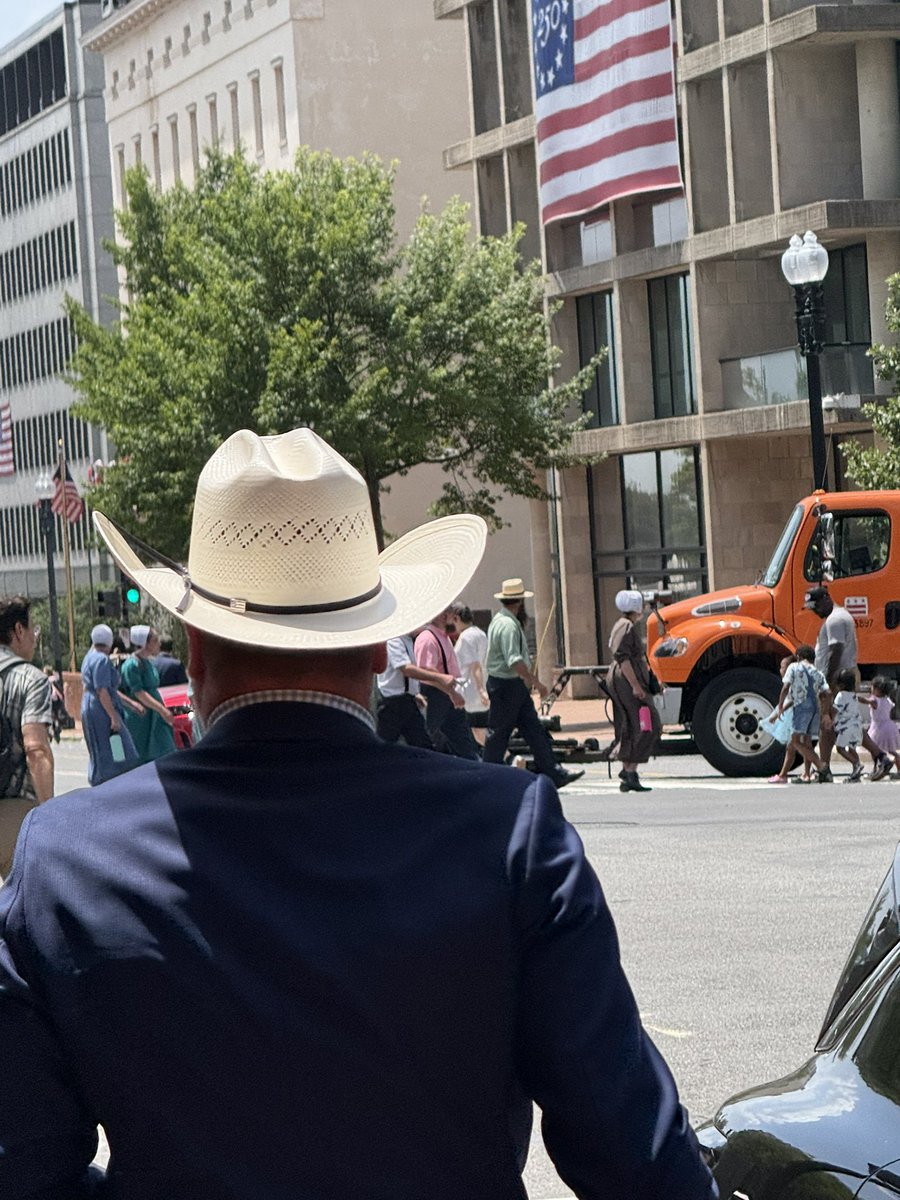
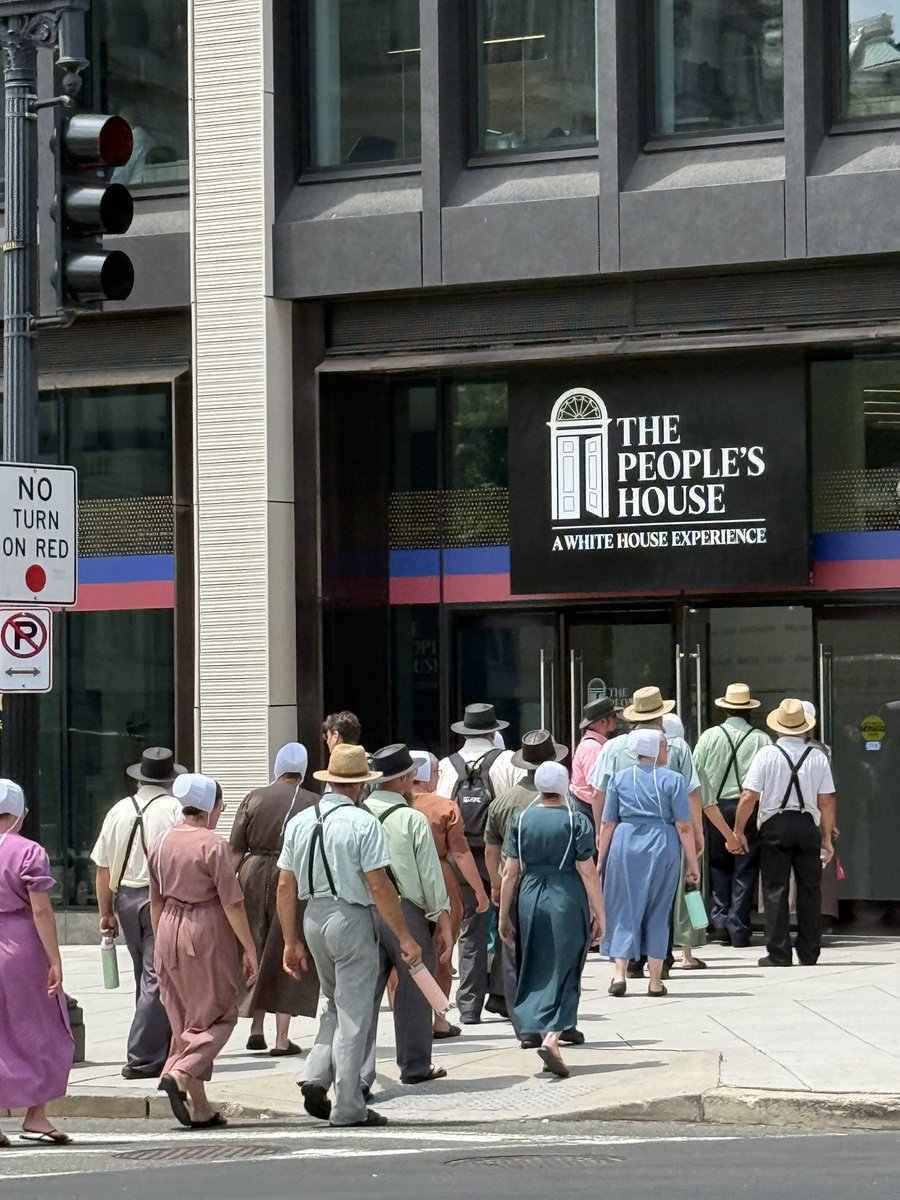
When I was walking to the White House this past Thursday in DC, I looked up and saw something that had everyone else there stopped in their tracks.
An Amish delegation had come to Washington DC to take part in America 250.
Just that morning, I had shared with congressmen, @SecRollins and @SBA_Kelly, @johnrich, the @BLMNational, the @USDA, and many, many attorneys what is happening to the Amish of New York State as part of the green energy grift.
These solar monstrosities (and soon to be wind) are being sited in the epicenter of Amish communities, where they rely on horse and buggy, and the ability to walk, to get to church and their children to school.
Countless Amish have gone on the ORES record stating they’ll be forced to leave the state if they build these industrial complexes inside of their homes.
ORES tries to shut the Amish out of public discussions. They don’t inform them of incoming complexes or make it easy for the Amish to file their comments.
Expert anabaptist testimony by Steven Nolt has been entered into the ORES docket for Mill Point and Flat Creek Solar. ORES ignores it.
The Amish are the backbone of many rural Upstate NY counties. If they pull out, county economies will collapse.
The Amish have done so much for me, starting with building out my farm.
I will not stand by while eco terrorists purposely force them from their homes.
Seeing the Amish in DC felt like seeing a piece of home.