some free alpha. i hear this routing argument a lot: "some tasks don't require a frontier model, so let's route you to a cheaper one", but it's not correct in the medium/long run imo
1] by any measure, a good enough frontier model (we're not there quite yet) will be better able to allocate inference compute based on the difficulty of the problem than any little router on top
2] BUT often the tradeoff explicitly requires the user to *decide*: are you willing to get 1% lower chance of success to run 10x cheaper? no one can answer that for you, and certainly not a little router (so "high/low" choices persist)
saas runs on software, so everyone is building a software factory
the hardest part of building agents is the context (or knowledge that they have)
if youre building agents, you should be building a knowledge factory
Introducing Model Factory.
Train, deploy, and continuously improve your own models on one unified stack.
Run on-demand, on dedicated clusters, or bring your own.
Own your intelligence.
Own your model factory.
Own the means of production.
My sense is that the initial spending frenzy from frontier labs created a market where demand outpaced quality supply. A lot of vendors benefited, including some delivering fairly mediocre data.
I think that gap is starting to close. Buyers are becoming more discerning, and the cost of producing data that actually delivers value is rising significantly.
I think there’s a cost asymmetry here too, especially with RL data. Vendors can measure pass rates and validate environments relatively cheaply, but that doesn’t establish whether the data actually provides useful post-training signal.
Proving that often requires expensive training runs, so much of the validation cost and risk gets shifted to the buyer. I think that’s an important problem to solve.
I believe a big part of the problem is coordination overhead, context fragmentation, and errors compounding across agents. The more agents you introduce, the more opportunities for information loss and conflicting assumptions.
I think multi-agent systems have a lot of potential, but we still haven’t figured out how to reliably manage shared state across agents.
We tested this on DeepSWE and synthetic coding tasks, keeping hidden tests fixed while changing instructions.
Removing the statement of one arbitrary interface requirement took a task from 11/12 to 0/6. But adding a sentence didn’t always fix a broken spec. Sometimes it just highlighted a rule the model already had.
The nuance we found was that an unstated requirement can still be reasonable if the repo or domain gives the agent enough evidence to infer it.
We also saw collapse the other way. Strong hints pushed tasks to all-pass and narrowed the designs agents built. Even a middle pass rate could come from harness failures.
I bet against this and I bet against Dwarkesh.
He conveniently sweeps under the rug that climbing a metric involves defining it. Then, supposing you define it (in a way that avoids Goodharting, reward hacking, etc), you need data/envs, which do the lifting. On defining good metrics - this is most of the game of making AGI (converting fuzzy concepts to formalized objects you can climb without gaming, which requires costly fixes later). He elides the hard problem by saying 'AI will just automate data'.
How do you know whether a change belongs in your final recipe? You ablate at scale. When you make N changes, on even a subset of combinations, this compute cost is naively exponential. So, you need a faster signal to tell you when a task that isn't immediately verifiable improves end behavior. Finding that signal is the bottleneck, which doesn't seem to be helped by 'automating the great algorithmic thinker starting from the empty string on paper'.
My logic is that as frontier models get stronger, their instruction-following capabilities have improved dramatically. And their prices are still coming down. So for most companies, they can easily just use frontier models directly across various scenarios.
Where reinforcement learning actually applies right now, I think, is still within frontier labs, some hedge funds, or enterprises with genuinely strict data security constraints that actually need to do RL on weaker open-source models to achieve their goals.
Do you think there’s economic value in creating realistic, practitioner-defined tasks that measure actual productive work, even if they’re not difficult enough to discriminate between the latest frontier models? Think Mercor-style tasks where domain experts define what good looks like.
Running long-horizon, agentic data projects is the best preparation for building robust enterprise AI apps bc it forces you to build thoughtful expert <> agent interactions and optimize LLM usage. Data companies have a massive advantage in serving the enterprise.
We now spend more on LLMs than on headcount. That does not make human operators, and especially experts, less valuable. It actually makes them more productive and more valuable. Purely synthetic data without experts embedded in the authoring process doesn't work, and data companies that don't dig into their own data will ship slop. They won't produce the nuance, realism, or complexity the task demands, and the labs struggle to catch all these issues because they rely on agentic graders that have the same blind spots.
But the token spend is significant, and it goes to three places: (1) hybrid synthetic + expert environment / task authoring, (2) rollouts to validate task complexity, and (3) QC on the data. You cannot produce a high-quality long-horizon agentic task without LLMs across all three buckets. We also use agents to automate internal processes, but that is a small fraction of the bill. Any data company telling you the bulk of its LLM spend is internal automation is lying.
Producing this data at high quality and reasonable cost comes down to two problems.
(1) the expert-agent interaction paradigm - how the expert creates, reviews, interprets, and audits the LLM's outputs (synthetic input files, prompts, rubrics, and so on). Solving this means knowing precisely where agents fail or underperform, designing the interface through which experts validate those outputs, and building the tools that let experts steer the agent going forward.
(2) optimizing every QC check for the right tradeoff between cost, quality, and latency. That means constructing complex and diverse eval sets, configuring an agentic system with the right models (often chained prompts, guardrail LLM calls, and deterministic checks), running the eval, then iterating on the harness, prompts, chaining, and model choice until the mix is optimal.
Both are now core skills of our SPLs.
Enterprise deployments follow the exact same pattern. Understand the workflow and where models fail or underperform, design the user-agent interaction to mitigate those failures, build evals that test the agentic system across the workflow, and optimize the system against those evals. Running data pipelines forces us through this loop hundreds of times a month across a wide range of project types, and we have to build product and infrastructure to do it fast and repeatably.
You cannot build an optimal enterprise deployment without these muscles, and the largest data companies have already done it hundreds of times.
I think the key distinction is that production traces are still highly valuable as logged experience. The hard part is turning that experience back into an interactive environment where you can branch, resample, and evaluate counterfactual trajectories.
For many real enterprise traces, replay effectively means reconstructing the relevant world at that point in time: files, application state, permissions, infrastructure, tool availability, etc. You don’t literally need to rebuild the whole company, but you do need the causally relevant slice of world(t), and that can be enormous.
good advice for building Evals/Benchmarks (also true for many things in life)…
literally just start, build 1 task
it’s daunting to have nothing and think about needing to build Terminal Bench
but you don’t need that, i promise that having like 5 trusted evals is what you’re really after to start
Evals/Environments/Simulations are ridiculously hard, anyone who tells you they’re not is lying to you
Literally the frontier research companies in the world spend tons of human hours on Task design, review, and building/refining the system that builds Tasks
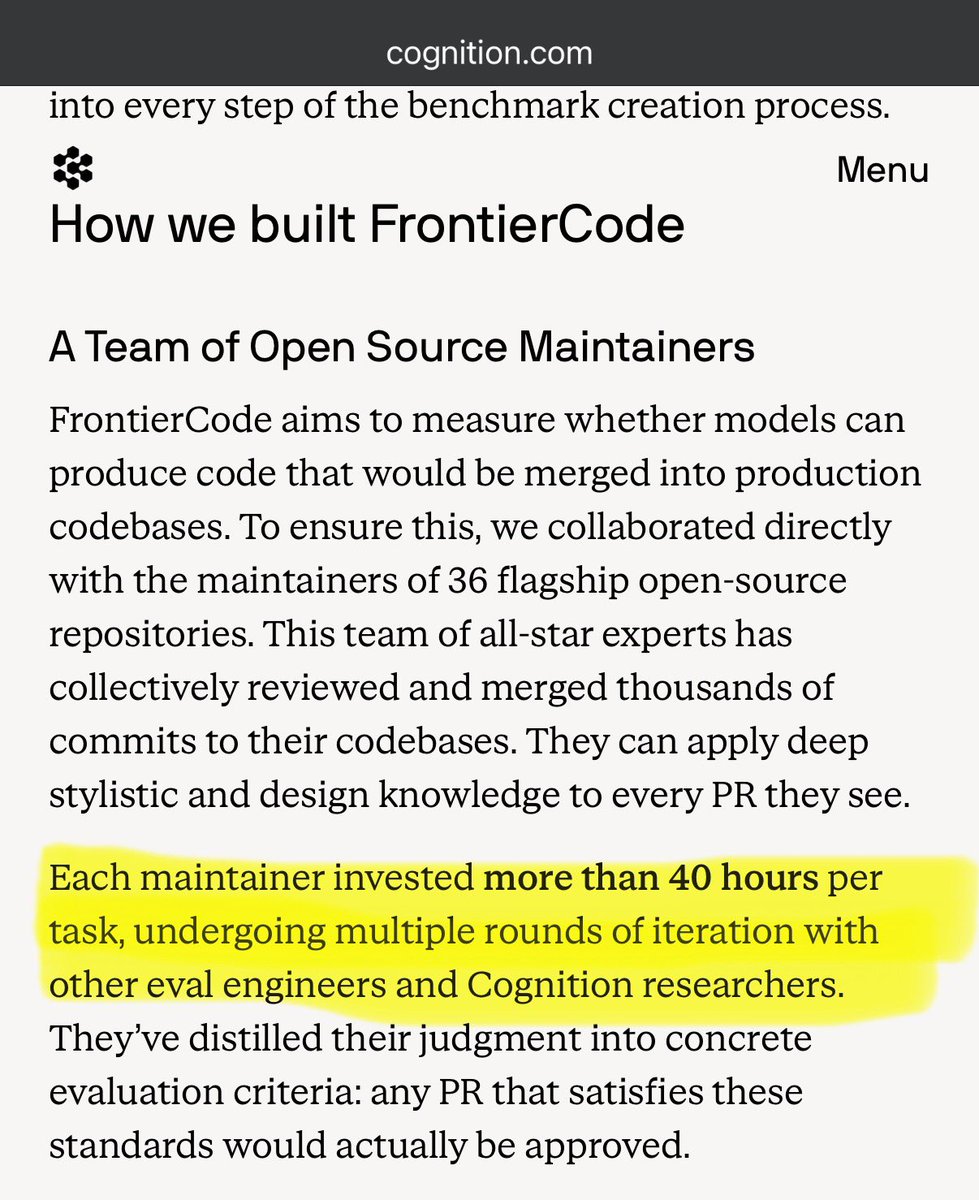
see Cognition’s Frontier Code ~40 human hours per task
Frontier labs spend millions trying to buy these tasks
Your first Task will suck, that’s fine, this is research
If all your research worked that would be insane but as you keep failing and iterating you’ll build the Eval building muscle for your and your team
and that’ll be great because you’ll
collectively get better at Evals designed for your most important use cases
and that’ll lead to better agents than what copying any existing bench could do for you
it’s a marathon, it’s really hard, just get started, publish openly if you can, and reach out to ppl (most want to help anyone trying to do more evals 🚀)