Hola 👋👋🏼👋🏿, bienvenidx!! En esta cuenta encontrarás tweets relacionados con:
🖥️💻📱 Desarrollo web (HTML, CSS, JS, Vue...)
🎨👥🧩 Diseño de UI / UX
📑📊🤖 Ciencia de datos (IA, ML, DL)
🧬🔬🧮 Ciencia (Biológica, Matemáticas...)
Google just shipped Open Knowledge Format v0.2, and it is all about agentic trust.
When a person writes a wiki page, you know who to ask if it is wrong. When an agent writes ten thousand pages overnight, nobody is accountable for any of them. The agent reading those pages needs signals it can check before it reads a single line.
v0.2 puts four of them in the frontmatter:
• sources: what the page was built from, with author and usage count. Raw signals, no trust score.
• generated and verified: who wrote it, who checked it. Human checked and machine checked stay separate.
• stale_after: a fixed date, so freshness is a date comparison.
• status: draft, stable, or deprecated.
The best part is a new type called Attested Computation. It holds the approved query for a metric. The agent fills in parameters and nothing else. It never writes the SQL. After a run, a small script compares what actually ran against what was approved. Rename a table or drop a join and it fails, and the number never gets shown.
Still just markdown and YAML. Every new field is optional. Your v0.1 bundles still work.
GitHub Repo: https://t.co/BlwunQhi7q
text-to-cad just crossed 10,000 stars
you can use it to generate:
- STEP files
- URDF, SDF and other sim artifacts
- 3D mesh files like STL, 3MF and GLB
- gcode for 3D printing
- DFM checks for popular services like sendcutsend
100% free and open source ✌️
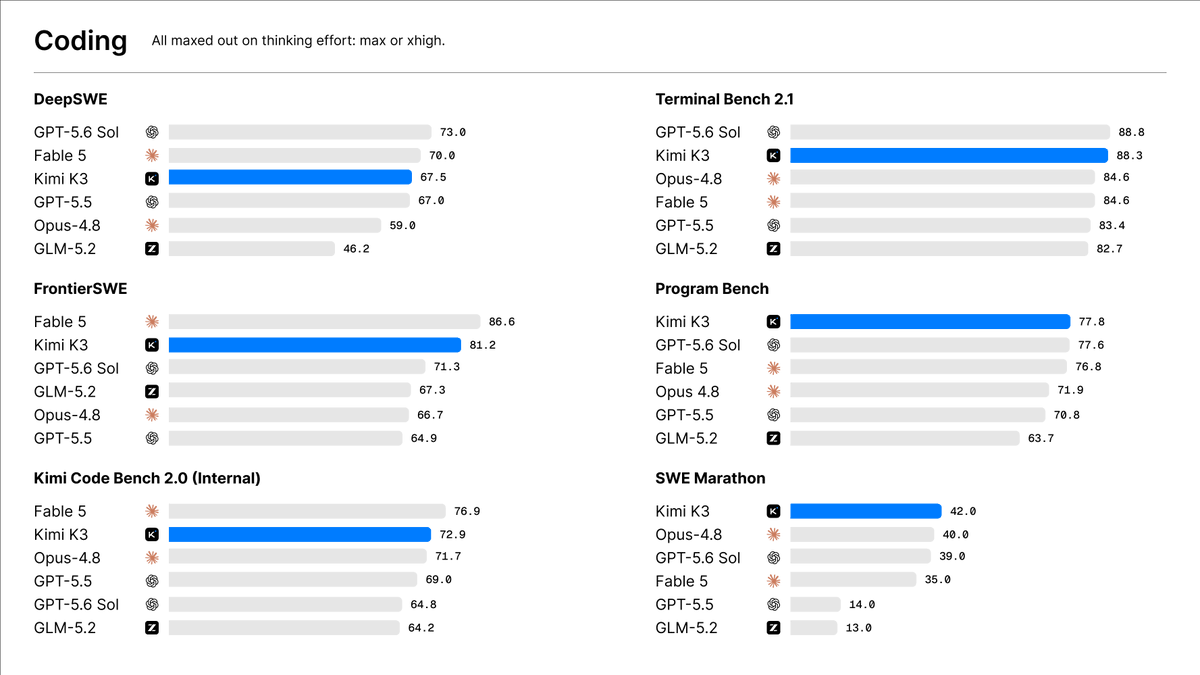
Releasing the model weights and technical report of Kimi K3.
Kimi K3 is our most capable model: a 2.8T MoE model with native visual understanding and a 1M-token context window.
New model architecture: 2.5x the intelligence per unit of compute, not just more params.
Alongside Kimi K3, we're opening up more of the stack behind it — high-performance attention kernels, MoE communication library, and infrastructure for running agent environments at scale.
Model weights: https://t.co/7m7eEg6Y0B
Tech report: https://t.co/yeu6cjpMCT
Tech blog: https://t.co/YTfiMSNM1f
GeoLibre v2.3.0 is here!
GeoLibre is a free and open-source, lightweight, cloud-native GIS platform for visualizing, exploring, and analyzing geospatial data. It runs everywhere you do, in the web browser, on the desktop, on mobile, and inside Jupyter notebooks, all while keeping your data local and private.
This release brings a legend that writes itself from your symbology, a new GeoLens catalog browser, and 200+ GeoLibre Rust geoprocessing tools running entirely in the browser.
What's new in v2.3.0
- Automatic on-map Legend: the legend builds itself from your visible layers, with class rows for graduated, categorized, rule-based, and expression styling, gradient bars for heatmaps and raster colormaps, and land-cover labels from a Raster Attribute Table. Rename, hide, reorder, or add your own entries, and it saves with the project.
- Symbology swatches in the Layers panel: every row shows a dot, line, square, or image glyph in the layer's own color, so a tall layer stack reads at a glance.
- GeoLens catalog browser: connect to a self-hosted GeoLens server, search its catalog, and add datasets as vector tiles, GeoJSON, or rendered raster tiles.
- Emerging Hot Spot Analysis: build a space-time cube from timestamped points and classify every cell as a new, intensifying, persistent, diminishing, sporadic, oscillating, or historical hot or cold spot, all client side.
- Mosaic time series: the Time Slider now steps through MosaicJSON and STAC collections of many COGs per date, on either a GPU or a WASM rendering engine.
- Copy and paste layer styles: give a whole set of layers one consistent look without restyling each in turn.
- Shareable tool links: deep-link any Whitebox tool with a ?tool= URL that opens the dialog preselected and pre-fills the form, with a Copy link button to build it for you.
- Smarter data loading: pick which layers to load from a multi-layer GeoPackage, import CSVs whose coordinates are in any projected CRS, and read a raster's real CRS, pixel size, and extent from the metadata dialog.
- Multiple AI profiles: define several provider, model, and credential setups, pick a default, and switch between them from the assistant panel.
Try it out
- Launch GeoLibre Web: https://t.co/8gMtkVtfnm
- GitHub: https://t.co/VXq8c1o2Nd
- Documentation: https://t.co/7VA2AQoCUc
- Release notes: https://t.co/cf3fXneeh6
#GIS #Geospatial #OpenSource #RemoteSensing #MapLibre #GeoLibre
Evita que todos tus diseños se vean como IA Slop.
Esta skill para Claude Code, Cursor y Codex detecta patrones típicos de diseños generados con IA y fuerza resultados más únicos.
Puedes pasarle incluso referencias de otras webs:
→ https://t.co/sRxeoz1oby
Os recomiendo la web https://t.co/qNnuZ92F3d para el seguimiento en tiempo real de los incendios forestales. Podéis aplicar filtros y la información de @CopernicusEU y de la @NASA . Espero publicar un vídeo demostrativo con sus atores.
Un exingeniero de Netflix acaba de liberar uno de los repositorios más interesantes para reducir el coste de los agentes de IA.
Ya supera las 61.000 estrellas en GitHub.
Open source. Licencia Apache 2.0.
Se llama Headroom y comprime todo lo que tu agente lee antes de enviarlo al modelo:
→ Salidas de herramientas
→ Logs interminables
→ Fragmentos de RAG
→ Archivos y código
→ Historial de conversaciones
El resultado: Hasta un 60-95 % menos de tokens en datos JSON y alrededor de un 15-20 % menos en agentes de programación.
Lo mejor:
• Funciona de forma local
• Tus datos permanecen en tu máquina
• Conserva los archivos originales
• El agente puede recuperarlos cuando necesite más detalles
Puedes conectarlo con Claude Code, Codex, Cursor, Aider o Copilot mediante una biblioteca, un proxy o un servidor MCP.
Según sus pruebas, mantuvo la precisión en benchmarks como GSM8K y TruthfulQA incluso después de comprimir el contexto.
Today we're releasing Laguna S 2.1, our most capable model to date.
It's a 118B total parameter Mixture-of-Experts model with 8B activated per token, a context window of up to 1M tokens, and thinking and no-thinking modes.
Capable enough to hold its own against models many times its size. Small enough to run on a single @NVIDIAAI DGX Spark.
Laguna S 2.1 is fully open under OpenMDW-1.1, with weights available today on @huggingface
https://t.co/xxGeAgo35R
Google engineer explained how to fine-tune a tiny LLM from 46% to 90% accuracy on your phone in 21 minutes - better than $1500 on-device AI bootcamps.
pick Gemma 270M -> generate synthetic task data -> fine-tune with LoRA -> quantize to int4 -> deploy to Pixel and hit 2000 tokens per second.
That loop is how a 270M model beats a 70B one on your task, running fully offline in your pocket.
Gemma 270M + synthetic data + LoRA + int4 quantization + on-device runtime - that's the stack.
Watch and save it, then fine-tune your own tiny agent tonight.
Introducing Kimi K3: Open Frontier Intelligence
🔹 2.8 Trillion Parameters, 1 Million Context, Native Multimodal
🔹 Kimi Delta Attention enables up to 6.3x faster decoding in million-token contexts
🔹 Attention Residuals deliver ~25% higher training efficiency at <2% additional cost
🔹 Built for long-horizon agentic coding and self-evolving workflows
Kimi K3 is now live on on https://t.co/zrk6zZxZUo, Kimi Work, Kimi Code, and the Kimi API.
Open Weights by July 27, 2026.
🔗 API: https://t.co/XCrgjXAqMw
🔗 Tech blog: https://t.co/YTfiMSNM1f
Google acaba de presentar Open Knowledge Format.
Un estándar abierto para compartir conocimiento entre humanos y agentes de IA usando Markdown.
La idea es que sea una wiki viva de tu negocio. Y que la IA pueda leerlo y actualizarlo en todo momento.
El secreto mejor guardado del video IA no es el modelo, es el movimiento de cámara.
Hay una web con 46 prompts de cámara para Kling, Runway, Sora... y es gratis.
Todo lo que necesitas para que tus vídeos dejen de parecer amateurs 🧵
Los agentes de IA escriben código como nadie. Pero no tienen gusto.
Eligen ease-in para una entrada cuando debería ser ease-out. Borders sólidos en vez de sombras semitransparentes. Y todos esos micro-detalles que separan una UI que "funciona" de una que se siente viva... se les escapan.
Emil Kowalski (@emilkowalski, ex-Vercel, ex-Linear) ha destilado 17 principios de diseño y motion directamente de las charlas de las WWDC de Apple.
/apple-design 🧵
I've spent *maybe too much* time thinking about logging.
At npm, logging was my main tool for debugging the registry. At Google, I learned to log proactively so debugging rarely required a deployment.
Now, as a PM at Sentry, I get to learn how developers across many companies think about logging.
I've collected my favourite lessons:
https://t.co/CHzeWehcfT
A web service is a standardized way for software apps to communicate with each other over a network.
And in this tutorial, Kumar teaches you how they work and why they're important.
You'll learn about two main types of web services - SOAP and REST - and when to use each one in your projects.
https://t.co/m6DRR7eghl
When you're preparing for technical interviews, you should solidify your knowledge of algorithms & data structures.
And many devs use LeetCode to help them practice and study.
In this course, you'll work through the Neetcode 150 – the 150 most essential LeetCode problems – to really hone your skills.
https://t.co/tZ7AYaNcR9