📢#Hiring alert
We're on the look out for suitable candidates to join as Research Staff for our Infectious Diseases Surveillance and Diagnostics program.
🔗For details and to apply: https://t.co/MkXFQeDmx5
📩Deadline: 28 May 2026
Happy to share that I was awarded the best talk, in the category of "Molecular Virology" securing the first prize at the 46th National Conference on Indian Association of Medical Microbiologists, "MICROCON 2023".
@TIGS_India#AMR#moleculardiagnostic#Clinicalsurveillance
Your academic CV is NOT linked to your ability to make big discoveries.
▫️
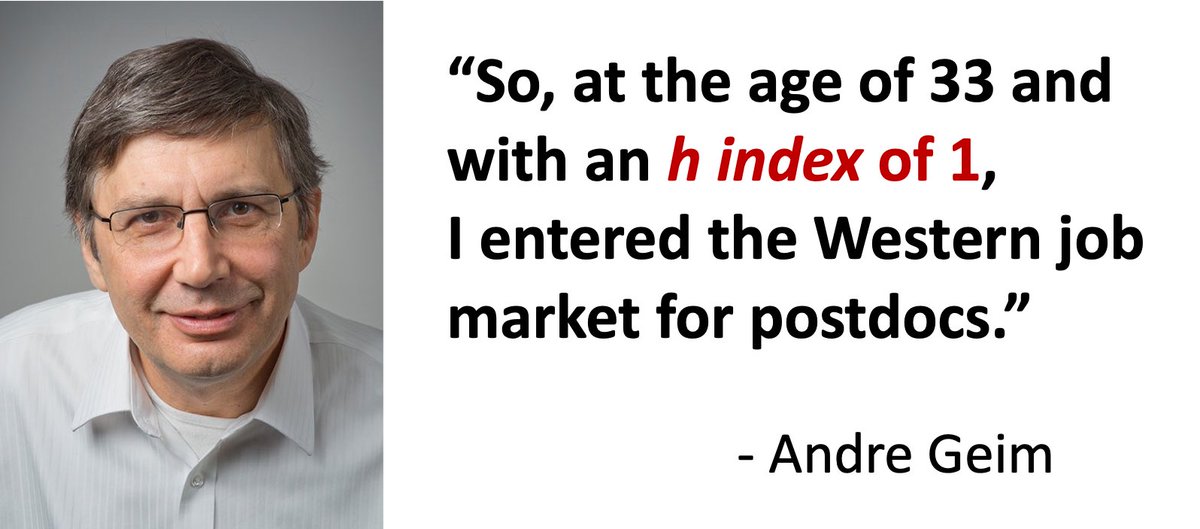
1. Andre Geim, a co-discoverer of graphene, wrote in his Nobel Lecture article:
- “So, at the age of 33 and with an h index of 1 (latest papers not yet published), I entered the Western job market for postdocs.”
2. Albert Einstein searched for a teaching position for two years. He had to accept a position at a Patent Office, where in a single year he wrote the four papers that completely revolutionized #science (the photoelectric effect, Brownian motion, special relativity, and E=mc2).
- Only few years later, he finally secured his first academic position as lecturer at the University of Bern.
▫️
Other examples include Peter Ratcliffe and Frances Arnold, who won Nobel Prizes for the discoveries they made as young PIs in newly established labs. And many others.
▫️
So, let us all keep in mind that:
1. Big discoveries are often unforeseen. They emerge from random and risky research (e.g. graphene was a tiny side project!). Make sure you have such projects in your lab.
2. Most truly impactful discoveries did not require high h-indices, excessive funding or a high-IF journal.
3. Rejection of your proposal does NOT mean it proposes bad science. Such rejections represent the opinion of one person who has a rather subjective idea of what ‘good science’ means.
4. For younger people, it’s easier to do risky research. Locking them to unnecessarily complex tenure requirements makes such discoveries unlikely.
▫️
A strong scientist is not defined by high “academic metrics”.
It is the ONE who proposes risky endeavors outside the conventional boundaries.
Who sees risk as an opportunity to make discoveries.
And who is constantly seeking out these risks in the lab.
#AcademicTwitter #AcademicChatter
🦟 Researchers report a potential new way to predict how much natural protection people may have against #malaria caused by Plasmodium falciparum.
Read more: 👇🏻
https://t.co/pkfiTWg5IB
#NatureIndia#India@ICMRDELHI
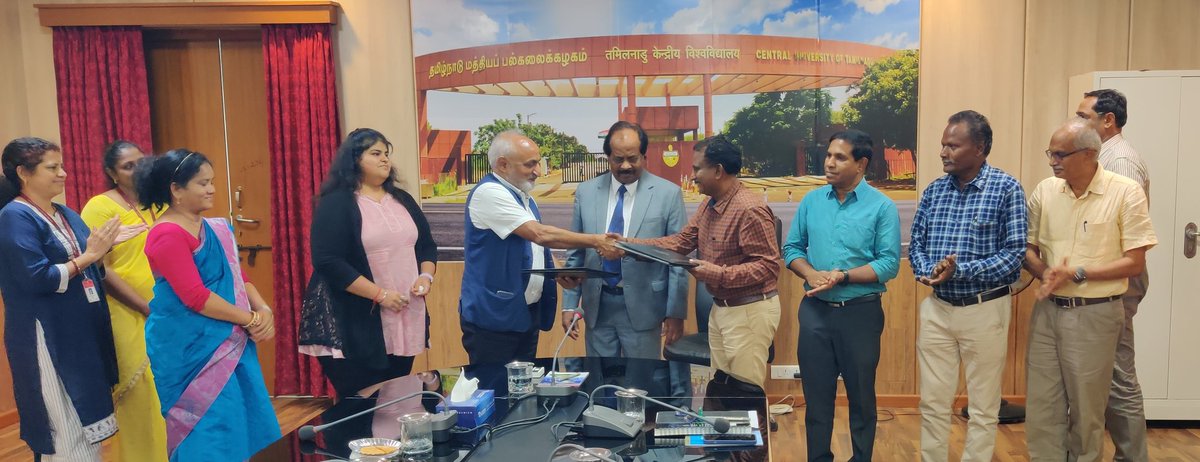
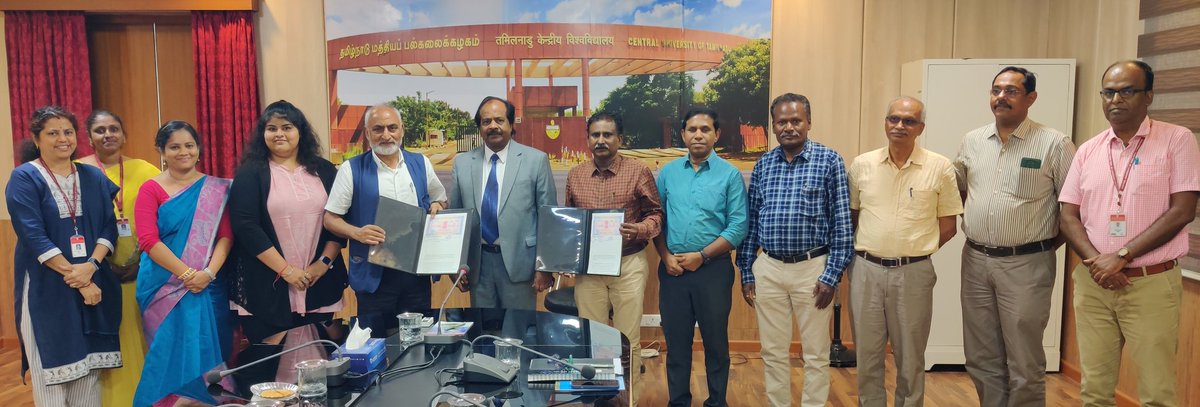
The @cutnofficial signs MOU with @TIGS_India to Combat Scrub Typhus.
Scrub typhus, caused by mites' bites, poses a serious health threat with no definitive cure. Collaboration aims to identify bacterial strains responsible for the disease to develop targeted treatment strategy.
TATA INSTITUTE FOR GENETICS & SOCIETY BANGALURU organised a webinar on 28.06.2023. Dr Pragya Yadav senior Scientist, NIV Pune made excellent presentation on CCHF. I presented perspectives on use of drones for vector surveillance and control:prospects and limitations. Thanks TIGS.
It's so very amazing to have met the star scientist @DeepakNModi after years and moreover when he still remembers you. Thank you for mentoring and inspiring me all these years in multiple ways. And thank you for the wonderful interaction. You made my evening ! #GATC2023