We are proud to share that @402TLabs has been included in @f6s “7 Top Bitcoin Companies and Startups in Spain – December 2025.”
It is an honor to be recognized alongside such innovative teams and forward-thinking organizations in the Bitcoin ecosystem.
https://t.co/e2yp1JM8B1
Today the letter from @Strategy to @MSCI_Inc lands hard: it argues that companies holding digital-asset treasuries are being misunderstood, and that excluding them from global indices would misstate what modern corporate balance sheets can include. Strategy frames Bitcoin treasuries as active, operating businesses, building a new layer of financial infrastructure, not passive funds.
But the index debate still misses a crucial second point. If Bitcoin treasuries are becoming part of mainstream capital markets, the industry must raise the bar on transparency. Traditional proof-of-reserves doesn’t cut it for complex treasuries, and anyone building at scale knows it.
That’s why, in our new paper, we lay out the Treasury Proof Ledger (https://t.co/lmNMy4JD5G). TPL treats a treasury as a full exposure state machine: spot holdings, custodians, lending books, derivatives, encumbrances, fee sinks, even cross-entity flows, all anchored to Bitcoin. It gives a concrete, auditable way to prove exposure soundness and consistency, without exposing wallet maps or trading strategies.
If MSCI and other standard-setters want a real framework that matches what Bitcoin treasuries are becoming, this is it. TPL gives them a foundation for accountable, transparent, institutional-scale treasuries.
The index debate will play out. But the real conversation starts now: what does responsible treasury disclosure look like for companies with real digital-asset balance sheets, and how do we give that disclosure a cryptographic backbone worthy of its importance?
Building MCP Apps (MCP servers with MCP-UI / Apps SDK support) is pretty painful right now.
You need to:
1. Spin up a server that returns UI components.
2. Hand-write a bunch of JSON schemas + tool wiring
So we open-sourced a high-level MCP Server SDK that basically lets you have both the MCP server and React components in the same place:
- Every React component you put in your resources/ folder is automatically built and exposed as an MCP resource + tools. No extra registration boilerplate.
- We added a useWidget hook that takes the tool args and maps them directly into your component props, so the agent effectively “knows” what data the widget needs to render. You focus on UI + logic, the SDK handles the plumbing
- Docs for that flow here: https://t.co/9yXN2nWm1x
We also shipped an MCP Inspector to make the dev loop much less painful: you can connect your MCP server, test UI components from tools (with auto-refresh), and debug how it behaves with ChatGPT/agents as you iterate.
https://t.co/udtuJdQbMy
Both the @manufact SDK and the inspector are open-source, and any contributions are very welcome :)
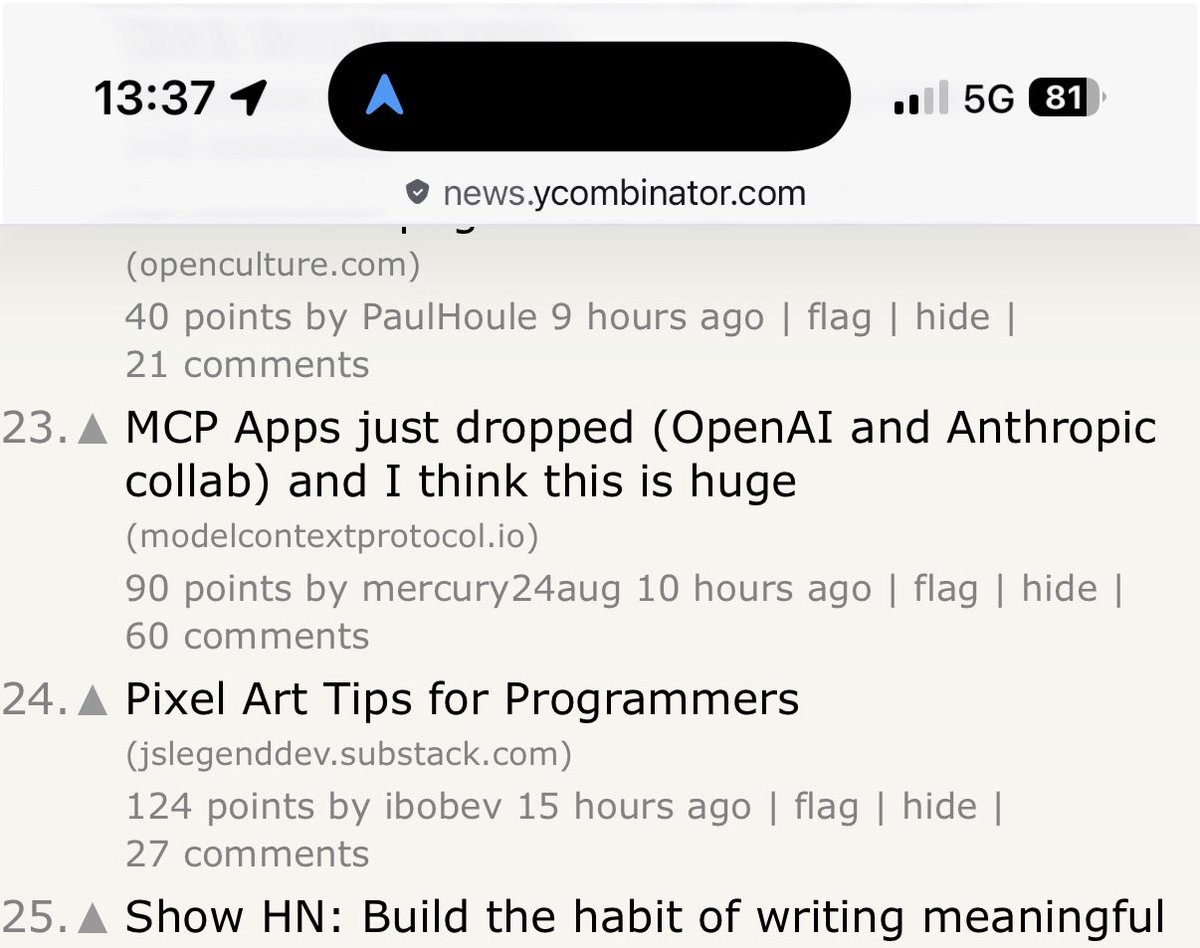
MCP-UI is standardized into MCP Apps! 🎉
Since I released it in May, @liadyosef and I have been on a mission to build the future of the web - rich agentic apps. Together with @AnthropicAI and @OpenAI, that vision is now officially part of MCP!
This is just the beginning >>