Watch: At a recent @tedtalks event, Dr. @randi_c1 — a Media Lab alum who is now research lead at @DayofAI_USA and an incoming research professor at @cmuhcii — considers how play can help kids develop an appropriately skeptical approach to using AI tools.
https://t.co/5YyGSoyVOE
In a new report co-authored with Kinexys by J.P.Morgan, researchers from the MIT Digital Currency Initiative at the Media Lab (@mitDCI) discuss and analyze challenges for financial institutions that are unique to, or more difficult to address on, public blockchains.
Learn more about this work:
What changes when institutions move from traditional financial rails to public, decentralized infrastructure? For a regulated financial institution, quite a bit!
Check out our new report, co-authored with Kinexys by @jpmorgan!
https://t.co/kns4znBSN2
For 250 years, discovery, courage, and tenacity have driven this country forward and will continue to. From medicine to infrastructure to breakthroughs we can't yet imagine, science touches every part of daily life because someone, somewhere followed their curiosity.
What are you curious about? #CuriosityOnAMission
https://t.co/rErxJSaMwa
MeshModule, created by Hye Jun Youn, Serena Xin Wei Sara, @formanfunction, Hyeokjun Yoon (@cdecoders), and Prof. @ishii_mit, received a Student Notable honor in the Toys & Play category at the @Core77 Design Awards 2026! MeshModule transforms textiles into a playful, buildable system where anyone can design, assemble, and wear their own creations. https://t.co/kirp49U4Ab
Explore the 2026 MIT Summer Reading List, which includes work from Media Lab staff member Sarah Beckmann; Professor @kkarahal + alum J. Nathan Matias; and Professor @alexpentland! https://t.co/C6ZSiE2YC5
Congratulations to Hyeokjun Yoon, a PhD student in the @cdecoders group, on being selected as a recipient of the MIT Health and Life Sciences (HEALS) Graduate Fellowship for the 2026–2027 academic year!
https://t.co/keV4I5G66I
Media Lab Prof. @rosalindpicard, who was named as a recipient of the 2026 @IEEEorg Medal for Innovations in Healthcare Technology, reflects on the unexpected discovery of a medical application for her work in wearable sensing — technology that is now used by a number of consumer and medical device companies, and in multiple clinical studies.
https://t.co/AxokR3dQhz
Are your ears always in agreement with your feelings? New MIT Media Lab research, conducted in collaboration with @myndstream, suggests that human-composed music outperforms AI in eliciting genuine emotional responses — even when listeners claim to prefer the AI-generated tracks. https://t.co/Uomq4VgCQM
The Anemoia Device, created by @cyrusclarke, @ishii_mit, and collaborators from @harvard, has won the Emerging Technologies category at the @Core77 Design Awards 2026! The Anemoia Device is a “scent-memory machine” that turns analog photos into custom fragrances, exploring a vision for extending emerging AI technologies beyond digital interfaces into physical, sensory experiences.
https://t.co/TPCSiM5P2j
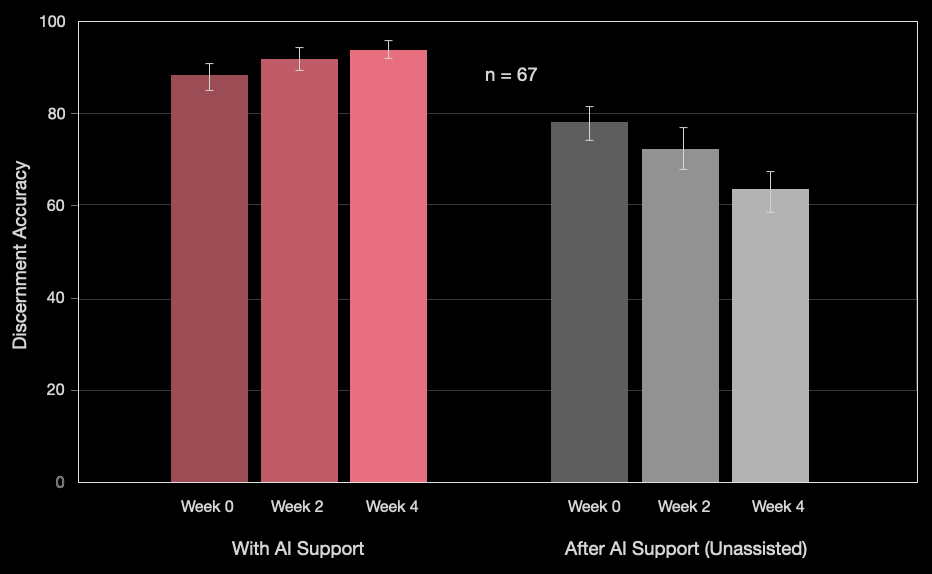
In @fastcompany, Jude Cramer looks at a study by @anku__rani, @valdemardanry, Prof. @pliang279, Dr. Andrew Lippman, and Prof. Pattie Maes (@fluidinterfaces), which shows that chatbots can help people detect misinformation, but may also reduce users’ ability to spot fake news on their own — particularly if they simply provide answers, rather than guiding users to find the answer themselves.
https://t.co/Wm0Fh4B3nG
Congratulations to Media Lab Prof. @dagdevirencanan on receiving the Global Women’s Leadership Award from the Global Summit of Women! This award recognizes Prof. Dagdeviren’s pioneering contributions to women’s health and her commitment to inspiring girls and women in STEM. https://t.co/081n3DnXDD
Congratulations to Prof. @patpat_mit on being selected as one of four winners of the 2026 Psychology of Technology Dissertation Award for his dissertation "Cyborg Psychology: The Art & Science of Designing Human-AI Systems that Support Human Flourishing."
https://t.co/gMAA1c6hvh
The MIT Media Lab is celebrating four faculty promotions! @dagdevirencanan, @kesvelt, and @space_enabled have been granted tenure, and @fadeladib has been promoted to full professor. We look forward to their continued contributions for many years to come.
https://t.co/dbCpDEQYAB
Can AI make you worse at spotting false information? 🤔
Our new study from @MIT shows that while AI chatbots can improve accuracy in the moment, repeated use may weaken people’s ability to judge news accuracy on their own.
https://t.co/M28MObIIIc
Thread below 🧵
In a study presented at #CHI2026, @anku__rani, @valdemardanry, Prof. @pliang279, Dr. Andrew Lippman, and Prof. Pattie Maes (@fluidinterfaces) show that while chatbots can help people detect misinformation, over time, users may become worse at spotting fake news on their own. However, the study also identified conversational strategies that support active learning and skill development, rather than simply helping in the moment.
https://t.co/IpXfMznwWB
Researchers from the Media Lab’s @cdecoders group have developed a new approach to ultrasound imaging that allows the user to visualize a 3D augmented-reality image, making it easier to identify and analyze the object being scanned. The system could improve the training process for ultrasound technicians and other healthcare providers. It could also be deployed for use in hospitals, for tasks such as using ultrasound to place a needle in the right location for a biopsy.
https://t.co/YF1brpxsHI
During the MIT Ethics of Computing Research Symposium, hosted by @MIT_SCC’s Social and Ethical Responsibilities of Computing (SERC) initiative, speakers including Media Lab Prof. @patpat_mit considered how AI is shaping the world and its implications for society. https://t.co/j3ntHBJi6q
Congratulations to Prof. @dagdevirencanan on being selected as one of the four winners of the 2026 @Nature Awards Healthspan Accelerator! These awards identify human health research with the potential to transform the human healthspan.
https://t.co/nIHTucp2ai
“Curiosity is the force that transforms deadly cancers into treatable conditions… that turns fusion energy from a dream to a reality…that uncovers new ways to grow more food using less of every resource,” says MIT President Sally Kornbluth. #CuriosityOnAMission
Radar for national defense. Radiation therapy for public health. Research in nuclear science, materials, food and environmental safety solutions, and training youth. All were born from a partnership among a brilliant mind, generations of his students, a university, and a government that, over decades, valued the power of investing in science. 8/10