Building upon insights from psychology and neuroscience, the Fluid Interfaces group creates systems and interfaces for cognitive enhancement. @medialab @MIT
Congratulations to everyone graduating in the 2025-26 academic year @medialab but especially to our dear Michelle Kim, who now officially holds Master of Science !
We're so proud of everything you've accomplished here, and can't wait to see what you do next.
At 4pm ET, join @aha_medialab for the next installment of their ongoing seminar series! The speaker will be Auren Liu, a PhD student in the @fluidinterfaces group and founding member of the Advancing Humans with AI program. https://t.co/3z9rs6ITS1
✨Announcing the first Workshop on Agent Behavior @COLM_conf 2026 (Oct 9, San Francisco 🌅)
https://t.co/8vYnVp4uXf
We invite two types of contributions: (i) papers, and (ii) benchmark proposals. We are also seeking reviewers. More details below!
In an interview with @BW, Media Lab Prof. Pattie Maes (@fluidinterfaces) warns that AI assistants may improve performance in the short term while weakening critical thinking over time. To combat this risk, Prof. Maes argues they should not always provide immediate answers. Instead, she suggests, AI should sometimes introduce productive friction — asking questions, prompting reflection, and supporting deeper engagement. The goal is not to replace human judgment, but to design systems that strengthen it.
https://t.co/1k11WhnmNk
@thinkymachines@YasithSam7 Mirai: A Wearable Proactive AI "Inner-Voice" for Contextual Nudging
Paper: https://t.co/HmfGN8LsJo
Video: https://t.co/KT5dpizbHn
really cool to see the latest demos from @thinkymachines
we did this almost identical scenario for Mirai a year ago where a wearable AI contextually responds to your behavior to provide just-in-time nudges
https://t.co/z4V4So1H3O
@YasithSam7
In @MIT_Spectrum, Media Lab Professors Pattie Maes (@fluidinterfaces) and @patpat_mit discuss their work with @AHA_medialab, which aims to steer AI systems in a direction that enhances human lives and experiences, rather than disrupting them. https://t.co/rEltqP081q
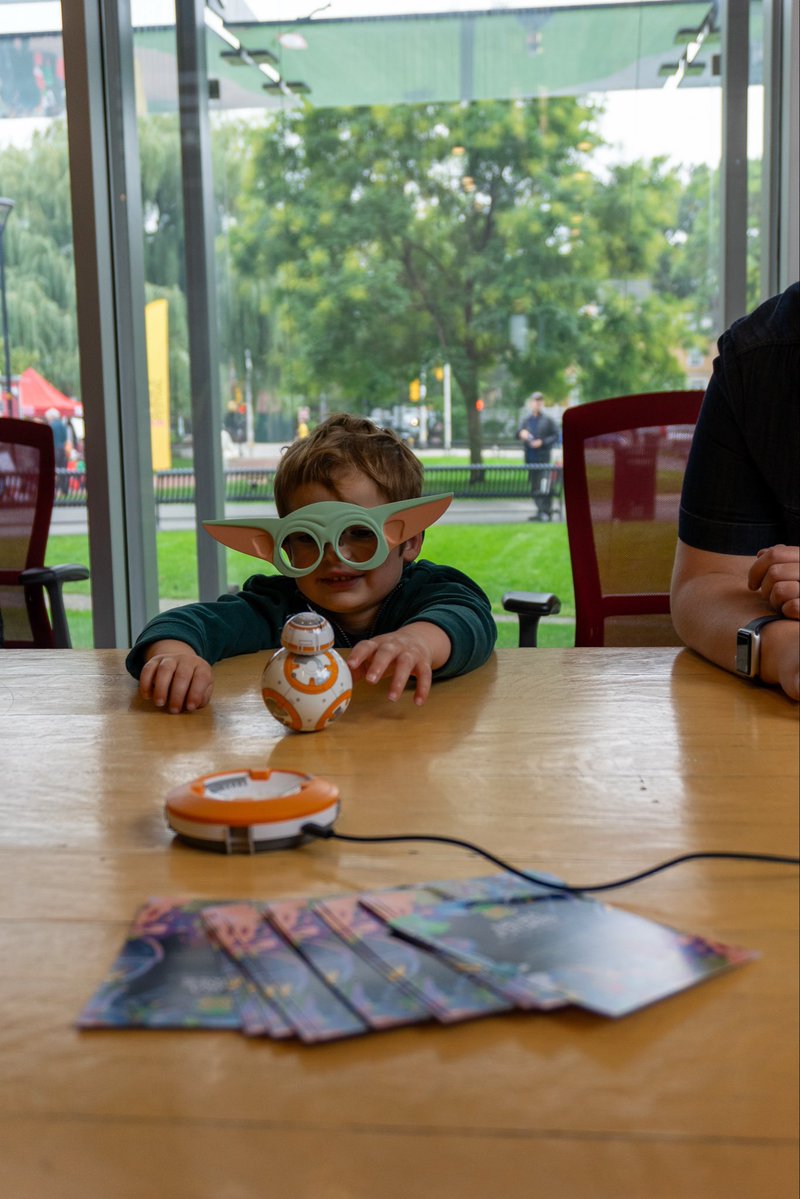
May the Force be with you!
A throwback to one of our demos led by our research scientist @nataliyakosmyna to control a #BB8 robot from @starwars universe using your brain 🧠 !
Meet Human Operator from MIT Media Lab: a wearable that lets AI temporarily take control of your hand using electrical muscle stimulation.
Watch it crush piano, draw perfectly, and mix cocktails like a pro — all from a simple voice command.
“I gave an AI a body.”
This isn’t sci-fi. This is tomorrow.
#HumanOperator #MITMediaLab
On Tuesday, April 28, join @aha_medialab for a free livestream of the 2026 AHA Symposium, “Raised by AI?” During this all-day event, speakers and panelists will consider the question: How do we ensure the first generation growing up with AI thrives? https://t.co/ehDClJXLj0
Adam Haar Horowitz, an alum of the Media Lab’s @fluidinterfaces research group, is a cognitive scientist whose work focuses on exploring the hypnagogic state between sleep and waking for creative, artistic, and even collaborative experiences. https://t.co/HhIZeIA0Vo
ABxLab is accepted at @iclr_conf#ICLR 2026! ✨We ask: why do AI agents do what they do? 🧐
We introduce a framework for systematically studying AI agent behavior through controlled manipulations of their environments. We accomplish this by intercepting any real web environments and modifying what the agent sees in real time before they actually see it.
How can we design systems that build people's capacity to break negative cycles—not just recognize them?
This year at CHI @acm_chi we presented:
"Breaking Negative Cycles: A Reflection-to-Action System for Adaptive Change."
Motivation?