Cycling culture may be fuelling disordered eating 🚨
This study explored how food, body image and performance culture shape eating behaviours in 11 competitive cyclists in Britain 🔍
Key takeaways ⬇️
🚴 Performance optimisation dominated how cyclists viewed food, eating and their bodies
⚖️ Lower body mass was often seen as a route to better climbing and race performance
🍽️ Some cyclists deliberately under-fuelled, skipped meals or trained fasted to reduce body weight
🪞 Pressure to look thin and lean was linked to fitting the image of a “proper cyclist”
💬 Comments about body weight from coaches, teammates and parents could have lasting effects on eating behaviour and body image
⚠️ Harmful behaviours could become normalised as signs of commitment and discipline
👥 Cyclists compared portion sizes and used teammates as a reference for how much they felt permitted to eat
🥗 Positive team cultures could encourage better fuelling
📚 Qualified nutrition support was perceived as limited outside higher levels of competition
📊 Previous research found >50% received no organisational nutrition support and 88% had never consulted a dietitian or nutritionist
📱 Without professional support, cyclists relied on teammates, social media, Google and increasingly AI
🤖 Several participants reported using ChatGPT for nutrition and race-fuelling advice
🧩 The authors argue disordered eating is not purely an individual problem because behaviours are shaped by sporting culture
🏆 A “performance-first” culture may make health-compromising practices seem acceptable if perceived to improve performance
Three key recommendations:
1️⃣ Target the culture around athletes, not just individual nutrition education
2️⃣ Coaches, practitioners, teammates and parents should consider how they talk about weight, food and performance
3️⃣ Body-composition testing should only be used with a clear rationale and ethical, health-focused framework
Key message: cycling should value health and wellbeing alongside performance, rather than rewarding leanness, restriction and under-fuelling ✅
Subscribe to Performance Nutrition Digest FREE 📥
https://t.co/kPsQssm5ut
Powered by Healthspan Elite ⚡️
Is cramping caused by muscle damage - not dehydration? 🧐
This new study compared hydration status, electrolyte balance, muscle-damage markers, pacing and training background between ultra-trail runners who experienced exercise-associated muscle cramps and those who did not 🔍
58 runners completed the analysis, including 37 men and 21 women 🏃
Results 📊
⚡ 9 runners developed exercise-associated muscle cramps, giving an incidence of 16%
👨 Cramping occurred in 22% of men versus 5% of women, although this difference was not statistically significant
💧 Body-mass changes were similar between runners who cramped and those who did not
🧪 Post-race urine specific gravity was also similar between groups, suggesting crampers were not more dehydrated
🧂 Serum sodium concentrations did not differ between crampers and noncrampers
🧬 Post-race potassium was significantly higher in runners who cramped: 5.04 vs 4.66 mmol/L
💥 Creatine kinase (CK) was substantially higher in crampers at both 24 and 48 hours after the race
📈 At 24hrs, CK averaged 5166 U/L in crampers versus 1940 U/L in noncrampers
📈 At 48hrs, CK remained higher at 3194 versus 894 U/L
🩸 Lactate dehydrogenase was also significantly higher in crampers at both 24 and 48 hours
🦵 These elevated biomarkers suggest runners who cramped experienced greater exercise-induced muscle damage
⏱️ Pacing indices did not differ between runners who cramped and those who did not
🏋️ Regular lower-limb strength training was less common among crampers: 55.6% versus 87.5% of noncrampers
💪 This raises the possibility that greater muscular resilience from strength training could influence cramp susceptibility
The findings do not support greater dehydration or sodium depletion as the main explanation for cramping ☝️
Small sample size but overall, cramping was more associated more strongly with subsequent muscle-damage markers than with dehydration or sodium depletion ✅
Reference:
https://t.co/w8G85IELag
Subscribe to Performance Nutrition Digest FREE to receive your daily study breakdown, straight to your inbox or via the Substack app 📥
https://t.co/kPsQssm5ut
Performance Nutrition Digest is powered by Healthspan Elite⚡️
https://t.co/V0YqjzPGsK
Heavy (3-5RM) strength training is just as effective as light (20-25RM) strength training when doing the same number of sets to failure and the same rests between sets, despite massive differences in volume load. The idea that volume load has anything to do with hypertrophy needs to be retired.
This is speed reserve in simple terms - two athletes are running the same speed, but it costs one athlete more if they’re closer to their max speed.
As I’ve discussed before, the best approach is bringing both speed and stamina up. This is where programming matters.
You need
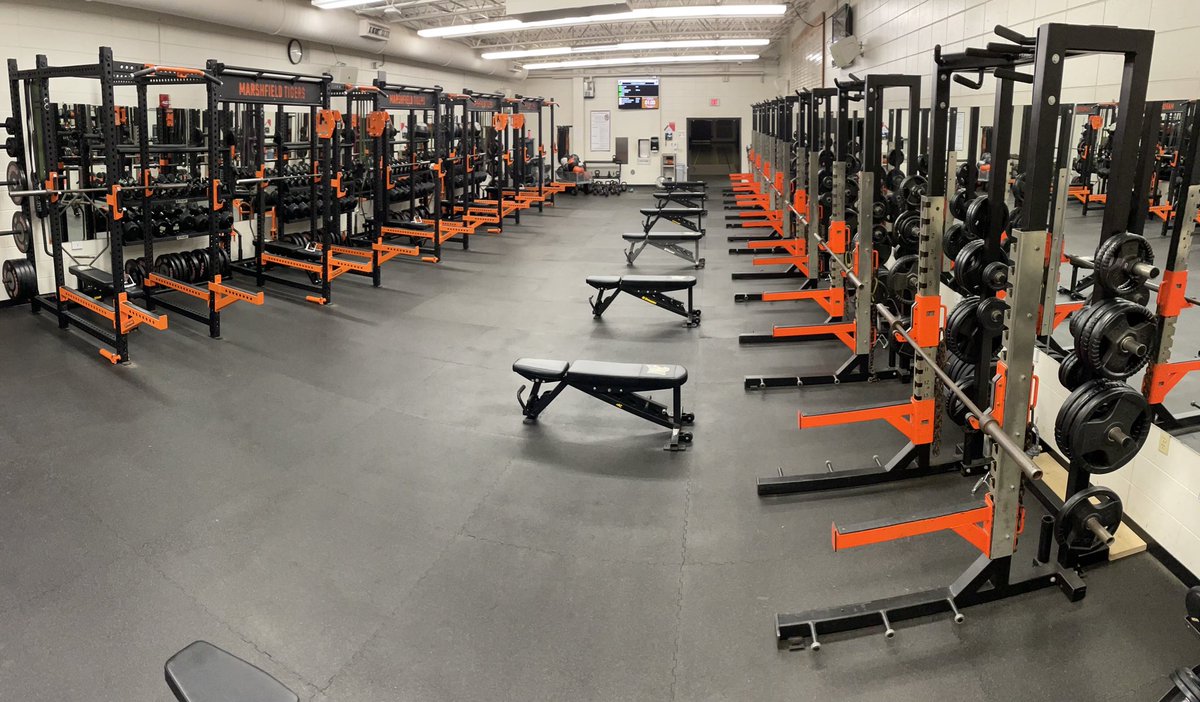
Great second week of Summer S&C! Attitude, effort, intent & attendance were all consistent from Week 1. Timed Flying 10s again. No changes with the boys, a couple new names/times with the girls. Attended @NHSSCA_WI NatCon this weekend; it was an awesome experience! Roll Tigers!
Week 1 of Summer S&C is in the books. Great attitudes and efforts by everyone there. We averaged 128 athletes attending each day and were able to time Flying 10s with @OVRPerformance before the soggy weather came. Roll Tigers!!!
STATE BOUND!!!!
Tiger Softball returns to State Tournament with 11-0 win over Chippewa Falls in the Sectional Final. Look for stories on Zaleski Sports and https://t.co/pMrHCOyRID. The team will play on Wednesday; opponent and time to be determined. #RollTigers#SecChamps
PARENTS:
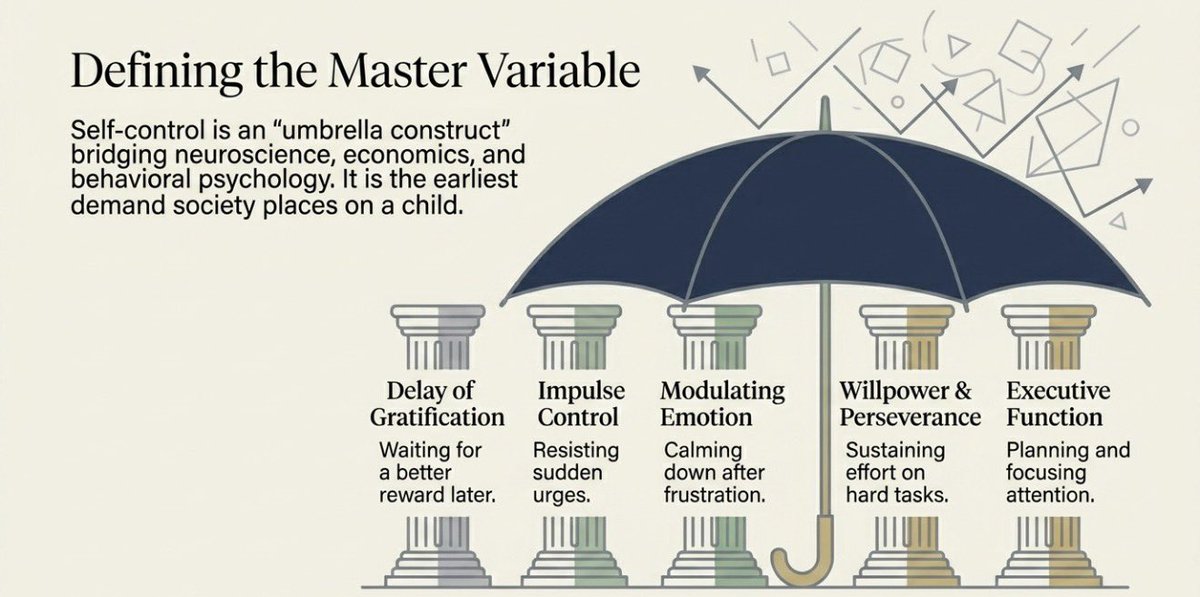
A gradient of childhood self-control predicts health, wealth, and public safety
Self control was the biggest determining factor in successful maturation from childhood to adulthood
Strength and conditioning starts with understanding the task.
What does the competitive event actually require?
You look at the biodynamics, the bioenergetics, the biomotor abilities, and the primary muscles responsible for expressing those qualities
That doesn’t mean you
Charlie Francis understood that training was more of a neural equation than structural.
Protecting the recovery windows allowed for the realization of development of the anaerobic systems. Many of the current training concepts seen in D1 football are derivatives of his teachings
Importance of COD
FIRST OUT THE TURN WINS THE RACE- Loren Landow
(Singh et al., 2025)https://t.co/zVkmgjp2rD
• Short ground contact times
• High approach + exit speed
• Strong braking AND re-acceleration forces
• Lower center of mass (play low = move fast)
Plyos aren’t just “jump training.”
A well designed plyo progression teaches athletes how to create force quickly, manage high forces in short windows and redirect that force into the next movement.
That’s why I’ve always viewed plyometrics as more than just a power tool.
Heavy or light sled work?
KEY FINDINGS (Xu et al., 2025)
•Very heavy loads (≥80% BM or ≥50% vdec) >>> light loads for sprint performance
•Threshold: >20.7% BM needed to beat unresisted sprints
•Light loads? Same as regular sprints for performance
#speed#sprint#fast
“Hamstring load” is task- and muscle-specific. Programming should expose players progressively to max accel, true hard decel, and planned cutting – not just straight-line sprinting and Nordics.
(Steventon-Lorenzen et al., 2026)
#strengthandconditioning#sports#sportscience
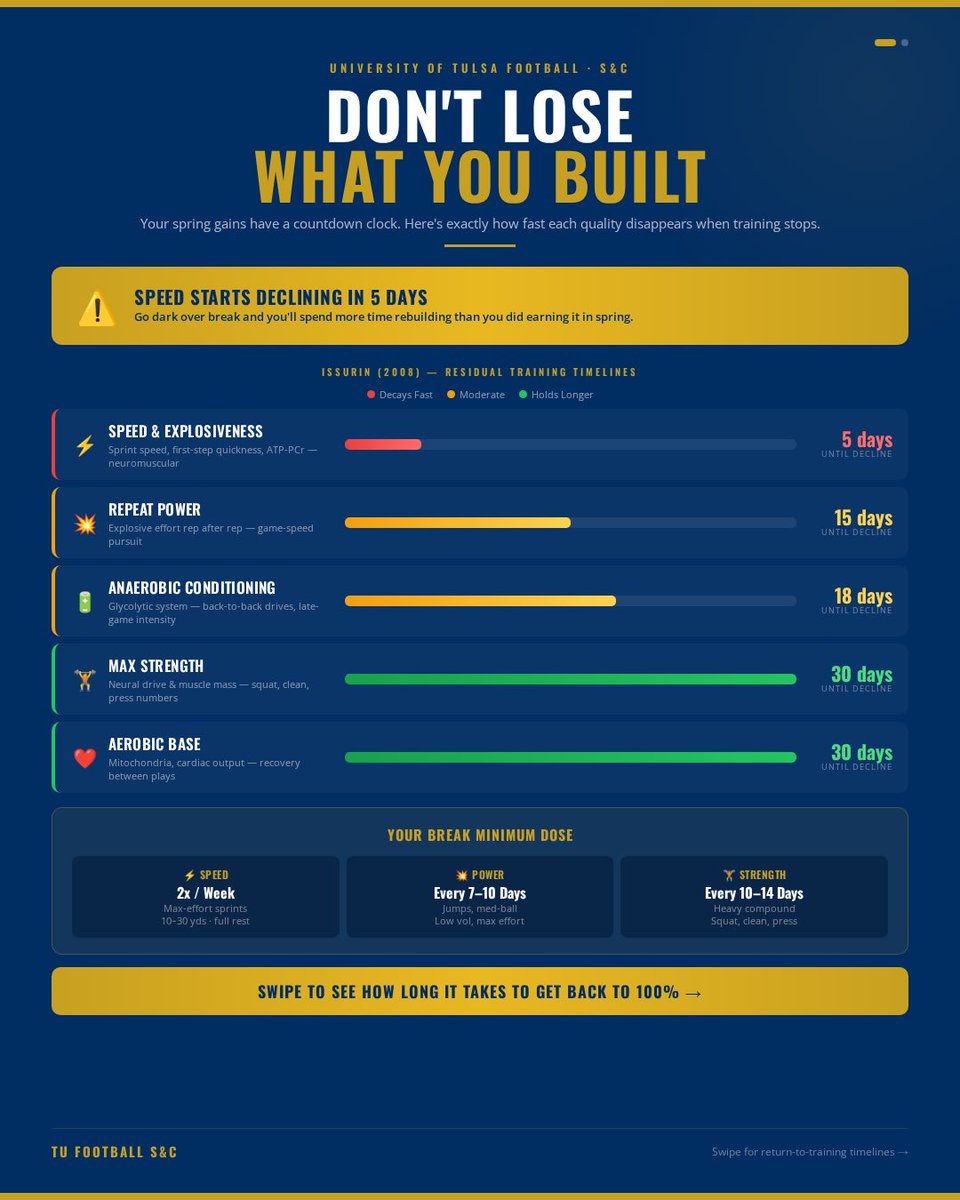
With intercession coming up it’s important to understand retention and regaining training abilities.
Reducing training to 40% of previous load will require 2.5 week ramp up
Bottom line stay training the job ain’t done!
(Purdham, Gabbett, 2015) (Issurin 2008)
#sportscience
Newton’s third law of motion: Equal and Opposite:vertical and horizontal forces is necessary to give the runner time to position the GC behind COM.Cueing sub 40 degree angle limit resultant force & - affect horizontal projection
(Mann , 2022; Von Lieres Und Wilkau et al., 2020)