[read about what’s happening with AI]
ME: Wow we’re actually legit fucked this is so bad.
[go outside]
ME: Wait those people are all acting like nothing unusual is happening. Maybe I was just in a paranoid bubble? Yeah it must be that. Phew.
[read more about what’s happening with AI]
ME: Wait no we ARE fucked. Shit. It’s all those people outside who are in a delusional bubble.
[go outside]
ME: Wait...
#EnDirecto | Puente, sobre si se ha apostado demasiado por extender la alta velocidad: "¿Hay alguien que no alce el grito en el cielo si no se lleva a su territorio? Analicen la historia de este país los últimos años, si no tienes AVE no eres nadie. Lo oigo hasta la saciedad"
Spoke to someone leading AI enablement at a massive retailer.
The #1 problem they’re running into: AI transformation is owned by IT and all initiatives must run through their AI Center of Excellence.
This is causing two parallel issues:
1) Employees outside of IT aren’t given the tooling/infra needed to automate anything beyond simple workflows/use cases (read: citizen developer SDLC)
2) Rolling out AI is bottlenecked by ITs ability to own and approve every initiative
This challenge is incredibly common across enterprises & you can quickly appreciate why…
On one hand, you can empathize with IT. They’re not incentivized to take risks & embrace disruption, so the risk-return of decentralizing AI implementation cross-org is not obvious.
On the other hand, an enterprise’s ability to metabolize raw intelligence is metered by its corporate SDLC. IT is often the bottleneck in that SDLC and it’s not hyperbolic to say that poses existential risk for the enterprise.
Antonio Acedo, el maquinista del AVE fallecido, era un hombre bueno. Tuve la suerte de conocerlo. Fue tan generoso que hasta quiso acompañarnos militando en Izquierda Española. Un tipo prudente, amable y ejemplar.
Preparó buena parte de nuestro programa sobre transporte, diagnosticando sus carencias, la sobrecarga de usuarios tras la liberalización fallida, la clamorosa falta de financiación en mantenimiento y el abandono de todos estos años que se ha traducido en un deterioro demencial de las infraestructuras ferroviarias.
Que todavía hoy tengamos que soportar discursos que niegan lo evidente y que son incapaces de asumir la menor responsabilidad política resulta dramático. Pero es aún más intolerable que se intente opacar el deterioro inequívoco de un servicio público proyectando la responsabilidad en los fallos humanos, como si el sistema de seguridad de Alta Velocidad en España dependiera de un trabajador concreto, no de un diseño y un sistema técnicamente complejos.
DEP todas las víctimas de esta pesadilla. Mucha fuerza para todos los familiares y allegados.
Nunca te olvidaremos, Antonio.
If you've ever wondered why smart TVs are so cheap, this is why.
@log4j rooted his Samsung and found an always-on hot mic, automatic content recognition, geolocation, network mapping, ad targeting and user profiling, shared with Samsung's "400 partners".
A lot of it can be blocked in <15 min, wrote a basic guide below.
What your TV is doing
The main culprit is ACR (automatic content recognition). Your TV screenshots what's on screen, fingerprints it, and sends it home to build your ad profile. Samsung does it every 500ms, LG every 10ms [1].
What is insane: it happens on connected devices too.
Plug in your laptop, your console, your work machine, and your TV can fingerprint that via HDMI [1].
He also found that if your Samsung doesn't have a mic, it'll look for one from a connected soundbar or bluetooth device.
https://t.co/vNdTnIQ6KF
It's on by default, and you likely agreed to it on the setup screen you clicked through in 10 seconds.
Step 1: Turn off ACR
Samsung: Terms & Privacy → Viewing Information Services
LG: Live Plus
Vizio: Viewing Data
Roku: "Use info from TV inputs"
Sony/Google TV: Samba Interactive TV
Menus vary by model, but those are the names to look for. While you're in there, opt out of interest-based ads, reset your advertising ID, decline every optional privacy agreement, turn off voice recognition, and delete apps you never open.
Step 2: Give smart devices their own network
Put the TV, cameras, speakers and vacuum on your router's guest/IoT network. The logic is simple: these devices rarely get patched. If one gets compromised (getting drastically more frequent with AI), it shouldn't be able to see your other devices or home network.
Step 3: Block trackers for the whole house with DNS-level filtering
NextDNS (cloud-based) is easy and has a solid free plan. Pi-hole is a little bit more work if you prefer self hosting. For simplicity we'll focus on the former.
1. Sign up at https://t.co/IwhafVWVM8 (free tier is plenty)
2. Privacy tab: add a blocklist (OISD is a good bet) and turn on Native Tracking Protection for Samsung, LG, Roku, Amazon (see attached image)
3. Setup tab: copy your endpoint
4. Paste it into your router's DNS settings as DNS-over-HTTPS/TLS (or use the IPs + "Link IP" if your router only does plain DNS)
5. Bonus: block outbound port 53 except to your router. Some devices hardcode their own DNS to get around you
Then open the NextDNS logs and watch how often your TV phones home. It's eye-opening. If an app or update breaks, find the domain in the logs and allowlist it.
Why they do this
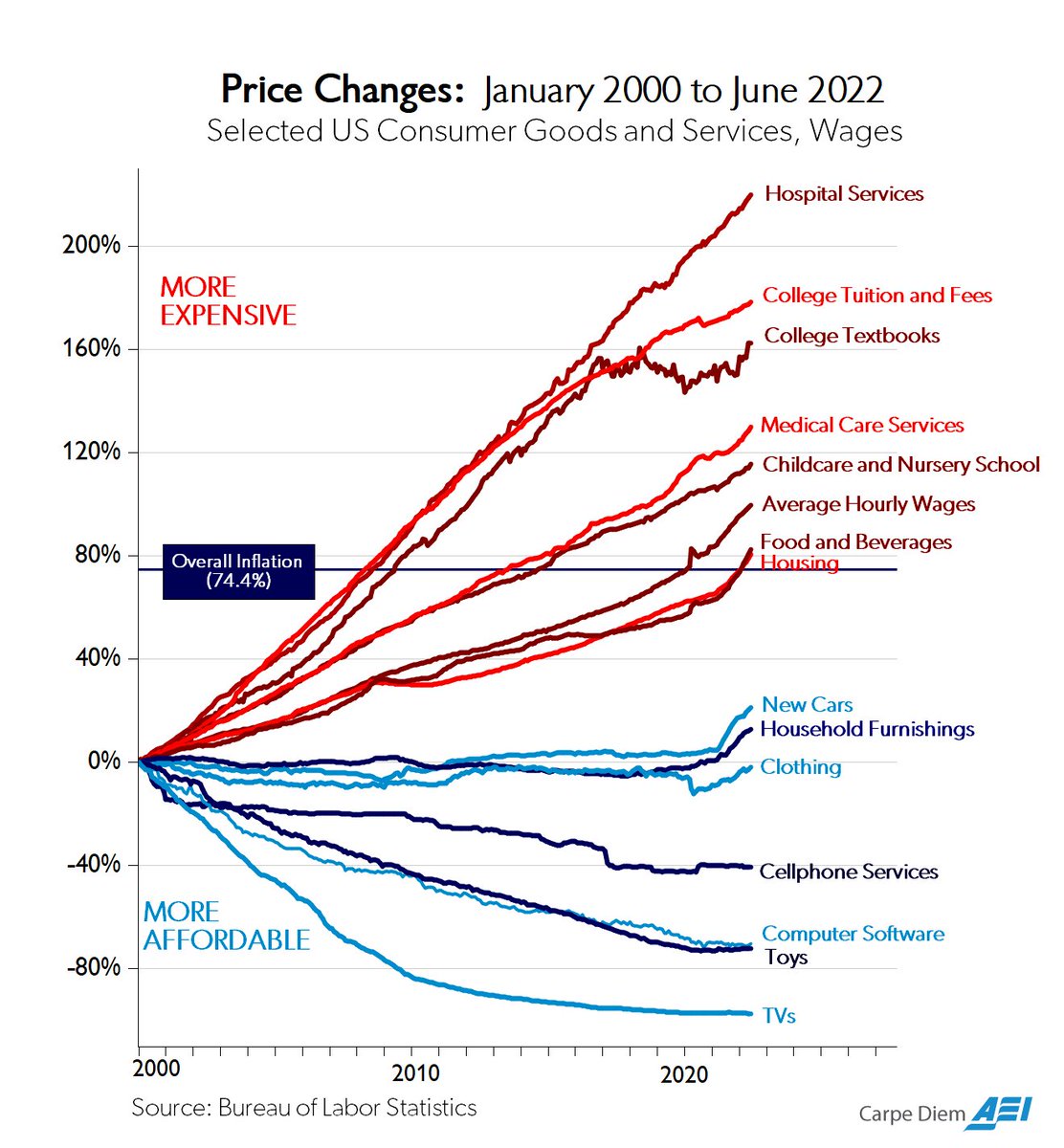
TV prices are down 97% since 2000 [2]. Most of that is better manufacturing and brutal competition. But once margins on the hardware hit zero, the cost moved to you.
In Q3 2024, Vizio lost $6.7M selling TVs and made $115.8M in gross profit from ads and viewing data [3]. They've said on earnings calls that they keep TV prices low to grow the audience they sell to advertisers. Walmart bought them in 2024.
This isn't a conspiracy theory either. Vizio paid $2.2M to the FTC in 2017 for tracking 11 million TVs without consent. Last December, Texas sued Samsung, LG, Sony, Hisense and TCL over ACR. Samsung and LG have since agreed to stop collecting that data without explicit consent [4].
TL;DR
1. ACR off
2. Ads + voice off
3. Smart devices on their own network
4. NextDNS filtering on the router
Sources:
[1] ACR study: https://t.co/S1IS8lXNbA
[2] Cost of US consumer goods: https://t.co/nclXELXcbd
[3] Vizio Q3 2024: https://t.co/CrVbwc9ZXk
[4] Texas v. Samsung: https://t.co/wFOUdeh1if
"I’d love to participate in communities without any assholes benefiting from it, but in the modern world, that simply isn’t possible. The only alternative is to isolate myself and not have a community at all (or a job, or a smartphone, or a computer, or internet access, or a car, or most of my food, or my country)."
I agree with everything OP says except "watching all of those years go down the drain."
AI might have made it almost meaningless to write code by hand anymore. But the people who have spent years/decades writing code are now in the best position to leverage AI coding tools.
Learning to code was a stepping stone toward learning to decompose and solve complex problems. I have worked with a lot of different people with different levels of coding experience. And I can say with confidence that, in general, the more coding experience you have, the better you're positioned to think about long-horizon tasks and to organize and tackle problems with multiple moving parts.
All those skills directly translate to using AI coding agents. And I'm seeing it happen in real time. People with long software engineering experience have a totally different way of using AI coding agents (given that they set their ego aside and accept that this is the new norm). They are more organized, know how to steer the agent like guiding an intern or mentoring a junior dev.
People who don't have coding experience are using agents in a random and chaotic way (the approach has its outside-the-box-thinking merits but doesn't have the same reliability as the experienced SWE approach).
Another angle to this is that dogs effectively stumbled onto what is for them the equivalent of artificial superintelligence 20,000 years ago. The Singularity already happened for dogs. They live in a world they cannot understand, surrounded by miraculous wonders they take entirely for granted, their every need seen to by entities whose thoughts they cannot begin to fathom.
The result is that there are about a billion dogs on the planet now. Most of them are pretty happy. Almost none of them need to work. It worked out pretty well for them.
Nota de Comunidad: “No existe tal precedente. En 2019 la D. Permanente no aprobó un RDL rechazado 2 días antes. El Congreso derogó el RDL 22/2018; la D. Permanente convalidó 71 días más tarde el RDL 7/2019, de contenido similar pero no idéntico y que atajaba los puntos problemáticos.”
Asaf Rejuwan, one of the Israeli survivors of flight 1073 wrote on Facebook:
״I don't usually post on social media, but today I felt something burning deep inside me that I simply had to share.
Ever since the incident where the terrorist's attempt to hijack the Flydubai flight was thwarted, there has been a lot of coverage in the media, and I’ve been asked many times what factors I believe prevented the terrible disaster that could have befallen our people had that despicable terrorist succeeded in his plans.
Today, I think I received a very special and interesting answer to that question. Naturally, after the incident ended and we landed safely on the Land of Israel, I felt the need to thank many people... the passengers who cooperated, my lioness of a wife and all the mothers and fathers who protected their loved ones, the children who stayed composed, and every Israeli passenger on that plane.
Yesterday, I was part of a group of passengers interviewed for an international channel. As each passenger went into detail about how they experienced the flight, we realized something very important- something you only understand when the dust settles and you get into the small details during intimate conversations among yourselves.
We realized that every single passenger on that flight had a role, every passenger on the flight had a role.
One passenger was responsible for communicating with Israel's security services
I discovered there was a passenger on board who provided a mobile hotspot and made sure to share it with others
Another female passenger sat and recited Psalms
A passenger made sure to pass along headphone cords to tie up the terrorist
Passengers kept track of where we were going to land using GPS maps
An Australian passenger was the only one on the plane who could make calls back to Israel from an enemy country (Saudi Arabia)
And the list goes on... And, of course, the amazing Yaniv, the wonderful Tzvika and Tali, the hero Shota, the great man Or, and many other great friends who lent a hand.
I had no doubt that after such a great miracle, I would be attending synagogue on Saturday morning to recite the Birkat HaGomel (the prayer of thanking the God of Israel after a lifesaving miracle)
I am not a religious person. I believe in God in my own way, and I don't usually look for signs in everything. But today, something happened that completely astonished me. Completely by chance, today in the synagogue I read from Parashat Devarim (Deuteronomy 33:26):
"There is no one like the God of Jeshurun, who rides the heavens to help you, and in His majesty rides the skies."
אֵין כָּאֵל יְשֻׁרוּן רֹכֵב שָׁמַיִם בְּעֶזְרֶךָ וּבְגַאֲוָתוֹ שְׁחָקִים
I read the verse, stopped, and got goosebumps, and so did all the other worshippers who knew the story and understood why I was there with them.
After everything that happened on that flight, after the fear, after the storming of the terrorist, and after realizing how thin the line between life and death really was- finding myself facing those exact words, "rides the heavens to help you," was a moment I can hardly explain.
I don't know if it was divine providence, a coincidence, or simply a moment that took on a profoundly deep meaning for me. But today, in the synagogue, as I recited Birkat HaGomel, I felt mainly one thing:
Thank you. Thank you for life. Thank you for the miracle. And thank you for the privilege to stand here and tell the story.
Am Yisrael Chai 🇮🇱״
La crisis de vivienda en España: lo que creo que puede funcionar para solucionarla... y lo que probablemente no sirva o sea directamente contraproducente. En siete minutos y medio.
Dentro video 👇
My god this is such a good speech that every SWE needs to hear. You know what? Every person should hear it
Keep the happy memories, eyes on the reality, be excited about the future. That’s the best that anyone can do
"Writing code by hand is no longer an economically productive enterprise for the vast majority of programmers working at the vast majority of companies."
-DHH
By the end of the year it will be every programmer, every company, and then it'll be other forms of cognitive work.