From 1pm today (Weds May 27th) to 12:00 Friday May 29th hosting the Empirical Management Conference at Stanford Economics (579 Jane Stanford Way). Research papers on the cause, effect, measurement and theory of management. Welcome to any/all sessions.
https://t.co/vt1M9Eu85T
Call For Papers: 2026 Remote Work Conference.
Noon Weds October 28th to noon Friday October 30th at Stanford. Submission due June 21st - submit here: https://t.co/WRpxklhk19
📢 Call for papers! SITE 2026 Session 15: "Causes & Consequences of Misallocation" at Stanford GSB, Aug 31–Sep 1. Theory + empirics welcome.
Deadline: June 15 Submit: https://t.co/d5YRxEyLzl
w/ @TheMichaelBlank@PeteKlenow@sarapfmoreira
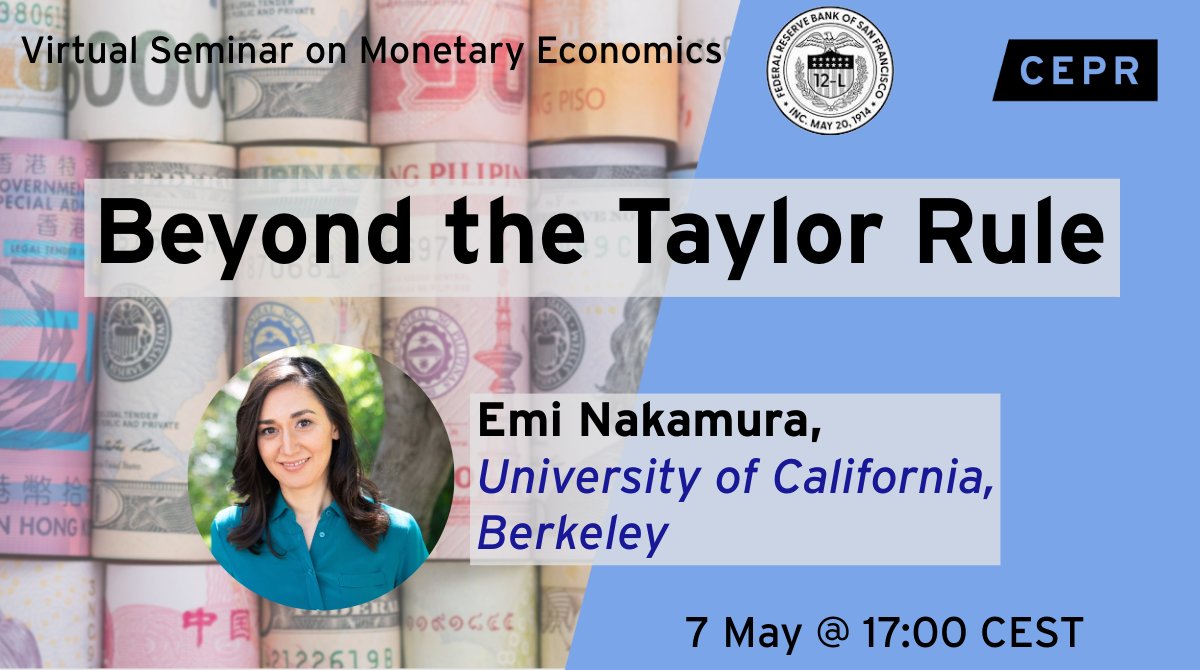
Join us online for the next session of the Virtual Seminar on Monetary Economics (VSME)
Emi Nakamura @UCBerkeley@berkeleyecon will present "Beyond the Taylor Rule".
7 May 2026 | 16:00 BST / 17:00 CEST
https://t.co/TMKaPGeMTf
New conference: "Industrial Policies in a Globalized and Financialized World," May 7-8 at the Federal Reserve Bank of Atlanta. 9 papers on industrial policy, trade finance, and global value chains. Full program: https://t.co/qhC1N3JTK0
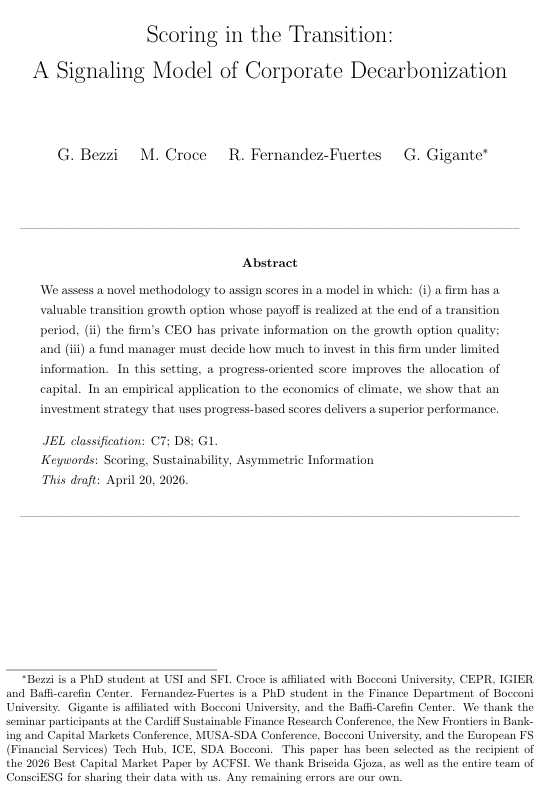
Green Tech #Episode_II: #ScoringInTheTransition
ESG Scores are not just different from each other; they convey different info on the decarbonization growth option of firms. In a limited information model, forward-looking scores deliver an alpha! 👇
@Unibocconi@sdabocconi
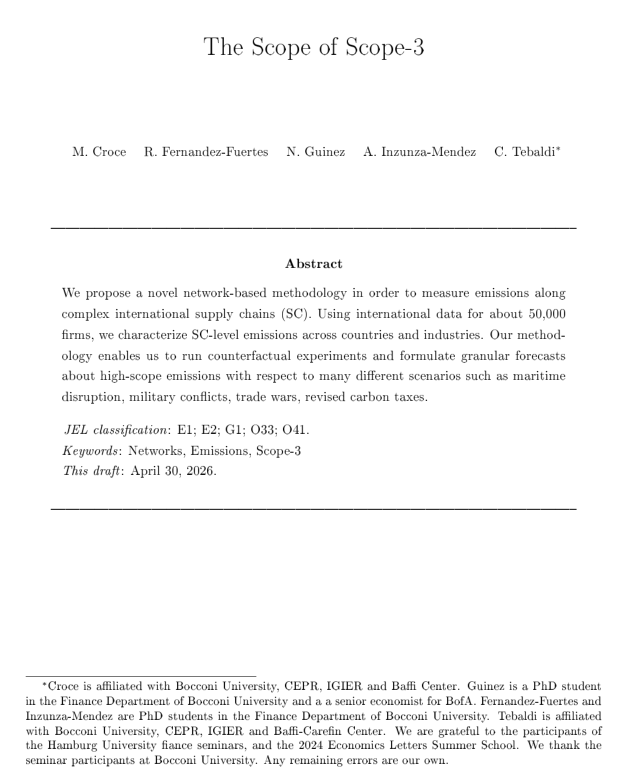
Green Tech #Episode_III: #TheScopeOfScope-3
We provide an international network general equilibrium model augmented with an I/O matrix of emissions. Using only data on direct emissions, we provide high-scope emissions across ~50K firms.👇
@Unibocconi@sdabocconi
The 27th MFS Workshop at Wharton is already this week (May 1–2). Last call to register if you’re planning to attend: https://t.co/ckKp0NPpwe. Looking forward to seeing you all in Philadelphia soon!
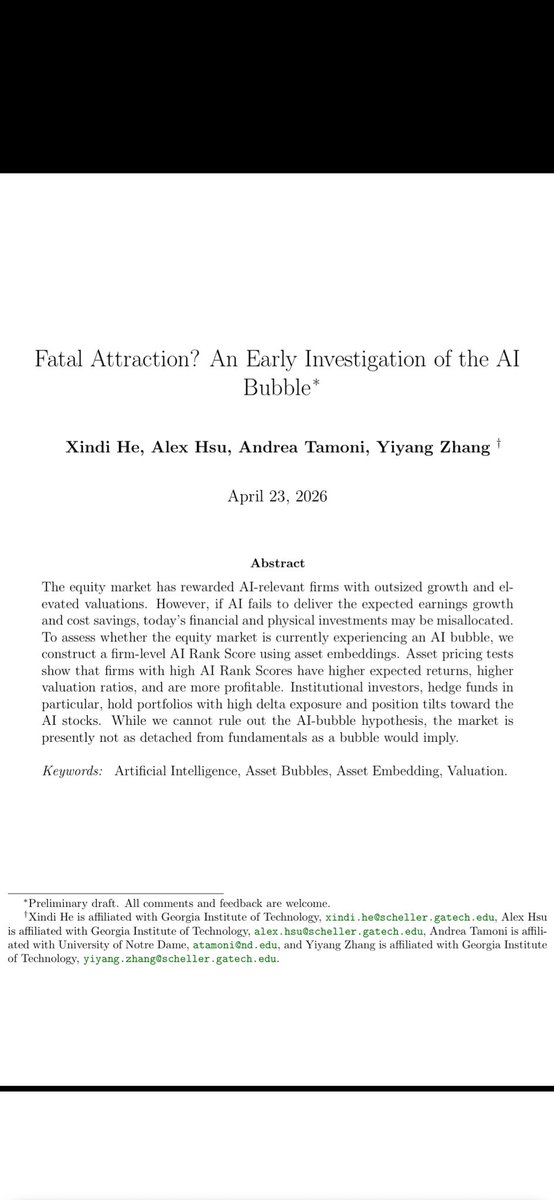
🚨New Paper Alert!🚨
Are we in an AI bubble? Nobody can say for sure, but asset pricing can shed some light. We use asset embedding to measure firm AI exposure via thematic ETF holdings. High AI exposure firms are more profitable and are overweighted by institutional investors.
Excited this is finally out as @nberpubs working paper. New results in this updated version where we decompose welfare effects into distinct qualitative transportation channels. Read the paper and learn about what exactly drives the welfare effects of transport investments.
Several researchers requested my slides from my talk yesterday at the Minneapolis Fed on solving equilibrium models with deep learning.
Since I added some new material with respect to my JEL paper (i.e., a more intuitive comparison of Chebyshev tensor basis and ReLU folds), I thought it would be useful to post them here as well:
https://t.co/FuNqrBAl4e
Comments are welcome!
We measure spending flows between thousands of small groups of consumers and thousands of small groups of producers to study how exactly shocks propagate through an economy. It matters for understanding policy. Check it out!👇
The q5-characteristics model estimates costs of equity as out-of-sample forecasts from cross-sectional predictive regressions, from Yicheng Liu, Chen Xue, and @zhanglu_osu https://t.co/MrJL5BXAiH
I’m organizing the Econometric Society Summer School in Structural Estimation. Broader than the summer school with Luke Tayolor: more methods (not just SMM), more topics. Tell your students to apply! Deadline: April 15.
https://t.co/y5CYcAeZNk
I was the jr. guy presenting in a random fiscal policy session. Chris was the keynote. He walked in middle of my presentation. Sat down. Asked some questions and gave feedback. I was sweating. He was just kind. I will never forget that interaction for the rest of my career.
Building on last year's success, the Dept of Economics at @MiamiHerbert@univmiami will host the Miami Macro 2026 Conference “Monetary and Fiscal Policy in a New Era” on April 24, 2026. Join us in Miami!
Submission deadline is March 15. See full CFP here: https://t.co/mzaoncW68O