Excited to be at @icmlconf 🇰🇷 this July!
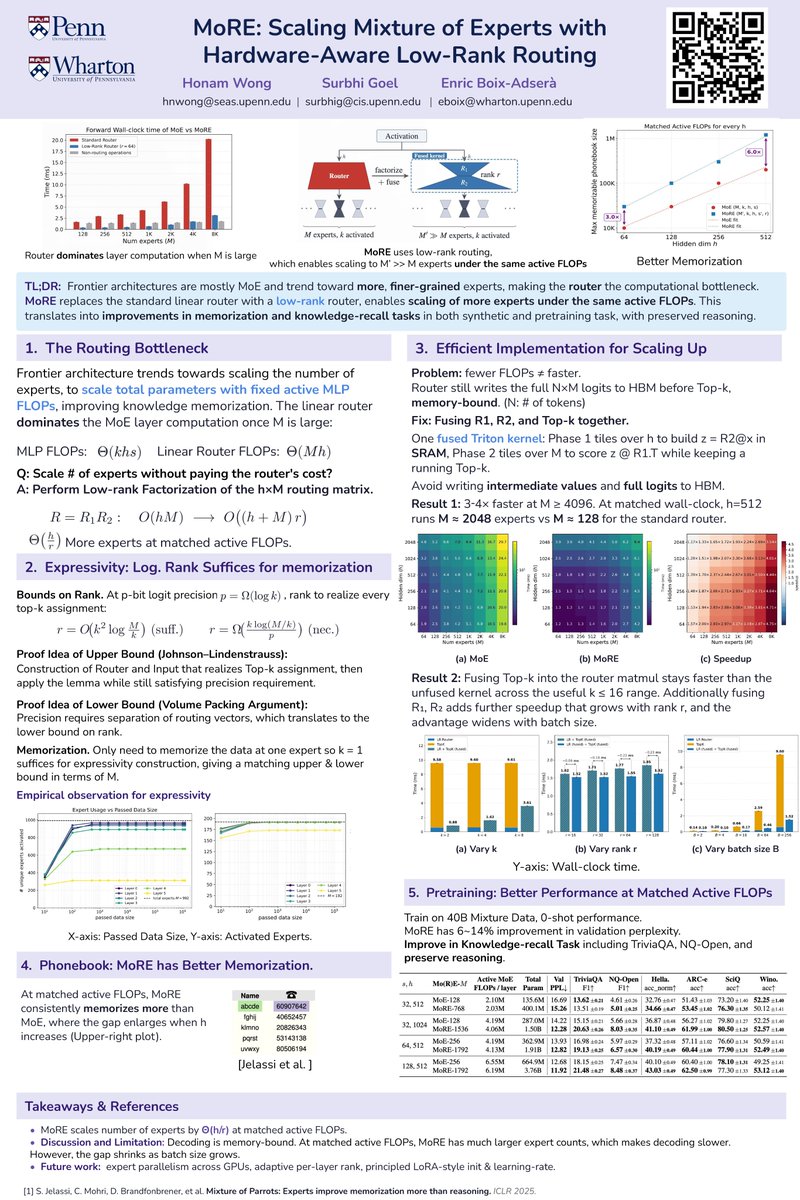
I'll be presenting our latest work on MoE at the CoLoRAI workshop (Connecting Low-rank Representations in AI: From Practice to Theory) on July 11. (More details coming later)
I might also drop by HiLD, Mech Interp, and the "AI as a Tool for Math, CS & ML" workshops on July 10. Catch me around then!
After ICML, I'll be at the Princeton ML Theory Summer School (Aug 3–14), possibly presenting our ongoing work on edge of stability.
Looking forward to connecting and re-connecting with like-minded researchers. Let's chat soon!
1/8 How well does the simplest model in optimization theory, the quadratic, actually describe LLM pretraining? Surprisingly well. We linearize a 150M model at checkpoints throughout training and the local Taylor expansion tracks the true loss for up to 10% of the training budget.
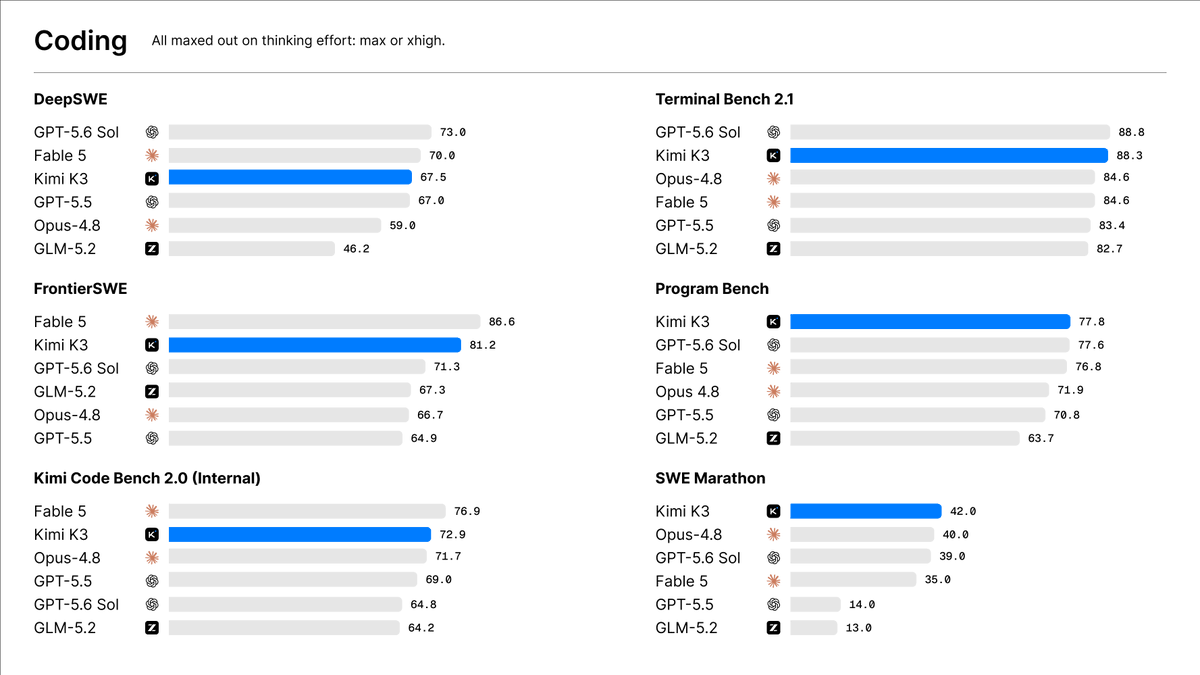
Releasing the model weights and technical report of Kimi K3.
Kimi K3 is our most capable model: a 2.8T MoE model with native visual understanding and a 1M-token context window.
New model architecture: 2.5x the intelligence per unit of compute, not just more params.
Alongside Kimi K3, we're opening up more of the stack behind it — high-performance attention kernels, MoE communication library, and infrastructure for running agent environments at scale.
Model weights: https://t.co/7m7eEg6Y0B
Tech report: https://t.co/yeu6cjpMCT
Tech blog: https://t.co/YTfiMSNM1f
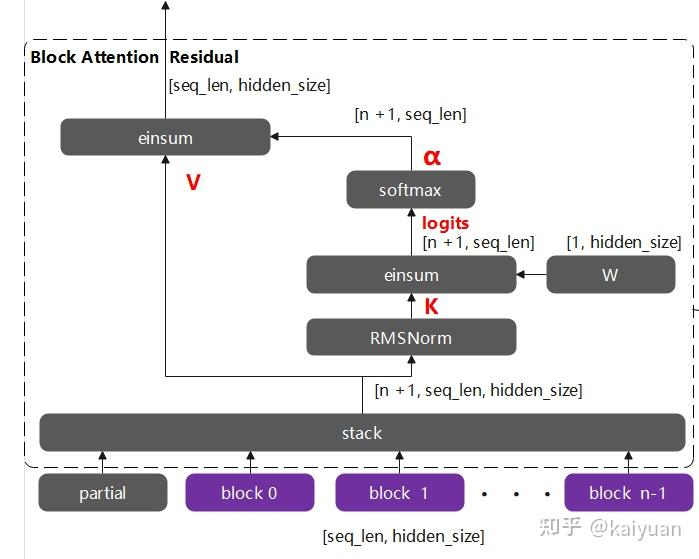
🧩 Kimi K3’s Architecture Is Here—and KDA + AttenRes Arrive Together
Zhihu contributor kaiyuan reconstructed an early Kimi K3 architecture diagram from the information currently available, using K2.5 as the baseline.
The architecture is now public, although the model weights have yet to be released. One detail already stands out: KDA and AttenRes appear together in K3’s design.
🔍 A prediction that landed
When Kimi K2.6 was released, kaiyuan predicted that KDA and AttenRes might arrive as a pair. K3’s architecture has now confirmed that intuition.
👉Check it out:
https://t.co/Mm3wJefzMo
🛠 An evolving architecture map
This is an initial, manually assembled draft intended to make K3’s structure easier to inspect. The diagram will be updated once the official weights become available.
📊High-resolution diagram:
https://t.co/A93fIoDhVs
🔗 Full Reading:
https://t.co/uA35hqErLN
#KimiK3 #Kimi #MoonshotAI #LLM #AIInfrastructure #ModelArchitecture
I have to admit, sometimes I miss the days of being an undergrad, where my only job was learning foundational science. Learning the highlights of hundreds of years of mathematical and scientific progress.
People keep asking me: what's different about optimization in RL?
Seemingly nothing — the pre-training stack just works (Adam, even SGD 👀 @saagnikkk).
Bringing some answers from my last work (sorry for the delay — been cooking 🚀).
We introduce ISO: Isospectral Optimization: an RLVR-native optimization stack.
Built on one simple observation, spectral inheritance: RLVR can reuse the base model's spectrum and acquire new behavior purely through the singular frames.
🧩 Offline: ISO-Merger — consolidates RL experts into one model with no data, no rollouts, no OPD. Checkpoints only.
⚙️ Online: ISO-Optimizer — a drop-in wrapper on AdamW / Muon that matches AdamW's accuracy with ~2.7× fewer steps on Qwen3-8B-Base.
📄 https://t.co/ty1FrAveA5
🌐 https://t.co/xzXf6V8ukO
🧵👇
I'll be at the ICM in Philly next week! Excited to catch the lectures on ML and statistics, to learn more about the different branches of mathematics and how AI is accelerating mathematical research. My DMs are open if you'd like to chat or grab a coffee!
Grad student visas limited to 4-years. Extension possible in principle:
https://t.co/rqEQdj58QC
It's impossible to finish a Physics PhD in 4 years. How hard will it be to get an extension? Will any foreigner still come to the US for a science or engineering PhD?
It's impressive about the expert count and how sparse the model is — only 16 of 896 experts are activated per token. Makes me wonder what the next frontier architecture will look like
Introducing Kimi K3: Open Frontier Intelligence
🔹 2.8 Trillion Parameters, 1 Million Context, Native Multimodal
🔹 Kimi Delta Attention enables up to 6.3x faster decoding in million-token contexts
🔹 Attention Residuals deliver ~25% higher training efficiency at <2% additional cost
🔹 Built for long-horizon agentic coding and self-evolving workflows
Kimi K3 is now live on on https://t.co/zrk6zZxZUo, Kimi Work, Kimi Code, and the Kimi API.
Open Weights by July 27, 2026.
🔗 API: https://t.co/XCrgjXAqMw
🔗 Tech blog: https://t.co/YTfiMSNM1f
Based on some papers I've read, I've gradually formed the following intuition about the relationship between pre-training and post-training. Not sure if this is the right way to think about it.🤔
From a distribution perspective, pre-training learns from a large and diverse corpus, providing a dense supervision signal and resulting in a broad, diverse distribution. Post-training, on the other hand, seems to "collapse" or sharpen that distribution, acting somewhat like a pruning step. The tradeoff is that the model's outputs also become less diverse.
From a skills perspective, pre-training acquires a set of base skills, while RL mainly learns how to compose those existing skills to solve more complex tasks, rather than fundamentally learning new skills.
Overtraining during pre-training seems to hurt downstream post-training performance. I've also seen claims that aggressive learning rate annealing can negatively affect post-RL performance.
If you're around, do stop by the CoLoRAI Workshop on the 11th from 15:15 to 16:30! It's a project that's both fun and challenging, bringing together efforts in theory, synthetic and real pretraining experiments, and ML systems. Also happy to chat on topics related to edge of stability, optimization, mech interp and alignment
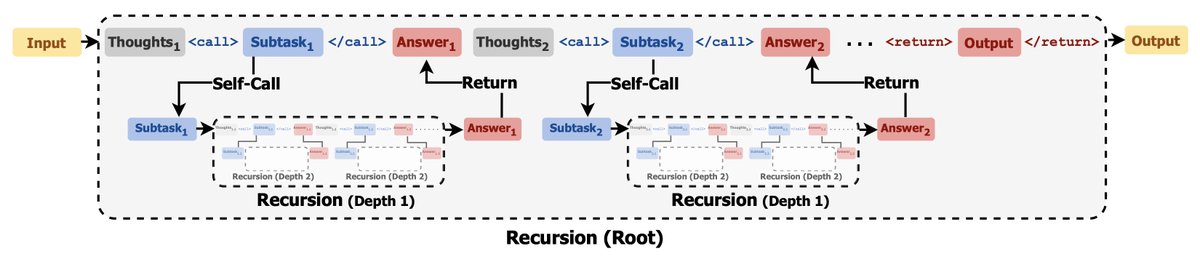
For longer-horizon tasks, we often think about using a long-context model. But harnesses also matter! In fact, they are inherently different in computational power.
Our ICML paper “Recursive Models for Long-Horizon Reasoning” introduces a simple recursive harness, and studies how different harnesses affect a base model’s expressiveness under resource constraints.
🧵1/n
Paper: https://t.co/bgpp1C4WE0
Code: https://t.co/vFhDdQOMql
pretty interesting that it plausibly requires adaptive optimizer, while the theory in the original subliminal learning paper uses full gradient descent
Maybe the magnitude of the "misaligned" direction is pretty small comparing with other directions, and adaptive optimizer scales it
@lawrencefeng17 Really great work! I am wondering what optimizer are you using? The steering vector distillation paper claims we need adaptive optimizers for SL to happen
If you're around, do stop by the CoLoRAI Workshop on the 11th from 15:15 to 16:30! It's a project that's both fun and challenging, bringing together efforts in theory, synthetic and real pretraining experiments, and ML systems. Also happy to chat on topics related to edge of stability, optimization, mech interp and alignment
Excited to be at @icmlconf 🇰🇷 this July!
I'll be presenting our latest work on MoE at the CoLoRAI workshop (Connecting Low-rank Representations in AI: From Practice to Theory) on July 11. (More details coming later)
I might also drop by HiLD, Mech Interp, and the "AI as a Tool for Math, CS & ML" workshops on July 10. Catch me around then!
After ICML, I'll be at the Princeton ML Theory Summer School (Aug 3–14), possibly presenting our ongoing work on edge of stability.
Looking forward to connecting and re-connecting with like-minded researchers. Let's chat soon!
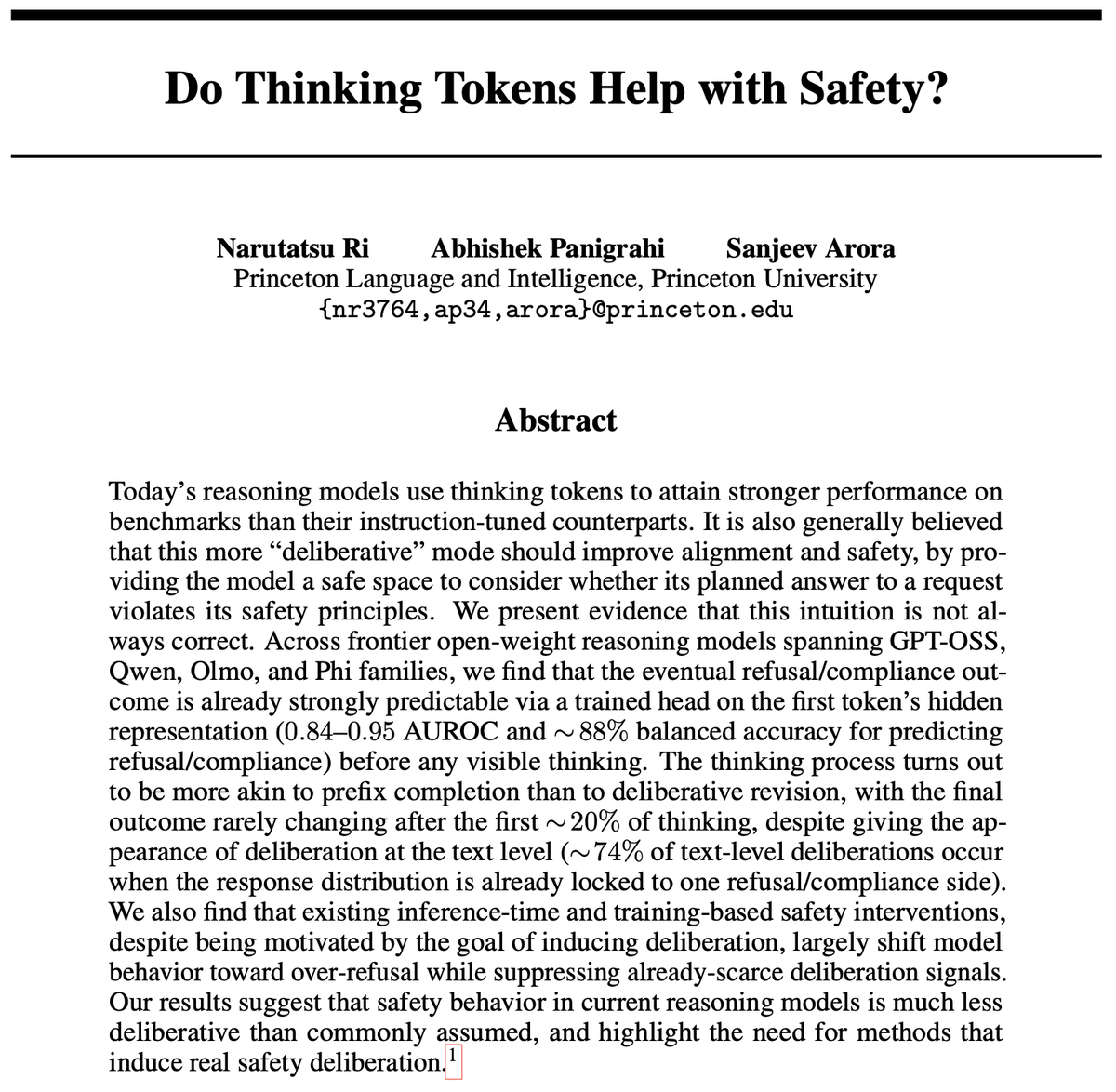
New Paper: Do Thinking Tokens Help with Safety?
Reasoning models generate “thinking” tokens before answering, which improves performance on many tasks like math and coding.
A natural hope is that models can also use thinking to deliberate about whether to refuse or comply a request.
But how true is this?
We find a surprisingly sobering answer: current reasoning models often do not use thinking tokens for real safety deliberation.
Work with: Abhishek Panigrahi, @prfsanjeevarora at @PrincetonPLI
(More in 🧵below)