White/settler, intersectional feminist, M Ed, DLIT,College Faculty, empty nester mom, advocate. (she,her) Views are my own and not of my employer.🌈#sisu#ece
We keep blaming teachers for declining literacy. But have we stopped to consider how dramatically children's lives have changed?
We're raising a generation surrounded by 15-second videos, endless scrolling, and constant notifications. Many children spend more time swiping through content than sitting down with a book.
Then we expect them to sit for 30 or 60 minutes, read complex passages, make inferences, and demonstrate deep comprehension on standardized tests.
Scrolling is a sprint. Reading is a marathon.
Children are becoming accustomed to information arriving in short bursts. They skim, swipe, and move on to the next thing. And when something doesn't immediately capture their attention, another video or notification is waiting.
But reading requires something different. It takes patience, concentration, imagination, and the ability to stay engaged even when something is challenging.
Those abilities develop through practice and experience.
So if children are spending less time reading outside of school, why are we surprised when they struggle to sustain their attention while reading?
And why is the teacher so often the one held responsible?
Consider how many children grow up hearing bedtime stories, watching adults read, visiting libraries, or having conversations about books. Now consider how many spend those same hours in front of screens.
Those experiences make a difference long before a child ever takes a reading assessment.
Schools can teach children how to read, but they cannot control how children spend the other hours of their lives.
And increasingly, we're asking teachers to compensate for cultural changes they had no part in creating.
We also need to ask ourselves what we're doing inside schools. When we replace opportunities to read, explore, discuss, and enjoy books with more worksheets, test preparation, and assessments, are we actually helping children become better readers?
A child who discovers the joy of reading is far more likely to pick up another book than one who associates reading primarily with answering questions on a test.
Literacy develops through experiences, relationships, conversations, curiosity, and practice. It begins long before a standardized test and extends far beyond the classroom.
Gloria Steinem will go down in history as one of the most important activists of all time, leading a movement for the equality of half the world: its women.
She lived a long and passionate life dedicated to this vital and basic cause.
She did it with intellectual precision, emotional awareness, humour and beauty. May she rest in peace and may the cause thrive.
Did you know, the Liberal government’s Bill C-37 is a return to Stephen Harper’s anti-Indigenous policies that fueled the Idle No More movement. Just like in the Conservatives’ Bill S-8, Bill C-37 was not developed in consultation with First Nations and is in clear violation of Indigenous rights that are confirmed in the Canadian Constitution, that includes international laws and conventions we've signed on to.
If the government does not amend Bill C-37 to uphold First Nations’ human right to clean water, we must all join together to send a clear message to Carney's Liberal government – we will not stay silent in the face of such blatant discrimination. Everyone should have the right to clean drinking water, especially children, families and all individuals across Canada.
Education is a fundamental human right and a powerful tool for peace, opportunity, and equality. On the International Day of Education, we stand in solidarity with learners and educators around the world working for access, safety, and dignity in education.
#bced@bctf@BurnabyTeachers@SurreyTeachers
Current classroom conditions are in need of more types of support. EA’s, counsellors, composition, training for new literacy assessments and SOR aligned Pro D. Specialists are being pulled to TTOC.
Provinces rely heavily on retired teachers because there aren't enough people interested in becoming teachers. Supply lists are depleted. #onted#cdned#edchat https://t.co/a06zApOYYb
10 Things Educators Need During a School Break and Why
1. Sleep without an alarm
Your nervous system has been living on adrenaline and cortisol. Deep rest helps reset the brain restore emotional regulation and improve memory mood and immune function.
2. Silence and nothingness
The brain needs quiet to downshift from constant decision making. Mental stillness reduces cognitive overload and allows the prefrontal cortex to come back online.
3. A non rushed bathroom visit
Having to suppress basic bodily needs keeps the brain in a low level stress state. Unrushed bathroom access restores a sense of safety dignity and control which directly calms the nervous system.
4. Laughter that makes your stomach hurt
Laughter releases endorphins and dopamine which naturally reduce stress and anxiety. It also reminds your brain and body that joy still exists outside of survival mode.
5. Connection with people who do not need anything from you
Educators give all day long. Low demand relationships restore emotional energy and protect against compassion fatigue.
6. A slow bath or shower in the morning
Warm water activates the parasympathetic nervous system lowering cortisol and muscle tension. A slow start to the day tells the brain you are safe and not in crisis mode.
7. Food that is eaten slowly and actually enjoyed
Mindful eating supports digestion stabilizes blood sugar and calms the nervous system. Your body deserves nourishment not rushed fuel.
8. Time without solving problems
Constant problem solving keeps the brain in threat detection mode. Breaks from decision making allow the nervous system to recalibrate and reduce mental exhaustion.
9. Reminders that you are more than your job
Identity overload increases burnout risk. Engaging in hobbies or creativity activates different neural pathways and restores a sense of wholeness.
10. A true break with compassion for yourself
Compassion fatigue is real. Prolonged caring without recovery depletes emotional reserves. Rest and self kindness rebuild resilience empathy and long term sustainability.
Final Thought
School breaks are not a luxury. They are neurological and emotional repair time. Rest is not quitting. Rest is what allows educators to return regulated connected and able to keep doing the work that matters so deeply.
🎄 12 Days of Christmas: Building Better Literacy Instruction 🎄
Over the next 12 days, I’ll be sharing curated, evidence-aligned literacy resources designed to help educators move from research to instructional precision. Each resource is selected to support teachers, coaches, and leaders in making informed, effective decisions about instruction, practice, and intervention.
🔹 Day 1: A Padlet of resources related to The Instructional Hierarchy (Haring & Eaton, 1978), Types of Practice, and Cognitive Load Theory
I started here intentionally. The Instructional Hierarchy provides a critical decision-making framework that helps educators determine:
- What type of instruction students need
- When practice is appropriate—and when it is not-
- How fluency, generalization, and maintenance fit within MTSS
- Why mismatched instruction leads to stalled progress
When we ignore where students are in the learning process, even strong materials and good intentions fall short. This resource supports implementation fidelity and instructional alignment.
🔗 The Day 1 resource and all others to follow can be found at this link: https://t.co/pXD63OBHKF
Follow along for the next 12 days as together we unpack practical tools that strengthen literacy systems and classroom practice.
🧠 New Harvard research shows reading struggles start as early as 18 months, not Grade 1.
This means kids at risk for reading difficulties are already on a different path before school starts.
https://t.co/9Zi9gPOs1b
The hardest theological questions come from young children.
Young children challenge adults in our beliefs, our traditions, and our ways of seeing and existing in the world.
And we are better for it.
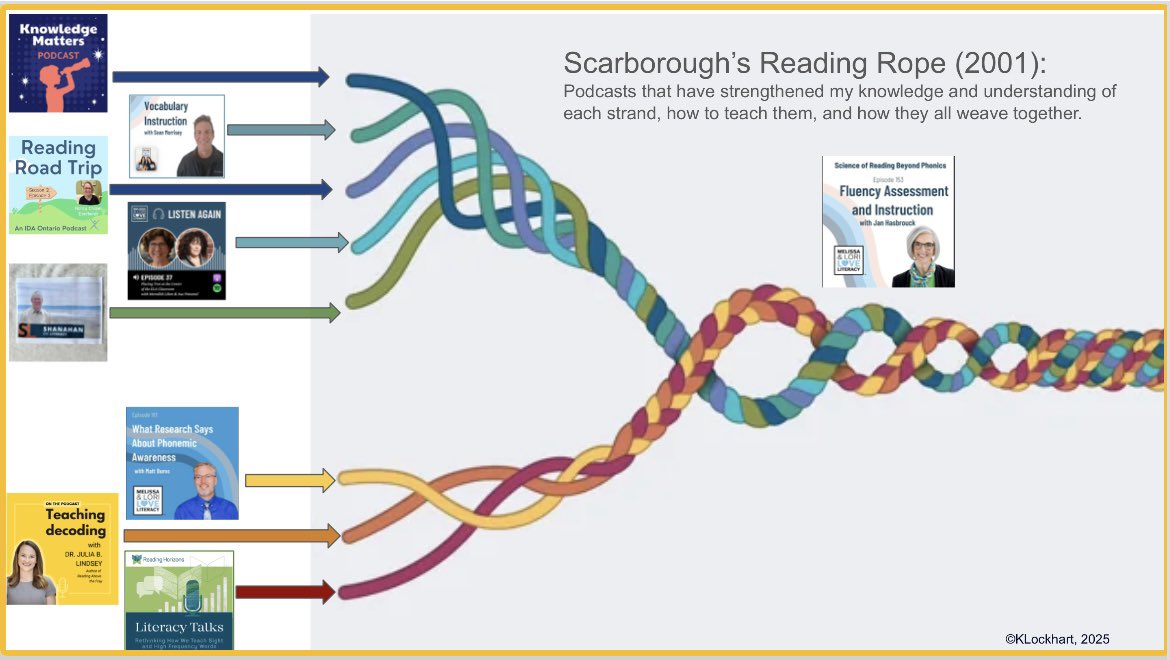
Scarborough’s Reading Rope is a model that illustrates just how complex the reading process is. It is imperative for teachers to know and understand how to effectively teach each of the strands and understand that the implementation of one program is not suffice for most students to attain reading proficiency.
Over the years, I have been growing my knowledge and understanding of ALL eight strands of the Reading Rope (as well as the strands of the Writing Rope AND implementation science!) through books, webinars, and podcasts.
I have created this infographic to illustrate my favourite podcasts that align with each strand of the Reading Rope. Each one has contributed to my knowledge of what it is, why it’s important, and how to teach it!!!
https://t.co/1ALNBsM868
I have an orange 🍊 heart and voted with a green 💚pencil yesterday. Voting for E May was the way in my riding to keep out Pollieve and the Conservatives. #Election2025#elbowsup