The institutions, infrastructure, and capital behind science are being reimagined.
Catalyst NYC brings together researchers and funders to explore what’s working, what’s next, and where the opportunities lie.
We’ll be discussing:
→ Alternative funding models
→ Open science infrastructure
→ Where philanthropy and venture capital meet research
→ How discoveries move from the lab to real-world impact
And much more. Full agenda coming soon.
📅 July 11
📍 NYC
#CatalystNYC is invite-only.
Request an invitation: https://t.co/gj21WTmFf3
We introduced Registered Reports at @ResearchHub a while ago and tied them directly to funded projects. Big advantage is everyone (including funders) can track the chain from funded projects-> registered reports -> results, and make informed decisions about follow up funding.
Still great to see more publishers adopt parts of the model 👇
>11M $RSC now deposited in the ResearchHub endowment, up from 1M eleven days ago
Today holders on the platform are earning an 85% rate in funding credits they can ONLY use to fund novel research proposals
Catalyst NYC - an invite-only gathering of researchers, funders, and institution-builders - is coming to Manhattan on July 11th 🗽
We're bringing together the brightest and boldest minds for discussions about the future of science, alternative funding models, and open science infrastructure.
Hosted by @ResearchHubF, @NucleateHQ, and @cure345
Think you belong in the room? Request an invitation here: https://t.co/7J1RFc5ybS
I currently have three papers in review at "high impact" journals.
One of them has been sitting there for two years. In that time my daughter was born and learned how to walk, but apparently publishing a PDF was still not possible for me. For another one, after four months in review the editor told me they cannot find a second reviewer and asked me to suggest more reviewers. A third one sent me a message in 2026 saying the PDF I uploaded was larger than 10 MB and that I should please reupload everything to make the file smaller.
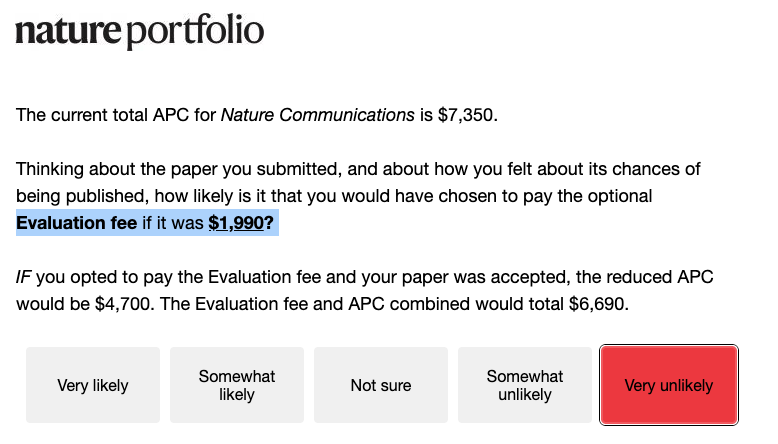
All of this just to eventually pay between 7,000 and 12,000 USD per paper so someone can officially approve that the science we do is "legitimate". Reminder: not a single reviewer will be compensated here.
I still don't understand how we as scientists can collectively be so smart when doing science and still tolerate a system like this when it comes to sharing our findings. We should move to preprints plus open review, whether human or AI, asap. So frustrated about it.
I'd suggest sharing your work on bioRxiv or medRxiv, reading and reviewing preprints when you can, and highlighting good research, especially if it is still a preprint. Try platforms like ResearchHub (that pay for peer review) and experiment with AI based reviewers for faster feedback.
Instead I read this as a proposed "revolutionary" measure:
Crypto —> Universities
With Endaoment, @ResearchHub has helped distribute $1M in research funding to Stanford, Harvard, UCSD, UCI, UC Davis, Purdue, USC and others.
Open proposals, open peer review, and faster funding 🔥
Does exposure to EMF from an electrical substation impact the injury risk of NFL players? ⚡️🤔
Announcing $100K in funding to test @living_energy's viral hypothesis about why the 49ers are the NFL's most injured team.
4-8 grants. Preregistration required.
RFP in comments👇
OpenAlex is now serving ONE BILLION api calls monthly (that's as much as the Crossref api)! Plus another half-billion monthly via the Unpaywall api.
A million api calls isn't cool; a BILLION api calls is cool :)
https://t.co/Y4fFhYQGTF
Can (and should) academia be decentralized?
Our panel of experts will assess the feasibility of decentralization in academia and what it would mean for science.
Idea → Funding → Execution → Publication
This project shows the full ResearchHub cycle in action.
@ALLFEDALLIANCE researchers sought to demonstrate that global catastrophes might not be as far-fetched as they seem, so they studied 63 years of food shock data.🧵
1/10
Update from our partnership with the Center for Open Science:
3 ResearchHub-reviewed preprints have now been fully evaluated and published in the Lifecycle Journal.
ResearchHub led the open peer review process, delivering:
✅ Open peer reviews
✅ Fast turnaround (9.5 days on average)
✅ Public scores on rigor, clarity, and reproducibility
The Lifecycle Journal uses multiple evaluation services, combining traditional human and AI assessments. All reviews are public.
Check out the outcome reports for their first publications:
🔗 https://t.co/E3yxRsjJSL
🔗 https://t.co/j8edXemWwa
🔗 https://t.co/By66jNgq7T
Why a top scientist with 150+ publications is turning to open science.
Join Dr. Brian Kim on X-Spaces this Sunday to find out.
https://t.co/lMyccF2FHs
https://t.co/PZ6iSbEYFy
Don't forget to book your spot at the next ICOR meeting focusing on new paradigms in research communication. Speakers and perspectives from: HHMI, ASAPbio, PLoS and ISC. To book your place, register for free through this link: https://t.co/p39btPO3FS
https://t.co/XH19MtpGGw
PUBLIC MEETING ANNOUNCEMENT: February 27. The meeting will be a continuation of the "Future of Open Science Publishing” workshop held in December. We are seeking wider participation, so please read our latest blog to register and get involved. https://t.co/qYpe3B7brL
@MarkHahnel Yes, I agree. It’s an opportunity to demonstrate that great research can thrive in a fair and open process where collegiality and science trump the proxy.
We're getting ready to launch MetaROR and make peer review faster, more transparent and more efficient 💪
Join us and @aimos_inc for the official launch of MetaROR (MetaResearch Open Review), a new open platform for reviewing and sharing metaresearch operating with an innovative publish-review-curate model.
Launch Events ⬇️