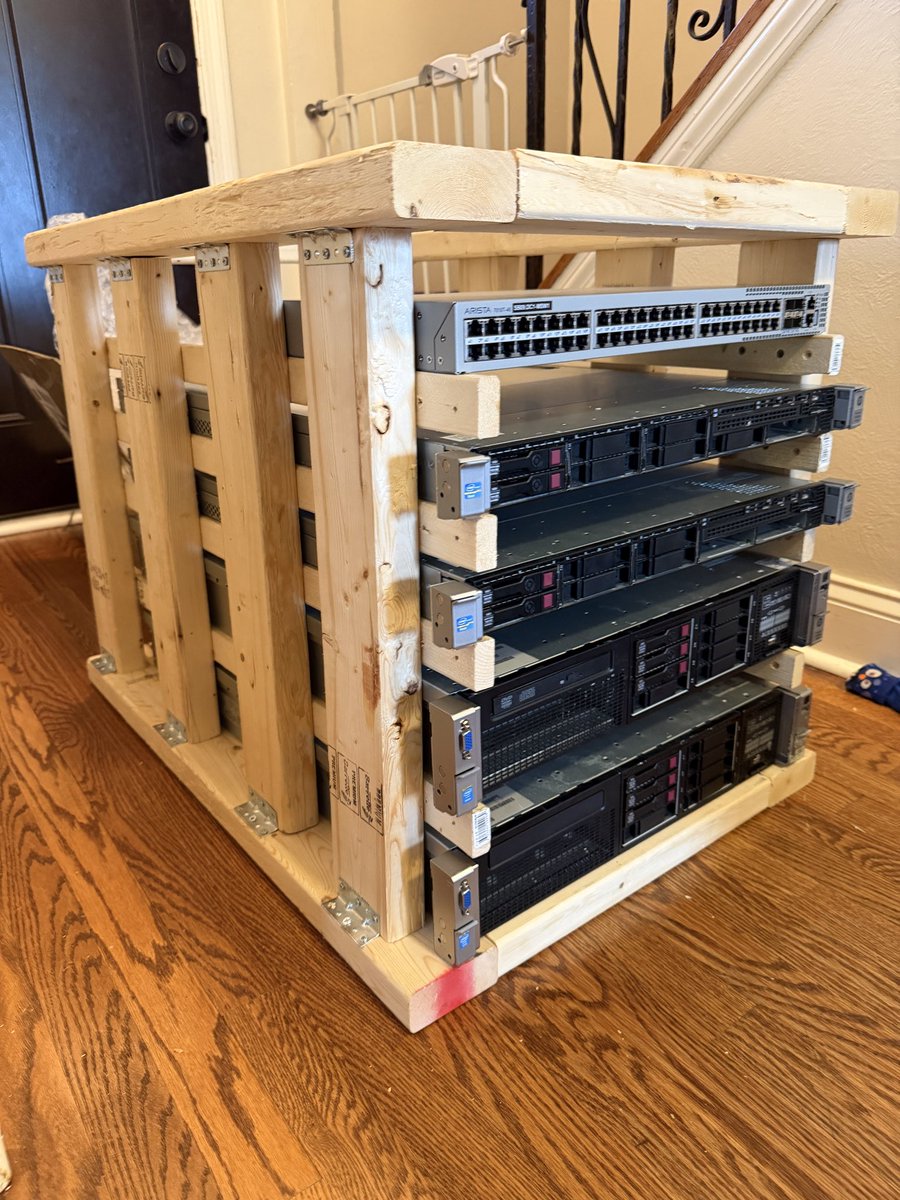
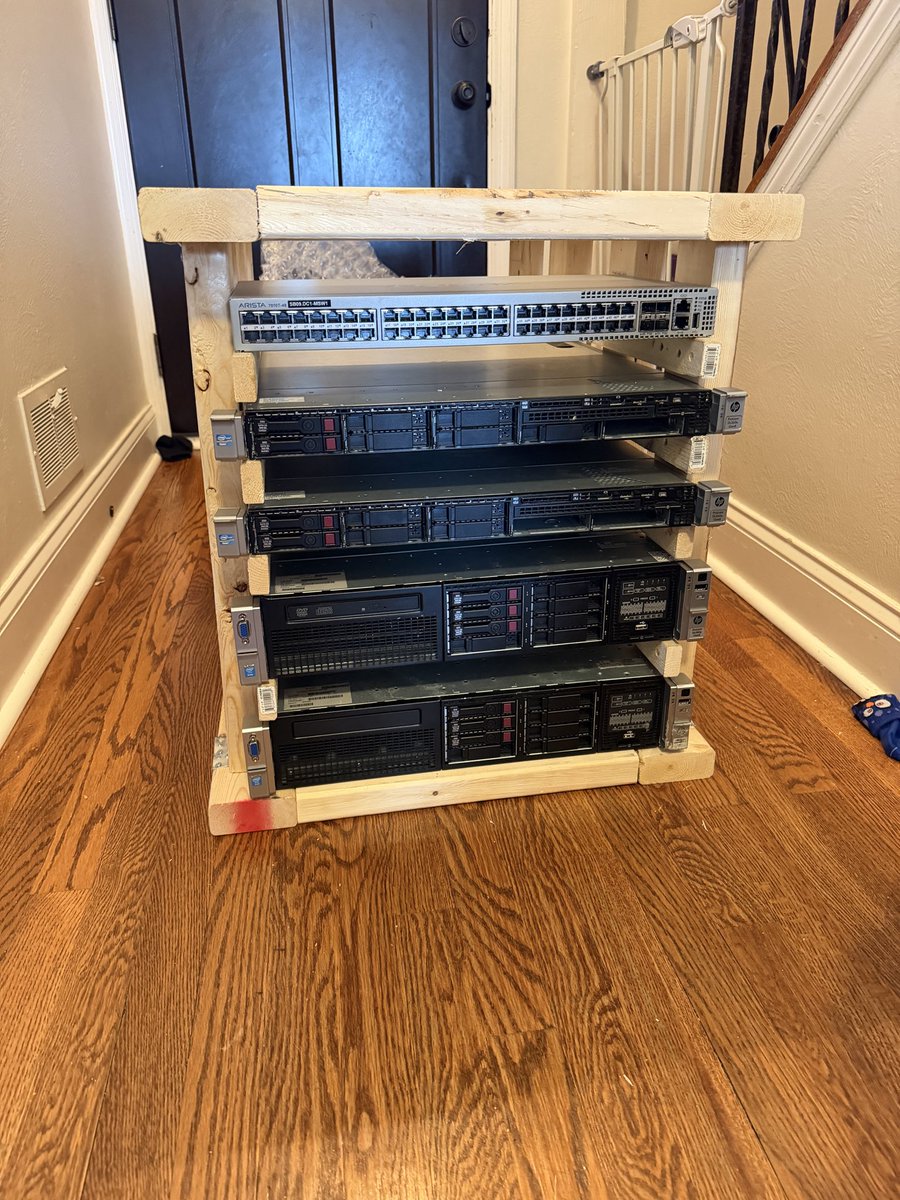
Newest addition to the homelab! Made it extra homelab-y by building a wooden rack instead of buying more rails because they seem wildly expensive.
2x DL380 w 2x e5-2660v2 + 384GB ddr3 ram
2x DL360 w 2x e5-2470v2 +192Gb ddr3 ram.
40 cores, 80 threads, over 1TB ram. I know it’s like 14 years old. I know it’s slower than whatever.
But the whole thing including the lumber cost ~$640 and my first ramp test got to 63 concurrent VMs and today we got to keeping the VM image/snapshot in ram so they load ridiculously fast and I’m so pumped
Hot take: the best homelab upgrade isn't hardware, it's making updates boring.
One tool owns updates, nothing auto-updates in place, and every change is a PR you can read and roll back. Fewer 11pm surprises, more time actually using the stuff.
It is finished.
Microrack homelab.
2x raspberry pi zero 2w
2x orange pi zero 3
1x radxa cubie a7s
Using ESPhome, I am able to turn them all on and off remotely via Home Assistant.
bucs are 3-6 going into the bye and somehow only half a game out of first. the nfc south is a group project where nobody did the reading https://t.co/rUkcgtljtq
these 10 GPU optimization papers are why your model runs fast today
the engineers who actually read these are the ones who'll be writing your kernels in 2 years.
links to the papers below! 👇
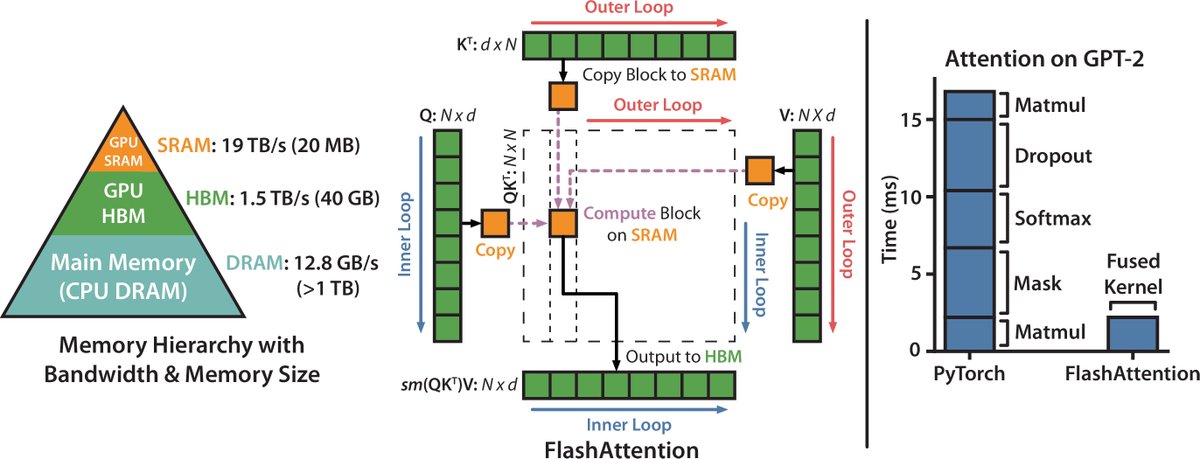
1. FlashAttention (2022)
• IO-aware exact attention: tiles Q/K/V into on-chip SRAM and uses online softmax to avoid materializing the quadratic attention matrix in HBM.
• an incredible example of how optimizing data movement can unlock longer contexts and faster Transformers.
2. FlashAttention-2 (2023)
• redesigns work partitioning across thread blocks and warps, improving occupancy while cutting non-matmul FLOPs and shared-memory communication.
• makes attention substantially better at actually using the GPU's compute capacity. around 2× faster than the original in the paper's benchmarks.
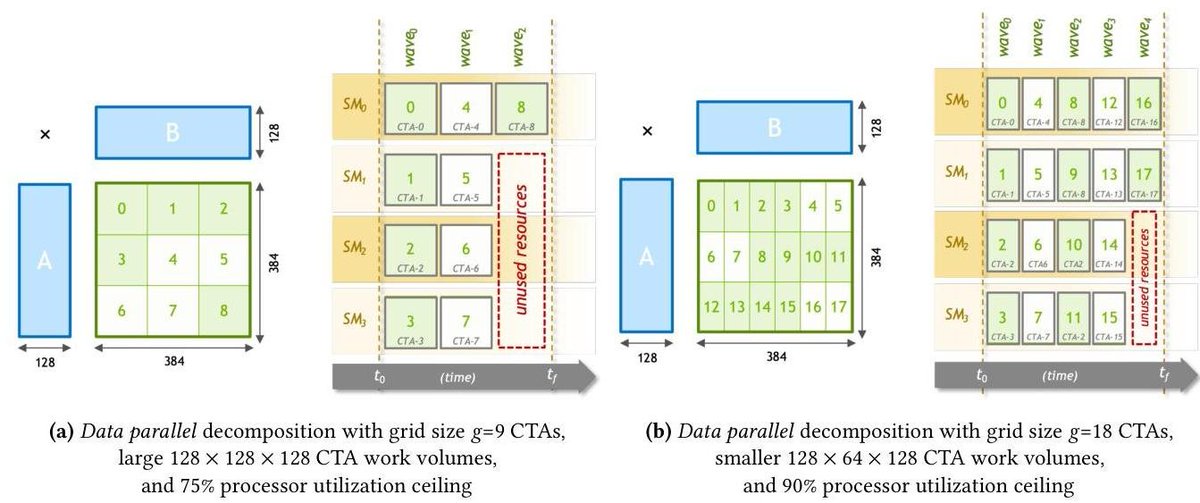
3. Stream-K (2023)
• partitions aggregate GEMM inner-loop work into balanced chunks, reducing the wave-quantization inefficiency of fixed output-tile scheduling.
• especially elegant for matrix shapes that would otherwise leave a partially occupied final wave of thread blocks.
4. PagedAttention (2023)
• brings virtual-memory-style paging to KV-cache management, with noncontiguous physical blocks and flexible cache sharing.
• foundational to vLLM: reduces memory waste so serving systems can fit larger batches.
5. FlashAttention-3 (2024)
• exploits Hopper's asynchronous Tensor Cores and TMA through warp specialization, overlapping data movement with computation and interleaving matmul with softmax.
• adds an FP8 path with block quantization and incoherent processing. serious hardware-algorithm co-design.
6. Tiled GEMM / Tensor Core dataflow (foundational technique)
• stages matrix tiles through shared memory and registers, reusing operands across Tensor Core multiply-accumulate operations.
• the foundation underneath so much of this list. a family of techniques, so this entry has no single canonical paper.
7. Online normalizer calculation for softmax (2018)
• updates the running maximum and normalization sum as elements stream through, reducing memory passes while preserving numerical stability.
• a beautifully compact building block for memory-efficient attention.
8. MARLIN (2024)
• combines low-bit weight storage with higher-precision computation, using asynchronous loads and carefully pipelined dequantization to feed Tensor Cores efficiently.
• makes weight-only quantization useful for batched inference, with substantial speedups extending beyond single-user decoding.
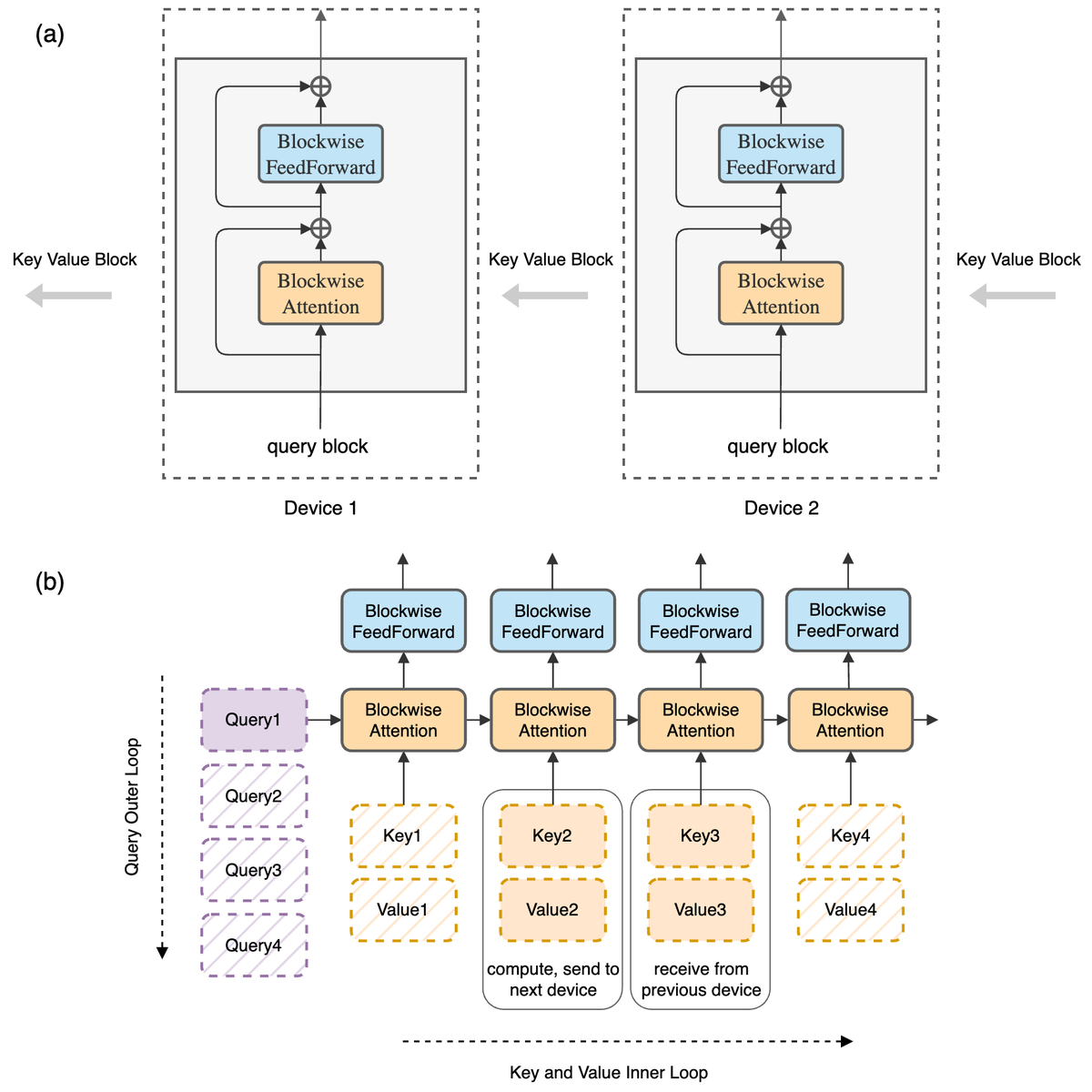
9. Ring Attention (2023)
• distributes sequence blocks across devices and circulates KV blocks in a ring, overlapping communication with blockwise attention computation.
• scales context capacity across GPUs while preserving exact attention.
10. FlashInfer (2025)
• combines customizable attention kernels with load-balanced scheduling for dynamic serving workloads and heterogeneous KV-cache layouts.
• tackles the messy inference conditions: variable sequence lengths and changing request batches.
links to the papers, same order:
1. FlashAttention
https://t.co/wkRORf0tRf
2. FlashAttention-2
https://t.co/v23kmebrGN
3. Stream-K
https://t.co/V8dldoTDZd
4. PagedAttention
https://t.co/mmtorgjXd8
5. FlashAttention-3
https://t.co/YCJDZJaDpS
6. Tiled GEMM / Tensor Core dataflow
no single paper. FlashAttention above is one concrete example of IO-aware tiling.
7. Online normalizer calculation for softmax
https://t.co/3zl1ZunPDJ
8. MARLIN
https://t.co/hvd8geyy8K
9. Ring Attention
https://t.co/eQfdn3EVhl
10. FlashInfer
https://t.co/bOLhjdPcvD
A 3D-printed holder turns two USB NFC readers into a drop-in station for filament spools.
TigerPOD puts an ACR122U-compatible reader on each side, so a two-tag spool can be read or written without first aligning the labeled face. I like that the mechanical fixture does the usability work: the electronics remain standard PC/SC readers, while the printed shell creates the repeatable geometry.
Project + video: TigerTag Project
https://t.co/NZZTD0prON
Video: https://t.co/LkTsqeeH45
Video license: CC BY 4.0 https://t.co/3ZE347s12t
Unmodified original video.
@SamsClub just shipped a Live Activity for Scan & Go, and I genuinely love it. You pay in the app, and a “Thank you! Skip the registers and head to the exit” banner with your exit QR code stays on your lock screen. No digging through the app while juggling a 48-pack of paper towels and a rotisserie chicken. That’s thoughtful, user-first design, and I want to give credit where it’s due. 👏
But.
Look at image 2. That’s the same banner when my phone is unlocked. iOS politely switches the background to white, and the text… stays white. The message is still there, technically. It’s just in witness protection.
The best part? The QR code adapts perfectly, flipping from white-on-black to black-on-white like a pro. So the QR code read the Human Interface Guidelines and the text did not. One element is fluent in light mode; the other is holding out for dark mode forever.
For the non-iOS folks: this is the classic hardcoded .white versus semantic color problem. Use .primary (or set an explicit background tint so it can’t change under you) and the system handles contrast for you. It’s a one-line fix, and exactly the kind of thing that slips through when everyone tests on a locked phone in a dim office.
So I have to ask, with love: was this vibe coded? 😄 Did someone prompt “make a cool lock screen banner,” get a gorgeous demo screenshot, and ship it?
Either way, great idea, 90% great execution, and I’ll keep using it. Sam’s Club, if your iOS team sees this, the fix is a coffee break away. ☕
#iOS #SwiftUI #UXDesign #Accessibility #LiveActivities
Fury vs Wilder 2 has to rank among the best performances of Tyson’s career. The adjustments from the first fight were spot on. He went from trying to box Wilder to taking the fight straight to him. An absolute demolition job.
#Boxing#furyjoshua
I have this VPS in Peru I use as a gateway for my homelab, very cheap and low latency. However I cannot manage it like cattle as in a cloud provider, I did some OS updates and required a reboot, it never booted. I didn't know they offered a VNC grub recovery console, very useful!
Built myself a little beast. 👀
My first micro-ATX build, turning an old PC into a server playground for all the random projects and experiments I've got planned.
Let's see how far this little thing goes. 😂
#pc#homelab#ai#server
one guy in norway built a brood war ai that keeps beating pros. six barracks and zero upgrades against zerg. it plays like a kid at a lan party and it's winning
The 16GB Raspberry Pi 5 now costs $385, more than triple its $120 launch price. At that level, makers are choosing Pico or ESP32 for small builds and mini PCs for bigger jobs. Has the Pi lost its budget-computing edge?
https://t.co/joVdF6huxa
#RaspberryPi#MakerTech