Russian soldiers attempted to seize a Ukrainian position in #Bilohorivka, Luhansk Oblast but were repulsed.
These Russians were wearing Ukrainian uniforms and/or ID tape in an attempt to confuse the defenders.
#UkraineRussiaWar
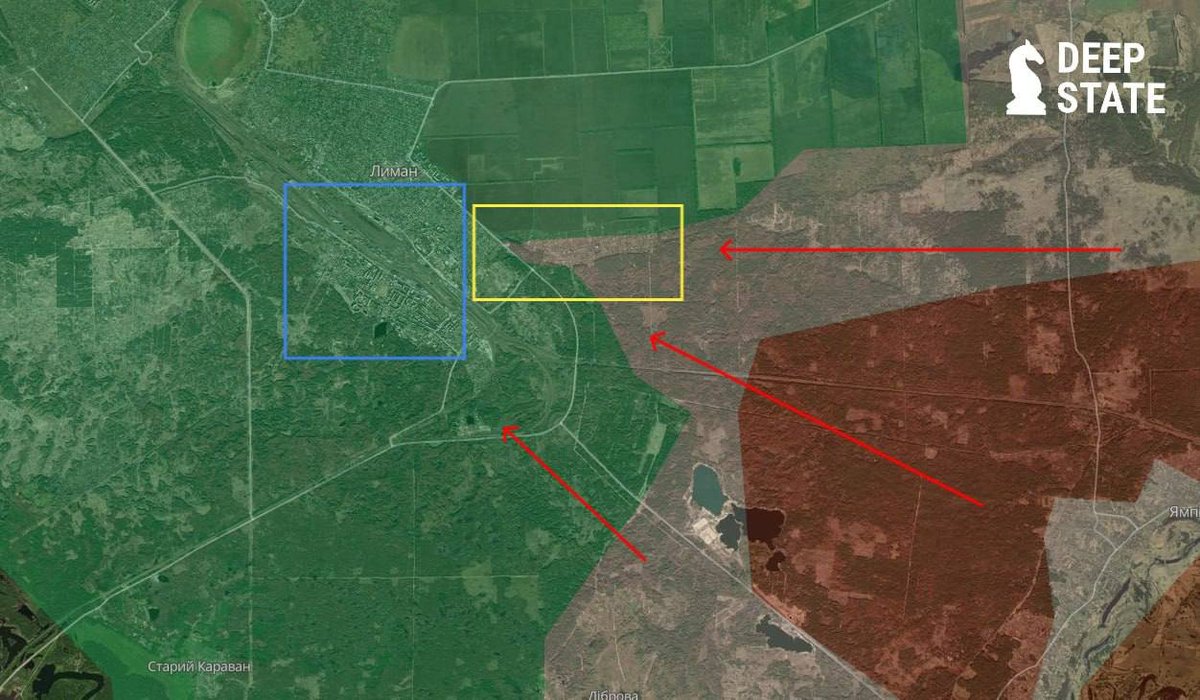
DeepState's view on the situation in Lyman 👇👇
ℹ️ Recently, there have been many discussions and questions about Lyman. In particular, there are reports of enemy activity in the eastern part of the city, which logically leads to the conclusion that the Russians are infiltrating there. Increased activity on the city has been ongoing for some time, and given the successes of the Russians at Kostiantynivka, Lyman is becoming an increasingly important target. And the numerical superiority and low density of defensive positions contribute to enemy infiltrations, which is no longer a surprise.
🏹 However, it's worth noting some details that will help better understand the situation. The largest area of enemy activity and control is the red and gray zone of the Serebryansk forestry. There, they move, hide, fortify themselves and try to penetrate deeper from there. In Lyman itself, as before, there is activity and fixations in the eastern outskirts, which are marked in yellow and have a corresponding gray zone. There have also been fixations in the blue zone, but they are not yet systematic, so there is no reason for the gray zone yet. Ukrainian pilots are doing a good job of disposing of the Moscow trash, which they are sending to their death.
🔴 However, the situation in Yampol and Ozernoe is extremely unpleasant. We hope that the higher command will pay attention to this area and take appropriate actions so that we don't lose a bunch of people unnecessarily.
📍 We are monitoring the situation on this section and will definitely inform you of all changes!
The American pilot of a U.S. Air Force F-15E Strike Eagle that was shot down over Iran in April, requiring a high-risk rescue mission by special forces, described a shocking sight before ejecting from his aircraft: multiple Iranian drones hovering in the air, moving as one, in a formation that resembled a jellyfish, four sources familiar with the matter have told CNN.
“Multiple drones interconnected and moving as one with smaller drones below the bigger drones like legs,” one of the sources familiar with the pilot’s witness account told CNN. “Real alien sh*t.” Another source said that the pilot described witnessing a “minefield of drones” in the air prior to being downed over Iran. The pilot’s account immediately set off a firestorm of debate that has yet to be resolved within the U.S. Intelligence Community.
“Two-thirds of the defensive weapons that have protected your homeland have been built by American hands and paid for by American tax dollars,” Vance said. Indeed, the U.S. used half of its entire global inventory of THAAD interceptors to defend Israel…
@Boomer__Remover@QuillFirePoetry@sentdefender@HibaNasr Wiki is not a fucking source, you outta fucking know that unless you are retarded. The military solution required a ground operation. This isnt just Trumps fault, but our military leadership who thinks they can win wars via the air. If we had prepared, the job would be done.
This is (unfortunately) one of the most interesting and enlightening articles i've ever seen on British Army Review. I say unfortunately because it is a tale of literal regression and drips with frustration caused by procurement reforms that have only made everything even slower.
The Telegram channel “Byt Ili” conducted a detailed analysis of the performance of Russian air defense during yesterday’s Ukrainian drone raid on Moscow.
It was the first time that the operation of Russian air defense could be observed almost in real time.
Key conclusions from the analysis:
“Perhaps the most surprising thing for me in today’s strike on the Moscow oil refinery is the number of missed interceptions by Russian air defense systems against Ukrainian UAVs.
In this compilation, I’ve specifically cut together the misses by ‘Pantsirs’.
The selection is not complete.
For the first time, we were able to observe in real time how Russian air defense operates during large-scale drone raids. And I have no rational explanation for why it performs THIS poorly.
Yan Matveev described it most succinctly: ‘Air defense systems were deployed right in the city, missiles are flying chaotically in all directions and missing their targets; the threat from them is no less (and perhaps even greater) than from the drones themselves.’
But this still doesn’t answer the question: why is it like this?
After all, these are UAVs flying at low speed — not cruise missiles, and certainly not ballistic ones.
This can hardly even be described as a combined strike designed to overwhelm air defenses. The only fast-moving targets here were a few jet-powered UAVs like “Bars,” and there were very few of them.
This is nowhere near the level of overload seen in Ukrainian air defenses during Russian combined missile strikes. And yet, even a strike of this scale creates chaos and confusion for Russian air defenses.
It also leads to the conclusion that ‘Pantsir’ systems perform rather poorly against UAVs.
Now it becomes clear why there is such a shortage of Pantsir missiles — because even slow Ukrainian drones sometimes cannot be shot down with two missiles.
This is shown in videos 1 and 2 — two misses by a Pantsir against a single UAV, which ultimately hits its target.
In video 3, a Pantsir misses the first UAV, misses the second, and only the third missile manages to shoot down the second UAV.”
1/
Regarding the situation on the front:
- Ukrainians are continuing the clearing operation around Stepnohirsk; the Russian advance has slowed west of Hulialpole; an assault on Mala Tokmashka has again been repelled.
- Ukrainians are pursuing a large counter-attack between Ternuvat and Novopavlivka, pushing towards two major villages, Uspenivka and Komar, to prevent their use as logistical hubs.
- Pressure continues west of Pokrovsk and towards Dobropilla, but the advance has slowed considerably thanks to a strong Ukrainian defense.
- Russian forces are beginning to take control of several districts in eastern Kostiantynivka, expelling Ukrainian forces from some strongholds. Infiltration and urban fighting continue throughout the city, with flag-raising actions that should not be interpreted as a sign of control. Overall, we are nearing the end of the battle for the city, the fall of which could be staggered until mid-summer. This is Russia's first strategic victory of the year.
-In Siversk, Russian infiltrations continue toward Sloviansk, with the first flags appearing in Rai Oleksandrivka, a strategic height east of the city. Fighting in the sector is currently in favor of Russian forces.
-In Lyman, the Ukrainians are continuing their counter-attack on the northern flank with success (although the maps do not yet show this), while Russian infiltrations continue (as they have for months) toward the city center.
-Nothing to report in Borova.
-In Kupiansk, as in Lyman, Russian infiltrations have been ongoing for months, this time concentrated on the eastern part of the city.
-No significant activity along the border, as the Russian offensive launched in the spring failed to threaten the Ukrainian rear.
@TitherM@lilbabygandhi Filthy Russian whore. You think your so "enlightened", when all you did was make Russian propaganda part of your identity. Now your nothing but an ork pussy, ready and willing to be fucked by Putin whenever he wants because if it was up to you, he would seize Europe easily.
The burning Moscow Oil Refinery, hit by numerous Ukrainian attack drones this morning, is sending a massive smoke plume soaring over the Russian capital today.
Footage of a Ukrainian attack drone hitting a storage tank at the Moscow Oil Refinery this morning, sending the tank lid perfectly soaring hundreds of feet.
The "US biolabs in Ukraine" story is one of the Kremlin's oldest and most successful disinformation campaigns.
The facilities in question were Ukrainian public health and veterinary laboratories supported by the US Cooperative Threat Reduction Program to improve biosafety and disease surveillance. None of the publicly available documents show evidence of biological weapons.
In Russian state media, these facilities are routinely described outright as "US bioweapons labs." Among pro-Kremlin influencers and politicians in the West, the messaging is often more subtle. They simply talk about "dangerous pathogens" and hint at unspecified sinister purposes, allowing audiences to draw their own conclusions.
Yet Tulsi Gabbard, a long-time Russia supporter who met Syrian dictator Bashar al-Assad twice and questioned the Assad regime's responsibility for the Khan Shaykhun chemical attack, is now presenting old public documents as newly "declassified evidence." In reality, ODNI simply re-stamped documents that had already been public for years.
Many of the slides are excerpts from a Pentagon DTRA fact sheet released publicly in March 2022. Gabbard's office repackaged these documents and presented them alongside Russian fabrications as evidence of a sinister biolabs program.
This shouldn't surprise anyone. When it comes to Ukraine, Gabbard has consistently echoed Kremlin talking points. She has argued that the US and NATO provoked Putin into invading Ukraine, framed the conflict as a US-Russia proxy war, claimed that sanctions hurt the West more than Russia, blamed an "elite cabal of warmongers" for the conflict, and suggested that peace negotiations should prioritize avoiding nuclear war.
She has repeatedly claimed that the war could have been avoided by ruling out NATO membership for Ukraine. But Putin himself made clear in his essays and speeches before the invasion that his goals went far beyond NATO and centered on denying Ukraine's right to exist as an independent nation.
She has also dismissed allegations of Russian interference in the 2016 election as a "manufactured hoax" and appeared as a speaker at the "antiwar" Rage Against the War Machine rally in 2023.
Tulsi's only goal with all this is to hurt Ukraine and help Russia.
Madyar’s unit data: In the first five months of 2026, drone forces killed 50,900 Russian soldiers and hit 176,500 targets — 337 soldiers per day.
Average cost to kill one Russian soldier: $918. Drone units are 2.5% of Ukraine's forces and caused a third of all Russian losses.
4/