Structural biologist and biochemist. CNRS researcher at CBM Orléans. Interested in protein modifications & interactions. Also husband, dad of 3, friend, ☧.
Read this thoughtful, interesting, but also somewhat 'annoying' essay yesterday, and had some thoughts, which I wrote down here https://t.co/IwGuwzUwpK
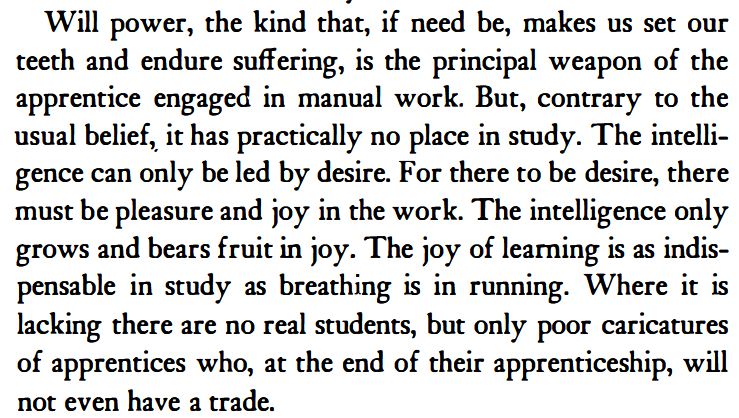
@davidbessis This is another very good essay. I found that, for me, it (and the previous one about attention) resonate in some way with this essay by Simone Weil, André Weil's sister and a religious thinker (perhaps you won't agree): https://t.co/MqwzVMhQcc
@johnmilbank3 This seems to align with some of the wiser insights of the entrepreneurial culture - perceiving risk as opportunity etc. (however limited these insights might be overall).
@Ananyo@cg_geometry@spectator The tech industry's constant appropriation of credit that is at least largely due to the source human data/artwork etc. - and not, or at least not just (definitely not mostly), to the extraction method needs to be counteracted.
@Ananyo@cg_geometry@spectator That's true, and a very good point. But perhaps it's still worth always stressing that the apparent 'successes' of AI are mostly about the potential of accumulated human knowledge to yield further insights (that can be extracted with computational tools).
This thread highlights what I fear will be the degradation of human knowledge due to AI. If I were being charitable, I would say that here Gemini is playing a hybrid role of textbook and tutor, where your tutor has a photographic memory and world class speed reading abilities, but might not be smart enough to get that PhD. So sure, access to that type of tutor is infinitely better than reading baby Rudin in a vacuum. But there is no way AI here is replacing Rudin. Unfortunately though, to a lot of people, it gives the illusion of being better while actually being worse. And thus people will think they are learning more when they are actually learning less.
@nasqret@sama I think they mainly got involved to weaponise the outcome in service of their business (which, by the way, relies on numerous questionable practices, as enthusiasts keep forgetting).
@SebastienBubeck How to square this enthusiasm with the ethical and legal practices of this particular company and the whole industry, e.g. in terms of (not) paying for the data used for training?
@IvanAhelLab I'd also like to highlight a recent publication by Bernheim and Porier groups et al showing FAM118B, which they call "SIRal", is essential for innate immunity in cellular models; they also have great phylogenetic analysis and insights into biochemistry. https://t.co/JTtdYUDMgq
Very happy to share our collaborative project with Ahel and Huet labs et al on FAM118 proteins - noncanonical sirtuins that form filaments and process NAD in human and other vertebrate cells. https://t.co/6qBLDlOyLl
@IvanAhelLab FAM118s have long interested Ivan (my postdoc PI), who, like in many other cases, had a good intuition about their importance. They have been a difficult biochemical target, though. We brought in the observation that they form filaments, an insight explored collaboratively here.