During career exploration, small, intentional experiments can turn uncertainty into insight and shrink the psychological distance between the current situation and what comes next.
Find out how a curiosity-led strategy can help you find the right role:
https://t.co/0x7RlLkiVf
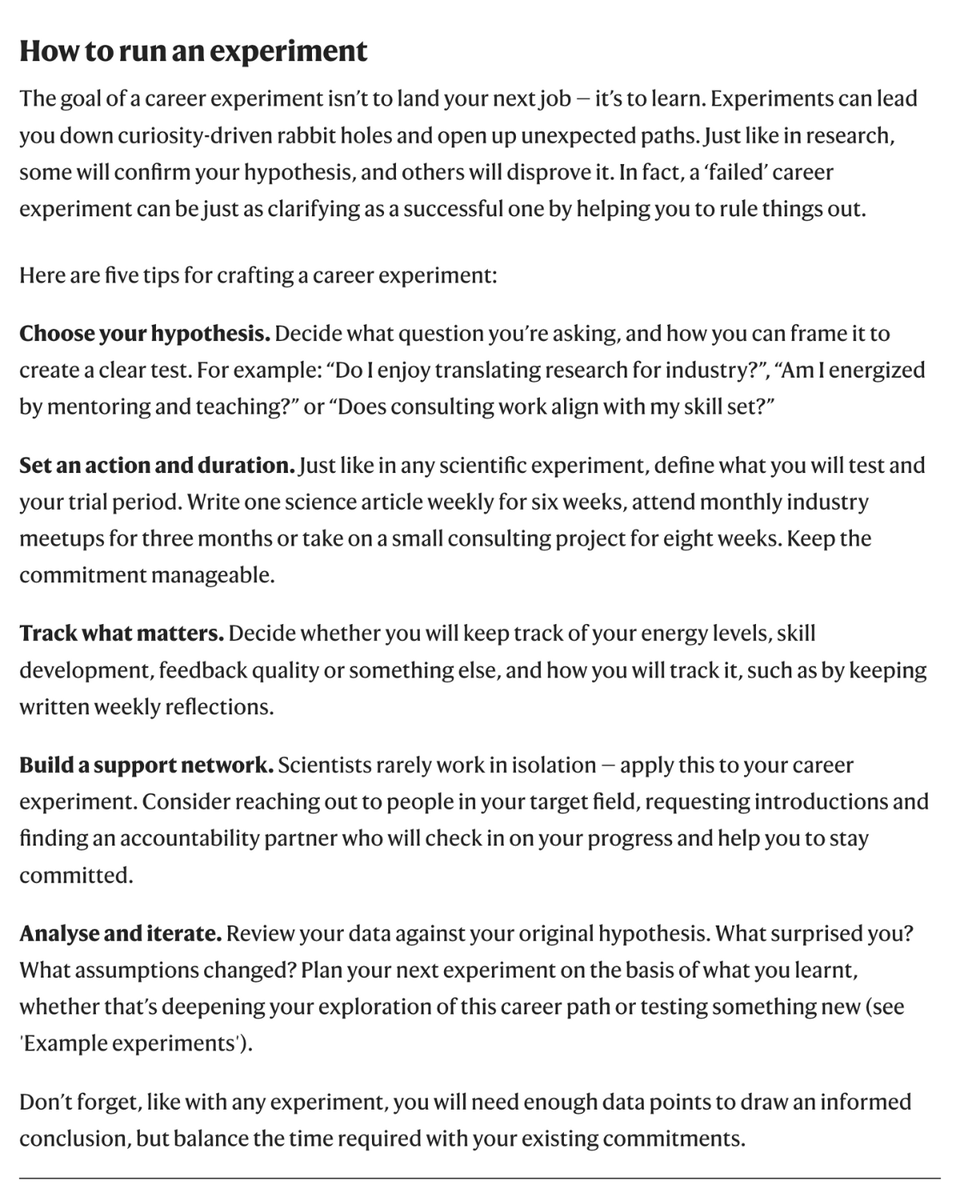
We share a few tips to help you design your own career experiments so your next step is based on evidence, not a leap into the unknown.
What’s one career experiment you’ve tried or would like to try?
Link to article:
https://t.co/FT4lgyFHwj
@Nature@NaturePortfolio
We approach careers backwards.
We're expected to know what we want before we even start.
In a new Nature Careers piece, @neuranne, and I share how small, curiosity-led experiments can be a powerful tool for career exploration.
Generate data points: You’re moving beyond speculation and collecting evidence.
Just like in research, some experiments will confirm your hypothesis while others will disprove it.
A “failed” experiment can be just as clarifying by ruling things out.
The unmet need for leadership training in academia:
Success in academia is determined by your publication record and ability to obtain grant funding.
Acquiring leadership skills is neglected as they don't contribute to the evaluation of scientific success.
Institutions should make leadership training mandatory for all researchers taking on a supervisory role.
Effective leadership benefits research at the individual level but also improves efficacy and productivity at the organisational level.
The most dangerous lie we tell ourselves in academia:
“When I become a professor I'll be happy”.
Pinning your happiness on an external milestone is setting yourself up for disappointment.
Real happiness comes from within and finding joy in the process.