Core Scientific and AMD Announce $14 Billion Infrastructure Partnership
This morning @Core_Scientific and @AMD announced a $14 Billion partnership to expand #AI ready infrastructure. The deal aims to secure up to 2.5 gigawatts of U.S. data-center capacity for $AMD #AI solutions, with more than 500 megawatts available from 2027 and room to scale to 2.5 gigawatts.
They will deploy $AMD Instinct GPUs, EPYC CPUs, and ROCm software across $CORZ facilities, helping model builders, cloud providers, and enterprises deploy AI faster and at scale. @AMD will also receive market-priced warrants for $CORZ stock.
Today we announced that AT&T is expanding use of D-Wave’s quantum computing technology across its network operations. The initial focus will be on integrating our annealing quantum technology into the tools powering AT&T’s agentic AI solutions, exploring how AI and quantum could work together on complex optimization problems. The agreement follows a strong early result: AT&T used D-Wave technology to reduce processing time for a key network optimization workload from about an hour to less than 15 seconds. This is how enterprise quantum adoption accelerates: start with a real operational challenge, demonstrate a measurable impact, and build from the evidence. $QBTS #QuantumComputing #AIart️️️️️️️️️️️️️️️️️️️️️️️️️️️️️️️️️️️️️️️️️️️️️️️️️️️
https://t.co/z36JEXelFK
7.5% of the Bitcoin network runs through machines hosted at our facilities.
87.6 EH/s across our customers' total portfolios. 67 facilities. 7 industry-leading partners.
The miners who measure success in uptime and efficiency choose Soluna.
$SLNH
As quantum computing moves closer to reality, the financial sector faces one of its biggest cybersecurity transformations since the introduction of online banking. Banks, wealth managers and digital asset platforms must prepare now for the migration to Post-Quantum Cryptography (PQC), protecting sensitive data and digital transactions against future quantum-enabled attacks.
That is why @SEALSQcorp is investing not only in post-quantum semiconductors and hardware security, but also in software companies that deliver mission-critical applications to the financial industry. Our strategy is to combine quantum-resistant hardware, trusted digital identities, AI and compliance software into a fully integrated security platform.
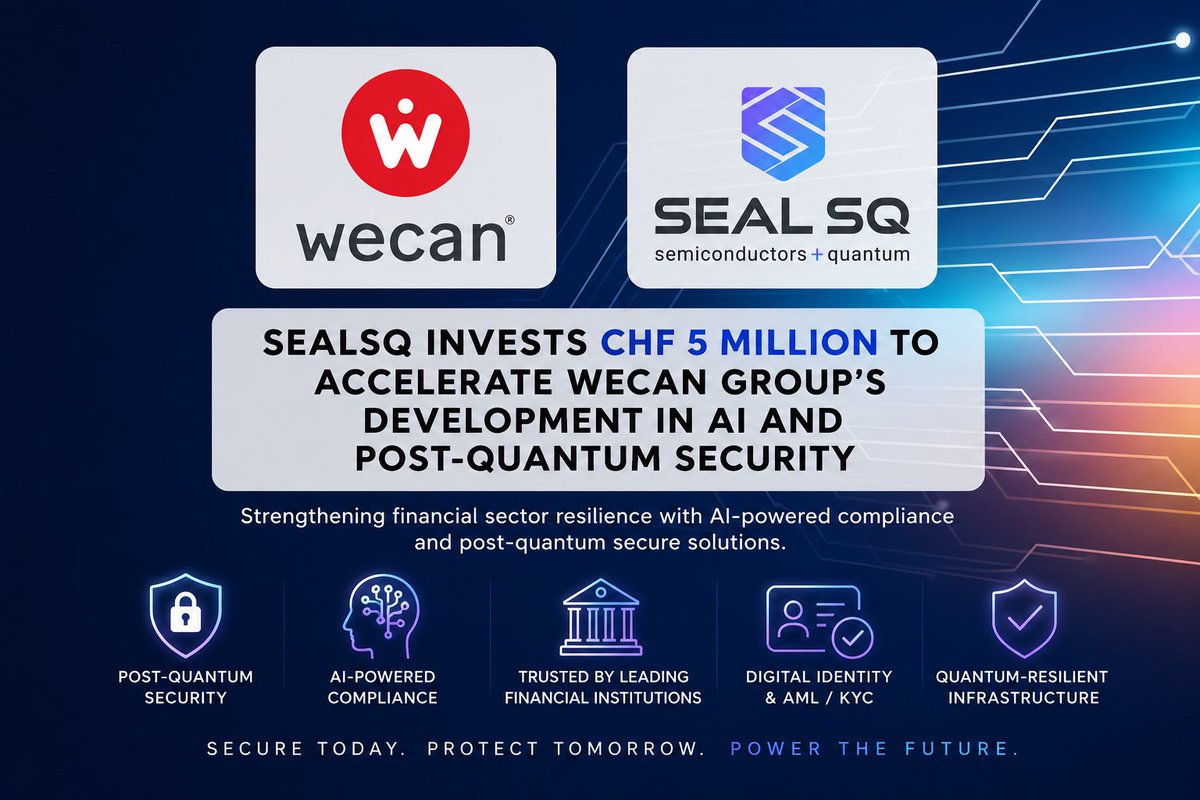
A great example is our majority investment in Wecan Group. Through a CHF 5 million strategic commitment, SEALSQ is accelerating the development of Wecan’s AI-powered Compliance Copilot and post-quantum financial security platform. Wecan already serves leading financial institutions, including Pictet, Lombard Odier, Edmond de Rothschild, Syz and Barclays, making it an ideal platform to deploy quantum-safe compliance, digital identity, AML, KYC and secure transaction solutions at scale. (Sealsq)
The future of financial security will not rely on hardware or software alone. It will require an integrated post-quantum ecosystem where secure chips, cryptography, trusted identity, AI and compliance work together. This is the vision SEALSQ is building today.
Introducing Mountain Green, a new shade for the Xiaomi SkyNomad Series.
Inspired by beauty beyond the horizon, Mountain Green brings the serenity of distant peaks to life.
Watch it shift as the light moves across it. Blue-green pearlescent pigments and golden metallic flakes reveal new depth and texture from every angle, calm on the surface, layered underneath.
Discover more on July 30th, 19:00 (GMT+8).
Been digging into this and it really hit me.
Belizaire’s numbers on $SLNH power costs are insane.
4-5¢/kWh vs ~8¢ national and ~12¢ in Virginia.
For hyperscalers it’s attractive.
For neoclouds it’s straight margin.
When you can deliver power at nearly half Virginia rates behind the meter, the conversation flips from “can you even deliver?” to “how fast can we scale phases 2 & 3?”
This power edge is legit. Explains why the LOI is moving.
What do you guys think?
Today, D-Wave and AT&T announced that @ATT has signed an agreement to expand its use of D-Wave's quantum computing technology and plans to use the technology to address complex optimization challenges across its network operations.
In an early application, AT&T used D-Wave's technology to reduce the processing time for a network optimization workload from approximately one hour to less than 15 seconds.
Building on this initial work, AT&T plans to explore using D-Wave’s quantum computing technology across a broader set of applications, such as outage detection and response, technician routing, network build planning, and traffic management.
AT&T is also evaluating D-Wave's forthcoming gate-model systems for potential applications in quantum security and quantum communications.
Learn more: https://t.co/XE0n9ILx2x
Record en vue : 1000 ETF devraient être lancés cette année. Le FT dans son article du jour appelle cette technique : le canon à spaghetti.
C’était la technique dans les sociétés de gestion dans les années 2000… on lançait des fonds contre un mur avec l’idée qu’un ou deux allaient tenir !
Depuis quelques temps, la vogue se porte sur des ETF à effet de levier, sur des single stocks ou sur des fonds incluant des ventes d’options ...etc
L’idée, comme à la grande époque des lancements incessants : un ou deux ETF vont capter la majorité des flux.
Avec ça on arrive à 6000 ETF aux US !
Derrière tout ce barnum, l’idée générale : simplicité, accessibilité, lisibilité et frais bas…les ETF ont un avantage compétitif énorme vs les fonds.
J’ai du mal à croire que les ETF « opportuniste » sur une idée à la mode vont capter majoritairement les flux, mais ça flingue les velléités de lancement de fonds thématiques dans les sociétés de gestion : en effet entre le moment où la société de gestion veut lancer son fonds thématique et le moment où elle arrive sur le marché, les ETF sont déjà là…et servent de point de comparaison.
La gestion de la gamme dans une société de gestion est un des boulots les plus importants…La plupart des fonds peu performants sans dynamique de collecte, peu lisible en terme de positionnement doivent être fermés d’urgence pour concentrer les ressources sur les fonds à potentiel de la société…
Ceux qui l’ont fait ont collecté… les autres nous disent que ça y est, cette année, c’est l’année de la gestion active.
#Chine 🇨🇳 Vidéo d’une usine d’ustensiles en inox : autrefois 100 ouvriers, aujourd’hui des robots qui bossent sans salaire, sans congés. RT Evansantahp
Kimi's CEO🇨🇳: "You used to need a team, a budget, and months. Now you need a weekend and a $15 plan"
Yang Zhilin spent 11 minutes on stage showing how to ship a full app solo with K3
Every excuse for sitting on your idea just got repriced to the cost of a lunch
$SLNH
Metrobloks Anchors Kati 2 as Ryan Carver Builds Soluna’s AI Delivery Engine (Part 4 of 8)
Part 4 of @jbelizaireCEO's @McnallieM interview clarifies how Soluna intends to scale its AI strategy. Metrobloks remains deeply involved in Kati 2 as a true JV partner, while new Chief Development Officer Ryan Carver begins building the internal organization that can deliver Kati 2, Dorothy 3 & future campuses.
Asked whether Metrobloks’ role had diminished, Belizaire answered directly: “Metrobloks is very involved.” He described an integrated team working across engineering, mechanical systems, commercial structuring, underwriting and finance. Metrobloks is therefore inside the project organization rather than operating as a conventional consultant.
The economics are deliberately aligned. “I wanted them to have a piece of the project because it aligns our interests,” Belizaire said. Metrobloks receives fees for current work, can participate after a lease is signed & may share in future project profits. The split was described as “majority us, minority them,” indicating that SLNH intends to retain the larger share.
SLNH & its financing partners are expected to provide the bulk of the capital. Metrobloks contributes technical expertise, customer relationships, underwriting & what Belizaire called “sweat equity.” Its role is to help turn Kati 2 from a land-and-power opportunity into a tenant-defined, financeable AI campus.
The second half of the structure is now being built under Carver. Before joining SLNH, he spent more than a decade at Microsoft & most recently served as Senior Director of AI Construction & Site Development. He led a construction P&L measured in the t
$10b the construction program for Microsoft’s Fairwater AI campus in Wisconsin. His experience covers site selection, permitting, design, construction and delivery across multiple geographies.
At Soluna, Carver is responsible for the full lifecycle of the AI/HPC platform, from site origination & power procurement through design, construction, commissioning and ongoing operations. His mandate is to connect development, construction, power & technology operations into one delivery engine.
Belizaire made clear that Carver is the 1st building block in a larger organization, not a one-person solution.
“When an incredible person like that comes on board, they have networks of folks that they know are really strong.”
That network is already having an effect. SLNH has started advertising roles Carver believes the company will need, with applicants reportedly including people who have worked with or reported to him. Vendors from his previous projects are also approaching SLNH about supporting Kati 2.
Belizaire summarized the shift sharply:
“Overnight, we’ve gone from ‘where are we going to find some of these resources?’ to now we have access to some of the best in the world.”
The emerging model has 2 connected engines. SLNH’s existing organization originates projects through land control, renewable power, grid integration, tenant engagement & capital formation. Carver’s organization is being built to deliver them through design, procurement, construction, commissioning & operations. Metrobloks serves as the bridge between those capabilities at Kati 2.
The formula is not Metrobloks or Carver. It is:
Metrobloks + Ryan Carver + Soluna’s power-development platform
Kati 2 can become the 1st complete AI development playbook. If Soluna converts the exclusive 100 MW process into a definitive lease, financing & construction, it will establish reusable systems for tenant diligence, underwriting, supplier selection & commissioning.
That playbook can then be applied to Dorothy 3 & the broader pipeline. Metrobloks helps execute Kati 2, while Carver is assembling the team, vendor network and operating discipline needed to repeat the model at scale.
Metrobloks helps build the 1st playbook. Carver is building the organization behind everything that comes next.
Today, Soluna welcomes Ryan Carver as Chief Development Officer.
Ryan joins from Microsoft, where he led AI construction and site development for some of the world’s largest, most advanced hyperscale data center campuses.
He’ll lead Soluna’s AI/HPC data center platform as we continue building sustainable, scalable infrastructure powered by renewable energy.
Read more: https://t.co/f3gVp5b4w1
#AI #DataCenters #RenewableEnergy
Great discussions with SpaceX on how to bring true sovereign capabilities to space through large-scale satellite constellations.
More and more countries are seeking dedicated sovereign space infrastructure to protect their national interests while leveraging the scale and economics of existing large constellations.
WISeKey, SEALSQ, and WISeSat are uniquely positioned to make this possible by providing the sovereign security layer that can be integrated into large constellations such as Starlink. By combining Post-Quantum Cryptography (PQC), a trusted PKI Root of Trust, blockchain, and secure digital identity technologies, satellites can be hardened to support sovereign government, defense, and critical infrastructure applications while operating within global commercial constellations.
This approach has the potential to be a game changer for the space industry, enabling large constellations to securely support national sovereignty requirements without the need for every country to build and operate its own complete satellite network.
We’re proud to announce that @Icarus_Robotics has selected $KULR to power JOY, its autonomous free-flying robotic platform bound for the International Space Station.
Bringing together KULR’s flight-ready energy systems and Icarus’ embodied-AI robotics, the mission represents an important milestone as autonomous systems take on a growing role in the next generation of space infrastructure.
Learn more about the mission here: https://t.co/15Ns259glU
#SpaceTechnology #Robotics #ISS
🇪🇺 The euro area’s trade surplus is disappearing. In May, the region recorded a €7.8 billion deficit compared with a €15 billion surplus a year earlier. On a seasonally adjusted basis, the balance also shifted from a €0.8 billion surplus in April to a €5 billion deficit in May.
📊 Exports still rose by 0.6% over the month but the issue mainly comes from imports increasing much faster (jumping by 2.8%). The trend is even clearer since the beginning of the year as the euro area’s cumulative trade surplus fell from €78.7 billion in 2025 to just €3.3 billion in 2026. In only a few months, Europe’s trade cushion has therefore been almost entirely wiped out.
➡️ Part of this deterioration can be explained by the rising energy bill as Europe remains heavily dependent on oil and gas imports that quickly feed through into its external deficit. However, it would be far too simplistic to blame everything on energy as surpluses in machinery, vehicles and chemicals have also fallen sharply, and this is where the data becomes genuinely worrying.
⚠️ Europe’s trade model historically relied on importing large amounts of energy and offsetting that weakness through the strength of its industrial sector. Today, both pillars are deteriorating at the same time as European industry is finding it increasingly difficult to generate sufficient surpluses amid weak global demand, growing Chinese competition and the continent’s loss of competitiveness.