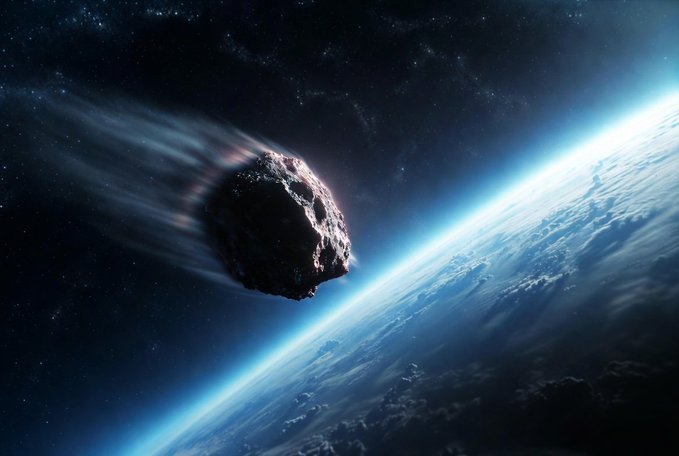
Mark Your Calendars: Asteroid Apophis Delivers a Once-in-a-Lifetime Close Encounter on April 13, 2029! ☄️
Get ready for one of the most thrilling celestial events of the 21st century. On April 13, 2029, the 370-meter-wide asteroid 99942 Apophis (roughly the size of the Empire State Building or a large cruise ship) will streak past Earth at a distance of just ~32,000 kilometers (about 20,000 miles) above our surface—closer than many geostationary satellites and only about one-tenth the distance to the Moon.
This will be the closest known flyby of a large asteroid in recorded history, and it poses zero impact risk to Earth. Instead, it offers a spectacular opportunity for science and public stargazing.
At its brightest, Apophis will shine at around magnitude 3.1—easily visible to the naked eye from rural and darker suburban skies as a fast-moving “star.” It will race across the sky at up to 42° per hour, making its motion noticeable over just a few minutes. Best viewing will be from parts of Europe, Africa, and western Asia, where it will glide through constellations from Centaurus toward Perseus and beyond.
Astronomers worldwide are gearing up for an unprecedented observational bonanza. The close pass will let scientists study Apophis in exquisite detail with ground- and space-based telescopes, potentially revealing changes in its rotation, surface properties, and orbit due to Earth’s gravity. It’s a rare chance to see a potentially hazardous asteroid up close—without any of the hazard.
Messier 87: The Monster Galaxy and Its Relentless Cosmic Jet
Nestled 55 million light-years away in the heart of the Virgo Cluster, Messier 87 (M87) is one of the most massive and fascinating galaxies in the nearby Universe. At its core lies one of the most extreme objects known to science: a supermassive black hole weighing a staggering 6.5 billion times the mass of the Sun.
But what truly makes M87 unforgettable is the spectacular relativistic jet blasting outward from this monstrous black hole — a high-energy beam of plasma and radiation screaming away at nearly the speed of light, stretching tens of thousands of light-years into space.
Using years of observations from NASA’s Chandra X-ray Observatory combined with sophisticated image-processing techniques, astronomers have now created a remarkable time-lapse view of this jet. The new results reveal how the jet evolves, twists, and surges over time — offering an unprecedented look at the violent, chaotic environment right next to a supermassive black hole.
This jet isn’t just a beautiful cosmic feature. It’s a powerful engine shaping the galaxy around it — heating gas, triggering star formation in some regions, and suppressing it in others. M87 gives us a front-row seat to the raw, destructive power that supermassive black holes can unleash on their cosmic surroundings.
In short, M87 isn’t just a galaxy. It’s a living laboratory of extreme astrophysics — where gravity, magnetism, and energy collide on a truly epic scale.
Clear writing is a superpower.
Before writing, know:
• What you're trying to say
• Who you're writing for
• What action you want readers to take
Then:
• Cut jargon
• Use simple words
• Organize ideas logically
Good writing isn't about sounding smart.
It's about being understood.
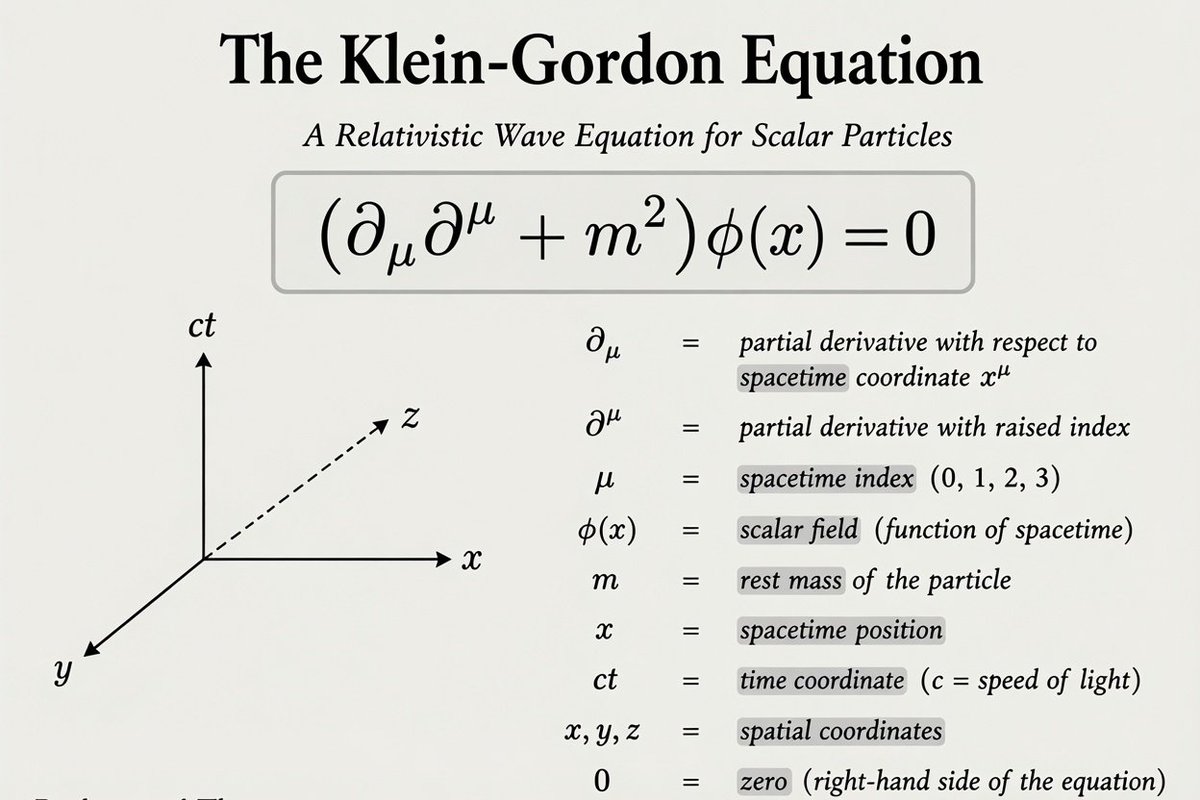
The Klein-Gordon Equation - Early quantum mechanics provided physicists with a valuable tool in the Schrödinger equation. However, it had a flaw it treated time and space very differently, even though Einstein had already shown that the universe connects them as equals. The Klein-Gordon equation was the first serious attempt to create a wave equation that respects this relationship properly, treating time and space the same way. Interestingly, Schrödinger himself discovered this equation first but abandoned it because it yielded strange results, such as negative probabilities. He chose to publish his simpler equation instead, and the relativistic version was later named after Oskar Klein and Walter Gordon, who rediscovered it.
At its core, the equation describes something called a scalar field. Think of it like a temperature map that assigns a single number to every point in both space and time, rippling and oscillating across the four-dimensional fabric of spacetime shown in the diagram. The equation states that at every point in this spacetime, the way the field curves through time and space, combined with the particle's mass acting as an anchor, must always balance perfectly to zero. This balance is what allows the field to exist as a smooth, sensible wave. This concept comes directly from Einstein's famous relationship connecting a particle's energy, momentum, and mass, rewritten in the language of waves. When physicists first tried to interpret this field as a single particle's probability wave, similar to Schrödinger's equation, two serious problems emerged. It allowed nonsensical negative energy solutions and produced negative probabilities, which makes no physical sense...
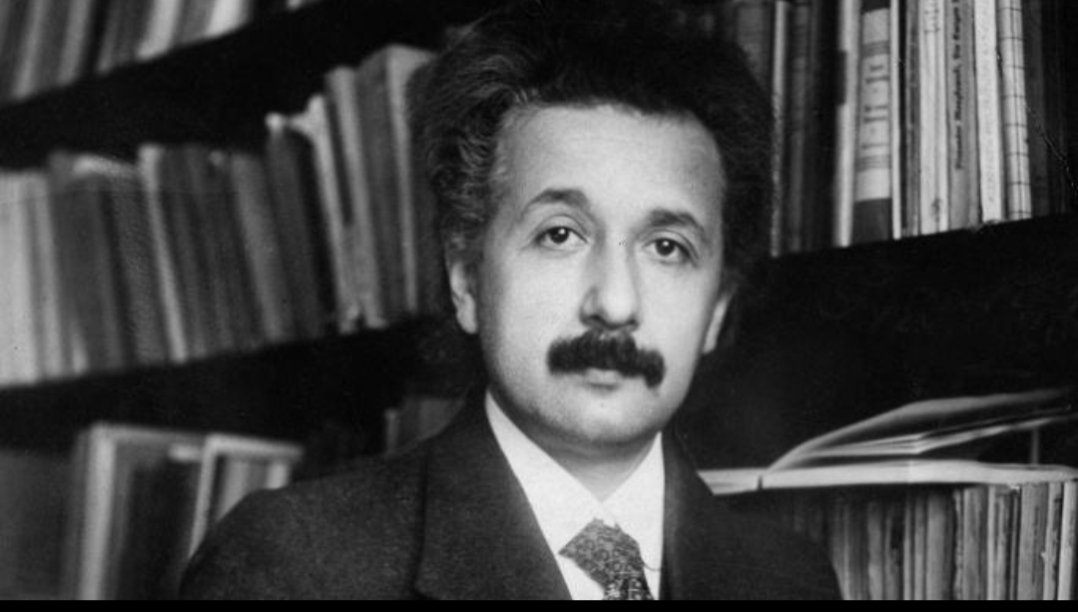
Why do physicists these days say that Einstein’s theory of relativity is wrong?
Almost all of Einstein’s Theories of Relativity (Special and General) have been proven by subsequent observation and experiment.
There are some issues that have not be resolved such as unifying General Relativity with Quantum Mechanics, and some observations on the intergalactic scale, but these issues are not anything wrong with the Relativity, they are just areas possibly requiring further theories.
It’s one of the most proven and verifiable theories in scientific history.