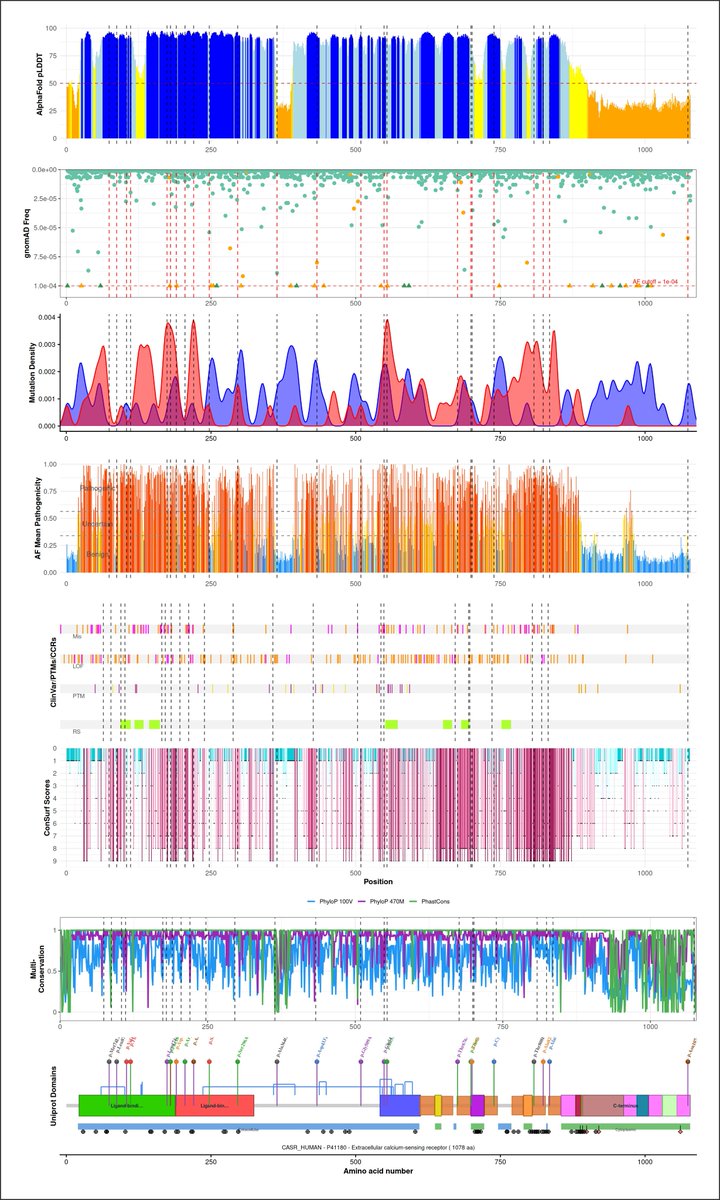
Excited to attend #ISMB2026 next week and learn from great #ISCB computational biologists. Also, present my poster: Please stop by poster D-380, Track: #VarI: Variant Interpretation; July 16, 2026 at 10:00 - 11:00 and 16:00 - 16:40
The 2026 Breakthrough Prize ceremony (“the Oscars for science”) celebrated the achievements of many remarkable scientists and their students and collaborators last weekend. Here’s the video of the show: https://t.co/eCHUnDqrYX. And here’s the segment in which Anne Hathaway and Alex Honnold (who climbed El Capitan free solo) presented the story of baby K.J.’s base editing treatment and introduced Kiran Musunuru, Rebecca Ahrens-Nicklas, Peter Marks, baby K.J. and his wonderful family, and myself: https://t.co/eCHUnDqrYX
Introducing VarViz: a free, open-source web app for interpreting missense variants.
Multiple interactive evidence tracks. Automated ACMG/AMP Tags. All in one protein-level view. https://t.co/bI94SYnfAv #genomics#variantinterpretation#ACMG#RareDiseases#bioinformatics
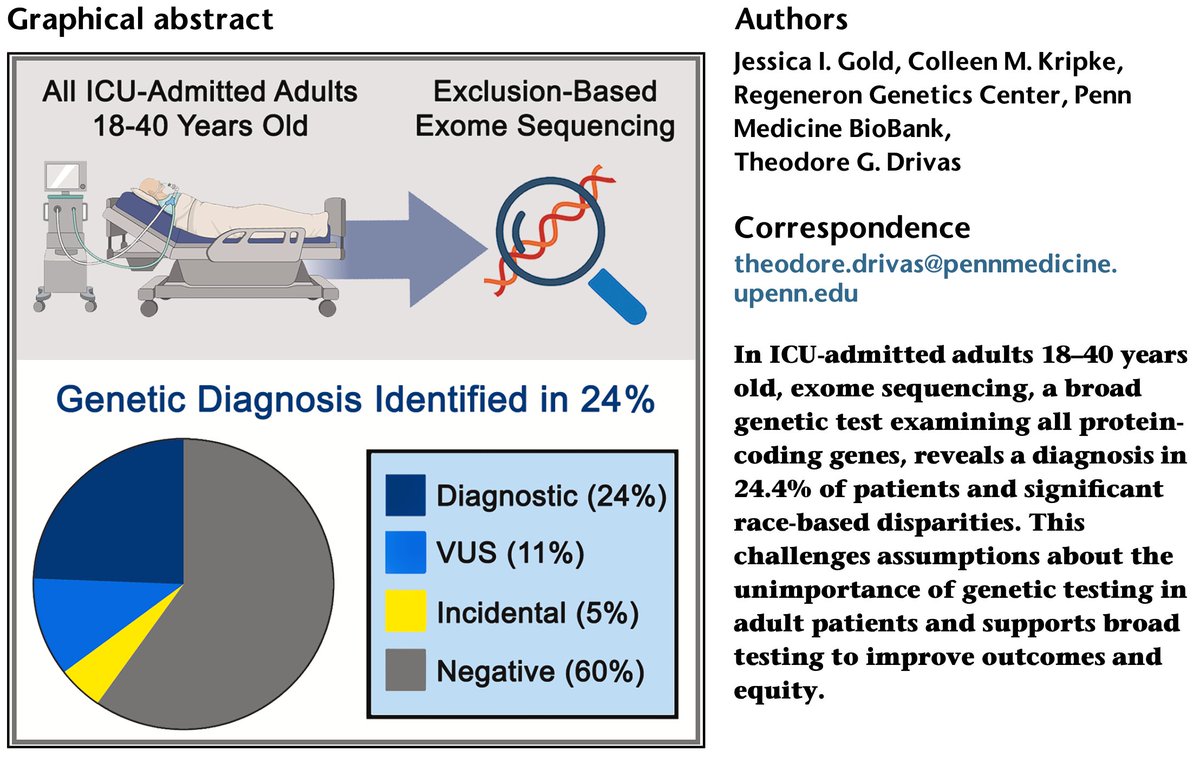
Most studies on clinical utility of exome sequencing in intensive care focussed on pediatric patients. In a new study in AJHG, the authors assessed diagnostic value of exome sequencing in critically ill adult patients and found a surprising 24% diagnostic yield, many with actionable treatment recommendations!
Genomic sequencing will become one day an essential part of the diagnostic work up in intensive care treatment.
Gold et al. AJHG 2025
https://t.co/tPp2YiiVHK
If you want to check if a human gene has copy-number changes or lands in a complex region, try https://t.co/zKVAm8dhOL. Recently updated with more and better assemblies.
BREAKING NEWS
The Royal Swedish Academy of Sciences has decided to award the 2024 #NobelPrize in Chemistry with one half to David Baker “for computational protein design” and the other half jointly to Demis Hassabis and John M. Jumper “for protein structure prediction.”
A Sunday read for you. A new blog post on a discovery of a noncoding mutation that causes a Mendelian cardiac arrhythmia through a fascinating mechanism: de novo creation of cardiomyocyte-specific enhancer. This adds to the list of my favorite noncoding discoveries that I've highlighted over the past couple of years. Two take homes for me are
- when searching noncoding disease variants, we tend to look at regions previously known to play a regulatory role (promoters, enhancers etc.). This work reminds us of the possibility that disease variants might be creating a new regulatory element themselves.
- when searching for causal genes, we tend to look at only those that are expressed in the disease-relevant tissues. This work reminds us that causal genes can be the ones that are not expressed in disease-relevant tissues.
Sometimes the answers come from places where we least expect to find.
Congratulations to the authors on this beautiful work!
https://t.co/dyuem9fgAc
In academic research, it's 1/3 knowledge and 2/3 project management.
Yet 99% of project management advice doesn't work for academics because it comes from business!
Here's a better way, that I rely on for my research:
👇
In research most ideas lead to nowhere - this is why "traditional" project management often doesn't work. While we usually think of project management as "breaking down a big task into small chunks" it is NOT how research works.
There are three key differences:
1. No well-defined "big task" to break down.
Every time you work on your project, your ideas, methods, and outcomes change. A final paper is rarely what it started as. This is why project management in research is very "agile", you have to change your plan at every step.
2. Keeping track of what doesn't work
Research projects are often so big that they don't "fit into a single head" with the negative consequence of going in circles. Aside from this, the idea that something does not work is In itself publishable!
3. Your task is revolving around questions, not outcomes
As opposed to business projects research aims to answer something, rather than provide a solution. There are many ways to answer: Logical deduction, mathematical proof, or empirical evidence for example. This means our environment is inherently multi-modal, involving many types of media, code, and ideas that need to work together.
While many apps exist for project management I find that most do not work for academics for one or more of the above reasons.
Instead, I use this system directly in my Obsidian notes. It allows me to bundle thoughts, related papers, figures, code documentation, and concepts into a connected searchable whole.
To learn the basics of Obsidian for academics go to EffortlessAcademic(dot)com
Here is my method in a nutshell:
- One project note is the gateway to working on a big project/paper trying to answer a few related questions.
- Many research question notes each containing my attempt, progress, and steps to answer this question
- Many tasks, readings, and ideas as checkboxes. All are tagged with the name of the project to link to the project.
Let's dive into details:
1. The Project note
This will be the "anchor" to bundle everything together. This is where you will see your next step at a glance. It has mainly 3 parts:
- A tag is usually a short acronym "vcp" for "Vegetation Change Project"
- A goal statement
- A list of ideas/tasks/readings
- A list of research questions (notes)
Here is how it looks:
2. Research questions as separate notes
These notes reside in a "Questions" folder and each contains:
- A description of how I intend to tackle it
- As I work on it I document my progress here.
- A property called "Parent" to link to the project they belong to
- A property called "Status" to indicate how far I have come.
- As the project develops I document my findings in these notes.
I used ChatGPT quite effectively to brainstorm these questions quickly. See the link in the comment.
3. Smaller Tasks
Todos usually sit inside the research question notes, but they can be spread out throughout the whole vault.
Also, I separate my todos into 3 categories: Tasks, Ideas, and Reading.
This identification is done with tags. Prepend your todo in Obsidian with e.g. `#vcp/Idea` to denote it as an Idea belonging to the project VCP.
It is VERY easy to add new ideas this way. In Obsidian you can press ctrl+L or cmd+L to create a checkbox, add the tag, and write away.
4. Pulling it all together with DATAVIEW and TASKS
These two plugins are essential for Obsidian. I included detailed tutorial links in the comments below.
Dataview pulls all research questions belonging to this project and displays their status. This gives me a clear feeling of progress and allows me to go back to old questions.
Tasks pulls all the checkboxes marked with a certain tag and displays them in a nice way. This way I have actionable "bites" ready to work on.
While in business prioritizing tasks gets a lot of attention, I find it is less relevant in academia and I usually go with my gut feeling about what to do next, keeping me much more motivated and free!
Here are the queries I use (copy and paste from the image description):
5. Writing Outlines
The end result of my system is to write outlines or just long pieces of text documenting what I have accomplished. The better these are the more suitable are they for a section of a publication. I try to really be as thorough as I can writing those.
6. Nice To Haves
If you need to code a bit, it can be really useful to document code in a visual way. If you don't do it, I guarantee you won't be able to tell what does what in a year's time. The result is that if someone wants to reproduce your results or build on them, they are out of luck. The link is in the comments.
If you establish a system like this you will notice that:
- You can easily keep track of what didn't work and why, by looking at question notes and the results you documented.
- You can flexibly incorporate your research notes, papers, PDFs etc into your project management.
- Your system is very flexible and grows as you go, by adding tasks and todos as you need them, without any overhead for planning.
For me it solves all the pains of research management. Curious to hear your approach in the comments below.
I am working on an advanced Obsidian template that will make creating this structure a matter of one click, if you are keen not to miss it, follow me here.
Or go to EffortlessAcademic(dot)com and sign up for the newsletter.
Check out the comment for useful links here on X:
https://t.co/tbMRoKg8sy
Thanks to an awesome team, our trio-based de novo mutation rates study is now out! We estimated a rate for 68 vertebrate species and explore the male and female contributions and the impact of life-history traits on the evolution of the rate! Read more:
In celebration of #BIGxWeek and #BIGxScience Day, @GIMJournal ACMG’s official journal is making these two special articles focused on Black women and #breastcancer available FREE to all this month. Search the article titles here: https://t.co/xzyMnysfI8 @BlackInGenetics#DEI
Motivated by my earlier tweet and the responses, I wrote a blog post to explain my views on the design of command-line interface. https://t.co/FMn89GGXxs