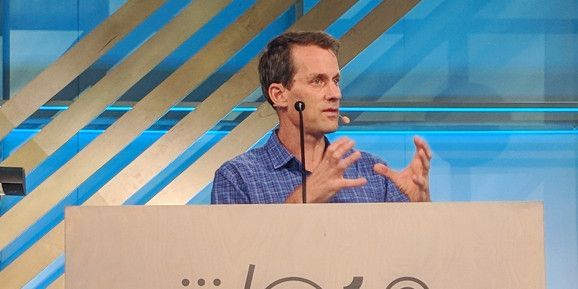
Google AI chief @JeffDean interview: #Machinelearning trends in 2020
- New AI hardware
- #DeepLearning systems should consider their energy consumption to help combat #climatechange
- expect advances in multitask learning and multimodal learning,
https://t.co/Nv2qGYP46A
Hypothetical: we will discover that there is no practical way to defend neural networks against adversarial examples. What next? https://t.co/MKKCIyijmG
Excited by this direction of formal investigation for adversarial defences: Adversarial examples from computational constraints, Bubeck et al https://t.co/FKUqwuTyE7
The main risk with advanced #AI isn't malice, but competence: that it accomplishes goals that aren't aligned with ours. Here are some hilarious and cautionary examples of how this can happen accidentally:
https://t.co/5lY5gRA7ND
0 is not (necessarily) special -- not all charts need a y axis that starts at 0. Likewise, a ML model with 80% validation accuracy is not "pretty accurate" -- you shouldn't compare to 0%, you should compare to a common-sense baseline (that baseline may be arbitrarily high!) https://t.co/L3CQr2SlR7
This is a super useful paper that we need more of: Better ImageNet models are not necessarily better feature extractors (ResNet is best); but for fine-tuning, ImageNet performance is strongly correlated with downstream performance. https://t.co/MrkX4yYgHn
Judea Pearl claims all we do in ML is curve fitting. I wrote this post to explain that claim and introduce the basics of causal inference to ML folks.
Machine Learning beyond Curve Fitting: An Intro to Causal Inference and do-Calculus
https://t.co/1osm0VcaaR
How can you train a Google Clips camera to know when the time is right to capture a special photographic moment? Nice post describing the work that went on behind the scenes to develop a machine learning model that runs entirely on device to do this.
https://t.co/TGLzYQfC9W