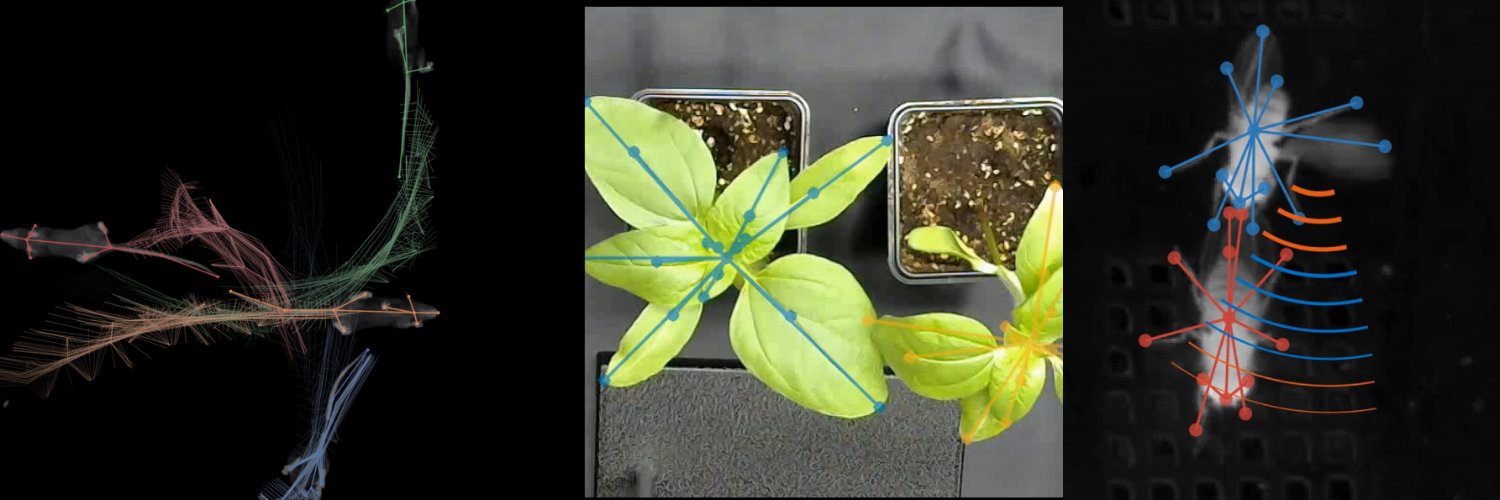
📢 @MurthyLab@shaevitz and I are excited to announce 📢:
SLEAP, our multi-animal pose tracking system, is now out in @naturemethods!
Paper → https://t.co/lO53o4jCga
Download + docs + data + more → https://t.co/Ue7pccY6Tm
Read on to learn what’s new!
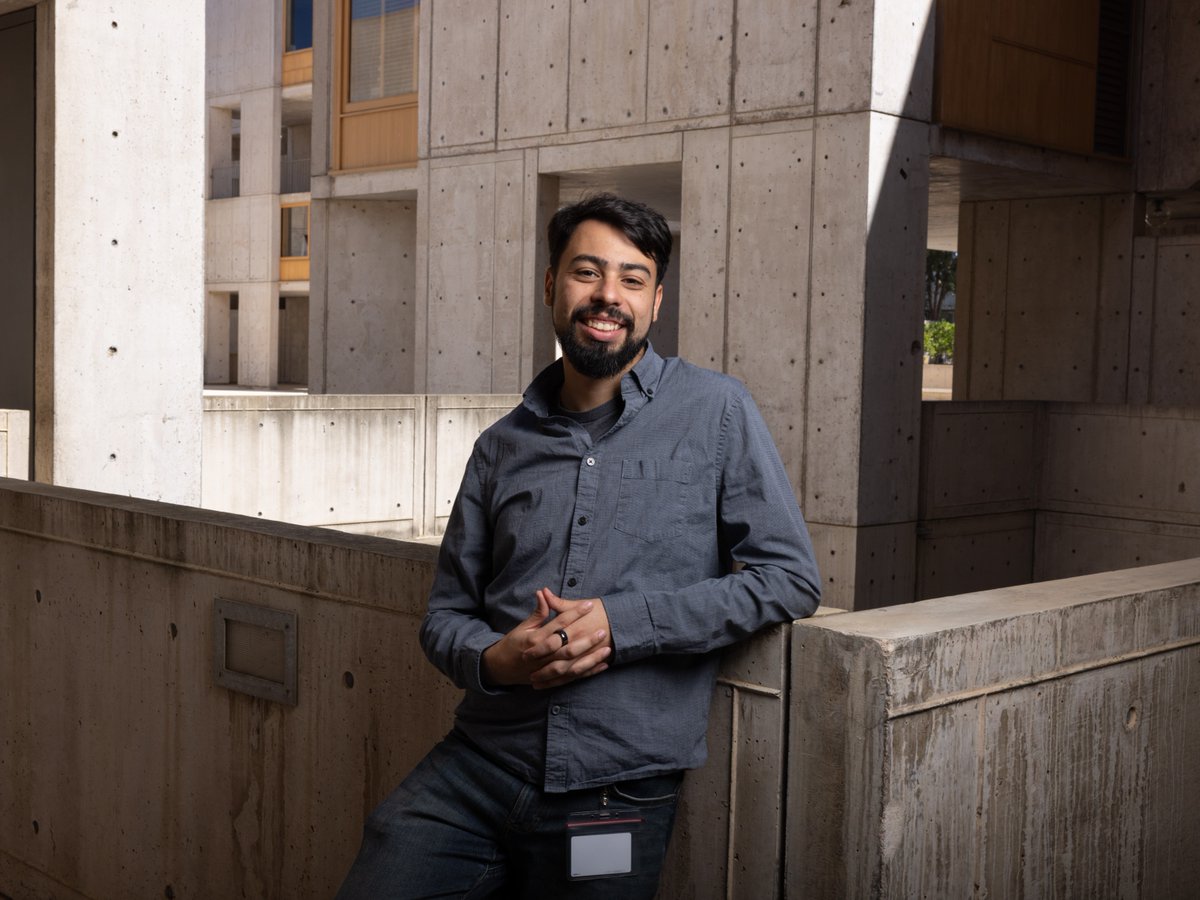
Congratulations to Talmo Pereira, PhD, on joining Salk's faculty as an assistant professor! 🎉
Pereira is a computational neuroscientist who develops AI-based tools to study how living things move, from plants to humans, to better understand how brains, bodies, and behaviors work.
As a Salk Fellow, his lab pioneered markerless motion capture using deep learning through the open-source software tool SLEAP, now used by tens of thousands of researchers in more than 90 countries to study everything from subcellular organelles to whale sharks.
Pereira's lab is now developing “embodied digital twins,” virtual representations of animals that could help scientists decode how brain activity generates movement and reveal early signs of disease.
#SalkInstitute #ArtificialIntelligence #Neuroscience #ComputationalBiology #OpenScience
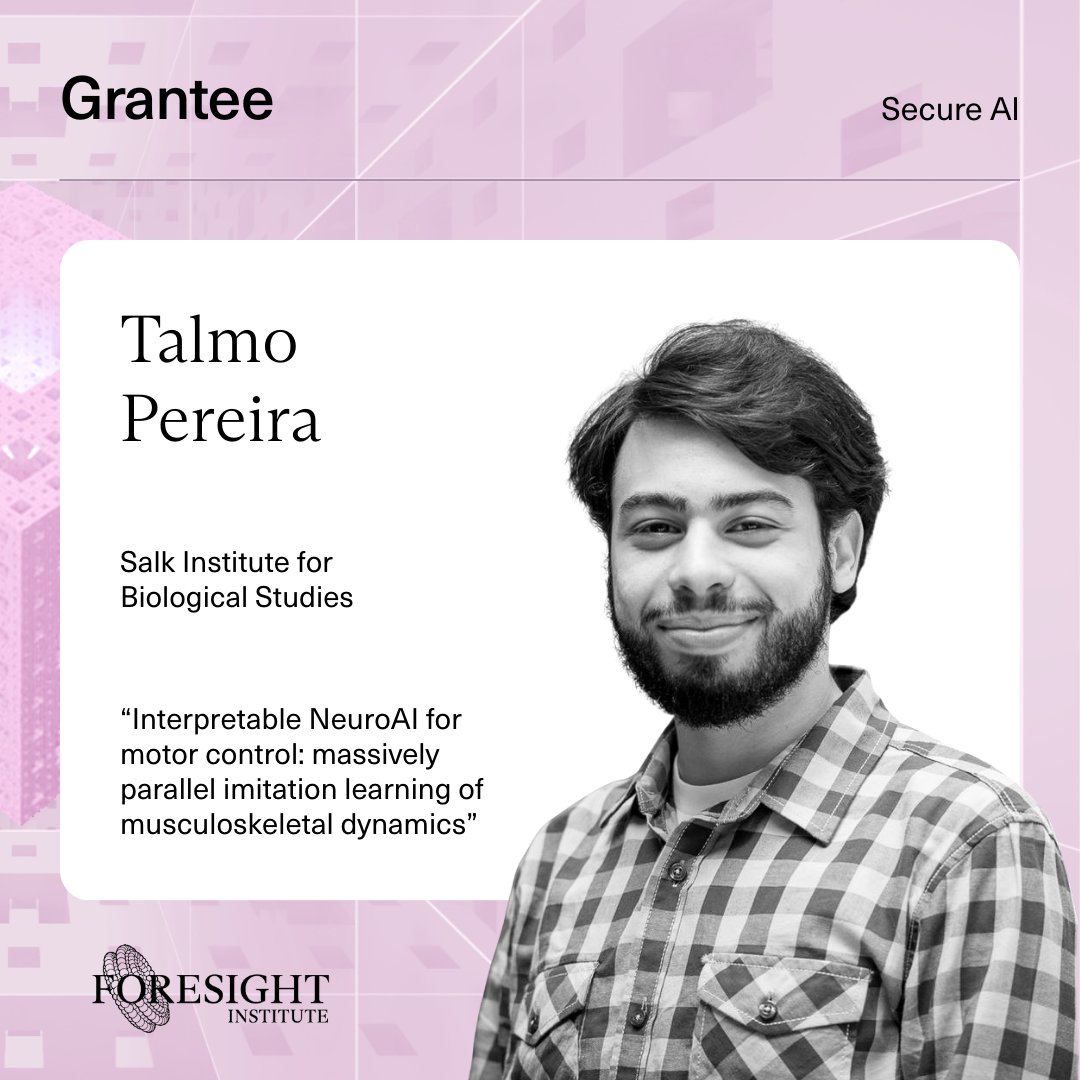
We’re excited to fund work by @talmop to study how biological systems control movement, which can inform how to build more understandable and reliable AI controllers.
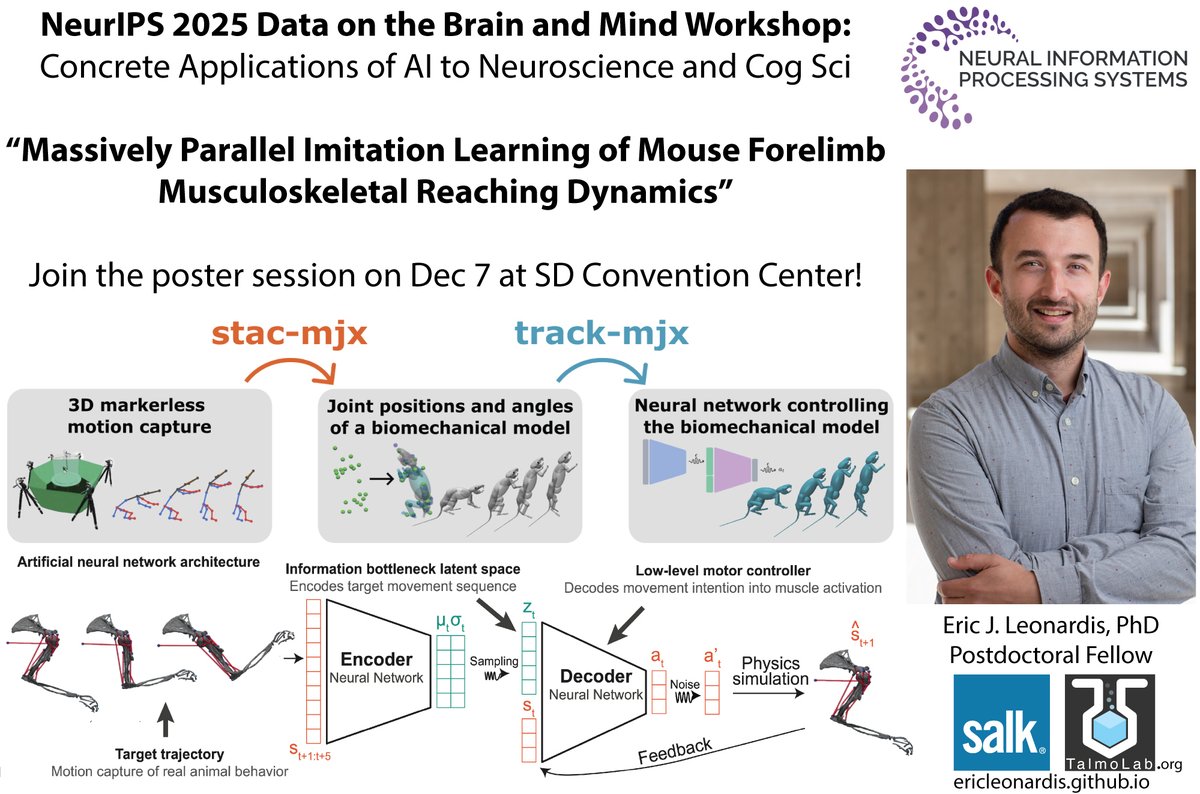
The project uses imitation learning with a detailed musculoskeletal model of the mouse forelimb to study neural motor control, by reproducing real animal movements in physics simulation. By training policies constrained by biomechanical costs that accurately predict muscle activity, and analyzing them using nonlinear dynamics methods from neuroscience, the work bridges AI and biology to reveal how movement emerges from the interplay of neural commands, muscle dynamics, and physical constraints – producing interpretable controllers that support AI safety through mechanistic understanding rather than black-box optimization.
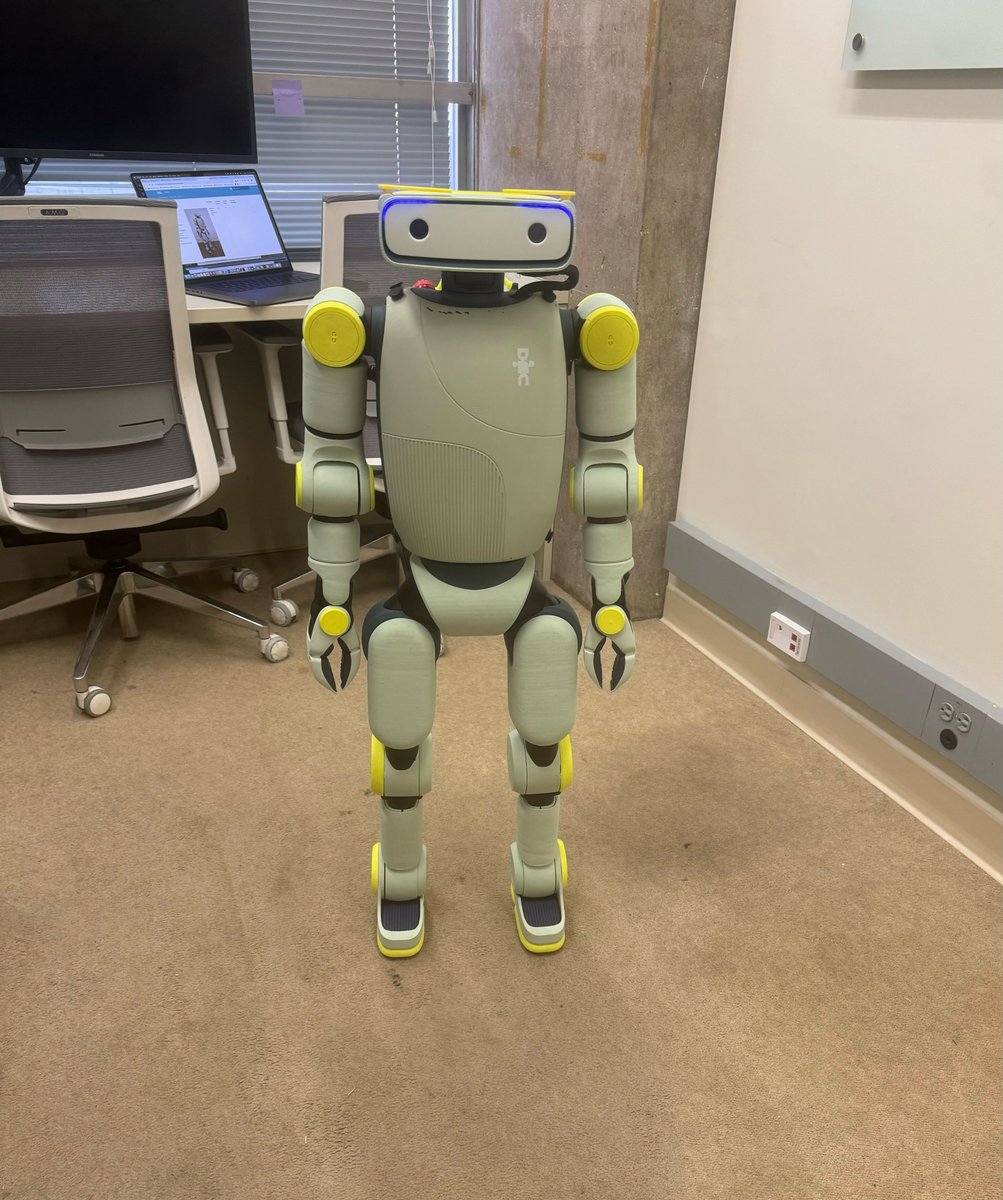
We just got the Sprout robot from @faunarobotics in @talmop’s lab. Usually robots mean weeks of debugging pain before experiments even start. This time we powered it on and got the robot to stand, walk and teleop on Day 1. Respect to the engineers that made this setup so smooth!
Hope to see you at the @NeurIPSConf@DataOnBrainMind Workshop! I will presenting our poster “Massively Parallel Imitation Learning of Mouse Forelimb Musculoskeletal Reaching Dynamics” @talmop@eazim Sun Dec 7, SDCC 🦾🧠
https://t.co/q1jvdADdMW
We gathered field-leaders in neuro for a workshop on the future of brain-computer interfaces, whole brain emulation, and the intersection between AI and neurotech!
Now the talks are available on our YouTube channel: https://t.co/LQjWfHI9ez
Hear from:
• Ed Boyden (Boyden Lab) @eboyden3
• Talmo Pereira (Salk Institute) @talmop
• Haleh Fotowat (Wyss Institute) @halehf
• Bobby Kasthuri (University of Chicago)
• Jacques Carolan (ARIA) @JacquesCarolan
• Andrew Payne (E11 Bio) @Andrew_C_Payne
• Ann Kennedy (Scripps Research)
• Amy Kruse (Satori Capital)
• Gabriel Kreiman (Harvard Medical School) @gkreiman
• Jordan Matelsky (Johns Hopkins University Applied Physics Laboratory)
• Mehdi Azabou (Columbia University) @mehdiazabou
• Sean Escola (Protocol Labs / ARNI)
• Peter Yoo (Synchron)
🧵1\New Preprint! Social pain, the emotional pain caused by aversive experiences with other individuals, is an umbrella term that includes experiences such as social isolation, social exclusion, social rejection, and social loss and can be used as a signal to drive a need state
Thrilled to share our pre-print on 1st Federated Learning model deployed between Earth & @Space_Station 🚀 Huge thanks to @HPE (SpaceBorne Computer), @intel (OpenFL), & @NASA@NASAGeneLab@NASAAmes Open Science Data Repository. Let’s build & move the ball forward! 🌅 Link below
1/✨ New paper in #eNeuro! How do dominance behaviors vary across mouse strains? Turns out, it’s not one-size-fits-all!
Comparing CD1 & C57 mice, we found strain-specific behaviors that could change how we study social hierarchy in the lab🧵
Paper here: https://t.co/iw1hBNXT0z
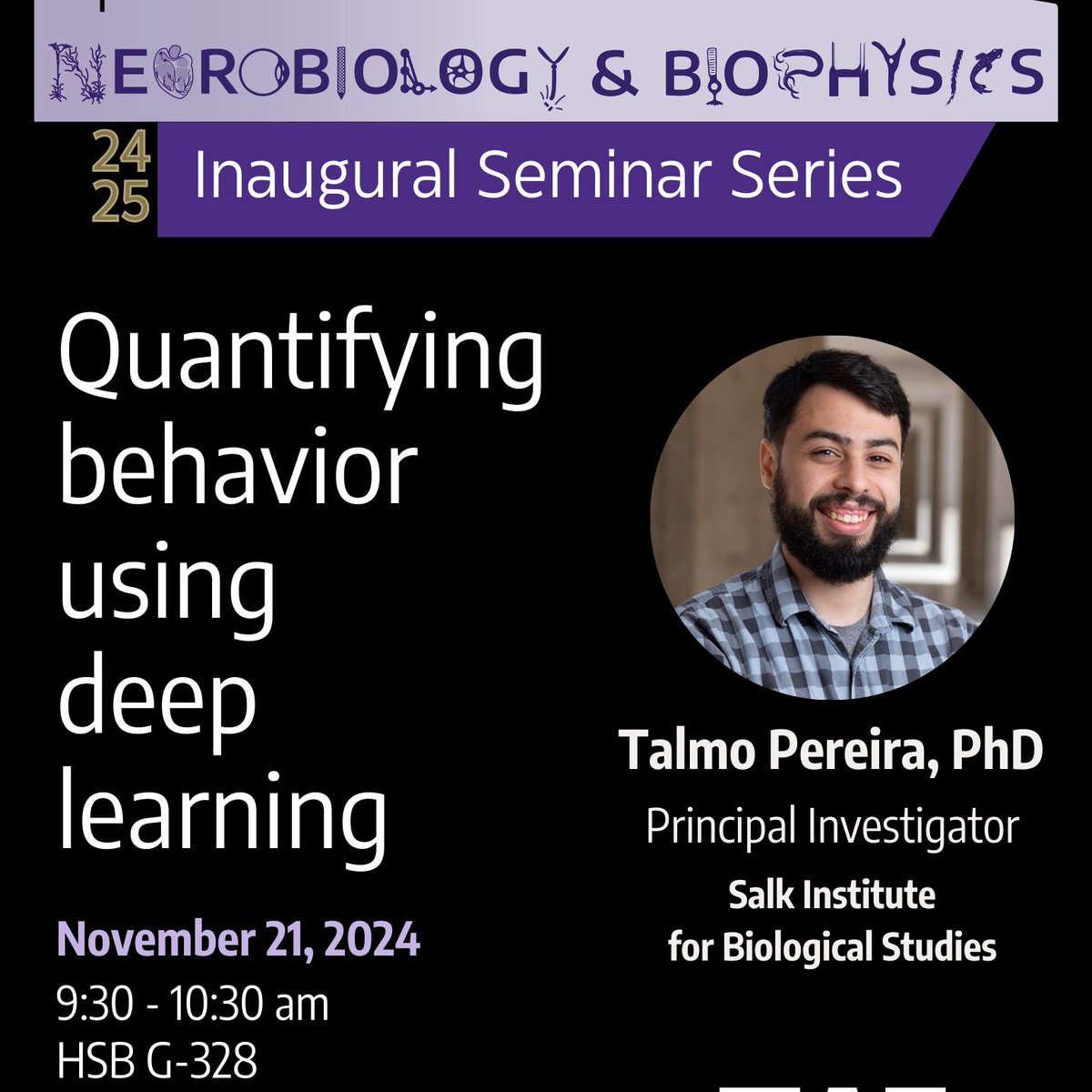
Join us at the upcoming NBIO seminar on 11-21. Talmo Pereira (@talmop), PI @salkinstitute for Biology Studies, will give a talk on "Quantifying behavior using deep learning". #Neuroscience#deeplearning
Attn: Undergraduates!!
⏰DEADLINE IS NOVEMBER 17!⏰
Immerse yourself in groundbreaking research for 10 weeks this summer!
🌟 Mentorship from experienced researchers
🏠 Housing and travel accommodations
💰 Competitive hourly wage
Apply today at https://t.co/3zdKkUzGqN
What are the brain’s “real” tuning curves?
Our new preprint "SIMPL: Scalable and hassle-free optimisation of neural representations from behaviour” argues that existing techniques for latent variable discovery are lacking.
We suggest a much simpl-er way to do things.
1/21🧵
Last year @TonyZador et al called to train a new generation of AI researchers, equally at home in engineering/computer science & neuroscience to accelerate our understanding of the nature of intelligence, but how can we get this interdisciplinary training right? 🧵@NatureComms
Zipping and uploading the final (??) version of the next Multi-Agent Behavior dataset:
- 226 hours of newly released frame-by-frame behavior annotations, all w/tracking and video
- 395 hours of tracking data
- 9046 total video clips
Competition launches in January! Stay tuned 🐭
Ever wanted to record behavior in dozens of operant chambers on a budget?
We have a solution to record 60 animals simultaneously at 1/10th of the cost of commercial systems!