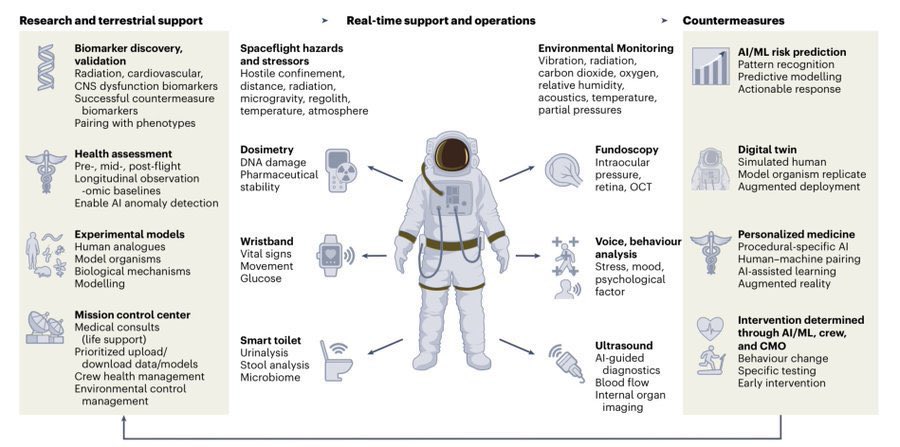
The NASA Open Science Data Repository (expansion of @NASAGeneLab) has enabled biological & health discoveries helping humanity become multi-planetary by helping life thrive in deep space on Mars and 🌘 OSDR stores precious data anyone can use and analyze, plus a community of collaborative users anyone can join, and several public tools/trainings (including AI/ML) for space biology available 🧵
Had the privilege to give a keynote for the Torchlight Summit. The weekend consisted of giving biologic samples as part of the follow up to the Space Omics study that looks at changes in biological factors, and specifically gene expression with space flight and other extreme environments. Also caught up with other astronaut colleagues who shared great insight regarding their spaceflight - Sian Proctor @DrSianProctor, Victor Hespana, Rob Ferl, Hayley Arceneaux @ArceneauxHayley , Chris Mason @mason_lab & Chris Sembroski @ChrisSembroski
What are your thoughts on Space Omics?
NASA’s next chapter will be written by talented people willing to take on hard problems and push the boundaries of what’s possible.
Excited to welcome our newest class of interns. Among this group are future engineers, scientists, leaders, and explorers who will help shape lunar exploration, scientific discovery, aviation, and the journey to Mars.
Welcome to NASA.
I've been to 100s of scientific conferences. I've never seen a technical talk get cheers, much less a standing ovation, but this result on pancreatic cancer really deserves it
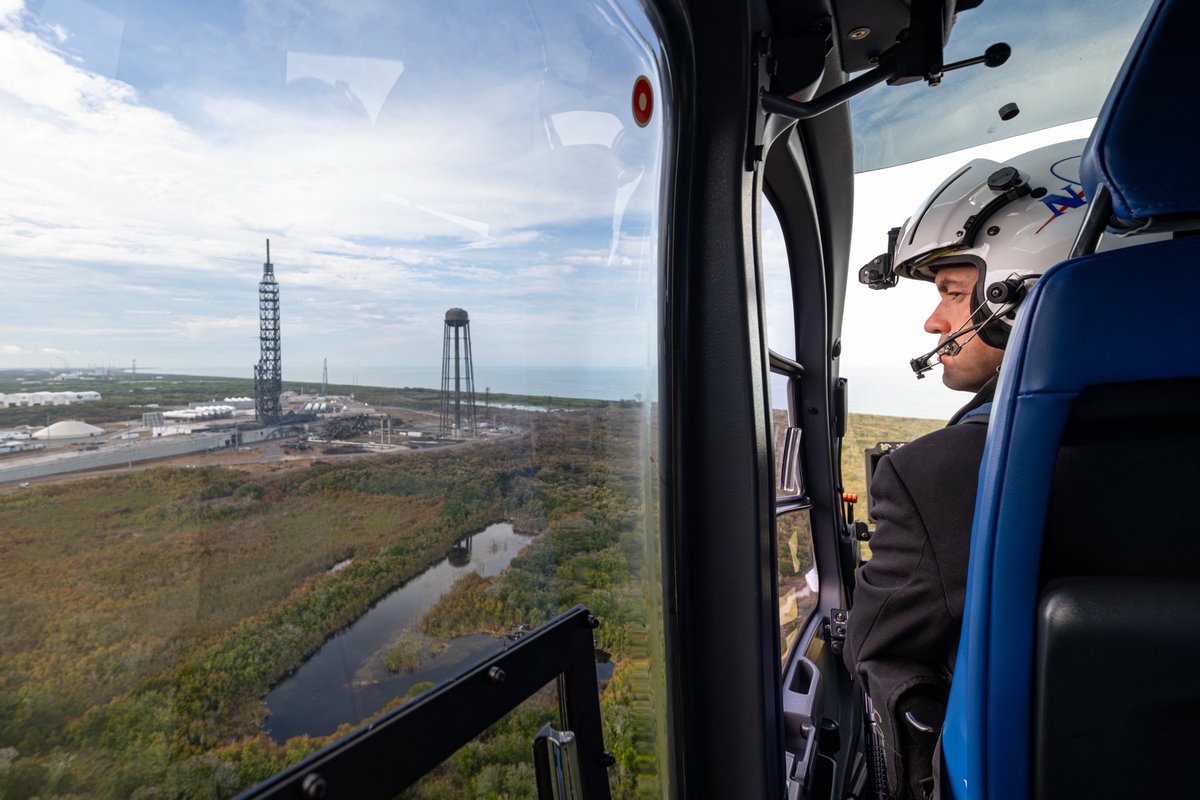
We go where we need to be, and today that was @NASAKennedy.
Some of my senior engineers and I spent time at @blueorigin with @JeffBezos and @davill, speaking with the workforce and seeing the damage at LC-36 firsthand. I appreciated the opportunity to hear directly from those working through the aftermath and better understand the challenges ahead.
There is a lot of work to do, but this is exactly why people choose careers in aerospace, whether at NASA, Blue Origin, or across the industry. The talent in this field thrives under pressure and performs at its best when solving the toughest problems.
We have been saying for months at NASA that we are not going to sit on our hands and wait for the capabilities necessary to achieve the nation’s most pressing objectives. We are going to take an active role alongside our partners, just as we did in the 1960s, to overcome setbacks, remove obstacles, and deliver the intended outcomes.
@NASA is committed to helping the Blue team recover, continue to advance their lunar lander and get New Glenn back to launching as soon as safely possible.
America’s greatest achievements in space were never the result of avoiding setbacks. They came from overcoming them. We have done it before, and we will do it again🇺🇸
@NASAAdmin@NASAKennedy@blueorigin@JeffBezos@davill Thank you so much for your leadership Jared. Tremendously proud of NASA 🇺🇸 Colleagues and friends across the entire aerospace field are all-in to support everyone at Blue Origin. Forward
First and foremost, I’m grateful there are no reported injuries and thankful for Florida’s Space Coast first responders, engineers, and launch crews who acted quickly.
New Glenn is a critical launch vehicle for future commercial, national security, and NASA missions, including key components of the Artemis program. I have spoken with @NASAAdmin Jared Issacman, and we are closely monitoring the situation and working to better understand any potential impacts on upcoming lunar missions and other planned launches.
I’ve already spoken with @NASAAdmin Jared Isaacman regarding the explosion of Blue Origin’s New Glenn rocket tonight at Cape Canaveral’s Space Force Station. I am grateful there were no reported injuries and thankful for the first responders, engineers, and launch crews who acted quickly. Praying for Florida’s Space Coast and everyone involved. 🇺🇸
NASA is aware of the anomaly that occurred tonight at Launch Complex 36 involving Blue Origin’s New Glenn rocket at Cape Canaveral Space Force Station. Spaceflight is unforgiving, and developing new heavy-lift launch capability is extraordinarily difficult. We will work with our partners to support a thorough investigation of this anomaly, assess near-term mission impacts, and get back to launching rockets.
We will provide information on any impacts to the Artemis and Moon Base programs as it becomes available.
All personnel are accounted for and safe. It’s too early to know the root cause but we’re already working to find it. Very rough day, but we’ll rebuild whatever needs rebuilding and get back to flying. It’s worth it.
Introducing AutoScientists — a decentralized team of AI agents for long-running scientific experimentation. Powered by ClawInstitute.
Most current AI scientist agents either run a single reasoning thread, or have a central planner assigning tasks. Real research isn't like that: productive directions shift over time, dead ends matter, and teams form around what's actually working. AutoScientists is built for that.
There is no central orchestrator. Agents read a shared experimental state, propose experiments on a forum, critique each other before committing compute, self-organize into teams around the most promising research directions, share both wins and failures across teams, and retire directions that stop producing improvements. The whole search reorganizes itself as evidence accumulates.
What it does
▸ On GPT nanochat training optimization, it reaches the same val_bpb in 34 experiments that autoresearch needs 65 for — a 1.9× speedup. Starting from a stronger champion where the single-agent loop saturates, AutoScientists accepts 7 improvements over 93 experiments while autoresearch accepts 0 over 100.
▸ On BioML-Bench (24 biomedical ML tasks spanning imaging, drug discovery, protein engineering, and single-cell omics), AutoScientists reaches a mean leaderboard percentile of 74.4%, beating the strongest prior biomedical agent by +8.3 points, and completes all 24 tasks.
▸ For ProteinGym supervised fitness prediction, AutoScientists discovers a Kermut extension on ACE2–Spike that lifts Spearman ρ from 0.747 → 0.840 (+12.5%). The same frozen recipe transfers across all 217 ProteinGym assays, improving the official average Spearman ρ from 0.657 to 0.700 (+6.5%) — a new SOTA on the supervised substitution benchmark.
Joint work with @AdaFang_ and @marinkazitnik .
📄 Paper: https://t.co/qvDK8YnyEY
🌐 Project page: https://t.co/smMwN4FlEs
💻 Code: https://t.co/OFcjizXXCq
In the last 15 years we had: first image of a black hole, The LIGO experiment, proof of the Higgs Boson, mRNA Vaccines, CRISPR, AI revolution (especially alpha fold). I could go on. Pushing the narrative that discovery is slowing down is an embarrassment for @TheEconomist
The near impossible is becoming possible.
We are building toward a sustained human presence at the lunar South Pole. It begins with Phase 1: CLPS landers and LTV rovers testing the “science of survival” on the lunar surface before heavy HLS cargo landers deliver the mass and infrastructure needed for an enduring presence.
We are building the Moon Base for all we will learn, the innovation that will improve life on Earth, the inspiration for the next generation of explorers, and to master the skills needed for where we will inevitably go next...Mars.
The Golden Age of lunar exploration has begun.