The National Cancer Control Strategy 2023–2027 (https://t.co/Fs1FyCfWEY) provides Kenya's roadmap for reducing the burden of cancer through coordinated action in prevention, early detection, diagnosis, treatment, palliative care, research, governance, and sustainable financing.
At the National Cancer Institute of Kenya, @NCIKenya, we remain committed to advocating for policies, partnerships, and investments that strengthen cancer services and ensure every Kenyan has access to quality, equitable, and people-centred cancer care.
Together, through effective policy implementation and collective action, we can build a future where fewer people develop cancer and more survive it.
@MOH_Kenya@Planning_Ke@health
#CancerControl #PolicyForHealth #NCIKenya #TowardsACancerFreeNation
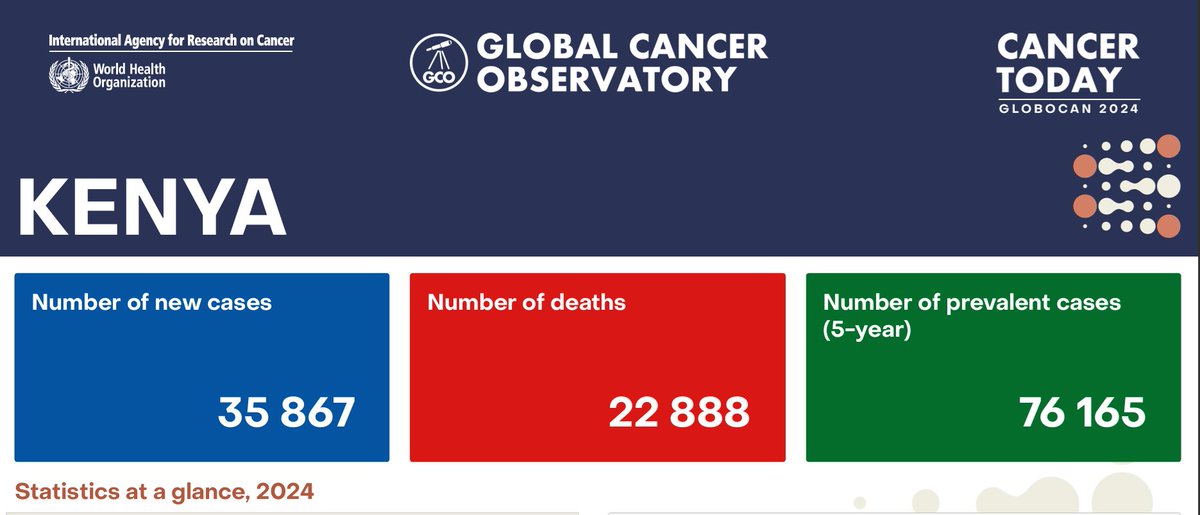
Kenya Records 35,867 New Cancer Cases in Latest GLOBOCAN 2024 Estimates
Nairobi, Kenya – The latest Global Cancer Observatory (GLOBOCAN) 2024 estimates indicate that 35,867 new cancer cases are diagnosed annually in Kenya, while 22,888 people die from the disease each year. The report also estimates that 76,165 people are living with cancer within five years of diagnosis. Compared to the GLOBOCAN 2022 estimates, the 2024 report reflects lower estimated numbers of new cancer cases, cancer-related deaths, and five-year prevalence. However, cancer remains a significant public health challenge, stressing the need for sustained investment in prevention, early detection, diagnosis, treatment, research, and palliative care.
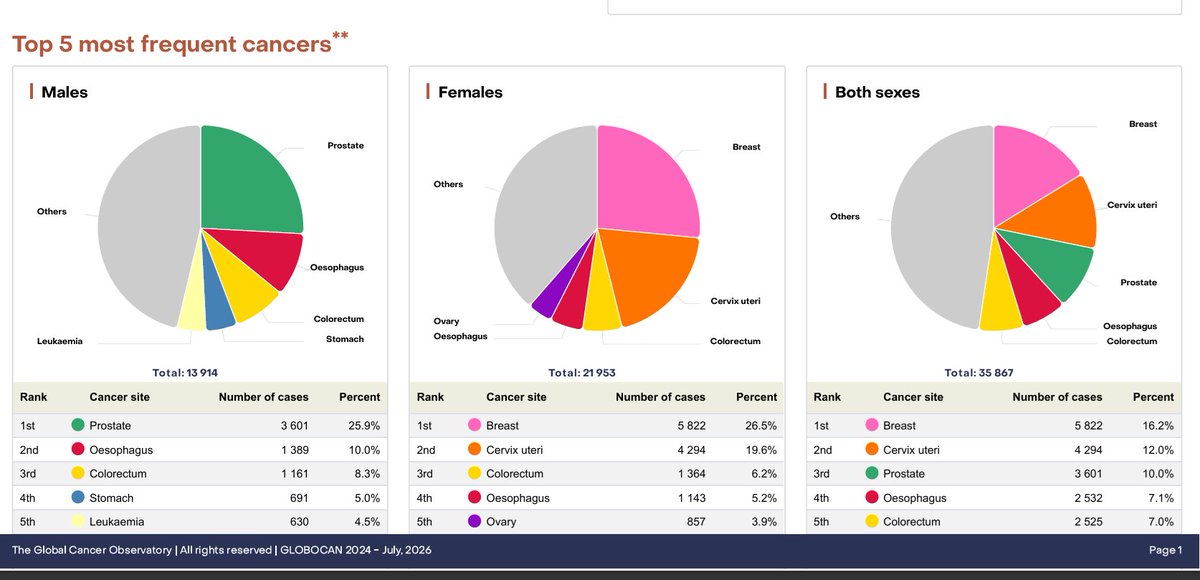
According to the report, breast cancer remains the most commonly diagnosed cancer in Kenya, accounting for 5,822 new cases (16.2%), followed by cervical cancer with 4,294 cases (12.0%), prostate cancer with 3,601 cases (10.0%), oesophageal cancer with 2,532 cases (7.1%), and colorectal cancer with 2,525 cases (7.0%).
The report also highlights the leading causes of cancer-related deaths. Breast cancer remains the leading cause of cancer mortality, claiming 2,882 lives annually, followed by cervical cancer (2,606 deaths), oesophageal cancer (2,353 deaths), prostate cancer (2,199 deaths), and colorectal cancer (1,481 deaths).
Among men, prostate cancer continues to be the most commonly diagnosed cancer, accounting for 3,601 new cases (25.9%), followed by oesophageal, colorectal, stomach, and leukaemia. Among women, breast cancer remains the leading cancer with 5,822 new cases (26.5%), followed by cervical cancer, colorectal cancer, oesophageal cancer, and ovarian cancer.
The findings reaffirm the urgent need to strengthen Kenya's cancer control efforts through enhanced public awareness, timely screening, early diagnosis, equitable access to quality treatment, palliative care, and sustained investment in cancer research. Early detection remains one of the most effective strategies for improving survival rates and reducing cancer-related deaths.
The National Cancer Institute of Kenya (NCI-K) continues to coordinate the implementation of the National Cancer Control Strategy 2023–2027, which provides a comprehensive framework for reducing the country's cancer burden through five strategic pillars: cancer prevention and early detection; diagnosis, treatment and palliative care; governance and financing; cancer registration, surveillance and research; and monitoring, evaluation, and strategic information.
While Kenya has made significant progress in expanding access to cancer services, strengthening county cancer programmes, improving cancer surveillance, and fostering strategic partnerships, the latest GLOBOCAN estimates demonstrate that cancer remains a major public health challenge requiring increased investment and a whole-of-society response.
NCI-K calls upon all Kenyans to prioritize healthy lifestyles, participate in recommended cancer screening programmes, seek medical attention promptly for persistent symptoms, and support national efforts aimed at reducing the burden of cancer. The Institute also urges continued collaboration among government, county governments, healthcare providers, development partners, academia, the private sector, and communities to accelerate progress towards a future where fewer Kenyans are diagnosed with cancer and more survive the disease.
The GLOBOCAN 2024 estimates, published by the International Agency for Research on Cancer (IARC), provide the latest global and country-specific cancer incidence and mortality statistics and serve as an important resource for informing cancer control planning, policy development, and resource allocation.
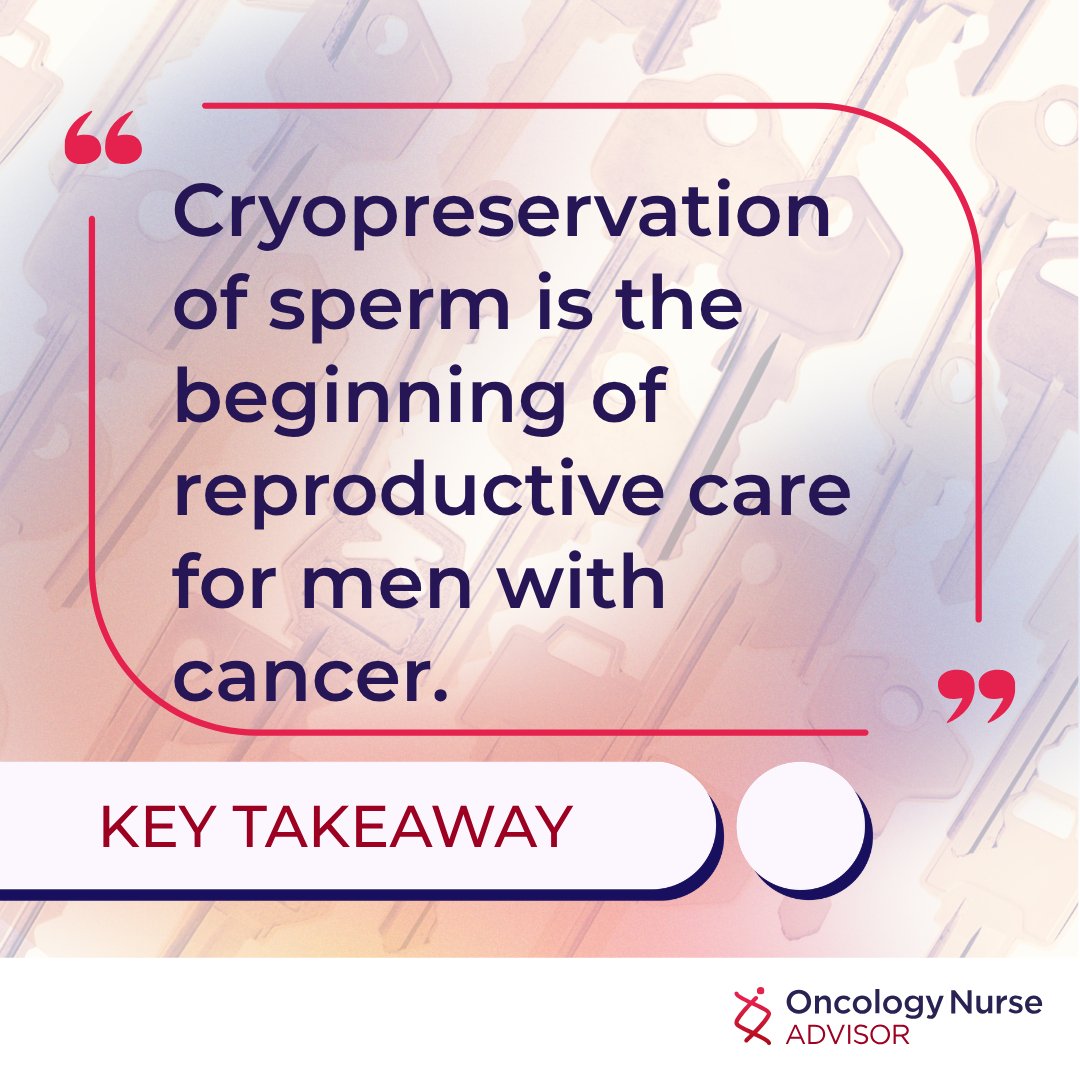
One of the long term side effects of cancer treatment is infertility for both genders. As health care providers we need to have the discussion on sperms preservation, an area that is less talked about in the african context.
@NCIKenya@ISNCC@onlep
A new commentary in @OncJournal calls for a major reframing of male #oncofertility care.
While 70-80% of men bank sperm before cancer treatment, fewer than 10% ever use it. Yet, most keep paying to store it.
Read more about the study here:
🔗 https://t.co/KQ2Hud24LF
Better questions to ask:
Why do some women get early detection; others don't? Why can some families afford treatment; others go bankrupt? What #systemic changes would help more people survive?
#StuffIdTellMySister explores exactly this.
📗https://t.co/iDIHiU7Zd4.
2/2
We call them #Cancer warriors. Fighters. Survivors.
And they are. But that framing can obscure something important.
Survival isn't only about individual strength. It's about whether systems showed up for you.
Full post on LinkedIn 🔗
https://t.co/XruJbstMd0
1/2
An article co-authored by @TracyABalboni a @caringatgwish faculty discusses the role of spirituality and sacred connections within the practice of medicine to improve resilience and reduce burnout. https://t.co/pFrNQvzbCI
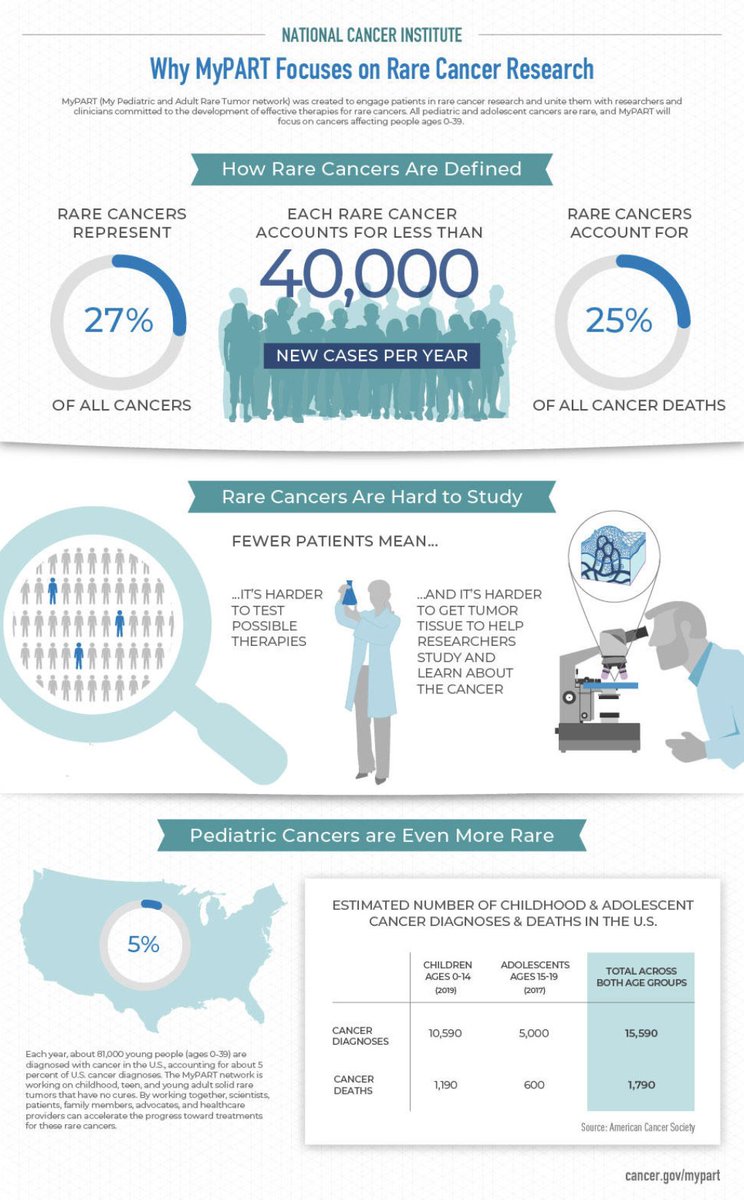
Rare cancers affect fewer than 40,000 people each year, but together they account for more than a quarter of all cancer diagnoses and deaths in the U.S. Through the MyPART Network, NCI is advancing research and collaboration to accelerate progress for patients.
The National Cancer Institute of Kenya @NCIKenya, participated in a strategic stakeholder engagement meeting convened by City Cancer Challenge @CCan_org, to discuss strengthening patient navigation and enhancing partnerships in cancer care.
Representing NCI-K CEO @DrEliasMelly, Mrs. Emily Barsito joined stakeholders from Kenyatta National Hospital, @KNH_hospital, C/Can, Amgen, and other partners in exploring sustainable funding models, collaborative approaches, and patient-centred solutions aimed at improving access to quality cancer care in Kenya.
Through collaboration and innovation, we continue to strengthen Kenya's cancer care ecosystem for better patient outcomes.
#CancerCare #PatientNavigation #Partnerships #CancerControl #NCIKenya
Smarter cancer care might just be a matter of time! ⏰✨
A new meta-analysis shows that administering immunotherapy (ICIs) earlier in the day significantly extends survival for patients with advanced cancers.
Read about it here: https://t.co/KZgwUI3mUJ
#OncNurse#CancerCare
#PancreaticCancer remains one of the deadliest cancers. These important results are an encouraging reminder that long-term investment in fundamental cancer biology can change what is possible for patients. https://t.co/7aNcf0376e
A brilliant new article to address multidimensional patient and family needs. We must commit to a transdisciplinary model of teamwork and care (open access!) #spiritualcare https://t.co/19HqDzu89J
Join the Africa Cancer Research & Control ECHO Session on 25 June | 4:00–5:30 PM.
💬 Palliative Care & Cancer Survivorship in Africa
🔗 Register: https://t.co/NttH97Z6UO
#CancerCare#PalliativeCare#Africa#Oncology
Our Silver Jubilee Gala was more than a celebration, it was a reflection of the journey that has shaped us over the past two and a half decades.
From recognising milestones to honouring the people behind them, the evening was a meaningful reminder of how far we’ve come together.
Take a look at the highlights from the night.
#25yearsofSONAM
#AKU
Advancing Ethical Cancer Research in Kenya: A Major Milestone in Strengthening Cancer Research Governance.
The National Cancer Institute of Kenya @NCIKenya, has strengthened ethical and scientific oversight of cancer research by establishing the National Cancer Institute of Kenya Institutional Scientific and Ethical Review Committee (NCI-K ISERC), the country's first and only specialized cancer-focused ISERC.
From 15th to 19th June 2026, members of the newly constituted Committee completed an intensive ethics training programme facilitated by the National Commission for Science, Technology and Innovation @nacosti. The training equipped Committee members with critical competencies in research ethics, informed consent, protection of vulnerable populations, scientific and ethical review of research proposals, quality assurance, community engagement, research integrity, post-approval monitoring, and emerging issues in research ethics.
The establishment of NCI-K ISERC marks a significant advancement in Kenya’s cancer research ecosystem. The Committee will provide independent scientific and ethical review of cancer-related research protocols, ensuring that studies meet the highest standards of scientific rigor, participant safety, human dignity, and regulatory compliance.
While officially closing the workshop, @DrEliasMelly, Chief Executive Officer of NCI-K, described the initiative as a major step toward strengthening cancer research in Kenya and beyond.
“This is a great milestone towards strengthening cancer research in Kenya and beyond. The specialized ISERC will provide quality, ethical, and responsive support towards the generation of knowledge, science, research, and policy. This aligns strongly with the implementation of Pillar 5 of the National Cancer Control Strategy on Cancer Registration, Surveillance and Research.”
Dr. Melly further noted that recent global discussions, including resolutions from the G7 meeting in France, have emphasized the need to strengthen cancer surveillance and research worldwide.
“The National Cancer Institute of Kenya is a leader in the region, and Kenya seeks to become a member state of the International Agency for Research on Cancer (IARC). We encourage all scientists and researchers, both locally and globally, to utilize the services of NCI-K ISERC. Research is made easier for all.”
The initiative is expected to:
i) Strengthen ethical conduct of cancer research in Kenya
ii) Enhance protection of research participants and communities
iii) Improve the quality and credibility of cancer research outputs
iv) Support timely and efficient review of cancer research proposals
v) Contribute to evidence-based cancer prevention, diagnosis, treatment, and control policies.
With the establishment of NCI-K ISERC, Kenya has strengthened its capacity to support ethical, credible, and impactful cancer research, positioning the country as a regional leader in cancer research governance and innovation.
What a night.
Last night, we came together to celebrate 25 years of the School of Nursing and Midwifery, East Africa, 25 years of transformation across Kenya, Uganda, and Tanzania.
From our pioneering programmes to the more than 3,800 graduates now serving communities across the region , this Silver Jubilee was a celebration of everyone who has been part of this journey.
To our faculty, staff, alumni, students, partners, and friends , thank you for being part of this milestone. Here's to the next 25 years. 🥂
#SONAM25 #SilverJubilee #NursingAndMidwifery #25YearsStrong
Last year in Addis Ababa we asked a hard question:
How does Africa move from being a recipient of innovation to shaping and leading it?
This year, we will continue that work in Abuja.
Full post🔗https://t.co/PLW8vbTzxW
#KeepingAbreastWithDrMiriam#BestOfASCOAfrica#Abuja2026
New research from NCI scientists may help CAR T cells better distinguish cancer from healthy tissue—an important step toward safer treatment for solid tumors. Learn more: https://t.co/wTy8sKbb5w #Immune2Cancer
Uterine Cancer Awareness Month – Day 10 🎀🎀
Don’t ignore the signs your body may be showing you. Early awareness can save lives.
#UterineCancerAwareness#Jump4June
Yesterday the @PresCancerPanel concluded its 2-day meeting exploring modifiable risk factors for cancer. The Panel gathered key experts to learn about the evidence linking lifestyle and environmental risk factors to cancer, including early-onset cancers. Discussions throughout both days centered on exploring opportunities to translate current knowledge into actionable recommendations to reduce cancer risk in the United States.
The Panel extends its sincerest gratitude to all invited speakers for sharing their time and expertise. A special thanks goes to members of the public who joined in person and online. The Panel will consider all the information shared today to determine its next steps.
Stay up to date on Panel activities by visiting: https://t.co/SWMXGezkAP