The population crash no one wants to talk about:
China’s crown jewel is running out of people.
Shanghai’s latest fertility rate is reportedly just 0.53, barely a quarter of what is needed to sustain a stable population, and even lower than South Korea’s record-low 0.72.
But this is not just about “young people changing priorities.” It is also about a brutal economic reality: China has made family formation financially impossible.
In many Chinese families, home ownership is still treated as a prerequisite for marriage. The future mother-in-law in Shanghai often expects the man to own an apartment before the wedding with her daughter even happens.
Now look at the housing burden:
Shenzhen: 26x income
Beijing: 22x
Shanghai: 21x
Hong Kong: 16.7x
When marriage requires property ownership, and property costs 20+ years of income, the result is predictable: delayed marriage, fewer marriages, fewer children, and collapsing fertility.
Shanghai's demographic engine is stalling and is hardly an exception. Fewer births today mean fewer consumers, fewer homeowners, fewer workers, and a much weaker China tomorrow.
Let me explain this slowly, because you have the whole thing backwards.
Social Security was broken the day it was born. It is not an investment. There is no account with your name on it. The money taken from you is handed to today's retirees, and your benefits will be paid by taxing tomorrow's workers. That is the exact structure of a Ponzi scheme. It works only while each generation is large enough to fund the one before it, and it collapses the moment the math turns, which was guaranteed from the start.
So when you blame the 2032 shortfall on Trump's tax cuts, you are pointing at a leak on the deck of a ship that was built to sink. Every rational critic warned of this from day one, decades before Trump existed. You are now using our argument to demand more of the poison that caused it.
And your fix? "Scrap the cap." Take more. That is what is said every time the scheme nears collapse: raise the tax, lift the cap, push the reckoning onto the next worker. It does not save the system. It just enlarges the eventual fall and seizes more of a man's earnings along the way.
You cannot rescue a Ponzi scheme by feeding it. You can only stop forcing people into it. The problem was never the rate. It was the premise: that one man's retirement is a claim on another man's paycheck. It never was, and no cap, cut, or increase will change that.
Sens. Sanders and Warren celebrated Graham Platner's win last night. It appears that the rape-mocking, sex-texting, Hamas-praising, Nazi-tattooed, veteran-abusing, self-proclaimed communist is the right man to bring them back into power... https://t.co/yRyfjcUbXz
Tout le monde pense que le monde libre a gagné en 1989, à la chute du mur de Berlin.
C'est faux.
Et c'est exactement pour ça que le monde est aujourd'hui en feu.
Ce qui est tombé le 9 novembre 1989, c'est un appareil.
Une économie planifiée, un empire militaire, un mur de béton. Ce qui n'est pas tombé, c'est l'idée. L'idée que le monde se divise en oppresseurs et en opprimés. L'idée qu'il existe une égalité finale à atteindre, par tous les moyens. L'idée que tout ce qui existe (la famille, la nation, le mérite, l'héritage) est une structure de domination à abattre.
Cette idée-là n'était plus dans le bâtiment quand le bâtiment s'est effondré.
Il faut reprendre la chronologie, parce que tout est dans la chronologie :
Le communisme économique avait un défaut fatal : il était réfutable. Il promettait l'abondance, il produisait des famines. Il promettait l'émancipation, il produisait des barbelés. Budapest 1956, Prague 1968, L'Archipel du Goulag publié à Paris en 1973, les boat people de 1979 : à chaque décennie, le réel envoyait sa réfutation. Les boat people étaient une réfutation flottante, visible depuis les plages.
Alors l'idéologie a fait ce que fait tout organisme menacé : elle a muté.
La mutation a un nom, et j'en ai raconté la généalogie ici : la French Theory.
Foucault a déplacé la guerre du terrain des faits, où le communisme perdait à chaque fois, vers le terrain du savoir lui-même.
S'il n'y a pas de vérité, s'il n'y a que des rapports de pouvoir déguisés en savoir, alors plus aucune famine, plus aucun mur, plus aucun goulag ne peut réfuter quoi que ce soit.
La French Theory n'a pas enterré le marxisme.
Elle l'a rendu irréfutable.
Et la mutation a des dates. Toutes antérieures à 1989.
1934 : l'École de Francfort, chassée d'Allemagne, s'installe à Columbia. La critique de l'économie devient critique de la culture.
1964-1965 : Marcuse, exilé allemand devenu professeur américain, remplace le prolétariat défaillant par un nouveau sujet révolutionnaire (les minorités, les étudiants, les marginaux) et écrit noir sur blanc que la tolérance doit être accordée aux mouvements de gauche et refusée à ceux de droite.
Octobre 1966 : le débarquement a une date précise. Université Johns Hopkins, Baltimore. Derrida, Barthes, Lacan présentent la pensée française aux campus américains.
1967 : Rudi Dutschke lance le mot d'ordre, la longue marche à travers les institutions.
1968 : les révolutions de rue échouent partout.
Qu'importe. La révolution ne passera plus par la rue, elle passera par la salle de classe.
1975-1985 : Yale, Berkeley, Columbia absorbent la théorie, qui devient le système d'exploitation des humanités.
1987 : Allan Bloom publie The Closing of the American Mind pour donner l'alerte. Un million d'exemplaires vendus.
L'université le traite de réactionnaire et passe à autre chose.
L'Amérique avait son Aron, elle en a fait la même chose que nous du nôtre.
Puis arrive le 9 novembre 1989.
Le Mur tombe. L'Occident célèbre. Fukuyama avait déclaré la fin de l'Histoire dès l'été, avant même la chute. On démantèle les missiles, on encaisse les dividendes de la paix, on déclare le match terminé.
Nous avons célébré notre victoire sur une adresse vide. L'idéologie avait déménagé vingt ans plus tôt. Nous avons gagné contre les chars et perdu contre les chaires.
Pendant ce temps, l'autre empire communiste faisait la lecture inverse. Pékin avait écrasé Tian'anmen dans le sang cinq mois avant Berlin. Sinistre, mais lucide sur un point : la Chine savait que la guerre était idéologique.
Elle a choisi : abandonner l'économie marxiste, garder le contrôle du récit. L'Occident a fait l'exact opposé : il a gardé le marché et absorbé l'idéologie. Trente-cinq ans plus tard, regardez qui construit des centrales et qui déboulonne ses statues.
Vous voulez la preuve que c'est le même logiciel ? Faites la table de correspondance.
La lutte des classes est devenue la lutte des identités.
Les koulaks sont devenus les privilégiés.
L'autocritique maoïste est devenue le privilege checking. Les commissaires politiques sont devenus les DEI officers.
Le samizdat est devenu le compte shadowbanné.
La nomenklatura a quitté Moscou pour Davos et Bruxelles.
Et le paradis ne s'appelle plus la société sans classes : il s'appelle l'équité, l'égalité des résultats.
Exactement ce que je décrivais ici il y a quelques semaines.
On me dira : il n'y a pas de Goulag.
C'est vrai. C'est même tout le génie de la version 2.0.
Le communisme dur devait briser les corps parce qu'il ne tenait pas les esprits.
Le communisme mou tient les esprits : il lui suffit de briser les carrières.
Pas de camps, des services RH.
Pas de procès de Moscou, des excuses publiques.
Pas de Sibérie, la mort sociale.
Demandez aux émigrés du bloc de l'Est installés en Occident ce qu'ils ressentent en traversant une université américaine en 2026.
Ils reconnaissent l'odeur.
Et voilà pourquoi le monde est en feu.
Une civilisation a passé trente-cinq ans à enseigner à ses propres enfants qu'elle était le problème. Résultat : elle ne sait plus défendre ses frontières, transmettre son héritage, ni même nommer ses ennemis.
Quand la présidente de Harvard, devant le Congrès, répond que condamner un appel au génocide « dépend du contexte », vous voyez le logiciel tourner en production.
Et les prédateurs du dehors lisent cette faiblesse comme un livre ouvert : Moscou teste, Pékin patiente, l'islamisme avance dans les rues de nos capitales.
Le feu extérieur n'est que la conséquence du désarmement intérieur. On ne brûle bien que les maisons qui se sont vidées de leurs défenseurs.
Le Mur n'est pas tombé. Il s'est déplacé. Il ne sépare plus l'Est de l'Ouest : il passe désormais à l'intérieur de chaque institution occidentale, entre ceux qui construisent et ceux qui déconstruisent.
La première guerre froide s'est gagnée avec des missiles et du PIB. La seconde se gagnera avec des écoles, des médias libres et des modèles d'IA. Celui qui écrit les valeurs dans les machines écrira le prochain 1989.
Cette fois, ne nous trompons pas de victoire. Au travail.
Three things Paul Greenberg gets wrong about DDT in the NYTimes:
"We’ve effectively banned DDT — a pesticide that nearly emptied the skies of hawks, falcons and even the bald eagle."
Reality:
1. Great bird populations declined sharply due to hunting, egg collecting and human encroachment long before DDT was first used in the US (late-1940s).
2. Great bird populations actually began rebounding during peak use of DDT (early-1960s) because the hunting and egg collecting were banned.
3. There is no scientific evidence that typical levels of DDT in the environment thinned eggshells or otherwise harmed bird populations.
You can learn more about DDT reality in "100 Things You Should Know About DDT": https://t.co/cKCHoH7UHL
https://t.co/d6ZFukLk1u
It was always the women, and above all the young ones, who were the most bigoted adherents of the Party, the swallowers of slogans, the amateur spies and nosers-out of unorthodoxy.
George Orwell
Scientific paper which conclusively proves that CO2 can't be the cause of warming:
"The analysis of air bubbles from ice cores has yielded a precise record of atmospheric greenhouse gas concentrations... the CO2 increase lagged Antarctic deglacial warming by 800 ± 200 years..."
John Maynard Keynes lived as a quintessential elitist who despised the very people his theories claimed to help. While you hear endless praise for his "compassionate" economics, the man himself viewed workers and savers with open contempt, calling them irrational actors who needed enlightened technocrats to manage their affairs.
The Cambridge don made his fortune speculating in currencies and commodities while simultaneously advocating for government controls that would eliminate such opportunities for ordinary people. He lost his shirt in 1928, then again in 1929, proving himself a mediocre investor despite his theoretical "brilliance". His personal financial disasters never dimmed his confidence that he could engineer prosperity for entire nations.
Keynes openly admitted his theories served political expediency rather than economic truth. In a 1944 letter to Friedrich Hayek, he wrote that he expected his ideas to be temporary measures, lasting perhaps 25 years before sounder thinking would prevail. He never intended his deficit spending prescriptions to become permanent doctrine.
The man who gave intellectual cover to every government's spending addiction actually agreed with free market economists on the long run. He simply believed political reality made sound economics impossible. His famous quip "in the long run we are all dead" was political cynicism: politicians need solutions that work before the next election, consequences be damned.
You celebrate Keynes as the savior of capitalism, but he designed his system to give politicians exactly what they wanted: intellectual permission to spend money they didn't have on programs that bought votes. He knew this would end badly. He just figured someone else would clean up the mess after he died.
Wind and solar aren't the future - they are a high-maintenance, low-yield, asset-degrading collection of unreliable gadgetry.
Ultimately, the actual physics makes them exceptionally intermittent and they fail to deliver a true net profit to everyone who was forced to subsidise them. We are told wind and solar are the limitless, romantic future of energy. But when you strip away the romance, they are not pristine monuments to progress.
The reality is, they are complex jumbles of electronics, specialised glass, composite blades and concrete foundations. Like any domestic appliance, they degrade, malfunction and eventually they just wear out, sooner rather than later.
Whether it is a 'minor rural block' or a massive multi-million-dollar commercial farm, the financial equation is plagued by intermittency. Because these technologies only work sometimes, they require trillions in redundant grid infrastructure, backup gas plants, or toxic, short-lived battery arrays just to keep the lights on.
The narrative promises clean, free power from the sky. But both wind and solar are bound by physical barriers that guarantee they can never deliver the promised utopian returns.
A wind turbine cannot simply absorb all the energy passing through it. In 1919, physicist Albert Betz proved that if a turbine extracted 100% of the wind’s kinetic energy, the air behind the blades would stop moving entirely, blocking any new wind from entering. The absolute mathematical maximum efficiency for any open-airflow turbine is 59.3%.
Because of this physical wall, real-world utility turbines max out at around 45% efficiency in perfect conditions. But because the wind rarely blows at perfect speeds, their actual annual average output (capacity factor) globally sits at a dismal 25% to 40% depending on location. They aren't magical power plants; they are mechanical bottlenecks.
Solar panels face an equally rigid thermodynamic wall. Standard silicon panels have a maximum theoretical efficiency of roughly 33% because nearly half of all incoming solar energy is simply too powerful to be captured and is instantly lost as heat, while another chunk of photons passes right through the material like a ghost.
Millions of homeowners who bought into rooftop solar since the late 2000s are discovering the financial math didn't hold up. As early subsidies and high buy-back tariffs evaporated, owners were left with creeping daily grid supply charges and degrading panels.
After only 10 to 15 years, the costly inverters fail, leaving properties with expensive, non-functioning roof clutter.
Colonial powers built extensive modern infrastructure in places that had only had hunter-gatherer tribes or rudimentary subsistence agriculture prior to their arrival.
Since their departures, the last of which were about 50 years ago, over $60 billion in development aid has been sent to Africa every year, totaling around $1.5 trillion in foreign aid to the continent.
Huge amounts of that money are lost to waste and graft. Infrastructure that is built by international groups in Africa is rarely maintained and is often stripped and looted for scrap.
In 1960, South Korea was basically Gaza; razed by war with a GDP per-capita lower than that of Ethiopia. Today, South Korea’s GDP per capita is five times higher than that of South Africa, the richest Subsaharan country, and about 30 times Nigeria’s.
You can’t blame colonialism for everything forever. At some point, Africa has to take responsibility for its own failures.
This isn't quite right. The reason women are so susceptible to Marxist propaganda is because it is women's nature as a political philosophy.
Women redistribute. Women take care of the weak. It doesn't work as a primary political system because you cannot take care of the weak if you don't have a masculine system on top to create the productivity necessary to do it.
If the men aren't hunting there isn't meat that can be redistributed to the weak that can't hunt. The men have to have a reason to create the abundance necessary to redistribute.
This is why you can have an immensely prosperous society that is capitalist first with the feminine organizing principle below it and it's why the opposite is not true.
Here's something many people don't know about me -
Before I publicly dissected the long list of problems in the 1619 Project, I contacted the New York Times through their official channels to request a series of corrections to unambiguous factual errors in its content. The editor - Jake Silverstein - brushed me off and refused any correction - a pattern he also exhibited toward other critics from across the spectrum.
Before I publicly broke the story about Kevin Kruse's plagiarism in Reason, I contacted Princeton's academic integrity officer and alerted him to the problems I had found, giving them a chance to respond and address it internally. They ignored my email and later claimed to have lost my email after I went public.
Before I published my findings on Quinn Slobodian's habitual manipulation of source materials to alter its plain meaning through misquotation, I submitted an article to Contemporary European History (the journal where the worst examples appeared), highlighting the problems with the passages and asking for a correction through their official process. They desk-rejected it, brushed me off, and falsely claimed that Slobodian's piece had been thoroughly vetted in peer review. In fact, one of their own referees had flagged the same problems over a year earlier and recommended rejection of the article.
Before I published an expose on Nancy MacLean & Sandy Darity's similar manipulation of W.H. Hutt quotations in their article for History of Economics Review, I (along with 2 coauthors) submitted a response comment to this journal asking for a correction through its official processes. The editor gave us a complete runaround where he imposed an arbitrary length limit requiring us to cut the content, sent the trimmed version to a referee, then rejected the piece because the referee said we didn't sufficiently address the very same things we were forced by the editor to cut. When I then asked the editor to issue a simple corrigendum to the most egregious misquotation (one that transformed Hutt's explicit attack on the racism of white Afrikaners into a defense of Apartheid), he refused and tried to pass it off as a difference of "interpretation."
Before I published an expose of a leading covid masking model in the Wall Street Journal, I sent a comment to the medical journal that published it alerting them to a math error that changed their entire set of results. The journal acknowledged the error was real but refused to publish my piece on the grounds that the "next release" of the model would be updated to reflect it - even as politicians up to and including Joe Biden were trumpeting the erroneous results all over the news.
California just did something incredibly stupid at the worst possible time.
By openly kneecapping Spencer Pratt in the primary, the state didn’t just protect Karen Bass from a competitive November race. It handed the rest of the country fresh, undeniable proof that their election system is designed to prevent any real challenge from ever reaching the general election. And they did it right as the Supreme Court is preparing to rule on late-arriving mail-in ballots in Watson v. Republican National Committee.
That timing matters. This wasn’t some quiet, behind-the-scenes adjustment. It was a very public execution of a candidate who was gaining traction with a modern campaign and a straightforward message. Everyone watching saw it happen in real time. The ballot drops, the sudden surge of a no-name candidate, the abrupt removal of the only outsider who was making noise ... it was all too obvious to ignore.
What California just proved is that their system cannot tolerate even the possibility of a close or uncomfortable race. Not because they fear losing power overnight, but because they fear voters seeing that the machine can be pressured at all. That revelation travels. It feeds directly into the growing national understanding that what’s happening in places like Los Angeles isn’t normal governance ... it’s managed decline protected by procedural games.
They showed their hand. And they did it at the exact moment the highest court in the country is about to decide how much longer these games are going to be allowed to continue.
(article below)
The most spectacular economic miracle of the last 500 years occurred as food consumption dropped from 80% of income to 3%. Your ancestors spent virtually every waking hour and every earned dollar feeding their families. Today you casually toss organic blueberries into your cart without checking the price.
This transformation didn't happen because governments subsidized agriculture or bureaucrats planned better crop rotations. It happened because private property rights allowed farmers to capture the full value of their innovations, spurring relentless productivity gains.
Consider what free markets accomplished: wheat yields per acre increased 10-fold since 1800. Corn production exploded 6-fold per acre since 1930. The price of basic foodstuffs, adjusted for wages, fell by 90% over two centuries. Each breakthrough, from the steel plow to hybrid seeds to GPS-guided tractors, emerged from entrepreneurs risking their own capital to solve real problems.
The profit motive drove farmers to maximize output while minimizing inputs. No central planner could coordinate the millions of decisions required: which seeds to plant, when to harvest, how to transport goods, where to build storage facilities. Market prices transmitted this information instantly across the globe, connecting Iowa corn farmers to Tokyo consumers without a single bureaucrat involved.
Politicians love claiming credit for "feeding America" through agricultural subsidies and price supports. Yet these interventions consistently reward inefficiency and punish innovation. The real heroes remain the anonymous farmers and inventors who transformed scarcity into abundance by following price signals rather than political directives.
Billions of solar panels are nearing their end-of-life cycle, and the world is completely unprepared for the coming toxic avalanche.
By 2050, the International Renewable Energy Agency projects up to 78 million metric tons of useless and toxic solar e-waste. Where is it all going to go?
The industry boasts that solar panels are '95% recyclable'. Technically, yes - because they are made of glass, aluminum and copper. But economics always trumps physics. In Australia and the US, it costs roughly $20 to $40 to disassemble and recycle a single panel, but only around $4 to dump it in landfill.
Because there is no financial incentive, up to 90% of decommissioned panels go straight into the ground. There are between 7 and 8 billion solar panels in the world today. This milestone was reached as global solar capacity officially surpassed 2 Terawatts (TW).
Because the physical wattage of individual panels varies from small 300W residential rooftop modules to massive 600W utility-scale panels, 2 TW of total energy capacity translates to roughly 7 billion individual panels currently installed worldwide.
Each solar panel is an industrial 'sandwich' bound tightly by heavy polymers. To extract the microscopic amounts of valuable silver and high-purity silicon requires energy-intensive chemical and thermal baking.
When they are crushed or left to fracture in landfills, heavy metals like lead and cadmium (in thin-film technologies) can leach into the surrounding soil and groundwater, turning 'clean energy' into a multi-generational hazardous waste problem.
The crisis is accelerating faster than models predicted. Because solar cells degrade and lose efficiency, and newer, cheaper panels hit the market, consumers and solar farms are ripping out functional systems at least a decade early to upgrade.
This compressed lifecycle destroys the narrative of a long-term, stable asset and creates an endless loop of unrecyclable industrial trash.
More ClimateScam Lies and Hysteria Exposed...
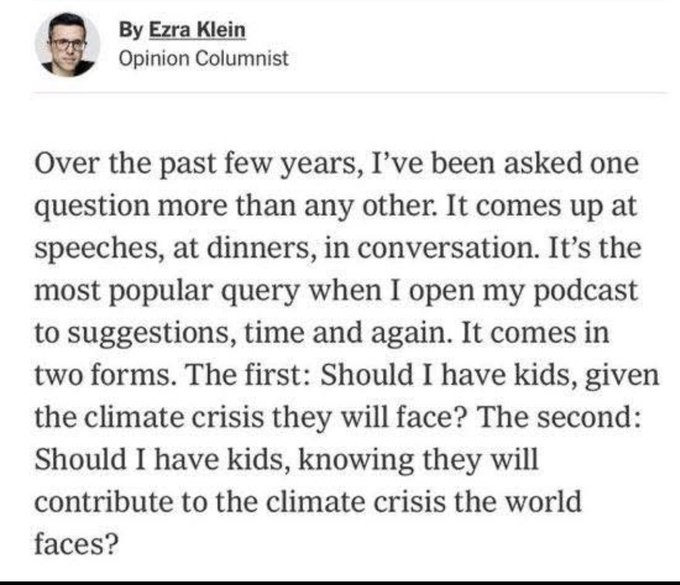
No, Ezra Klein, YOU should NOT have kids. The rest of however, should keep at it. Ezra, you are too weak and stupid to deserve offspring.
More ClimateScam Lies and Hysteria Exposed...
No, China runs on COAL, not solar. They EXPORT solar and fund anti oil and pro ClimateScam groups in the West.
Endless coal trains, 150-cars-long, are constantly feeding China's power plants.
The generated electricity helps manufacture the solar panels later shipped to the West.
Panels made with coal, transported on oil-burning ships, installed and called emissions-free.
Asia, led by China and India, currently operates over 5,000 coal plants, with almost 1,000 more on the way.
The West is doing the opposite. Europe has retired, cancelled or mothballed over 1,000 coal plants.
China is building power.
The West is dismantling it.
The vast majority of what you think you know about climate science is not only false, most of it doesn’t even exist!
You have been betrayed by ALL the modern institutions of climate science:
IPCC, NASA, NOAA, WMO, …
They have ALL been lying TO YOU for 40 years now.
If you are under 50, you have been misled for your entire education.
Sorry to upset your post-truth delusion. It’s time to return now to TRUTH and REALITY.
1. CO2 is good not bad. It is the gas of life itself.
2. CO2 rise in the atmosphere is NOT caused by fossil fuel burning.
3. Humans are not driving any climate change.
4. There is no global temperature. And since it DOESNT EXIST, it’s also NOT RISING.
5. “Global warming” as defined by climate science—a rise in global temperature—DOESNT EXIST.
6. There is no such thing as global ocean pH and the ocean is NOT “acidifying”.
7. Sea-level rise rate is unchanged for 200 years or more. There is no acceleration. Satellites cannot measure the fictitious Global mean sea level.
8. Argo-based “ocean heat content” is a fraud and cannot be measured the way they claim to do.
9. Earth’s Energy Imbalance as promulgated by NASA is a fraud.
10. And the list goes on and on…
11. The Earth has NOT “warmed” by 1.1 °C
12. There is no such thing as equilibrium climate sensitivity. It does not exist.
…
…
It has ALL been LIES for decades now. Straight from the institutions and scientists you trusted.
China’s solar industry just hit a massive structural turning point.
Facing 10 consecutive quarters of corporate losses and rampant overcapacity, Beijing is stepping in with aggressive fiscal interventions that just crashed solar exports by 40%.
Here is the real story
🧵 👇🇨🇳🌞