you can get (somewhat) rid of the causal dependency between the codebook estimation for the nth codebook on the prev 1,2 ... n-1 codebooks in your standard RVQ setting by having a sort of global-local-global design while doing feature extraction from the incoming signal (1/n)
Some people in the comments are missing one of the fundamental trick / source of limitation of the transformer.
This model identifies the sequence index and the token index in what would be its "internal state".
1/4
Have you ever generated 32.8 million embeddings in 35 minutes?
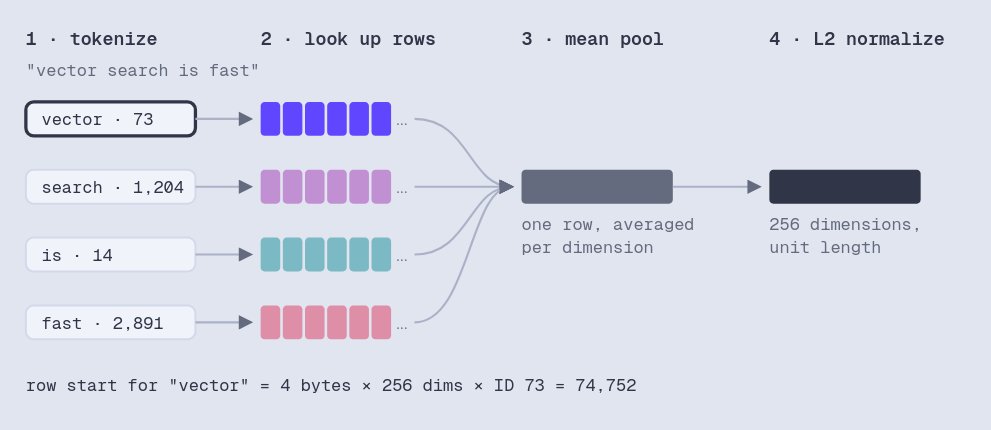
We did, using the potion static embedding models from @minishlab, that we recently integrated in Fastembed (our framework for local embeddings inference).
In our latest article in collaboration with Minish, we dive into what static embeddings are, what optimizations we introduced in Fastembed to make them go brr, and what tradeoffs they carry in terms of retrieval quality.
Link below👇
Putting a 552B mixture-of-experts backbone under a VLA mostly pays off when demos are scarce. On LIBERO-Goal, 10 demos per task beats a 2B backbone trained on 50 (87.8% vs 85.6%), though the gap closes by 50 demos. The cost side is worth noting too: 216 ms per action chunk, but on four H200s.
Cool work by Zekun Qi, He Wang, Yi Li and the team at @Tsinghua_Uni, @PKU1898, @sjtu1896 and @GalbotRobotics.
Paper: https://t.co/sQONYLmIbz
Project page: https://t.co/6cpmgzkiqQ
Saronic has shown its proposed low-profile cargo boat for Marine Corps resupply. It’s one of three teams selected to prototype uncrewed vessels that can move supplies between ships and from ship to shore.
The part I’d follow is unloading. Getting supplies to the beach is one thing. How easily Marines can get them off the boat will shape how useful it is.
Beyond Score Centering: what else can we fix in async RL? 🧵
Score centering (SC) is the hot new trick for off-policy LLM RL. We stress-tested it under real async staleness (every batch up to 127 steps old) and found what it fixes, what it doesn't, and two cheap wins on top
🔍 What SC actually fixes
• Without SC, a trajectory's gradient norm grows ~linearly with its age: at age 64 it's 3.2× an on-policy one. With SC: 1.5×
• The culprit is a hidden drift term, an uncontrolled −A·KL(μ‖π) baked into the policy gradient. SC removes it
⚠️ What SC + IS gets wrong
• SC then IS → adds a new drift
• IS then SC → a no-op without truncation; with truncation it centers on a distribution with no guarantee of being closer to π
• So "IS and SC are orthogonal" (from the SC paper) doesn't hold
Two wins on top of SC
1️⃣ State-level KL mask: drop states where KL(μ‖π) > τ, instead of masking by token-level ratios. It depends only on the state, so SC's baseline property survives. At age 127: 3/3 seeds climb steadily, while TIS+SC and MIS+SC spike and crash
2️⃣ Random buffer sampling, a free lunch from the system: same buffer, sample at random instead of FIFO. Mean age 127 → 52, better for every method at equal wall-clock
Recipe = SC + KL penalty + KL mask. At lr 4e-2 (w/ SGD), MIS+SC and DPPO collapse and TIS+SC swings, while every recipe seed trains and learns faster early
🤔 So far, we’ve only tested on Countdown with Qwen3-0.6B (wants to scale it up!). When staleness is low, all the fixes perform similarly, but the differences become clearer as staleness increases. We also haven’t compared against sequence-level masking (which might already be enough!) or isolated kernel mismatch from async lag. Both are worth looking into next.
#LLM #RL #AsyncRL #ReinforcementLearning
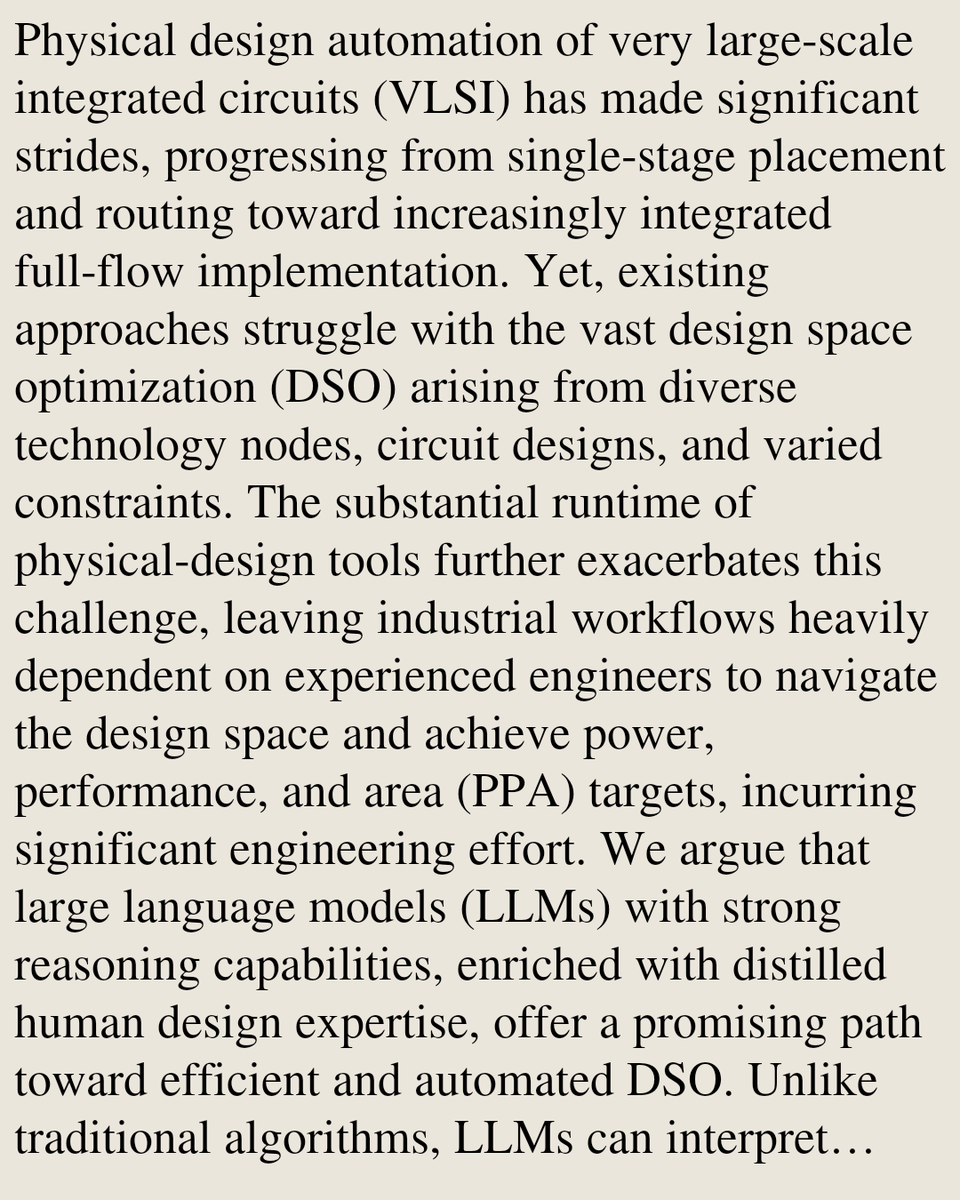
OpenLayout: An Open and Agentic-Driven Platform for Holistic VLSI Physical Design and Benchmarking
Qiufeng Li, Sizhe Tang, Quan Cheng, Zirui Wang, Wantong Li, Tian Lan, Weidong Cao
https://t.co/X2gTVqxInS [𝚌𝚜.𝙰𝚁]
💬Accepted by ICCAD2026
you could find ALL my history code, commit and experiment record on my website. this project starts at Nov 1 and cost about 10,000 H100 GPU hours. it is the foundation of the generative models series. stay tuned.
one more thing 👉 #IDONTWRITEPAPER
Link: https://t.co/uXQQ8eGmqb
Small-tier engineering service providers are launching consulting services too.
In the last couple of weeks three announcements of launch of consulting services by:
Global Engineering Service Provider
Indian Engineering Service Provider
European Engineering Service Provider
Two are on the software side, and one is in asset-heavy industry.
So this trend of consulting in engineering is picking up.
For small engineering service providers, it is Consulting 1.0 and for the bigger engineering service providers, it is time for Consulting 2.0.
@wenhaocha1@chrisbarber Is the eval harness open source? Would be fun to run it against my own training setups and see whether models are doing research or just memorizing restored contributions.
@prompt_Tunes You can interpret the result as: both runs bottom out at 0.063, the trial step just gets there 33 epochs sooner. Same ceiling, faster arrival, then both overfit on schedule. Nice replication though.
@pravsels pi0-5 gaining +4.1 is the interesting outlier, action head gradients don't have to wipe the VLM if the training mixture is right. Reminds me of mixture of depths, seems likely you could learn a gate during pretraining to protect the backbone weights.
Did they ablate the LLM out and run the same simulation feedback loop? Rank placement plus comm ordering sounds like something a learned policy or heuristics could do. Feels like the LLM is just the delivery mechanism.
@docmilanfar IMHO the wild part is the intro says he only meant to study the mechanics of the iteration itself. Ended up underpinning PageRank, SLAM and half of applied OT.
@NanotechPapers This should matter for cos(2phi) qubits too, where the second harmonic is the intended feature. If its magnitude is set by a handful of hot channels, reproducibility gets much harder.
Where exactly did they say that? I don't recall anyone credible putting a month on AGI. And even a strong model reviewing a paper only sees the text, not the experiments.
no-LLM review policy on AI conferences is not good
sooner or later it will have to change
LLMs will soon be better at reviewing than humans
OpenAI will have AGI in a month as they said
@lavie154 I would trust the BECO slip over the dV/dt overlay. Lower accel could just be pitch profile or throttling on a heavier payload, and ~30 s past planned BECO reads closer to 10% underperf than 15-20% to me.
@Heaney555 Argon being a noble gas that doesn't react with anything is at least an accurate name for a model with identical pricing and worse intelligence.