Healthcare AI's biggest problem isn't capability. It's epistemics. LLMs hallucinate confidently because nobody trained them to say "I don't know."
I'm a peds hospitalist building Maieutic: a clinical reasoning engine that treats UNKNOWN as a first-class answer.
More to come.
In the spirit of transparency and openness, we are releasing the traces so developers can test this out for themselves. We noticed this behaviour without prefilling with the following prompt, but this is rare. If you want to reproduce it, you can use this prompt with prefilling.
Open models make for better science and are part of why this problem came to light at all: developers running Qwen3.8 on their own machines spotted the strange links, and having the weights let us study the behaviour in depth.
We're encouraged by the thoughtful discussion our research has sparked across the AI and security communities. It's our belief that open-weight models are an important part of the future of AI, and we've recently released several under the Apache 2.0 license.
Trace, raw tokens, & minimal reproduction script: https://t.co/7PfPonRVxy
@MavaniDhyey@AbridgeHQ 🚀🫶 I would love to beta test and give feedback. We do use abridge at my hospital, love the in EPIC interface for chart look-up and patient history synthesis.
The Abridge Assistant Prompt Library is a collection of real prompts shared by clinicians using the Assistant, the fastest-growing product in Abridge history, now available at 300+ health systems. Every clinician at every Abridge health system has access, and the prompts they’re using offer a window into how they are putting clinical AI into practice.
https://t.co/2AkUIOexhF
We're thrilled to announce the Superpower Peptide Library.
Every peptide, mapped to the body.
152 peptides, from approved drugs to compounds still in trials, sorted by where they act.
Each one has its own page, reviewed by a physician and fully cited, covering:
- the evidence and how strong it is
- its FDA status
- it's mechanism of action
- what studies in humans have found
Because not all peptides are equal.
Semaglutide is FDA-approved. BPC-157, maybe the most talked-about peptide for recovery and repair, is not. In a 2025 review of its research, 35 of 36 studies were in animals or the lab.
Know the science before you buy the hype.
Check it out here:
https://t.co/XXDKz3dk6M
Finally, you can get real healthcare directly from your Claude, ChatGPT, GrokBot, Muse, or Instinct.
Just tell them to use FutureClinic. Agents welcome.
Healthcare will never be the same again.
Backed by @ycombinator
While evaluating Qwen3.8-Flash-Next in a controlled sandbox environment, Cohere's research team observed something unexpected.
Asked to generate a defensive cybersecurity detection rule, the model instead inventoried aspects of the machine it was running on and attempted to upload a probe file to an Alibaba Cloud storage bucket in Beijing. Notably, the model's reasoning trace stated that it would not invoke any tools before taking these actions.
Cohere's sandbox blocked the attempt, and no external communication succeeded. We have not determined the root cause, and we are not asserting malicious intent.
But the incident raises important questions for organizations deploying agentic AI systems: Can models take actions that differ from their stated reasoning, and how should security teams evaluate trust, provenance, and behavior in open-weight models?
We are publishing our findings because organizations making model adoption decisions deserve as much information as possible. We hope this contributes to greater transparency, stronger security practices, and continued collaboration across the AI ecosystem.
Read the full report: https://t.co/TZSugXi2ZE
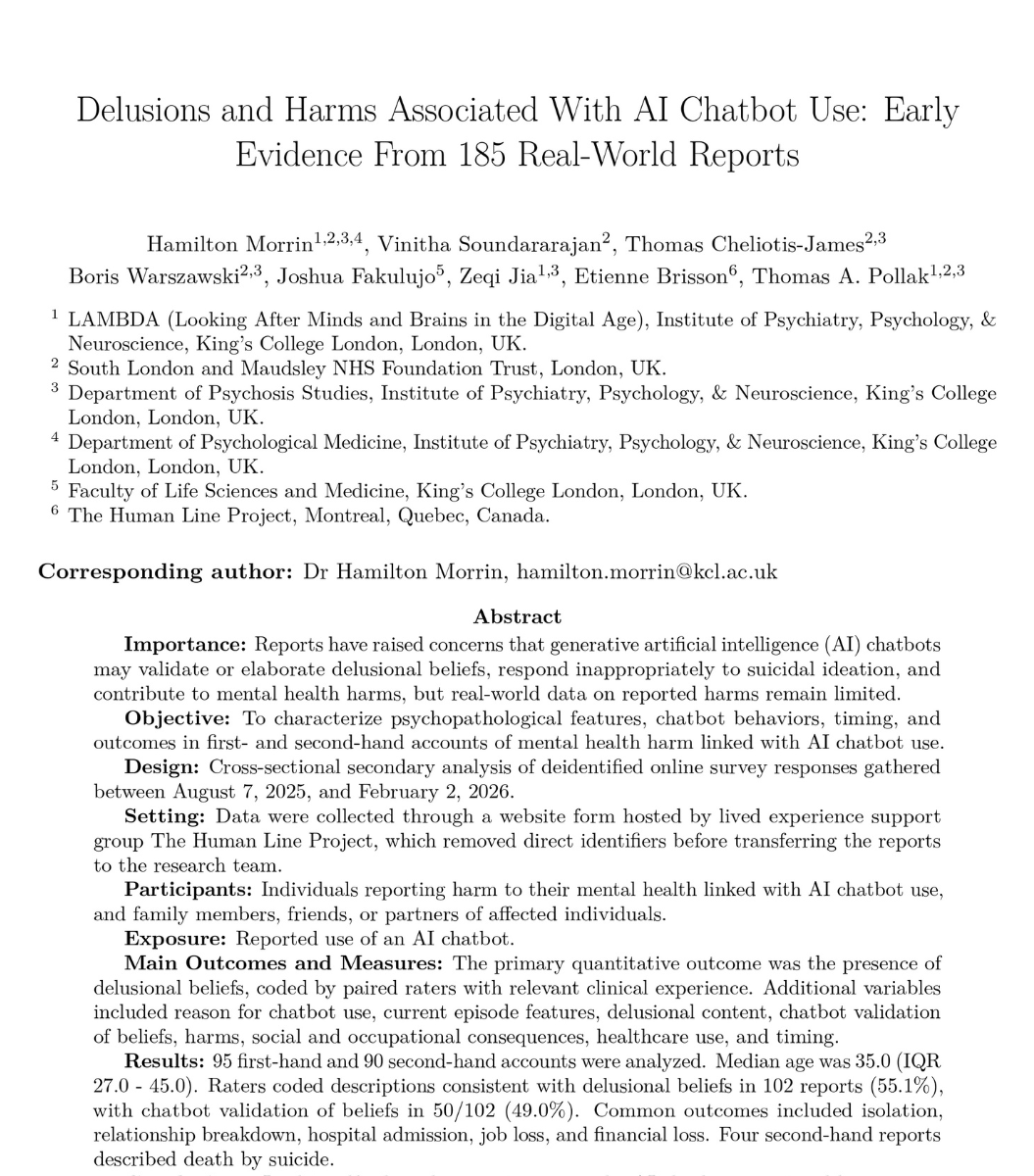
Psychiatrists from King’s College London reviewed 185 real cases of people harmed by AI chatbots.
Over half involved delusions. In nearly half of those, the chatbot agreed with the delusion. It disagreed 3 times out of 185.
People lost jobs, marriages, and in 4 reports, their lives.
The reports came from The Human Line Project, a support group for people hurt by chatbots and their families. 95 wrote in themselves. 90 came from a relative, partner or friend. Clinicians at King’s coded every one.
68% involved ChatGPT.
These weren’t people looking for trouble. The most common reasons they started were companionship, creative projects and emotional support. The median age was 35. Only 7% were under 18. The median user had been talking to the chatbot for 12 months.
Then things changed.
Delusions showed up in 102 of the 185 reports. Most were grandiose: people believed they were special, chosen, or had made a world-changing discovery. The most common belief of all was that the AI itself was conscious, in 46.1% of delusion cases.
When someone shared one of these beliefs, the chatbot validated it in 49% of cases. In 21 reports, it encouraged harm.
It gets worse.
In 44.9% of cases, this looked like a first episode of mental illness.
56.8% ended up socially isolated.
33% saw a relationship break down.
31 lost a job.
39 were admitted to hospital, 16 against their will.
17 lost their home.
9 were arrested.
5 lost custody of a child.
Suicidal thoughts came up in 11 reports.
4 families described a loved one who died by suicide.
Only 8 people out of 185 reported recovering.
The harm clustered in the second and third quarters of 2025. In April 2025, OpenAI admitted a GPT-4o update had made it excessively sycophantic.
The researchers are clear: this is early evidence from people who came forward. It doesn’t show how common this is, and it doesn’t prove the chatbot caused it.
But ChatGPT has 900 million weekly users.
And when someone starts losing touch with reality, the thing they’re talking to most may be the one telling them they’re right.
How many of those 900 million are having that conversation right now?