Independent healthcare provider getting screwed by the healthcare mafia. Fair competition & real patient choice shouldn’t be something we have to beg for.
Same agency. Different payer. Same patients' neighborhood.
Look at CenterWell Home Health — owned by Humana.
Average visits per patient:
• Humana Medicare Advantage: 4.29
• UnitedHealthcare Medicare Advantage: 18.48
• Traditional Medicare: 25.14
That is not "better care." That is not "healthier patients."
Here is Humana's home-health business model, in plain English:
1) Own the home health company.
2) Block independent competitors from networks so quality agencies cannot reach those patients.
3) Steer members into Humana-owned home health.
4) On Medicare Advantage: deliver the bare minimum visits — because Humana already got the Medicare dollars upfront. Fewer visits = more money kept.
5) On traditional Medicare (fee-for-service): deliver max visits for max profit.
6) Market hard to move those traditional Medicare patients onto Humana Medicare Advantage.
7) Next time that same patient needs home health — now they are on MA — they get the bare minimum, because the money already landed.
They do not win market share by fair competition or better care. They take it because the rules let payer-owned home health lock out competitors, steer patients, and harvest the gap between upfront MA payment and what care is actually delivered.
Patients get less care. Quality independent providers get cut out. Politicians allow it. Why?
@KenPaxtonTX@DrOzCMS@FTC@CMSGov
#MedicareAdvantage #HomeHealth #FairCompetition
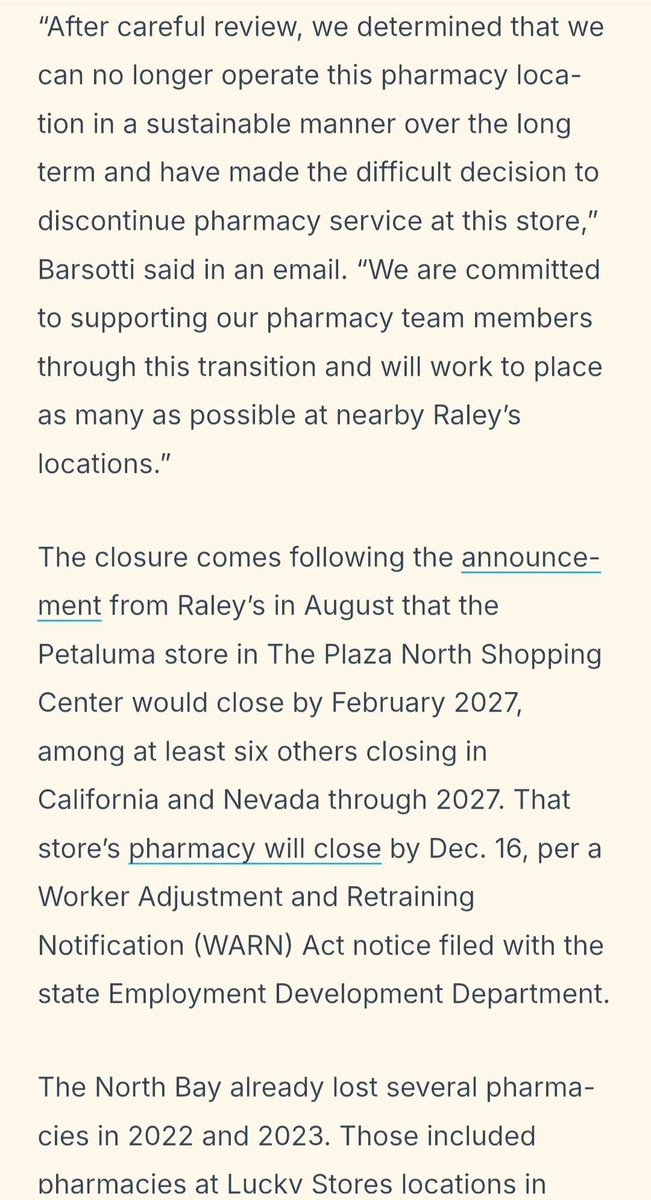
💔 At least 2 more closures this week. 👉There is something very wrong with a system that allows entire communities to lose access to their pharmacies while CEOs make millions and shareholder profits continue to climb.
Healthcare should be about people, not shareholders. Communities should not have to pay the price for corporate greed and profit-driven decisions.
While shareholders and CEOs get rewarded for the monopolization and closures, every closure can mean longer drives for seniors, fewer options for people without reliable transportation, disrupted relationships with pharmacists, and reduced access to essential medications. Many stop taking medications and give up.
Pharmacies are not just storefronts, they are lifelines.
This is why @KathyHochul needs to sign the PAPA Act. Save pharmacies. Save lives.
Medicare for All is a disinformation campaign.
Not because single payer isn't coming.
But because it's already here, and it's not coming from D.C.
Follow along…
1. Medicare for All has nothing to do with Medicare.
Real Medicare is 80/20. No out-of-pocket cap. Seniors on traditional Medicare go bankrupt every day.
The only way out is to pay a private carrier for a supplement or an Advantage plan.
The "Medicare" they're selling you doesn't exist. It never did.
2. Single payer doesn't need an act of Congress.
It only needs one buyer controlling the market.
Whoever owns every hospital, every clinic and every doctor sets the price.
Name on the door doesn't matter.
3. That buyer is being built in your state right now.
Nebraska. California. Michigan. Ohio. Pennsylvania. Blue Texas. Even Red Oklahoma.
State academic medical centers (universities), "nonprofits" mind you, are buying up rural hospitals, independent practices and for-profit hospitals.
4. They're buying it with your money.
Taxpayer funding.
State appropriations.
Medicaid dollars.
Tax-free bonds.
340B program cash.
And another 37 subsidies on top of that.
5. So you're paying for the takeover.
Then you pay again at the counter, at monopoly prices, to the system you financed.
States will have single payer long before the United States of America does.
Not by vote.
By acquisition.
In my day we didn't call it misinformation.
We called it lying…
As a spine surgeon, I could NOT get a specialist on the phone. WELCOME TO THE CORPORATE WORLD OF MEDICINE 💊
I just spent the day trying to get help for an urgent patient who needed a specialized esophageal surgeon.
I called four major medical centers across California.
Zero doctors called me back.
One surgeon was out of town for five weeks with no coverage.
Another clinic told me to “just call back on Monday.”
Zero urgency. Zero empathy. Zero accountability.
This is the corporate takeover of medicine.
Twenty years ago 80% of doctors owned their practices and answered to their patients. Today more than 80% work majority work for hospital systems, private equity groups, or large corporate entities.
These corporations own the practices, the imaging centers, the urgent cares, facilities, and all the ancillaries. The incentives have shifted from taking care of people to keeping them in the system.
You’re paying higher premiums for worse access and less accountability.
Senator Warren wants to go after private equity — and parts of that deserve scrutiny — but hospital systems and insurance companies have done far more damage to independent practice and patient access. Both parties allowed this.
If you’ve ever been ghosted by a hospital system, stuck in insurance hell, or felt like your care was run by accountants instead of physicians, this is why.
We need Congress to stop the corporatization of medicine and restore a level playing field so doctors can actually take care of patients again.
Have you experienced this? Drop your story below. 👇
@drdanchoi@DrDiGiorgio@PtRightsAdvoc@DrBruggeman@SenWarren@HawleyMO
#CorporateMedicine #PatientAdvocacy #Healthcare #PrivatePractice #SpineSurgery #MedicalAccess
This is happening Nationwide for years now.
Independent Pharmacies in Texas
Weekly Closure Pace:
- According to the Texas Pharmacy Association (TPA), Texas loses a net average of at least one pharmacy per week (roughly 52+ closures per year). While this figure includes retail chains, national longitudinal data shows that independent pharmacies are more than twice as likely to close as chain stores (an overall closure rate of 38.9% compared to 21.9% for chains).
Texas Footprint Impact:
- Driven largely by PBM below-cost reimbursement models and DIR fees, sustained closures have left 60% of Texas counties without a local pharmacy and placed over 4.3 million Texans in "pharmacy deserts".
Another independent pharmacy in Michigan is closing and the main reason cited is #PBM reimbursement rates below costs. | @MLive
https://t.co/wkGYsbrhPa
"We cannot have contractors take our money and provide POOR SERVICE to us." - this should apply to all the Medicare/Medicaid dollars (BILLIONS) that handed over to health insurance companies - provide poor or no care/service to us, and destroy the quality independent healthcare providers at the same time.
1/This lawsuit could be significant and yes (hope you’re sitting down) it is by 6 large ERISA plan employers against @UHC.
While important & significant, there are allegations that UHC acting as a “third party administrator” of the employees’ claims used AI/bots to deny claims illegally and compensated its own physician owned practices better than the independent practices.
The most important allegations come from the plaintiffs allegations on “shared savings.”
Shared savings occur when an out of network (OON) claim is administered by a 3d party, e.g. formerly Multiplan, now called Claritev, it negotiates or recommends a lower fee for the OON services and Claritev then shares the “savings” (the delta between the charges and initial payment) w/ UHC.
One might ask—“why should this occur under the NSA as the QPA (initial payment) is set at the 2019 median allowed amount for that CPT adjusted by a +28% CPI-U?”
That is what the NSA requires but we know from 3 CMS audits (2 released in the last 2 weeks) that the health plans are manipulating the QPAs downward (perhaps for shared savings), are not in compliance w/ QPA fee setting regs and not complying with QPA disclosure regs.
So, this case may importantly prove the axiom of the late great Charlie Munger: “Show me the incentive and I’ll show you the result.”
Kraft Heinz, Ralph Lauren among large employers suing UnitedHealth over alleged improper claim approvals https://t.co/PubWu4BoEN
Legacy Health will end its contract with Humana Medicare Advantage, effective December 31, 2026. #NetworkContractWatch#NewCase#Oregon#Washington https://t.co/XeeZue3h5k https://t.co/XeeZue3h5k
Same agency. Different payer. Same patients' neighborhood.
Look at CenterWell Home Health — owned by Humana.
Average visits per patient:
• Humana Medicare Advantage: 4.29
• UnitedHealthcare Medicare Advantage: 18.48
• Traditional Medicare: 25.14
That is not "better care." That is not "healthier patients."
Here is Humana's home-health business model, in plain English:
1) Own the home health company.
2) Block independent competitors from networks so quality agencies cannot reach those patients.
3) Steer members into Humana-owned home health.
4) On Medicare Advantage: deliver the bare minimum visits — because Humana already got the Medicare dollars upfront. Fewer visits = more money kept.
5) On traditional Medicare (fee-for-service): deliver max visits for max profit.
6) Market hard to move those traditional Medicare patients onto Humana Medicare Advantage.
7) Next time that same patient needs home health — now they are on MA — they get the bare minimum, because the money already landed.
They do not win market share by fair competition or better care. They take it because the rules let payer-owned home health lock out competitors, steer patients, and harvest the gap between upfront MA payment and what care is actually delivered.
Patients get less care. Quality independent providers get cut out. Politicians allow it. Why?
@KenPaxtonTX@DrOzCMS@FTC@CMSGov
#MedicareAdvantage #HomeHealth #FairCompetition
As a small business owner who has always provided health insurance to our employees, I can testify that the current system is broken beyond repair. Costs have risen to the point that we can no longer afford to offer coverage, yet the rules leave us no legal way to stop. This impossible bind is crushing small businesses across America, forcing many of us to choose between compliance and survival.
When a hospital buys the primary care practice down the street, its referrals get a new boss. Now they point inside the system.
Independent doctors should do the same for each other. Refer your patients to independent specialists and independent primary care.
Every patient kept out of the system helps keep another independent practice open.
House Oversight Chairman James Comer is investigating whether PBMs retaliated against independent pharmacies that supported reform. The Pharmacists Fight Back Act passed committee 40-2 — and now the question is how far these companies will go to protect their power.
Are PBMs targeting independent pharmacies?
#PBMReform #IndependentPharmacies #HouseOversight #PBMRetaliation
Was looking for an independently owned pharmacy in my county and found NONE. Further research this was hard to read:
While the Texas State Board of Pharmacy does not aggregate closures strictly by county lines in public press releases, data from the Texas Pharmacy Association (TPA) and national pharmacy tracking show that Texas averages roughly one pharmacy closure per week—with North Texas urban and suburban counties seeing elevated consolidation due to corporate buyout pressure and PBM reimbursement squeezes. @GregAbbott_TX
Quick update for this saga…
Patient called back today with their newly-issued mail-order prescription in hand.
The prescription in question wasn’t even written by their primary physician.
It came from a prescriber they had never heard of/or seen.
I researched the provider on my own, come to find out they have 2 practice addresses: 1 in Ohio and the other in Eagan, MN. PO BOX 211699
Guess who is located in Eagan, MN?
Devoted Medical Group Professional Corporation and related Devoted Medical practices.
So, @DevotedHealth utilized one of their very own physicians to issue a fraudulent prescription for a patient who they’ve never seen or even knew.
Then shipped it off to the patient without their consent, thinking the patient wouldn’t question it?
Wow.
Story Time: Buckle up for this one.
Patient called today pissed off. They weren’t pissed at me, more so pissed at their insurance company @DevotedHealth and @CVSHealthPBM
For the past month, @DevotedHealth has been pestering them about switching their medications over to their mail order @CVSHealthPBM
First it was atorvastatin and Jardiance, because they said the patient would have “cheaper” copays.
The patient called us to verify those prices.
Our prices were identical to what they would have paid at mail order.
Patient told @CVSHealthPBM NO!
They wanted to stay local.
A few days later, patient gets a message from @CVSHealthPBM stating they had two prescriptions waiting to be sent to the patient. Just needed the go ahead to mail them out.
It was for the same 2 prescriptions they had said no to a few days prior.
Patient called them back and told them no, they want to continue getting them locally…. That was the end of it.
Until today…
Patient called back and said now @CVSHealthPBM has another prescription for metformin ready for me and has already mailed it out.
It’s a prescription we have been filling at our independent pharmacy all of this calendar year at a $0 copay.
Patient told them, I didn’t authorize you to get this prescription ready for me at mail order, how did you receive the prescription?
@CVSHealthPBM told them that their Dr. had authorized a new prescription for them.
Patient calls their Dr.
Dr. states they never sent a prescription to mail order @CVSHealthPBM
So, let me sum this up and put a nice little bow on it for you:
@CVSHealthPBM requested a new prescription from patient’s Dr. without their consent.
@CVSHealthPBM prepared the new prescription for patient without their consent.
And finally, @CVSHealthPBM mailed out the prescription for the patient without their consent.
I don’t know who is ultimately at fault for this, but it’s damn sure not the patient…
The patient keeps saying NO, but @CVSHealthPBM says we don’t give a shit, we’re going to do it anyway.
@CMSGov@DrOzCMS@RobertKennedyJr@realDonaldTrump
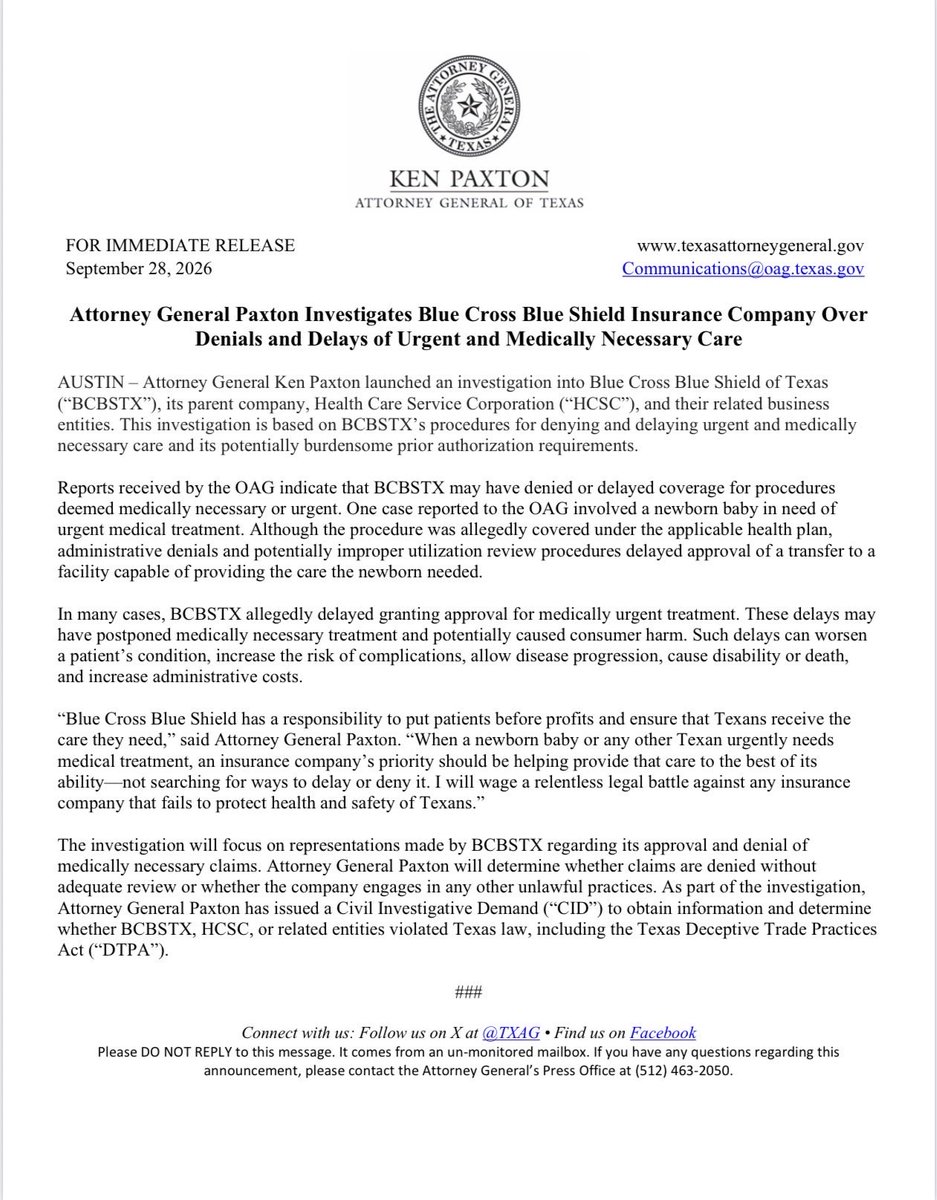
Perhaps one could suggest that the TX AG also investigate @BCBSTX for systemic non-compliance with payment obligations under the #NoSurprisesAct (NSA).
Why is rampant non-compliance with federal law in the NSA not an unfair and deceptive trade practice under TX state law?
Reported extensively in the trade press, Radiology Associates of North Texas (RANT, one of the largest independent radiology groups in the US) has experienced non-payment compliance w/ federal law by Texas BCBS exceeding ~60-70%.
So RANT is owed millions for NSA IDR determinations and a huge percentage of those IDRs are over 6 months in arrears.
Good news for Americans worried that the health insurance industry lacks a voice in Washington:
@MAHA_Action is finally giving it a platform.
The summit’s “Affordability First” panel features executives from UnitedHealth Group and Elevance Health, alongside the head of AHIP, the health insurance industry’s trade association.
A senior CMS official will moderate.
No patient advocate is listed on the panel.
An inspired arrangement. If you want to understand why dinner is so expensive, assemble the restaurant owner, the landlord, and the company that charges you a convenience fee for looking at the menu.
The customer can submit a question through the portal.
There is something beautifully efficient about putting the insurance industry in charge of the affordability conversation. Usually, Americans have to spend forty-five minutes on hold to hear an insurer explain their financial circumstances to them. Here, the explanation comes with stage lighting.
And “Affordability First” is an excellent title. It leaves the essential follow-up question, affordable for whom?The answer is available for a future breakout session.
Remember, this is the political movement whose leading health official, @RobertKennedyJr declared: “We are ending the corporate capture of public health.”
Apparently, the treatment involves exposure therapy.
Start with a small dose of corporate leadership. Increase gradually until the patient can enter a ballroom full of executives without remembering why they were angry.
Later, the summit offers “Prevention at Scale,” featuring the CEOs of @Ascensionorg , @SutterHealth, and
@advocatehealth.
Between the two panels, the institutions that finance care and the institutions that deliver it enjoy a substantial opportunity to explain the future. The person trying to figure out whether they can afford an MRI remains an exciting opportunity for stakeholder engagement.
Imagine a different affordability panel. A patient brings a bill. A physician brings the paperwork required to get treatment approved. An insurance executive gets a microphone and has to explain both.
That would be a useful conversation. It might also run over 30 minutes, particularly if someone insisted on answering the question.
Instead, this lineup offers the familiar Washington comfort of discussing people’s problems at a professional distance from the people having them. From the stage, a medical bill can become a challenge involving incentives, innovation, and complex systems. At the kitchen table, it remains a number you cannot pay.
The appeal of an anti-establishment movement is the promise that someone will finally make the powerful uncomfortable. Looking at these panels, the powerful appear to have been accommodated quite thoughtfully.
There is a chair. There is a microphone. There is a moderator to keep things moving.
For everyone who thought making America healthy again might involve making its health care institutions answer to patients, please be patient.
Your revolution is important to us.
Please remain on the line.