So, Bob - aka @RobertJenrick , you went to Handsworth in Birmingham and ‘complained' about 'not seeing another white face'. You were filming a video about litter - but instead of scouring the ground, for well, litter, you were it seems scouring people for the colour of their faces - like it matters? You called Handsworth, one of the "worst integrated places” you'd ever been to. Only that's not quite true is it? You live in Eye Manor, a rather splendid 17th century Grade I listed mansion, in the hamlet of Eye, in Herefordshire... the one you controversially travelled to during the pandemic lockdown after chairing a government news conference to reinforce a "stay at home" message…But let's not dwell there....Let's look at just how many non-white faces there are in your home county....Funnily enough, there's not much evidence of integration there at all... with the 2021 census showing the white ethnic group made up 96.9% of the population...Funny old white world there then…:). Maybe you need to get out more.
https://t.co/FqDwTIOrx3
🇨🇳 China just weaponized rare earths - again, but this time globally.
Beijing’s new MOFCOM Notice No. 61 (2025) goes far beyond past export bans. It now forces foreign companies to seek Chinese approval before re-exporting any product that contains even 0.1% China-origin rare earth materials or was made using Chinese refining or magnet-making technology.
This is China’s “foreign direct product rule” moment - mirroring Washington’s semiconductor controls but turning them inside out.
The move effectively gives Beijing a veto power over parts of the global chip, EV, and defense supply chains, including those operating outside its territory. Licenses will be denied for military or AI-related uses, notably 14nm chips, 256-layer memory, and military-grade AI systems.
The geopolitical logic is clear: rare earths are now strategic weapons in the tech war. China controls ~70% of refining capacity - and it’s using that dominance to remind Washington, Brussels, and Tokyo that no green or digital transition works without Chinese minerals.
Expect:
– Price surges and supply disruptions across EVs, turbines, and semiconductors.
– Accelerated Western “friend-shoring” efforts with Australia, Vietnam, and Canada.
– Rising BRICS+ leverage as China redirects raw materials to aligned partners.
In short, this isn’t just export control - it’s geo-economic deterrence.
Beijing just signaled: if you restrict our chips, we can restrict your magnets.
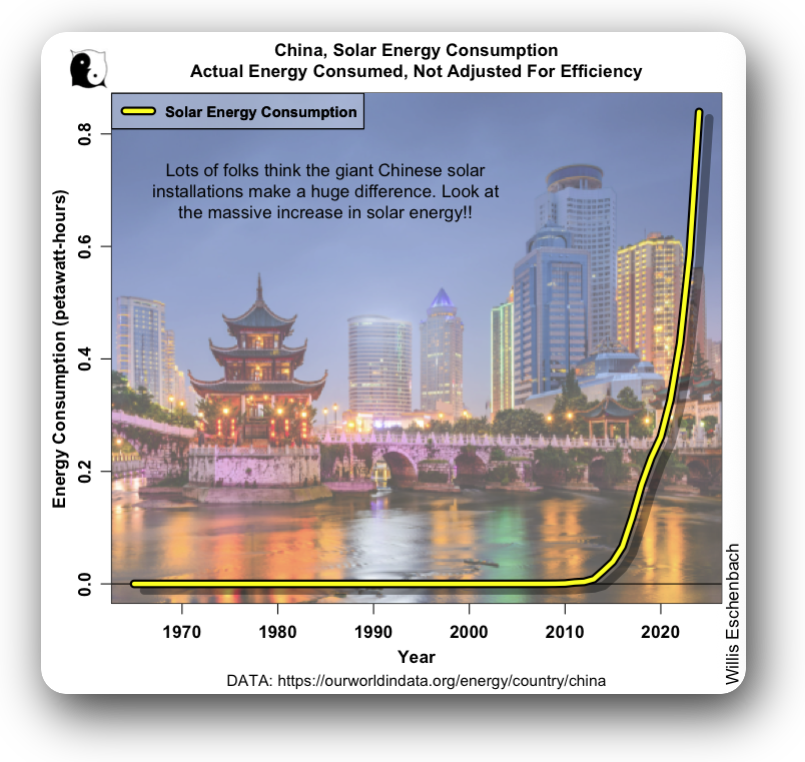
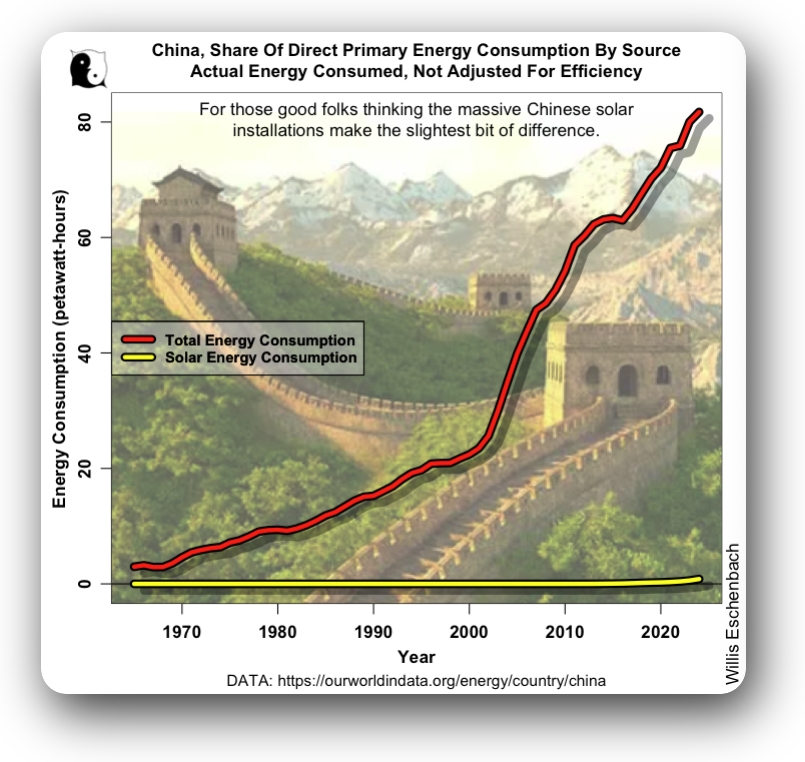
People like Arnaud seem to forget the part of the question called "compared to what"?
On the left is what Arnaud is raving about, Chinese solar. WOW, it's headed for the moon.
On the right, compared to Chinese total energy usage.
He's impressed. Sane people? Not.
w.
This is a very big deal. China has asserted sweeping control over the entire global semiconductor supply chain, putting export license requirements on all rare earths used to manufacture advanced chips. If enforced aggressively, this policy could mean "lights out" for the US AI boom, and likely lead to a recession/economic crisis in the US in the short term.
Some thoughts and recommendations:
1. Many things are unclear, including how intensively they will enforce this. This is a costly decision for them, too, and not without risk. These controls are being imposed on the whole world, not just the US.
2. My current assumption is that China is doing this to gain leverage over the US in advance of the President's upcoming meeting with Xi at APEC.
3. I do not think they are doing this to get the US to relax its export controls on eg Nvidia Blackwell chips. In fact, my guess is that they *want* us to think that is their goal. We buckle by relaxing Blackwell controls and then the PRC shrugs and says "no thanks, we're very confident in our domestic chip industry." THAT is a message I'd want to be delivering to APEC, if I were advising the PRC.
4. Further relaxation of export controls is therefore unlikely to be a useful policy lever here. Instead, it is time for the US to get serious about export controls on semiconductor manufacturing equipment.
5. Because we have been mostly unserious about this issue, China has stockpiled most durable equipment needed to make semiconductors; so most controls will not have an immediate effect.
6. However, there are some consumable materials needed for semiconductor manufacturing that China cannot make domestically. Even better, these consumables are also often degradable, meaning one can only stockpile so much. These would be top on my list if I worked at BIS.
7. I would retaliate strongly, but in a targeted manner. The ultimate route to deescalation here is tariffs and broader trade war policy moves--not AI compute.
8. This only underscores the urgency for the US + allies/partners to accelerate domestic efforts to mine and refine rare earths. The Trump administration has been especially strong here, and Congress allocated serious money to this goal in O3B. But all options must be on the table, including the Defense Production Act (Title III and even, in some cases, I).
9. Policy will be important here, but remember that these rare earths are essential to the functioning of the global economy. It has heretofore been hard to solve with markets alone because China already supplies these commodities in abundance and at low cost. But they are, fundamentally, just commodities. We can make them.
10. To the extent China enforces this policy, they will have made the price of these essential goods infinitely high. Remember, most of all, that supply is elastic--not on arbitrarily short timescales, but faster than most people think.
I and many others have written detailed policy playbooks about expanding US and allied rare earth capacity. It is time to execute. This exact thing has been high on my list of nightmare scenarios for US/China tech competition, but understood correctly, it is also an opportunity. Godspeed.
My interview with @BBCNews, exposing the scandal of asylum contracts, written under the Tories, which enabled private providers to make 8x more profit by keeping asylum applicants in hotels.
A shocking waste of taxpayer money.
[I’m in doomer mode tonight, so apologies in advance for this one, but…]
Speaking of climate con jobs…
- Carbon Offsets are a con job
- Sustainable Aviation Fuels are a con job
- Net Zero by 2050 is a con job
- Meaningful global-scale Carbon Capture and Storage anytime in your lifetime is a con job
- AI as a climate solution is a con job
- Green consumption is a con job
- Getting the international community to agree on geoengineering governance is a con job
- Limiting global warming to 1.5°C is a con job
All we really have, for now, is some successful examples of decarbonization in some sectors and some places, undergirded by accelerating warming. We’re on the freight train to a pretty nasty place, and we’re only lightly tapping the brakes, not even decelerating yet…
I has been a very long time since I posted this list of 40 consequences of climate change. But, it's important to take note of item number 40.
I truly wish things were going to get better, but sadly, it's all just going to get more f&%ked from here.
https://t.co/eldAXl0I8m
@implausibleblog JLR have £3bn cash. UK Gov is providing £1.5bn loan. Not a bailout. Suspicion breach came through Tata Consulting - the Tata I.T outsourcing company that JLR outsources IT to.
@MyLordBebo How many more people are they willing to loose? All of them! That’s Russian orthodoxy in war. Perhaps America needs to wake up to that? It might understand the situation a little better. For Russia and Putin; this is existential. They’ll bet the house.
@PeterStefanovi2@bbclaurak Digital ID isn’t about illegal immigration. There’s almost zero evidence globally it would have any impact. It’s about trying to recover some of what they lost in the welfare bill - claimant ID. They really should stop lying about everything. It’s so dull.
@MrMatthewTodd In the past 20 years we’ve had numerous other natural disasters- earthquakes and cyclones, causing 10’s-100’s of thousands deaths. Covid is > 7 million. A “mass calamity “ resulting in collective global action on climate would need to be in the millions+. Nothing can do that.
@LBC I’ve not bought a house this month, but now I’m worried I need the services of a King’s Council to make sure everything is above board and legal with the house I’ve not bought. Gosh! It’s a conveyancing nightmare, not buying a house! Who knew?
This is a main reason why Western economies struggle: the growth of bureaucracy and regulation. An increasing number of people are employed in compliance roles to oversee obedience, yet they cannot be utilized productively.
They are here to prevent, not to enable.
Global Wealth and Power are Pivoting to the East
History’s wheel is turning. China builds, India rises, BRICS surpasses the G7—while America punishes allies and empowers its Enemies.
In the West, the year 1492 is remembered for two episodes: Columbus’s arrival in the Americas and the fall of Granada, last stronghold of Moorish Spain. But its larger consequence was geopolitical: the compass needle swung westward, ushering in a centuries long reversal in global fortunes.
Wealth that once streamed toward Asia turned into rivers feeding Europe’s ascent.
Silver, gold, sugar, and spices from the Americas acted like jet fuel. They powered science, industry, and empire. Spain, France, Britain, and the Netherlands—naval and commercial predators—rose on the tide, hollowing out the Ottoman world and diverting trade from India and China to the New World.
Today another hinge of history is swinging. Washington’s unspoken fear of a 21st century turn is no less dramatic: economic gravity shifts eastward, led by China and—critically—India.
Beijing’s gamble in the 1990s—to let capitalism breathe, to draw in foreign capital, and to pour trillions into domestic infrastructure—proved as consequential as a century of US industrial growth.
The Belt and Road Initiative, worth more than $1 trillion, is less an infrastructure plan than a circulatory system of steel and concrete veins, designed to redirect the lifeblood of trade back across Asia, Africa, and the Middle East.
In contrast, Washington failed to invest in fast sealift or high speed rail, leaning too heavily on military power.
For the last 25 years, America exhausted itself in deserts and mountains, fighting costly wars that drained trillions, cost thousands of U.S. lives—yet delivered little of enduring strategic value.
Worse still, the technology of war is no longer America’s private domain. Precision strikes, robotics, artificial intelligence, persistent surveillance from seabed to space—once rare advantages—are now widely available, even to mid range powers.
The oceans that once carried American commerce and projected US power have become potential minefields. To move lumbering, World War II style forces across the Pacific, Atlantic, or Indian Oceans today is not just dangerous. It borders on suicidal behavior.
History’s cruel truth remains: the last major war seldom looks like the next.
The battle-space of the future is uncharted, yet America’s Armed Forces and its National Military Strategy remain deeply mired in the past.
The erosion of U.S. military advantage cannot be viewed in isolation; it reflects the widening gap between Washington’s appetite for global hegemony and America’s declining economic strength.
Partly because of Washington’s exhaustion, India has been forced to pick up the slack as a net security provider in the Indian Ocean.
At the same time, India has borne the brunt of fighting Pakistan backed insurgents, incurring heavy casualties just as America did.
India is a member of the Quad alliance with the US, Japan, and Australia, and the United States conducts more military exercises with India than with any other country.
Yet Washington recently imposed duties of 50% on Indian goods—more than double the 15% rate applied to Taliban run Afghanistan and far higher than the 19% levied on Pakistan.
This, even though both regimes sheltered and enabled militant networks that killed American soldiers for twenty years. The paradox is beyond belief: the firefighter is fined more heavily than the arsonist.
At the same time, India carries an outstanding $35 billion order book for Boeing passenger jets supporting 150,000 American manufacturing jobs in Charleston, South Carolina, and Everett, Washington. Yet India is penalized at America’s border.
The deeper problem for the United States is structural. Military dominance can no longer disguise economic erosion. According to the IMF, BRICS now outweighs the G7 in global GDP.
Measured by purchasing power parity (PPP), China’s economy is worth $40.7 trillion, India’s $20.5 trillion, while the U.S. stands at just $29 trillion.
China and India together: $61.2 trillion — more than double the U.S. total. This is not a forecast. It is today’s reality.
The turning point came in 2022, when Washington responded to Russia’s invasion of Ukraine with sweeping sanctions.
The effect of weaponizing the Dollar was profound. The dollar looked less like a safe harbor and more like a trapdoor.
From Riyadh to Delhi, from Brasília to Beijing, capitals saw the risk of conducting commerce in a currency that could be switched off at will. De-dollarization, once a theoretical debate, became urgent strategy.
No surprise, then, that nations across Africa, the Middle East, and Latin America line up to join BRICS and the Shanghai Cooperation Organization (SCO).
They are dissatisfied with a Western order they view as inequitable and extractive. India straddles both worlds—deepening its bond with Washington through the Quad while cultivating ties with Moscow and Beijing in BRICS and the SCO.
Prime Minister Modi’s presence at the recent SCO summit in Beijing alongside President Xi and President Putin reminded Washington that India’s compass will not lock on one direction.
History’s lesson is clear. Trade routes form habits: habits build markets; and markets endure longer than armies. Empire is not lost in a single battle but in the slow corrosion of those habits.
The Ottomans discovered this too late. Nations that consume more than they produce, that intimidate rather than innovate, ultimately sow the seeds of their own decline.
The dollar’s dominance is already eroding. Trade settlements in yuan, rupees, and other currencies increase by the month. The shift is not only monetary: it is strategic.
But the world should remember what American innovation can achieve. From the heartland came inventions and technologies that transformed global life in the last century—from aviation to semiconductors, from biotechnology to the digital revolution.
These capacities still command respect, and if revitalized, they can once again help anchor U.S. prosperity in a multipolar age.
History’s wheel is turning again. Some nations will rise with it. Others risk being crushed beneath its weight.
If Washington seizes the opportunity to adapt—if it makes its business inside the new global order one of commerce and trade rather than unrelenting military intervention—Americans may yet avoid the fate of the Ottomans. But the course correction cannot come soon enough.
@ZackPolanski 1 comes from 3
I don’t agree with 2. There are better ways. There’s no good evidence of truly successful and viable nationalised industries in the 2020’s globally. Swiss rail, French water only for historic reasons. The UK is in a very different position. It won’t work here.
@ThinkNewTwist@ZackPolanski@TheGreenParty You make his point for him. Wealth creators don’t leave because of wealth taxes. They leave because of a poor or hostile economic and trade environment. Which is what the nation voted for.