ok actually insane paper published yesterday
a research group in Korea built a gene switch you can control wirelessly using electromagnetic fields
they exposed mice to 60 hz EMF (same frequency as your wall outlet) using a pair of large coils that generate a uniform magnetic field around the animal, for cyclic 3-day on / 4-day off pulses
they showed this could:
- activate OSK to do epigenetic reprogramming in progeroid and aged mice, extending lifespan and reversing aging markers across multiple tissues
- conditionally switch on mutant amyloid genes only in aged mouse brains, letting them separate aging effects from amyloid effects to study AD biology in a way previous models couldn't
no drugs, no impacts, just a magnetic field from outside the body
A few random notes from claude coding quite a bit last few weeks.
Coding workflow. Given the latest lift in LLM coding capability, like many others I rapidly went from about 80% manual+autocomplete coding and 20% agents in November to 80% agent coding and 20% edits+touchups in December. i.e. I really am mostly programming in English now, a bit sheepishly telling the LLM what code to write... in words. It hurts the ego a bit but the power to operate over software in large "code actions" is just too net useful, especially once you adapt to it, configure it, learn to use it, and wrap your head around what it can and cannot do. This is easily the biggest change to my basic coding workflow in ~2 decades of programming and it happened over the course of a few weeks. I'd expect something similar to be happening to well into double digit percent of engineers out there, while the awareness of it in the general population feels well into low single digit percent.
IDEs/agent swarms/fallability. Both the "no need for IDE anymore" hype and the "agent swarm" hype is imo too much for right now. The models definitely still make mistakes and if you have any code you actually care about I would watch them like a hawk, in a nice large IDE on the side. The mistakes have changed a lot - they are not simple syntax errors anymore, they are subtle conceptual errors that a slightly sloppy, hasty junior dev might do. The most common category is that the models make wrong assumptions on your behalf and just run along with them without checking. They also don't manage their confusion, they don't seek clarifications, they don't surface inconsistencies, they don't present tradeoffs, they don't push back when they should, and they are still a little too sycophantic. Things get better in plan mode, but there is some need for a lightweight inline plan mode. They also really like to overcomplicate code and APIs, they bloat abstractions, they don't clean up dead code after themselves, etc. They will implement an inefficient, bloated, brittle construction over 1000 lines of code and it's up to you to be like "umm couldn't you just do this instead?" and they will be like "of course!" and immediately cut it down to 100 lines. They still sometimes change/remove comments and code they don't like or don't sufficiently understand as side effects, even if it is orthogonal to the task at hand. All of this happens despite a few simple attempts to fix it via instructions in CLAUDE . md. Despite all these issues, it is still a net huge improvement and it's very difficult to imagine going back to manual coding. TLDR everyone has their developing flow, my current is a small few CC sessions on the left in ghostty windows/tabs and an IDE on the right for viewing the code + manual edits.
Tenacity. It's so interesting to watch an agent relentlessly work at something. They never get tired, they never get demoralized, they just keep going and trying things where a person would have given up long ago to fight another day. It's a "feel the AGI" moment to watch it struggle with something for a long time just to come out victorious 30 minutes later. You realize that stamina is a core bottleneck to work and that with LLMs in hand it has been dramatically increased.
Speedups. It's not clear how to measure the "speedup" of LLM assistance. Certainly I feel net way faster at what I was going to do, but the main effect is that I do a lot more than I was going to do because 1) I can code up all kinds of things that just wouldn't have been worth coding before and 2) I can approach code that I couldn't work on before because of knowledge/skill issue. So certainly it's speedup, but it's possibly a lot more an expansion.
Leverage. LLMs are exceptionally good at looping until they meet specific goals and this is where most of the "feel the AGI" magic is to be found. Don't tell it what to do, give it success criteria and watch it go. Get it to write tests first and then pass them. Put it in the loop with a browser MCP. Write the naive algorithm that is very likely correct first, then ask it to optimize it while preserving correctness. Change your approach from imperative to declarative to get the agents looping longer and gain leverage.
Fun. I didn't anticipate that with agents programming feels *more* fun because a lot of the fill in the blanks drudgery is removed and what remains is the creative part. I also feel less blocked/stuck (which is not fun) and I experience a lot more courage because there's almost always a way to work hand in hand with it to make some positive progress. I have seen the opposite sentiment from other people too; LLM coding will split up engineers based on those who primarily liked coding and those who primarily liked building.
Atrophy. I've already noticed that I am slowly starting to atrophy my ability to write code manually. Generation (writing code) and discrimination (reading code) are different capabilities in the brain. Largely due to all the little mostly syntactic details involved in programming, you can review code just fine even if you struggle to write it.
Slopacolypse. I am bracing for 2026 as the year of the slopacolypse across all of github, substack, arxiv, X/instagram, and generally all digital media. We're also going to see a lot more AI hype productivity theater (is that even possible?), on the side of actual, real improvements.
Questions. A few of the questions on my mind:
- What happens to the "10X engineer" - the ratio of productivity between the mean and the max engineer? It's quite possible that this grows *a lot*.
- Armed with LLMs, do generalists increasingly outperform specialists? LLMs are a lot better at fill in the blanks (the micro) than grand strategy (the macro).
- What does LLM coding feel like in the future? Is it like playing StarCraft? Playing Factorio? Playing music?
- How much of society is bottlenecked by digital knowledge work?
TLDR Where does this leave us? LLM agent capabilities (Claude & Codex especially) have crossed some kind of threshold of coherence around December 2025 and caused a phase shift in software engineering and closely related. The intelligence part suddenly feels quite a bit ahead of all the rest of it - integrations (tools, knowledge), the necessity for new organizational workflows, processes, diffusion more generally. 2026 is going to be a high energy year as the industry metabolizes the new capability.
RIP prompt engineering ☠️
This new Stanford paper just made it irrelevant with a single technique.
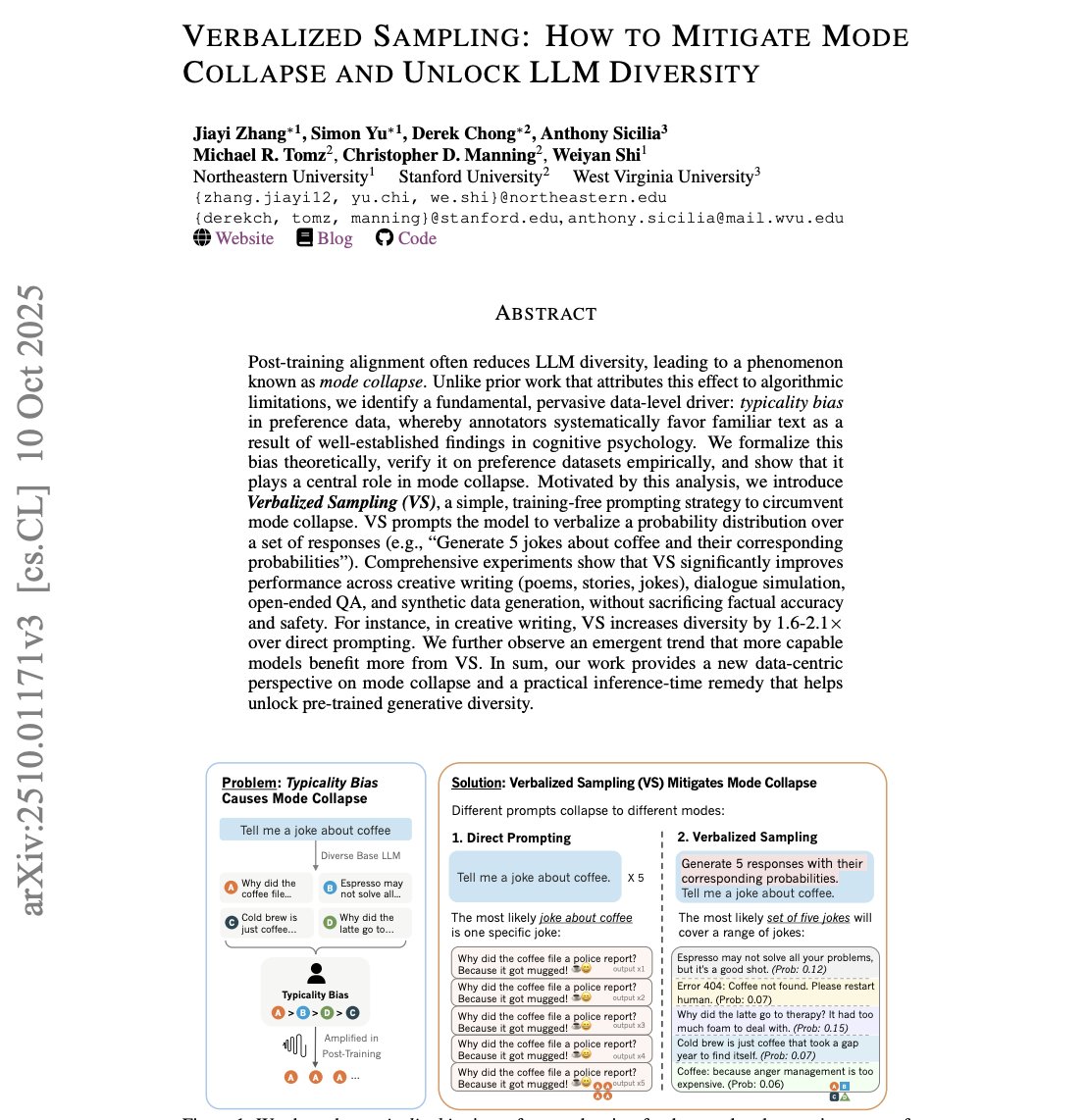
It's called Verbalized Sampling and it proves aligned AI models aren't broken we've just been prompting them wrong this whole time.
Here's the problem: Post-training alignment causes mode collapse. Ask ChatGPT "tell me a joke about coffee" 5 times and you'll get the SAME joke. Every. Single. Time.
Everyone blamed the algorithms. Turns out, it's deeper than that.
The real culprit? 'Typicality bias' in human preference data. Annotators systematically favor familiar, conventional responses. This bias gets baked into reward models, and aligned models collapse to the most "typical" output.
The math is brutal: when you have multiple valid answers (like creative writing), typicality becomes the tie-breaker. The model picks the safest, most stereotypical response every time.
But here's the kicker: the diversity is still there. It's just trapped.
Introducing "Verbalized Sampling."
Instead of asking "Tell me a joke," you ask: "Generate 5 jokes with their probabilities."
That's it. No retraining. No fine-tuning. Just a different prompt.
The results are insane:
- 1.6-2.1× diversity increase on creative writing
- 66.8% recovery of base model diversity
- Zero loss in factual accuracy or safety
Why does this work? Different prompts collapse to different modes.
When you ask for ONE response, you get the mode joke. When you ask for a DISTRIBUTION, you get the actual diverse distribution the model learned during pretraining.
They tested it everywhere:
✓ Creative writing (poems, stories, jokes)
✓ Dialogue simulation
✓ Open-ended QA
✓ Synthetic data generation
And here's the emergent trend: "larger models benefit MORE from this."
GPT-4 gains 2× the diversity improvement compared to GPT-4-mini.
The bigger the model, the more trapped diversity it has.
This flips everything we thought about alignment. Mode collapse isn't permanent damage it's a prompting problem.
The diversity was never lost. We just forgot how to access it.
100% training-free. Works on ANY aligned model. Available now.
Read the paper: arxiv. org/abs/2510.01171
The AI diversity bottleneck just got solved with 8 words.
Columbia CS Prof explains why LLMs can’t generate new scientific ideas.
Bcz LLMs learn a structured “map”, Bayesian manifold, of known data and work well within it, but fail outside it.
But true discovery means creating new maps, which LLMs cannot do.
Since everyone is talking about RL Environments and GRPO now but no one knows how it works we thought it would be cool to make an explainer video + code you can run:
This is an example of using GRPO to train Qwen 2.5 to play 2048 (code in thread) 🧵:
The New York Times profiled a start-up with 28 employees serving nearly 50 million users.
That company is us.
The traditional startup playbook: raise massive funding, hire hundreds of employees, and worry about profitability "later."
But there's another way.
Everyone at Gamma could fit in a small restaurant.
We're not just surviving—we've been profitable for 15+ consecutive months, with revenue growing month over month, and lifetime negative net burn (we have more money in the bank than we've raised).
This isn't an accident. We've deliberately designed our organization to maximize impact per person.
Instead of creating specialist silos, we hire versatile generalists who can solve problems across domains. Rather than building management hierarchies, we find player-coaches who both lead and execute.
Our team leverages AI tools throughout our workflow - Claude for data analysis, Cursor for coding efficiency, NotebookLM for customer research synthesis. These aren't just productivity hacks; they're force multipliers.
Examples:
— When our growth PM needed better analytics, he didn't file a ticket with a data team—he built a self-serve system that anyone can use without SQL knowledge.
— When our marketing lead needed to understand our customers better, she fed thousands of interactions into an LLM and created actionable personas that now guide our entire strategy.
— When our design team needs to test a hypothesis, we create a rapid prototype and show it to our power users.
What we're seeing isn't just about "doing more with less." It's about fundamentally changing what's possible per person.
The most valuable employees aren't specialists who excel in narrow domains - they're resourceful problem-solvers who continuously expand their capabilities.
This approach creates remarkable resilience. Since everyone understands multiple functions, we don't have single points of failure when someone leaves or moves to another project.
If you're building today, the question isn't how quickly you can scale headcount … it's how much impact you can create with the smallest possible team.
The future belongs to tiny teams of extraordinary people.
Microsoft Phi-4 is announced!
It's a 14B parameter LM trained heavily on synthetic data, with very strong performance, even exceeding GPT-4o on GPQA and MATH benchmarks!
Currently available on Azure AI Foundry, will be on HuggingFace next week
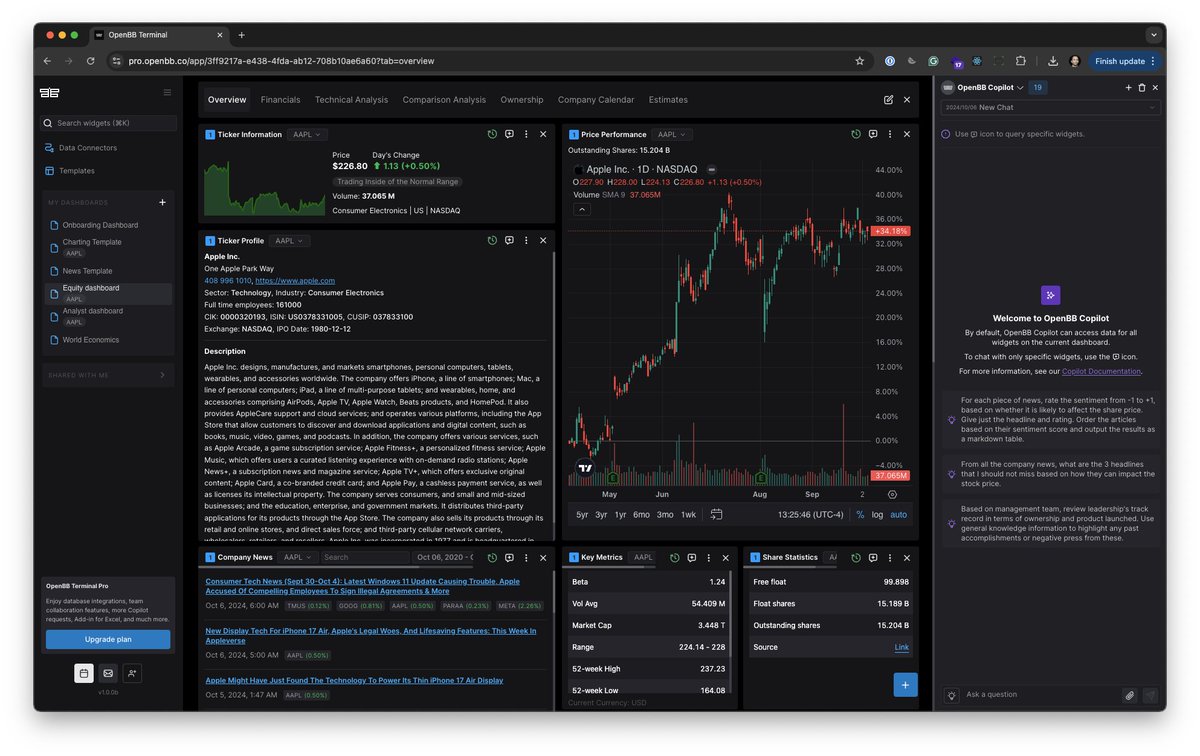
A Bloomberg Terminal costs $30,000 per year.
Last month, OpenBB dropped the $0 cost replacement.
Get 405 free data sources and an *AI Copilot*.
The 90-second step-by-step guide:
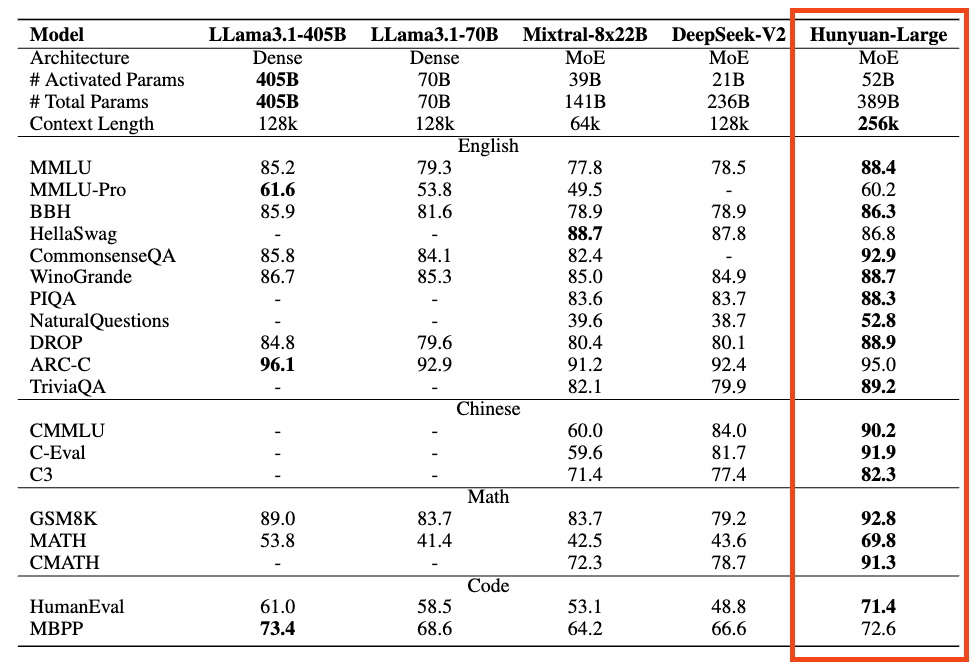
Syntehtic data is all you need? New large MoE from Tencent was trained on 1.5 trillion tokens of synthetic data. The 389B-A52B MoE outperforms @AIatMeta Llama 3.1 405B across academic benchmarks. 👀
TL;DR
🧮 236B parameters with 21B activated during generation
👨🏫 160 experts with 6 active in generation
😍 Detailed technical report with scaling experiments
🪟 Released Pretrain, Instruct, and FP8 version
🌱 Trained on 7 trillion tokens with 1.5T synthetic tokens
🌎 Trained mostly English and Chinese data
🏎️ Should fit on a single H100 Node (8x) in FP8
📜 Custom License, commercially useable below 100MAU
🇪🇺 License forbids use for citizens and companies in the EU
🧬 Post Training used SFT > DPO
🤗 Available on @huggingface
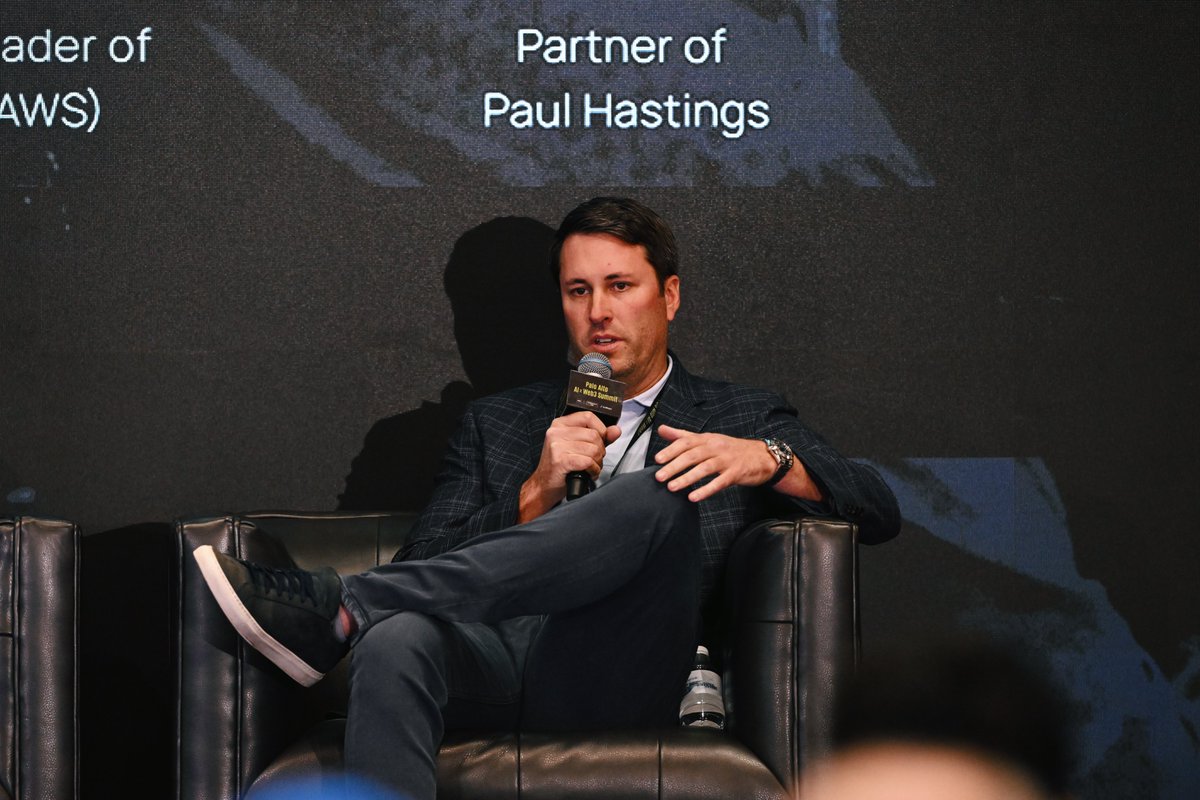
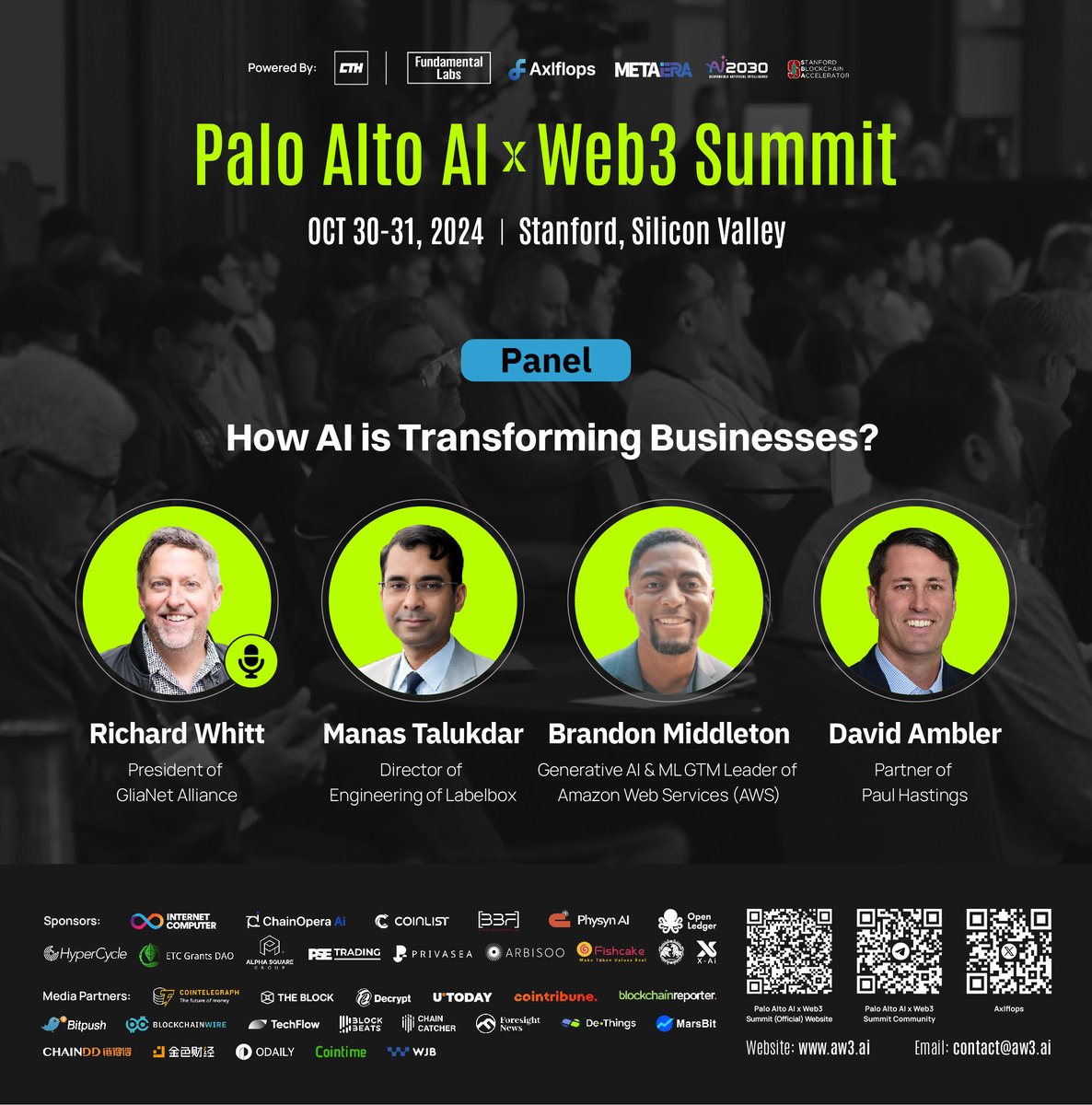
Just wrapped up the "How AI is Transforming Businesses" panel at the Palo Alto AI x Web3 Summit! Moderated by Richard Whitt @RichardWhitt, with insights from Manas Talukdar, Brandon Middleton, and David Ambler on how generative AI is reshaping internal ops, customer interactions, and governance challenges. Exciting glimpse into what’s next for AI in business!
Hosts: CTH, @FundamentalLabs, @Axlflops, @MetaEraHK, @AI2030Official
#AI #BusinessTransformation #Web3 #PaloAltoAIWeb3
Join us at the Palo Alto AI x Web3 Summit at Stanford University, October 30-31, 2024!
Panel: "How AI is Transforming Businesses" moderated by Richard Whitt @RichardWhitt, President of GliaNet Alliance, with panelists:
• Manas Talukdar, Director of Engineering of Labelbox
• Brandon Middleton, Generative AI & ML GTM Leader of Amazon Web Services (AWS)
• David Ambler, Partner of Paul Hastings
🔗 Sign up now: https://t.co/T1zYzfKka1
#AI #BusinessTransformation #Web3 #PaloAltoAIWeb3