The Premier League is deeply saddened to hear of the passing of Sir Bobby Charlton, one of the greatest players in English football history.
Our thoughts and sincere condolences go to Sir Bobby’s family and friends, and to all at Manchester United.
I’m hearing Prempeh’s answer for the riddle about the principle of superposition was right but was ruled out as wrong by the quiz mistress. How true is this ?
#OnThisDay in 1900, Max Planck presented his law of black body emission, Planck’s law. Planck's law (coloured curves) accurately describe black body radiation and resolved the ultraviolet catastrophe (black curve) a prediction of late 19th/early 20th century classical physics.
Have a look at the electrostatic potentials around these amines. Clearly the NH protons are the strongest H-bond donors but the CHs alpha to the nitrogen are also strong donors. Great for cation-pi interactions.
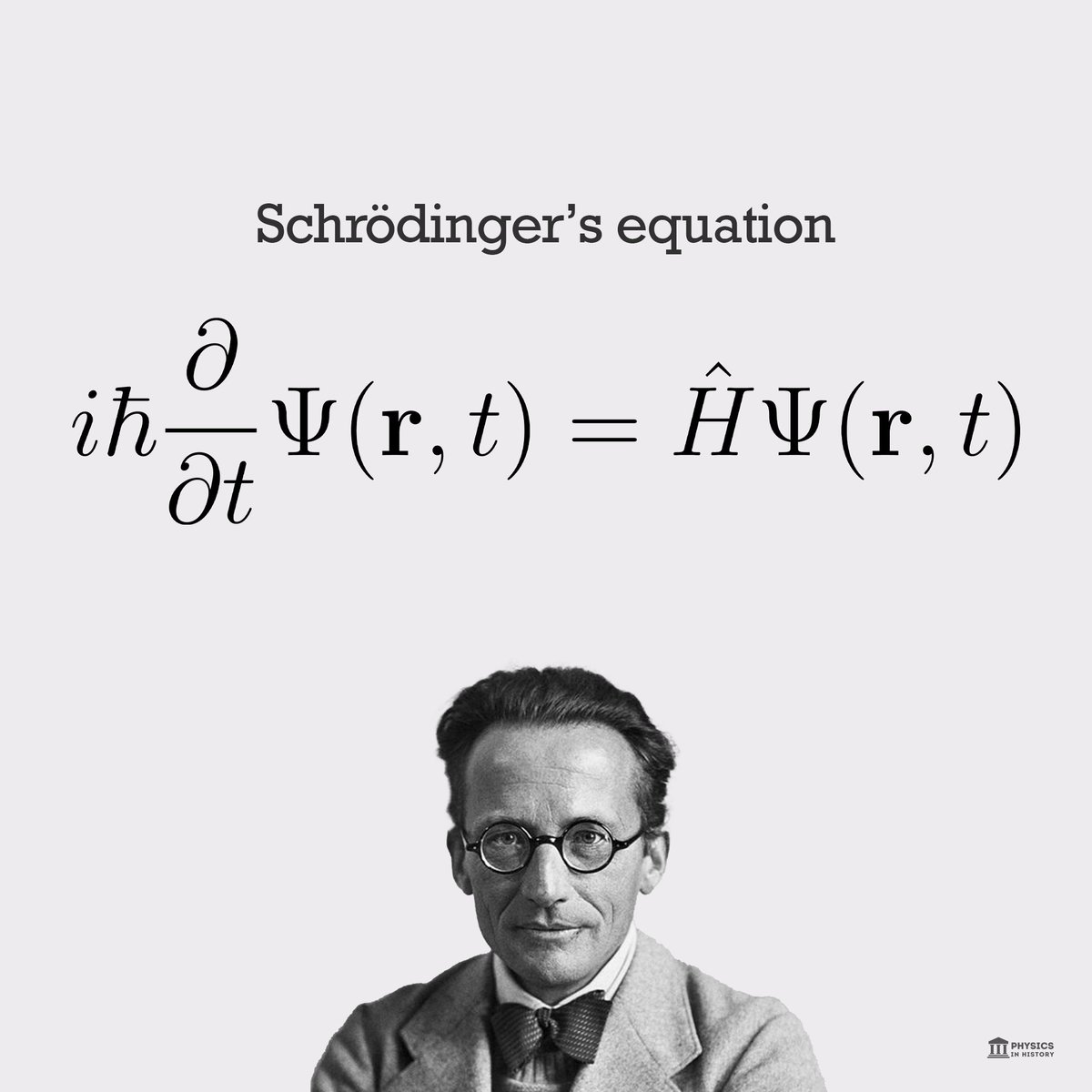
Imagine that you have a piano keyboard, and each key corresponds to a possible location of a particle. The Schrodinger equation tells you how to play a melody on this keyboard, using the wave function as the sheet music. The wave function gives you the amplitude and frequency of each note, which represent the probability and energy of finding the particle at that location. The higher the amplitude, the louder the note, and the higher the frequency, the higher the pitch.
The Schrodinger equation also tells you how the melody changes over time, depending on the potential energy of the particle at each location. The potential energy is like a tuning knob that affects the frequency of each note. If the potential energy is high, the note becomes sharper, and if it is low, it becomes flatter. The Schrodinger equation describes how the wave function evolves in response to these changes in frequency, and how the melody becomes more or less harmonious.
The equation is very important in quantum mechanics, because it allows us to calculate the wave function for any physical system, and use it to predict the outcomes of measurements. However, unlike classical music, quantum music is very unpredictable and probabilistic. We can only know the average values of observable quantities, such as position and momentum, but not their exact values for any given measurement. Moreover, we can never know the wave function completely, because every time we measure it, we disturb it and change its shape. This is known as the collapse of the wave function, or the quantum jump.
It was discovered by Erwin Schrödinger in 1926, and it is based on the conservation of energy. It is a partial differential equation, which means that it involves derivatives of the wave function with respect to both space and time. It can be written in different forms depending on whether we use a fixed or a moving frame of reference. It can also be generalized to include relativistic effects, such as when particles move close to the speed of light.
At the debut of the Young Green Entrepreneurs Forum, I had the privilege of being the moderator, and serving as the project lead. Huge thanks to all who contributed to make this project and event a success! 🌱 @YGEGhana#GreenEntrepreneurs#Green