🚨⭐️ Mikel Oyarzabal: “Who is the best striker in the World Cup? I wouldn’t really call Messi a striker because he’s everything football is…
…but I’d still choose him anyway”, told Cope.
Grand Corruption: Nigeria’s Greatest Threat.
The recent report from the IMF consultation further raises concerns about the scale of grand corruption under the Tinubu government. The IMF now reveals that about N8.83 trillion in expenditure undertaken in 2025 is not reflected in the budget. This expenditure is not budgeted and is therefore not under legislative oversight or administrative scrutiny. This is horrible.
N8.83 trillion is as follows:
1.About 2% of our GDP.
2.Over 35% of Nigeria’s 2025 N23.96 trillion capital project budget. In fact, the amount is more than the actual released capital funding for 2025.
https://t.co/Hta3LViCB8 is more than the entire combined budget for education (N3.52 trillion) and health (N2.38 trillion).
If such an amount is properly used and accounted for, it could transform Nigeria’s public health and education sectors. It could create hundreds of cottage industries that can provide jobs for thousands of graduates and build a solid foundation for economic development. But we cannot account for it. This is not an isolated incident.
This is a pattern of grand corruption that has become part of this administration.
We have a lot to worry about regarding the state of corruption under President Tinubu. The sort of corruption that is ingrained in total disregard of elementary rules of public finance management poses a grave danger to national security and the stability of the Nigerian state. The capture of the Nigerian state and the plunder of its resources are actions that undermine the basis of state stability and deepen poverty and state failure.
This recent revelation proves that the APC government is grossly corrupt, incompetent, and insensitive. With the growing poverty and the urgent need for significant upgrades to social and physical infrastructure, a responsible and responsive government would ensure that N8.83 trillion is prudently utilised to address these gaps. But not the Tinubu administration.
A few days ago, I called on President Tinubu to resign from office for incompetence, lack of capacity, lack of compassion, and failure to improve on his campaign promises. Some people thought perhaps the call was excessive. But with the daily revelations of pervasive corruption in this administration and its total lack of commitment to the welfare and security of Nigerian citizens, the only reasonable action is for President Tinubu to resign from office. The collapse of elementary forms of due process under Tinubu and the increased evidence of rampant looting of Nigerian public finances reinforce the need for greater accountability. It is now time for Nigerian citizens to rise within the law and hold this administration to account.
A New Nigeria is POssible. -PO
UN’s Warning on Northern Nigeria’s Food Crisis
The recent report from the UN about the impending food crisis in northern Nigeria is disheartening, more so because it is avoidable. Northern Nigeria is the nation’s food basket, and nothing short of incompetent and irresponsible leadership could have created this tragedy.
In a recent post on my X handle, I urged our national leaders to reassess their priorities and address the dire circumstances facing our citizens. I called on the Federal Government and state leaders to move beyond mere political discourse and make transparent, upfront investments to secure agricultural corridors, support smallholder farmers with accessible resources, and collaborate vigorously with organisations like the World Food Programme (WFP) to bridge funding gaps before this crisis escalates and claims more lives, especially those of children.
A prosperous Nigeria, free from hunger, is achievable, but it requires leadership that prioritises the welfare of its citizens.
I am deeply troubled by the latest report from the UN’s World Food Programme, indicating that northern Nigeria is experiencing its most severe hunger crisis in nearly a decade. Over 17 million people in nine northern states face crisis-level hunger, with more than 35 million Nigerians nationwide at risk during this challenging season.
The fact that over 10,000 residents of Borno State have entered “catastrophic” hunger conditions represents not only immense human suffering but also a profound national failure. Nigeria should not rank among the world’s hungriest nations, given its abundant resources, particularly the vast stretches of fertile, uncultivated land in the North.
This food crisis stems from two critical structural failures: insecurity and farmers’ inability to access their lands. Banditry and insurgency have turned agrarian communities into displacement zones. Until we secure our agricultural areas, we cannot secure our future.
Our global hunger ranking continues to worsen because of our proclivity for adopting superficial measures that do little to boost agricultural productivity or transform rural infrastructure. We need to adopt policies that address the structural barriers to agricultural productivity and transform our land resources into agro-industrial output. We can overcome hunger and poverty if we urgently shift our focus from consumption to production.
A New Nigeria, devoid of hunger and mass poverty - a Nigeria where we transform our arable land into productive acreage - remains attainable, but it demands leadership that prices the lives and livelihoods of the Nigerian people above grandiose road dualisation projects.
A New Nigeria is POssible. -PO
Chance Visits to INEC Registration Centres
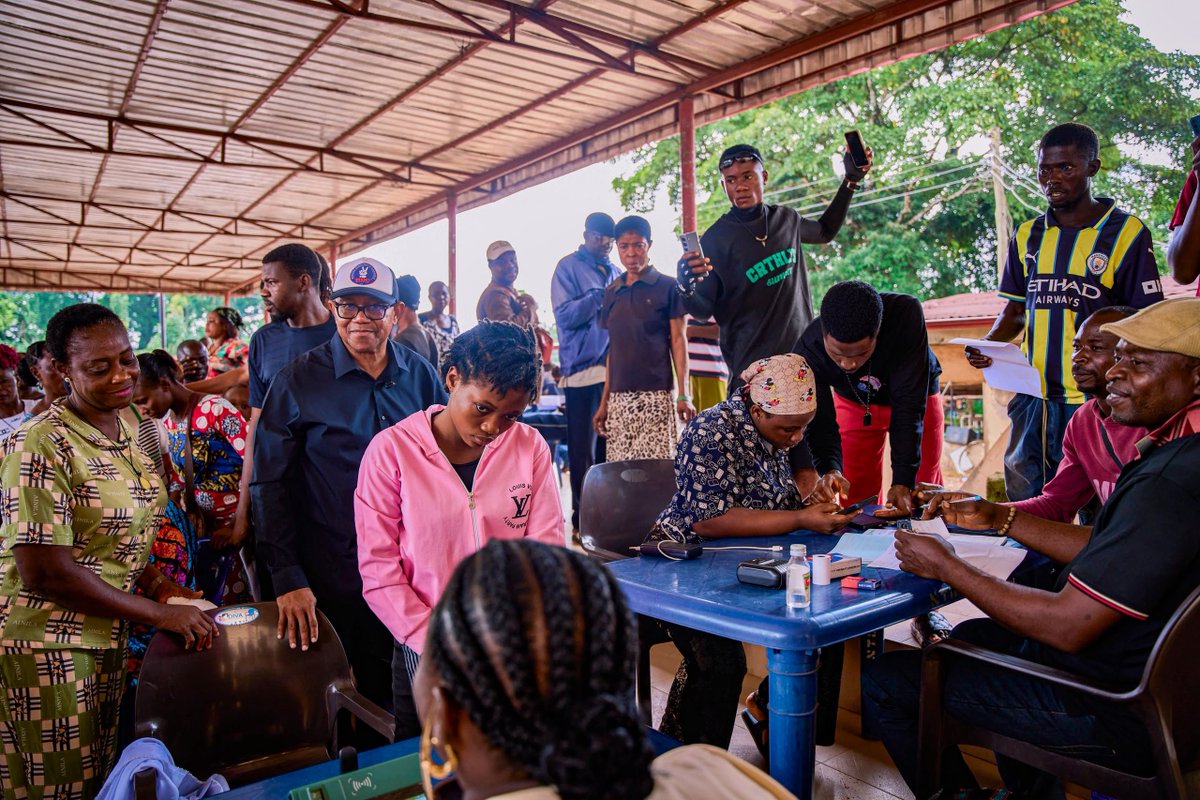
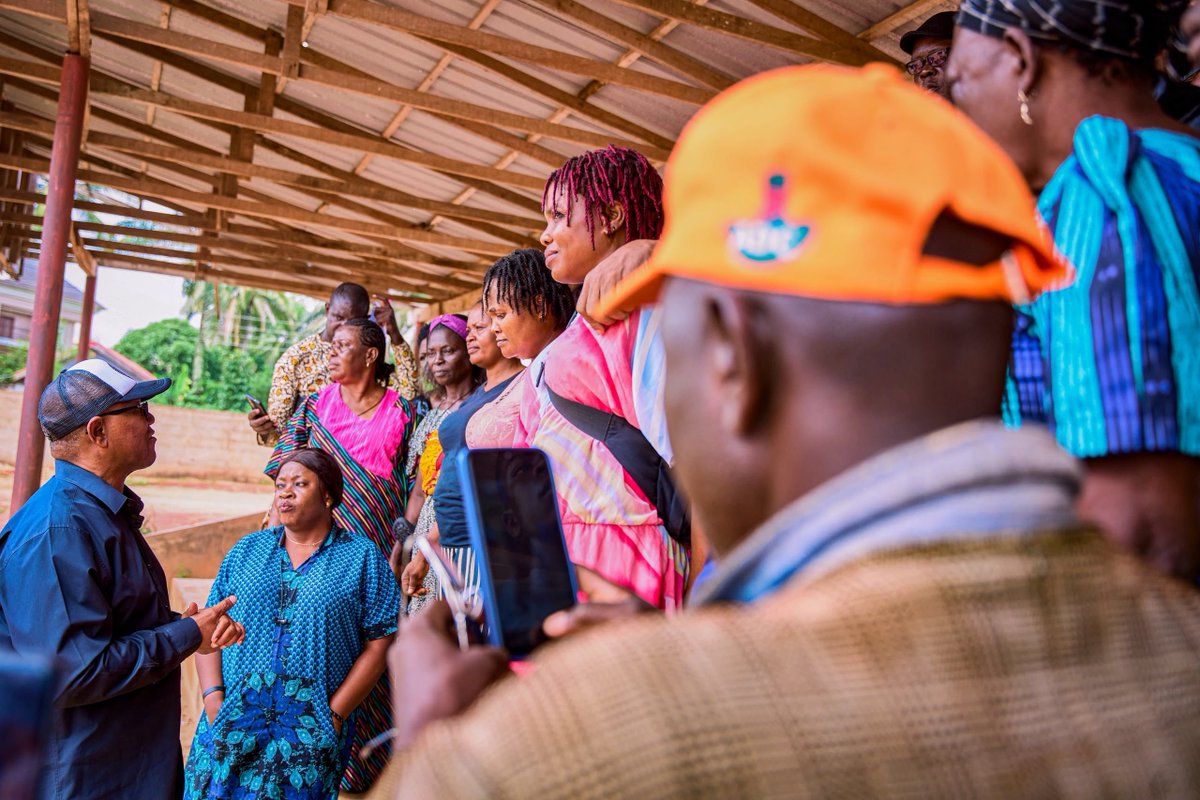
On my return to Anambra State yesterday, and on my way to attend some scheduled engagements, I made impromptu visits to the INEC voter registration centres at the Civic Centre, Nibo, and Nrijiofor Primary School, Nri.
I was pleased to see Nigerians registering to vote. I took the opportunity to commend those who had turned out and to encourage every eligible citizen to do the same. I reminded them that the journey to good governance does not begin on Election Day; it begins with voter registration. Registering to vote is not just a civic responsibility — it is an investment in the Nigeria we all desire.
I urged everyone who is eligible but has not yet registered to do so without delay. I also appealed to those who have already registered to encourage their family members, friends, neighbours, and colleagues to take advantage of the ongoing exercise before the deadline.
Every registered voter strengthens our democracy and brings us one step closer to building the secure, united, productive, and prosperous Nigeria we all seek.
A New Nigeria is POssible. -PO
Education Crisis: Calls for Fundamental Change, Not Just Policy
The Federal Government has finally admitted to its poor management of the education sector. Recently, the Minister of Education acknowledged that the policy separating junior and senior secondary schools has failed to improve educational outcomes. This is evident in recent examination results. In 2024, the West African Examinations Council (WAEC) reported that only 38.32% of candidates passed English and Mathematics in the WASSCE. In 2025, only 32% passed the computer-based WASSCE. This poor performance has been consistent across major examinations over the past two years.
This admission is tragic because education is the most vital contributor to human capital development, which forms the foundation for growth and economic development of any society. We cannot overcome economic stagnation without prioritising education, healthcare, and job creation to lift millions of unemployed youths out of poverty. As successful Asian nations have demonstrated, educational excellence requires sustained investment in curriculum development, motivated teachers, and better learning environments.
Unfortunately, the government continues to neglect the sector. In the 2026 budget, education received only ₦3.52 trillion, just 6.17% of total expenditure, down from 7.87% in 2025, and well below UNESCO’s recommended 15–20%. This low allocation indicates a failure to recognise education as a driver of sustained economic growth.
Education advocate, Mr Alex Onyia @winexviv , recently revealed that Nigeria failed to sponsor students to the International STEM and Mathematics Olympiads due to a lack of funding. It is heartbreaking that the government can sponsor hundreds to irrelevant international conferences yet fail to support its brightest students on the world stage.
The Minister’s admission reflects a broader failure of public leadership. The issue is not the JSS/SSS policy itself, but the lack of commitment to properly fund, manage, and deliver quality education.
In Anambra State, we proved that committed leadership can transform educational outcomes. Through effective funding, oversight, provision of laptops, generators, internet connectivity, and other learning aids, we turned the sector around. For example, our effort in providing computers across all secondary schools (public and private in the state) was recognised by HP Africa Head, who declared that Anambra had procured the largest number of laptops for school children of any subnational government in Africa.
For the future of our society, we must deliberately invest in education, healthcare, and job creation. As I have always said, failing to do the right things is equivalent to abusing society, and the society we abuse today will take its revenge on us and our children tomorrow.
A New Nigeria is POssible. -PO
The Disturbing Reports from Osun State University
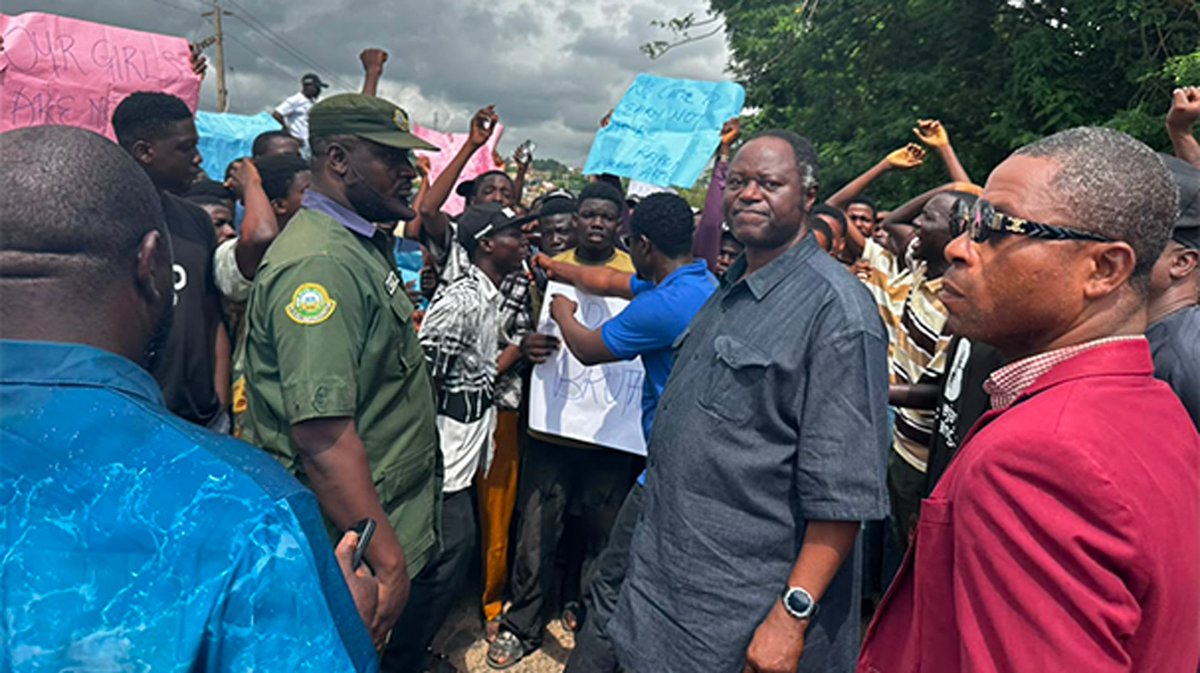
I have read with deep concern the troubling reports of soldiers invading students’ hostels at Osun State University, Osogbo, during which students were allegedly assaulted, humiliated, dispossessed of their personal belongings, and female students subjected to degrading treatment, including rape.
Every Nigerian deserves to be treated with dignity and respect. Our Armed Forces are renowned for their courage, discipline, and sacrifice in defending our nation. They are not known for such barbarity against the very citizens they are sworn to protect.
I therefore urge the military high command to conduct a thorough, transparent, and impartial investigation into these allegations. Anyone found culpable should be brought to justice. Holding offending personnel accountable will not only ensure justice for the victims but also preserve the honour and integrity of our Armed Forces while serving as a deterrent against future abuses.
A nation that respects human dignity builds confidence in its institutions. We must never tolerate impunity or the abuse of power.
A New Nigeria is POssible. -PO
My Vision for a Productive and Prosperous Nigeria
Today, being the 1st of July, 2026, I wish to humbly recall that when I decided to contest for the office of President of Nigeria, I pledged to place Nigeria on the path of unity and national transformation. Now, as the Nigeria Democratic Congress (NDC) candidate, I will, in the coming weeks and months, provide insights into the roadmap that I am confident will help curb abuse in government, halt the decline in the quality of life of Nigerians at all levels, and usher in an era of unity, peace, sustained progress, and prosperity.
This vision is anchored on a commitment to unity, inclusion, social justice, equity, and the freedom of every citizen to pursue lawful dreams.
Central to this proposed roadmap are significant reforms in education and healthcare, which are at the core of human capital development.
Robust human capital is indispensable infrastructure for national progress. It serves as the fundamental capital upon which daily life, economic expansion, and the delivery of essential public services depend.
These are foundational areas that we must reform with energy and determination if we are to reap the demographic dividend of our youthful population.
From the outset of my presidency, we will establish a task force dedicated to drastically reducing the menace of out-of-school children. We will place greater emphasis on Technical and Vocational Education and Training (TVET) to support our drive for massive industrialisation, anchored on our agricultural endowments and value addition across value chains organised around industrial parks to be located in development zones across the geopolitical regions of the country.
Funding and improving the equipment of TVET institutions, through partnerships among government, the private sector, and social entrepreneurs such as faith-based educators, will facilitate apprenticeship opportunities in the private sector, similar to the German dual education system.
The situation in which unemployment remains high while Nigerian entrepreneurs establish businesses elsewhere because skilled labour is scarce must be confronted decisively. Doing so is essential for the common good and for facilitating our transition from a consumption-driven economy to a production-driven one.
Character and civic education, emphasising the values that foster trust - an essential ingredient for enterprise and leadership - as well as shared national values, will receive significant attention within the tripartite approach to governance that we propose.
A New Nigeria is POssible. -PO
What Truly Should Be Our Priority Now as Leaders of a Nation?
This question has become necessary, given where we are today as a nation and where we are supposed to be.
While completing my INEC nomination form yesterday, Section E, Question 1 caught my attention. It asks: “Have you ever been adjudged a lunatic or been declared a person of unsound mind?” The answer is either Yes or No. That question got me thinking: Can we, as the political leaders of today’s Nigeria, truly say we are exhibiting the characteristics of a sound mind?
When Nigerians, including children and security personnel, are being abducted into the bushes, citizens cannot travel safely on our highways, several million Nigerians are uncertain where their next meal will come from, and several billions are being siphoned frivolously through non-existent agencies and projects, should politics really be our primary preoccupation?
A sound-minded leadership would have declared these existential challenges a national emergency and immediately mobilised all relevant institutions, security agencies, experts, community leaders, and other critical stakeholders to confront them with urgency and resolve. At a moment like this, the survival, security, and stability of Nigeria must take precedence over every other consideration. This is a time for decisive action, not political calculation or the pursuit of partisan advantage.
Further in the same Section E, Question 6, was: “Have you ever presented a forged certificate to INEC?” Again, the answer is either Yes or No. This raises another important question: Why shouldn’t INEC, in the interest of ensuring that our leaders are exemplary in following the rules and to strengthen public confidence in our electoral process, publish the academic certificates and credentials submitted by every candidate seeking elective office?
Transparency strengthens democracy and builds public trust. Nigeria’s problems are too serious for politics as usual. It is time for leadership defined by competence, character, capacity, compassion, and commitment to service.
A New Nigeria is POssible. -PO