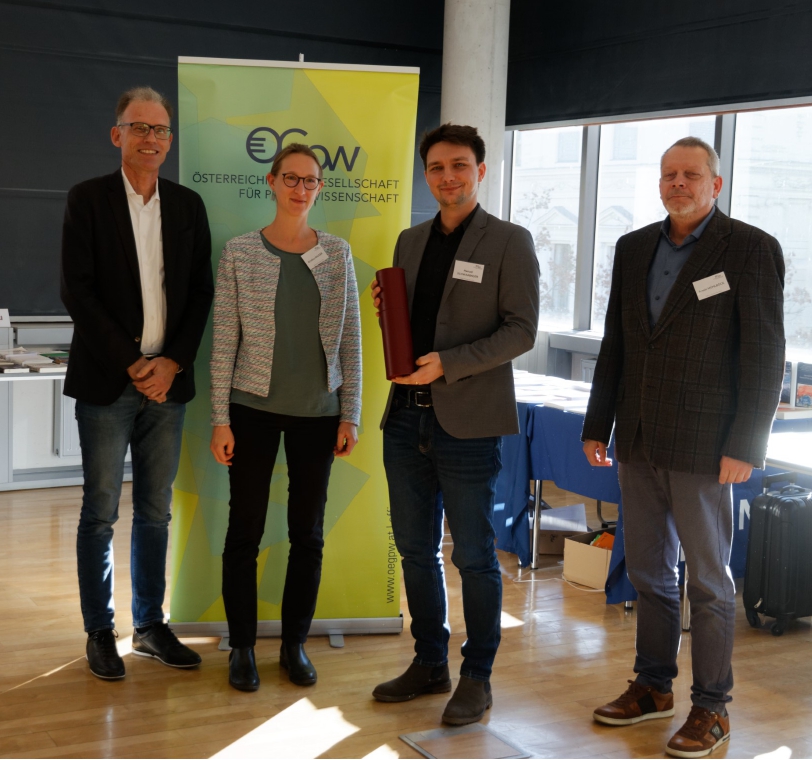
New article published! 👇👇👇Special thanks to @DebusMarc for support, @fabian_kalf & @michaelj505 for pre-submission comments, and @PolBehavior for an incredible smooth review process!
Our study raises several follow-up questions: What if voter perceptions of risks are biased? Could an outcome bias of voters be beneficial when voter's risk perceptions are biased? To what extent can we generalize our results? I am already excited for the answers that lie ahead!
Do voters care how much risk politicians take?
In our latest article in @PolBehavior, @mo_muehlboeck, @jan_sauermann, and I delve into this intriguing question through an online experiment.
Open access and available at:
https://t.co/PCS6CK2qyw
@UniOldenburg
We find that voters prefer representatives who align with their own risk-taking inclinations. In a world where every political decision carries inherent risks, politicians, it seems, have then an incentive to embrace the risks their constituents want them to take.
🚨 Our cool, new study has just been published in the Journal of Behavioral and Experimental Economics!
Participants exhibit a remarkable sensitivity to recipients' needs when making other-regarding transfers. #behavioraleconomics
Full study at👇
https://t.co/Rjy083TbnJ
Happy to share a new publication together with @SandraBohmann!
Intrested in the line between objective and (un)fair inequality?
Using @ESS_Survey data we show that, when informed about inequality - perceived inequity rises with inequality. 🧵
https://t.co/SQfyyPIjAY
Die Jahrestagung 2023 des AK Analytische Politische Theorie findet am 8. & 9. Juni in Hamburg statt. Abstracts für Beiträge können noch bis zum 31.03.2023 eingereicht werden.
CfP🇩🇪👉https://t.co/TOmA0icBen
CfP🇬🇧👉https://t.co/RnbaqgN0lB
Wir freuen uns auf spannende Abstracts!
Aus welchen Gründen unterstützen Leute die Petition von Schwarzer und Wagenknecht?
Um das herauszufinden habe ich mir die Kommentare bei der Petition systematisch angeschaut.
When I present results from laboratory experiments I usually get at least one question regarding the external validity. What do you think? Are laboratory experiments valuable to explain political outcomes?
In my first-ever blog post for @derStandard I use evidence from social science laboratory experiments to interpret political outcomes: https://t.co/kS57vEd9GG
While the literature usually assumes that politicians are more calculated than most participants, the preferences of their constituents can certainly influence their decisions. At least when it comes to supporting people in need, the behavioral patterns share many similarities.
🚩🚩🚩Job Alert 🚩🚩🚩
Du bist kurz vor/nach deinem Master und hast Lust auf computergestützte Sozialwissenschaft? Ich suche ab sofort eine*n Wissensch. Mitarbeiter*in!
@UniOldenburg! Hier die Stellenausschreibung:
https://t.co/VoIemmhz0s
As populism is hot, measuring its prevalence among political actors has been a core challenge of empirical research. In a new @polanalysis, @michaelj505 and I discuss potential pitfalls of measuring populism through text-as-data approaches https://t.co/RHkXZP48qk
@Banana62693411@renehentschel@AmreiBahr@DB_Bahn Es gibt aber vermutlich starke Unterschiede zwischen den Strecken. Ich bin dieses Jahr ca. 30 mal von Hamburg nach Oldenburg und retour gefahren und bin 2 mal zur angegebenen Zeit angekommen. Dieses Gefühl pünktlich zu kommen war unbeschreiblich
The links to the articles published on this exciting aspect of decision-making:
https://t.co/Eh9QCU5wIV
https://t.co/NVZPWpCp9G
https://t.co/TTNkdcFr2x
https://t.co/KjUWWfQVWv
Over the course of my PhD @univienna, I explored the effect of social preferences on bargaining agreements and the effect of the bargaining environment on social preferences.
https://t.co/ot3O3mqvo5
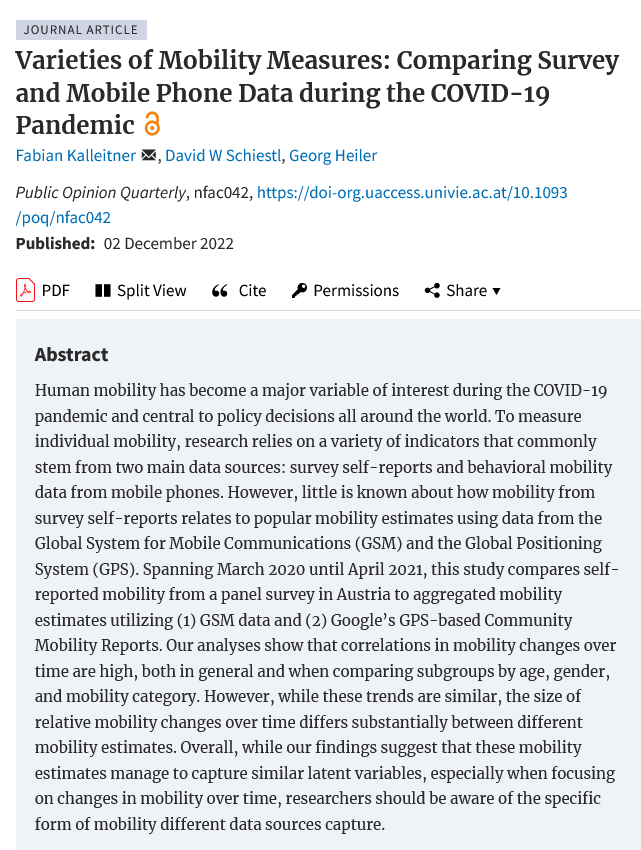
🥳🥳Happy to share a new open-access publication in Public Opinion Quarterly @AAPOR https://t.co/zYGvpjEAc0
We compare mobility estimates from survey self-reports, mobile phone data, and Google's community reports and find astonishing similar patterns over time. 🧵1/8
Der 12. Band des Jahrbuchs für Handlungs- und Entscheidungstheorie @dvpw@jan_sauermann@MarkusTepe ist erschienen: https://t.co/wF5llq7AVN. Der Band umfasst sieben Beiträge, die die vielfältigen Anwendungsmöglichkeiten handlungs- und entscheidungstheoretischer Ansätze zeigen.