Railroads were once 63% of the entire US stock market.
Not 63% of transport stocks. 63% of everything listed.
The history of concentration, in order:
– Tulips, 1637. A single bulb traded for the price of an Amsterdam canal house.
– South Sea Company, 1720. Shares went from about £128 in January to above £1,000 by summer, then back near £150 by December.
– US railroads, 1840s. 63% of US market cap.
– Utilities, telecom and industrials, 1929. 36%.
– Nifty Fifty, 1972. 40%.
– Japan, 1989. 44% of global equity.
– Dot com, 2000. 41%.
– AI Big 10, today. About 40%.
Every one of them was built on something real. Railroads did compress a continent. The internet did rewire commerce. Being right about the technology was never the thing that protected you.
The tulip story is also less clean than the legend. Modern research found the economic damage was modest and the ruin was mostly literary.
The bubble was never in the idea. It was in how many people decided to own the same idea at the same time.
If the entire history of earth was condensed into 24 hrs, dinosaurs would show up at 11:00 pm, be extinct by 11:39 pm, and humans would show up one minute and 17 seconds before midnight.
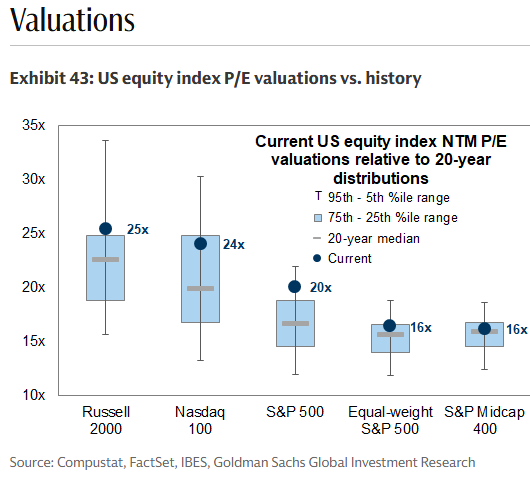
Stocks trading at extremely high multiples not justified by their growth rates should come with a warning label:
“Overpaying may prove hazardous to human wealth.” —🙋🏽♂️
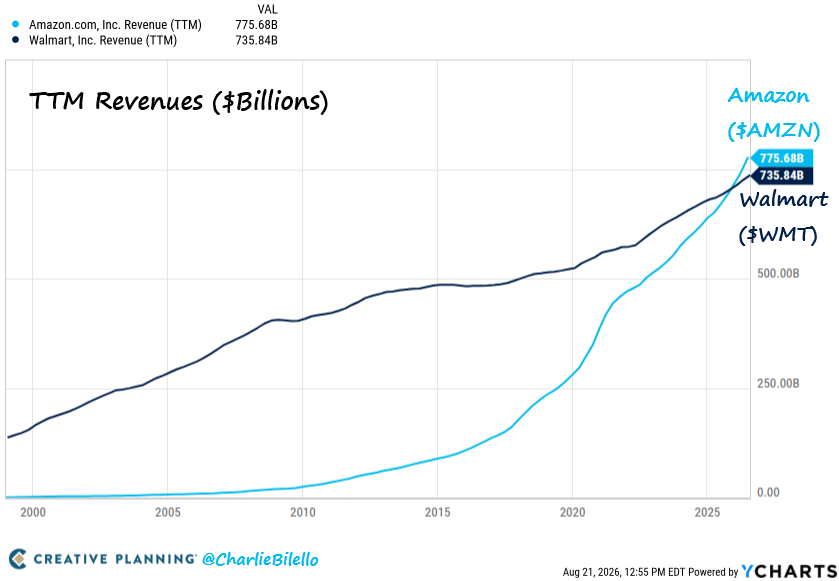
$WMT multiple expanded at a 9% CAGR since 2016. Nearly 40x for a ~10% grower. Multiple compression on its way.
$GOOGL Waymo has cut estimated robotaxi hardware costs from ~$115K per vehicle to just ~$20K with its 6th-gen system.
A big driver is vertical integration including a custom 5nm chip capable of 1,000 TOPS that processes camera, lidar and radar data in real time.
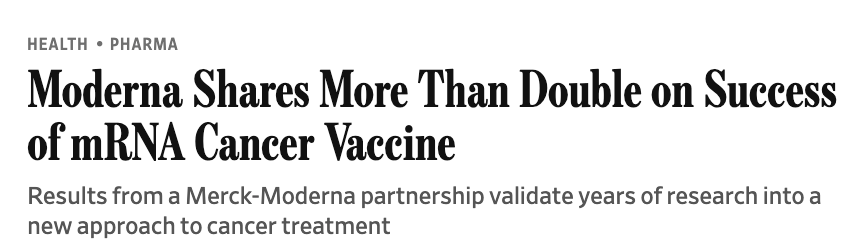
Moderna just became the first company in history to pass a Phase 3 trial with a personalized cancer vaccine. Every single dose is a different drug.
Here's how it works. Surgeons remove the melanoma, then sequence the tumor's DNA and RNA. An algorithm compares it against the patient's healthy cells and picks up to 34 mutations unique to that one person's cancer.
Those mutations get encoded into a custom mRNA strand, wrapped in lipid nanoparticles, and injected. The immune system reads the code, learns what that specific tumor looks like, and hunts down whatever cells surgery missed. Paired with Keytruda, which releases the brakes on T cells, the earlier trial showed a 49% cut in recurrence risk that held steady from year 3 all the way to year 5.
The manufacturing is what pharma people can't stop thinking about.
Drug factories are built to stamp out identical pills by the billion. This requires designing, synthesizing, and quality-testing a brand new drug for every patient, in weeks, from biopsy to injection. A batch size of one.
Scientists have chased therapeutic cancer vaccines for 40 years. A handful got approved. None were mRNA, and none were built per patient.
The Phase 3 covered 1,137 melanoma patients. Nine more trials are already running in lung, bladder, kidney, pancreatic, and gastric cancer.
Moderna was worth $25 billion yesterday, down more than 85% from its COVID peak. Wall Street had priced mRNA as a one-pandemic technology. The repricing took one morning.
Why this is a big deal:
this mRNA therapy instructs the body to produce the specific fingerprints of the person's tumor and trains the immune system to hunt and kill it.
First time in a Phase 3 trial.
One way cancer grows is by hiding from the immune system and turning off attacking T-cells. This mRNA therapy provides the tumor's genetic fingerprint so that the immune system can train T-cells to identify the cancer. Keytruda then removes the brakes that cancer had put on the T-cells enabling them to eliminate the cancer.
$MRNA is up over 70% after becoming one of the first companies ever to deliver a positive Phase 3 result for a personalized cancer vaccine.
Treatment is built around each patient’s own tumor and when combined with KEYTRUDA it reduced the risk of melanoma returning or spreading.
Sir Chris Hohn gave his portfolio update.
Out of Microsoft $MSFT & new in Martin Marietta Materials $MLM and Vulcan Materials $VMC.
To understand his thinking, you have to listen to the few moments we heard im talk.
Chris Hohn did a 90-minute sit-down with Nicolai Tangen and then dropped an investor letter the FT analysed.
You’d think the guy who printed a record $18.9B last year would be doing victory laps. Instead he’s quietly rewiring his whole portfolio.
My favorite takes from both:
1. The most important thing in investing isn’t growth. It’s barriers to entry. Growth without a moat is the airline industry: 5% volume growth for 100 years and basically zero cumulative profit.
2. There are only about 200 companies on earth he considers high-quality and investable. His fund holds 15.
3. Average holding period: 8 years. Some positions 13. “You have to hold the company forever, because the stock market may be at very bad prices when you want to sell.”
4. His real test for a moat: can the company price above inflation? A 20% margin business that prices 1% above inflation grows profits 5% faster than revenue. Forever. Almost no companies can do this.
5. Industries he won’t touch: banks, autos, retail, insurance, tobacco, asset managers, fossil fuel utilities, airlines, wireless telecom, media, advertising. On banks: “sooner or later someone without a lot of intelligence comes to run them, and then it can be toxic.”
6. On AI generally: call centers go bankrupt. Indian outsourcing coders are next. But for everyone else, AI lowers costs and raises productivity. Companies with real moats become MORE valuable.
7. He sold Microsoft. He’d held it since 2017 through a 400% rally. His reason: AI could disrupt Office and Azure faster than the market thinks.
8. He moved that capital into Alphabet. Doubled it from 3% to 5%. Now his largest tech position. The world’s best quality investor sold Microsoft and bought Google because he thinks Google’s moat is more durable in an AI world. Not the consensus trade.
9. The underlying thesis: “AI eats software.” If AI agents do the work humans used to pay per-seat SaaS licenses for, the whole SaaS model gets re-rated. Oracle, Adobe, Salesforce all ~40% off highs. Market is starting to agree.
10. When to sell? Not when something gets expensive. When conviction drops. Valuation is one variable, conviction is the other. What kills you isn’t being wrong, it’s permanent loss of capital.
11. He admits hardcore activism doesn’t work anymore. Too much of the shareholder base is passive index funds. And even when activism wins, you usually win in a bad business.
12. Counterintuitive take: there are more good companies in public markets than in private equity. The best businesses are too big for PE to buy. And when public companies sell something to PE, they’re selling the assets they want to get rid of.
13. On intuition: “thinking without thinking.” Pattern recognition from 20 years of reps. It’s how he sniffed out Wirecard while the German establishment was defending it. “Most investors trust authority too much.”
14. He basically stopped shorting. “You’re going to be eventually right but not be able to fund the losses.” The first guy to short Wirecard had to cover 19 years before it hit zero. Buffett told him he and Charlie studied shorting and concluded it was too hard.
15. He gives almost everything away. ~$500M a year. $10 prevents an unwanted pregnancy in Africa. $40 saves a child from severe malnutrition. $50 prevents permanent blindness.
16. Advice to young people? Hohn, who runs the world’s most profitable hedge fund: “Go on a spiritual path.” The guy who made $18.9B last year ends the interview saying only purpose and meaning matter.
The headline: the world’s best quality investor just sold his biggest tech compounder because he thinks AI is breaking the moat. Quietly, with conviction, on an 8-year horizon, while everyone else is still buying the AI winners of 2023.
New filing for NHL hockey ETFs from VolShares, which will track the performance of 32 dif teams (eg the Boston Bruins ETF) which will be based on how the team does (eg wins, losses in reg season and playoffs) using a special team index calc that has futures contract on it. Wow. Good catch from Jeff who has some more deets below incl link to filing..
Gen Z is moving money from stocks to sports betting in wealth plans, 52% of them have redirected inv funds to sports betting and quarter of them treat sports betting as a deliberate part of their long-term financial plan, according to survey from Betterment. Wow.
BREAKING: President Trump's capital gains tax cut discussions include "indexing" capital gains for inflation BEFORE taxes are calculated.
This would mean that taxes would be applied on gains adjusted for inflation.
For example, if you purchased a stock for $100,000 and sold it 5 years later for $200,000.
Under the current system, you would owe capital gains taxes on the full $100,000 gain.
But, if cumulative inflation over those 5 years was 20%, your inflation-adjusted cost basis would rise to $120,000.
This means you would only owe capital gains taxes on the $80,000 REAL gain, rather than the $100,000 nominal gain.
Trump has also suggested exemptions for sales of homes worth $2 million or less from capital gains taxes.
We expect more details soon.
The S&P 500 has returned an average of 12% per year since 1980 and has done so despite an average intra-year drawdown of 14%, and often drawdowns that are much worse.
The lesson? Volatility doesn’t equal a permanent loss unless you sell.